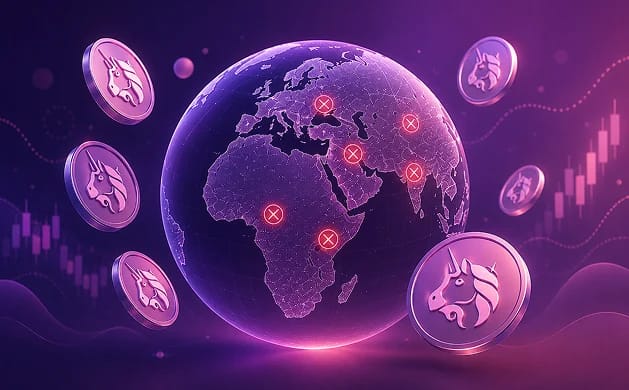

Which Countries Does Uniswap Restrict?
Whether a country is restricted depends on which half of Uniswap you mean. The protocol is immutable smart contracts that any wallet can reach. The interface at app.uniswap.org is a website Uniswap Labs runs from New York, and a company can be told which users it may serve.
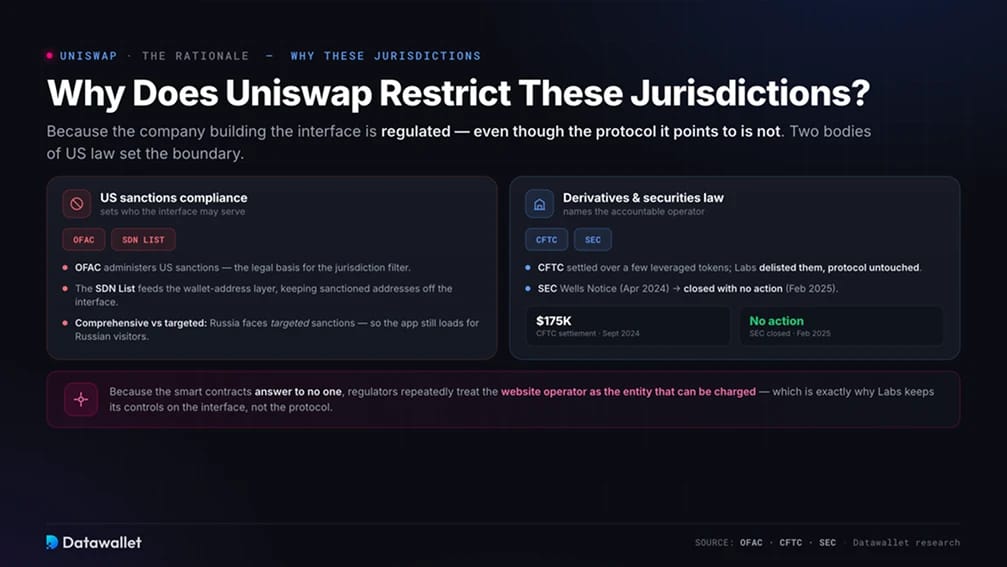
Uniswap Labs no longer publishes a fixed list of banned countries. Its current Terms of Service, last modified in late December 2025, instead tie interface eligibility to US sanctions, barring sanctioned parties and anyone who is a citizen, resident, or organized in a territory under comprehensive US sanctions. As of 2026, the US Treasury applies that comprehensive standard to Cuba, Iran, North Korea, and Syria, plus the Russian-occupied Ukrainian regions of Crimea, Donetsk, and Luhansk.
Older write-ups still circulate a ten-country list from a 2019 front-end change that named places like Côte d'Ivoire, Liberia, and Zimbabwe. It is out of date. Several of those programs were wound down years ago, and the current Terms track the live comprehensive-sanctions perimeter rather than a hardcoded roster.
How Uniswap Restricts Access: Three Separate Layers
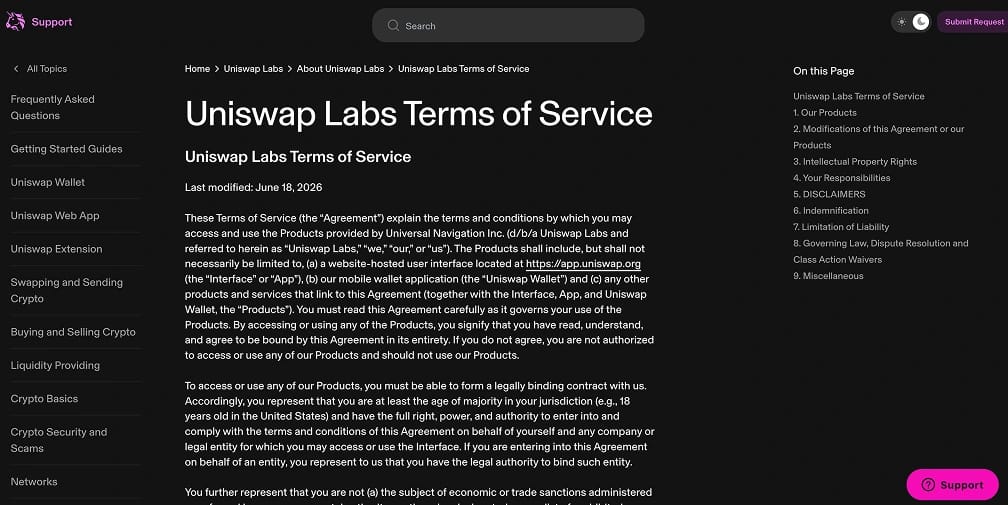
Most "restricted countries" guides stop at the IP block. Uniswap Labs runs three independent filters, each acting on the interface alone, and together they decide whether a country, a wallet, or a token gets through.
1. Jurisdiction Screening
The first layer is geographic. Uniswap Labs uses IP-based geolocation to stop the app from loading for visitors in sanctioned territories. This is what people mean when they ask which countries are restricted, and it maps to the comprehensive-sanctions perimeter above.
2. Wallet Address Screening
The second layer ignores geography and looks at the wallet itself. Working with compliance firm TRM Labs, Uniswap Labs blocks addresses on the OFAC sanctions list plus those tied to illicit activity such as stolen funds or ransomware. A flagged address can still hold and receive assets, but the interface disables any state-changing action, so it cannot swap or add liquidity.
3. Token Contract Screening
The third layer targets specific assets. Through its Unsupported Token Policy, Uniswap Labs pulls individual token contracts from its interface when a regulator or court reaches an adverse legal finding, when a major regulator alleges fraud against the issuer, or when someone files an intellectual-property claim. A blocked token shows a "not supported" notice and its pools are switched off, though wallet users can still send and receive it. The same criteria apply across the web app, the Uniswap Wallet, and the browser extension.
None of these three filters touches the protocol. The contracts run identically for a sanctioned wallet and an unsanctioned one, so the geofence has limited practical reach. The same liquidity stays reachable through other wallets, third-party front ends, and DEX aggregators that read the public pools.
Why Does Uniswap Restrict These Jurisdictions?
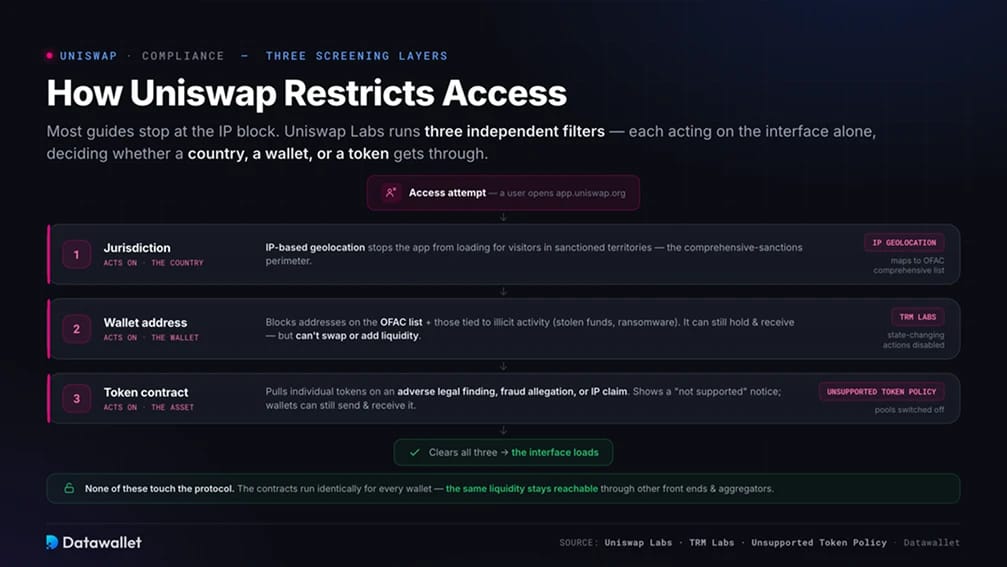
These restrictions exist because the company building the interface is regulated, even though the protocol it points to is not.
1. US Sanctions Compliance
As a US business, Uniswap Labs must honor Treasury sanctions or face liability, which sets the boundary of who its interface may serve.
- OFAC: The Office of Foreign Assets Control administers US sanctions programs and can block transactions for foreign-policy and national-security reasons, which is the legal basis for the jurisdiction filter.
- SDN List: The OFAC Sanctions List Search lets firms screen blocked persons and wallets, feeding the address-level layer that keeps sanctioned addresses off the interface.
- Comprehensive versus targeted: OFAC reserves full embargoes for a short set of jurisdictions, while places like Russia face targeted sanctions instead, which is why the app still loads for Russian visitors who are not otherwise flagged.
- Citizenship and residency: The Terms reach citizens and residents of restricted territories regardless of where they sit, so relocating an IP address does not change a user's eligibility on paper.
2. Derivatives and Securities Law
The interface is also the one named operator US market regulators can point to when they want someone to answer for activity on a permissionless system.
- CFTC: In September 2024 the Commodity Futures Trading Commission settled with Uniswap Labs for $175,000 over a handful of leveraged tokens offered to retail users, and Labs delisted those tokens from its interface while leaving the protocol untouched.
- SEC: The Securities and Exchange Commission issued Uniswap Labs a Wells Notice in April 2024, then closed the investigation in February 2025 with no enforcement action, a reversal that tracked the agency's wider pullback from crypto cases.
- The front end as the accountable point: Because the smart contracts answer to no one, regulators have repeatedly treated the website operator as the entity that can be charged, which is exactly why Labs keeps compliance controls on the interface rather than the protocol.
- User responsibility: The Terms put the burden on each user to confirm that their own activity, including any leveraged or derivative exposure, is lawful where they live.
The Ukraine Over-Blocking Question
The clearest sign that interface compliance can outrun the sanctions it cites came from Ukraine. Through 2025, users across the country reported that app.uniswap.org would not load, even though OFAC's comprehensive measures cover only Crimea and the occupied parts of Donetsk and Luhansk, not Kyiv or the rest of sovereign Ukraine.
A Ukrainian developer, Artem Chystiakov, filed support ticket 169045 and published an open letter in October 2025 arguing that Labs had read the sanctions too broadly. Reporting by Blockworks noted that the blanket country block sat awkwardly next to OFAC's own statement that it keeps no single list of off-limits countries, and that subregion-level filtering was technically available.
Throughout the episode, the protocol stayed reachable on-chain, the practical reason a front-end misconfiguration cannot lock anyone out of the underlying market.
Where Is Uniswap Available?
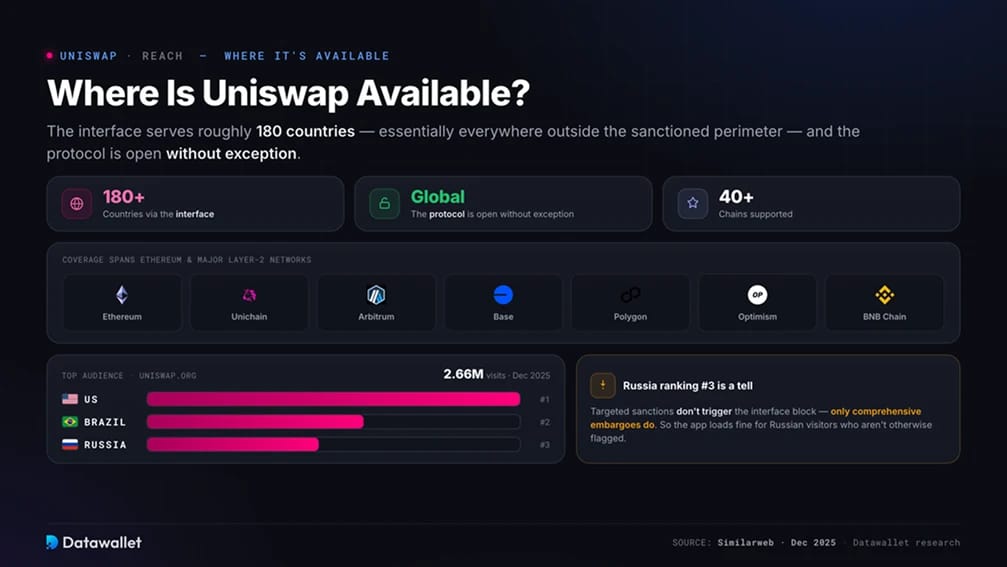
The interface serves roughly 180 countries, essentially everywhere outside the sanctioned perimeter, and the protocol is open without exception. Coverage spans Ethereum and major layer-2 networks including Unichain, Arbitrum, Base, Polygon, Optimism, and BNB Chain, so a supported user can swap ERC-20 assets, supply liquidity, and bridge across chains directly from a self-custodial wallet.
According to Similarweb, uniswap.org drew about 2.66 million visits in December 2025, with its core audience in the United States, followed by Brazil and Russia. Russia ranking that high is a useful tell. Targeted sanctions do not trigger the interface block, only comprehensive embargoes do.
For how Uniswap compares with rival venues, our guide to the best decentralized exchanges breaks down where each one leads.
Is Uniswap Legal in the US?
Yes. US residents can access the interface and use the protocol, and trading on Uniswap is lawful provided users meet their own financial and tax obligations and their wallets are not flagged for sanctions or illicit activity. The regulatory pressure has also eased. The SEC closed its investigation in February 2025, and the CFTC matter was settled the year before.
Tax responsibility sits with the user. Uniswap issues no 1099 forms and reports nothing to the IRS, so swaps, liquidity rewards, and other taxable events have to be tracked and reported independently, ideally with a crypto tax professional.
Does Uniswap Require KYC?
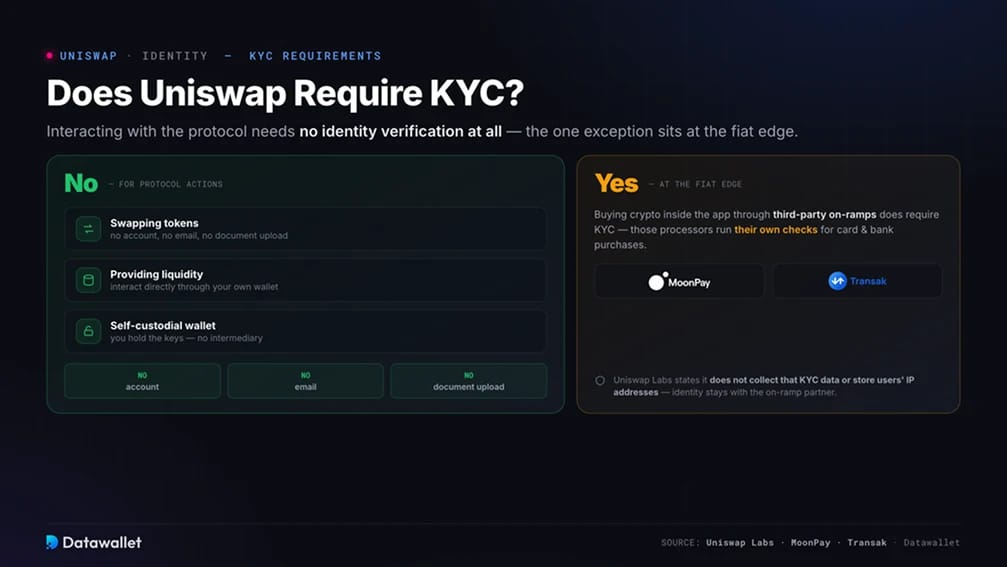
Swapping tokens, providing liquidity, and using a self-custodial wallet on Uniswap require no identity verification. There is no account to open, no email, and no document upload, because users interact with the protocol directly through their own wallet.
The one exception sits at the fiat edge. Buying crypto inside the app through third-party providers such as MoonPay or Transak does require KYC, since those processors run their own checks for card and bank purchases. Uniswap Labs states that it does not collect that KYC data or store users' IP addresses, leaving identity handling with the on-ramp partner.
Uniswap, MiCA, and the EU Front-End Question
Europe is where the protocol-versus-interface split faces its hardest test. The EU's Markets in Crypto-Assets regulation ends its transitional period on July 1, 2026, after which any firm serving crypto-asset services to EU users needs full authorization.
MiCA's Recital 22 exempts services offered in a "fully decentralized manner without any intermediary," which on its face protects the Uniswap protocol. The unsettled part is the front end. ESMA has not defined "fully decentralized," and legal commentators widely flag a front-end operator, a development team, or a managed treasury as the kind of identifiable intermediary that could pull part of a service into scope.
For Uniswap, the immutable contracts look safe while the company-run interface sits in the same grey zone that already drives its US compliance controls.
About Uniswap
Uniswap launched in November 2018, built by Hayden Adams after he taught himself Solidity and read Vitalik Buterin's writing on on-chain automated market makers. It pioneered the AMM model that most of DeFi still runs on, and it is now the largest decentralized exchange, with more than $3 trillion in lifetime trading volume and over six million wallets across its versions.
The protocol has kept iterating. Uniswap v4 went live on January 31, 2025, introducing customizable hooks and a singleton contract that cut the cost of creating a pool by close to 99%. Its own layer-2 network, Unichain, now handles a large share of v4 activity, and a late-2025 governance change switched on protocol fees that now buy back and burn UNI, tying the token to real trading activity.
Bottom Line
Uniswap restricts its interface, not its protocol. The web app applies US sanctions screening at three layers, by jurisdiction, by wallet address, and by token contract, while the immutable contracts behind it stay open to anyone. That design keeps Cuba, Iran, North Korea, Syria, and the occupied Ukrainian regions outside the front door even as the underlying market remains permissionless.
For everyone else, access needs no KYC and no account, and trading is legal across most of the world, including the United States after the SEC closed its probe. The open questions are now regulatory, not enforcement-driven, with MiCA's July 2026 deadline set to test whether a front-end operator can sit beside a decentralized protocol without being pulled into scope. Confirm your own jurisdiction and tax obligations before trading.