


Login to Track Your Live Crypto Portfolio
Sign Up and Track Your Live Crypto Portfolio for Free
Forgot your password?
Brazil Bars Stablecoins From Cross-Border Rails

This article has been reviewed and verified for accuracy by our editorial team. All claims, data points and platform details are cross-referenced against primary sources.
Some links on this page are affiliate links. Datawallet may earn a commission when you sign up through them, at no extra cost to you. This never influences our editorial ratings, rankings or recommendations.
Some links on this page are affiliate links. Datawallet may earn a commission when you sign up through them, at no extra cost to you. Ratings and rankings reflect our own testing and assessment criteria.

GM. Brazil’s central bank barred regulated providers from using stablecoins for cross-border remittances today, forcing a massive shift for the country’s $8 billion monthly market toward traditional exchange rails.
Meanwhile, a Paradigm researcher proposed a "PACTs" quantum escape hatch for dormant Bitcoin, Tether reported a $1.04 billion quarterly profit, and Arbitrum began voting on releasing $71 million to the DeFi United recovery effort.
Here are the details on remittance restrictions, Satoshi-era defenses, and record stablecoin reserves. 👇
Brazil Bars Stablecoins From Cross-Border Rails
Brazil’s central bank has barred regulated eFX providers from using stablecoins, bitcoin, or other crypto assets to settle cross-border remittances, drawing a sharp line around how digital assets can operate inside the country’s payment system. Resolution 561 takes effect on October 1, with some transition deadlines extending into 2027.
The rule does not outlaw crypto ownership or trading. Brazilians can still buy, sell, hold, and transfer digital assets through authorized virtual asset service providers, but regulated remittance firms can no longer take reais, convert them into USDT, USDC, or bitcoin, and settle abroad over blockchain rails.
That matters because Brazil had become one of the busiest stablecoin markets in the world. Receita Federal data shows the local crypto market moving about $6 billion to $8 billion a month, with stablecoins accounting for roughly 90% of that volume, and about 25 million Brazilians already using or holding crypto.
The new restriction hits firms that built crypto settlement into international money movement, including names such as Wise, Nomad, and Braza Bank. Under the revised framework, payments between an eFX provider and its foreign counterparty must instead flow through a foreign exchange transaction or a non-resident real account inside Brazil.
Paradigm Floats Quantum Escape Hatch For Satoshi Era Bitcoin
Paradigm researcher Dan Robinson proposed a timestamp-based safeguard called PACTs that could help bitcoin holders prepare for future quantum threats without moving coins or exposing activity. The idea targets dormant wallets, including Satoshi-era addresses. It would let users prove prior control before quantum attacks become realistically dangerous.
The mechanism would place a proof of ownership onchain now, then allow funds to be reclaimed later on a quantum-resistant Bitcoin if needed. Robinson framed it as preparation, not a forced migration. The proposal arrives as developers debate how to protect exposed public keys without sacrificing privacy, with other suggestions like BIP-360 receiving mostly negative feedback so far.
Tether Reports $1 Billion Profit During Market Slump
Stablecoin giant Tether reported $1.04 billion in net profit for the first quarter despite facing high levels of volatility in the digital asset market. The company also announced that a formal audit with KPMG has finally commenced to verify its massive holdings of United States debt. This profit helps expand the company's reserve buffer to a record $8.23 billion.
Management claims to hold over $141 billion in Treasury bills which makes the firm one of the largest government creditors in the world. Scrutiny of the offshore issuer continues to grow as federal lawmakers question the relationship between the company and high ranking government officials. This milestone coincides with the launch of a new token designed for the American market.
Arbitrum Votes on Releasing $71 Million ETH to DeFi United
The Arbitrum DAO has opened a vote to release 30,766 frozen ETH worth about $71.1 million to DeFi United, the industry coalition responding to the Kelp DAO exploit. Early ballots were overwhelmingly supportive. The vote follows the Security Council’s emergency freeze of the attacker’s Arbitrum-held funds.
If approved, the transfer would become the biggest single contribution to the rsETH recovery effort, which has already gathered more than $311 million. The plan remains controversial in governance terms. Supporters call it necessary crisis response, while critics say it underscores how much centralized power still exists.
Data of the Day
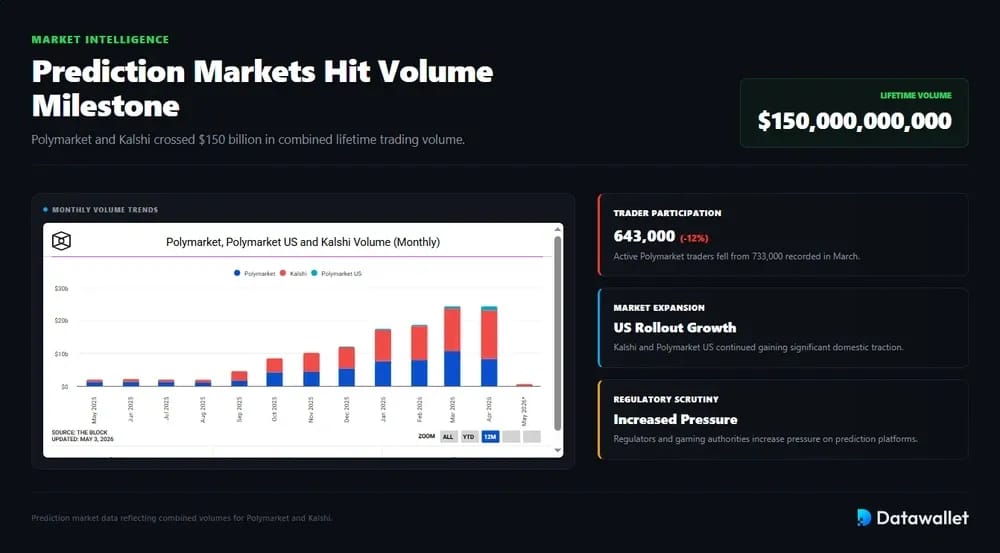
Polymarket and Kalshi crossed $150 billion in combined lifetime trading volume in April, even as the sector’s streak of fresh monthly records finally broke. The slowdown came mainly from Polymarket’s global platform. Kalshi and Polymarket’s US rollout continued gaining traction during the same period.
Active traders on Polymarket fell to about 643,000 from more than 733,000 in March, while notional volume on both platforms also slipped. Even so, scrutiny and interest are rising together. Regulators, investors, and state gaming authorities are all pressing harder on a market now valued in the tens of billions.
More Breaking News
- Ethereum ETFs lost $184 million across four straight sessions as bitcoin funds shed $476 million too, even while Ethereum climbed and the S&P 500 set a record.
- The Ethereum Foundation sold another 10,000 ETH to BitMine for about $22.9 million, marking its third over-the-counter sale in two months amid renewed community criticism.
- BlackRock urged the OCC to drop a possible 20% cap on tokenized reserve assets, arguing such a limit would unnecessarily constrain products like its $2.6 billion BUIDL fund.
- A CoinDesk survey found only 1% of US voters rank crypto as their top midterm issue, even as 40% said they could vote based on crypto views.
- MoonPay launched a Mastercard debit card for AI agents, letting stablecoin-funded bots spend directly from onchain wallets at merchants across the U.K. and Latin America.
- 250 Digital Asset Management chief Chris Perkins said crypto can keep advancing without the CLARITY Act, arguing regulators are already building workable rules and precedent.
- A U.K. agency found OpenAI’s GPT-5.5 can autonomously execute sophisticated cyberattacks, matching Claude Mythos and raising alarms over exponentially improving offensive AI capabilities.
For the latest updates on digital asset markets, follow us on X @Datawalletcom.
For the latest updates on digital asset markets, follow us on X @Datawalletcom.
Get tomorrow’s issue in your inbox