


Login to Track Your Live Crypto Portfolio
Sign Up and Track Your Live Crypto Portfolio for Free
Forgot your password?
CFTC Launches Task Force For Crypto, AI & Prediction Markets

This article has been reviewed and verified for accuracy by our editorial team. All claims, data points and platform details are cross-referenced against primary sources.
Some links on this page are affiliate links. Datawallet may earn a commission when you sign up through them, at no extra cost to you. This never influences our editorial ratings, rankings or recommendations.
Some links on this page are affiliate links. Datawallet may earn a commission when you sign up through them, at no extra cost to you. Ratings and rankings reflect our own testing and assessment criteria.

GM. The CFTC launched a dedicated Innovation Task Force today to draft rules for AI and prediction markets, asserting exclusive jurisdiction over binary contracts.
Meanwhile, Balancer Labs is winding down following a $128 million exploit, Circle and Coinbase stocks tumbled on stablecoin yield ban fears, and Tether is targeting a full Big Four audit.
Here are the details on new task forces, protocol sunsets, and stablecoin shifts. 👇
CFTC Launches Task Force For Crypto, AI & Prediction Markets
The Commodity Futures Trading Commission established a dedicated Innovation Task Force to govern emerging technologies like artificial intelligence and decentralized prediction markets. This specialized unit seeks to provide unambiguous rules for builders on the new financial frontier.
The federal initiative debuted as part of a broader commitment to future-proof derivatives regulation. These developments occurred amid intensifying scrutiny over prediction markets and potential insider trading onchain.
Chairman Michael Selig initiated this specific oversight body because he seeks to foster responsible innovation while ensuring American participants remain competitive. By coordinating with the SEC, the commission aims to synchronize various federal crypto innovation initiatives.
Regulators achieved this milestone by appointing senior advisor Michael Passalacqua to lead efforts in drafting compliance requirements for registered exchanges. Consequently, CFTC now moves to solicit public comment while asserting exclusive jurisdiction over binary outcome markets.
Balancer Labs Shuts Down After Major Protocol Exploit
Balancer Labs officially announced it will wind down operations following a devastating security breach from last November. The protocol suffered a $128 million exploit across six different blockchains due to a rounding error within its specialized stable pool vault contracts. This specific decision stems from unrecovered funds and persistent legal exposure that left the corporate entity without any sustainable revenue.
The core developers plan to transition the platform to a decentralized autonomous organization to ensure the protocol continues without a centralized corporate burden. Staff members will likely move to a new operating arm if the community approves the upcoming governance proposal later this month. Analysts suggest this highlights the structural failure of older DeFi models that relied heavily on token emissions for growth.
Circle and Coinbase Stocks Tumble On Yield Ban
Shares of Circle plummeted 18% after a draft version of the Clarity Act surfaced with restrictive new stablecoin rules. The proposed US legislation aims to ban interest-like rewards on passive stablecoin balances to prevent them from functioning as traditional bank deposits. This directly threatens the revenue-sharing model between Circle and Coinbase, which currently funds popular rewards for global USDC holders.
Market strategists argue that removing yield incentives could weaken the case for holding stablecoins as a long-term store of value. While the stock price suffered a sharp pullback, some researchers believe the market is overreacting to the potential impact of these legislative headlines.
Tether Hires Big Four Auditor For Massive Reserves
Tether announced that it has finally secured a deal with a Big Four accounting firm to audit its reserves. The company currently claims to hold roughly $192 billion in total assets, with a significant portion allegedly kept in secure US Treasuries. Although the specific auditor remains undisclosed for now, this independent review marks a major step toward transparency for the world's largest stablecoin.
The move follows the recent implementation of the GENIUS Act, which mandates rigorous financial oversight for all foreign issuers operating within the sector. CEO Paolo Ardoino previously stated that a full audit was necessary to achieve compliance with these strict new federal standards for digital assets. Successfully completing this audit could improve the firm's reputation among institutional users.
Data of the Day
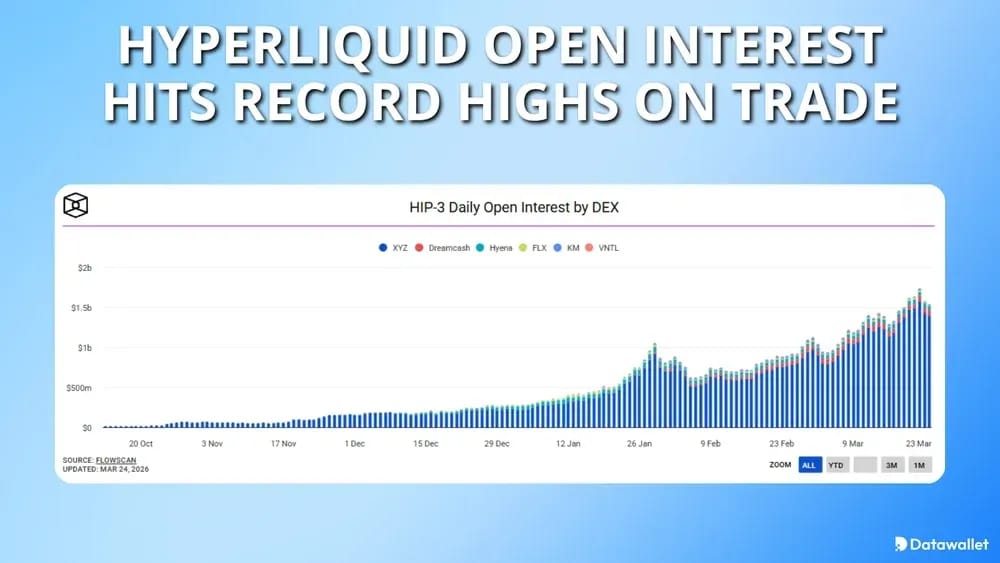
Aggregated open interest across Hyperliquid’s HIP-3 markets surged 25% this week to reach a new peak of $1.74 billion. The platform currently dominates the permissionless perpetual futures sector by offering tokenized traditional assets like crude oil, silver, and gold. This rapid expansion is primarily driven by the ability to trade these commodities 24/7 when traditional global exchanges are closed for the weekend.
The Trade.xyz platform handles over 90% of this specific activity and recently reported a record 45,300 unique daily traders on the network. Volume for oil contracts alone reached over $2 billion in a single day as geopolitical volatility pushed investors toward decentralized price discovery. This momentum has also boosted the native HYPE token, which is currently up more than 30% over the last month.
More Breaking News
- The Solana Foundation launched a developer platform for institutions, enabling firms like Mastercard and Western Union to build financial applications onchain easily.
- Resolv Labs issued a 72-hour ultimatum to an exploiter, offering a 10% bounty for the return of $22.5 million in stolen funds.
- OKX introduced equity perpetual swaps for the "Magnificent 7" stocks, allowing traders to use Bitcoin and yield-bearing crypto assets as trading collateral.
- Bitcoin experienced a rare two-block reorganization on Monday after Foundry USA Pool produced a heavier chain than rivals AntPool and ViaBTC during a fork.
- ECB Executive Board member Piero Cipollone argued that tokenized central bank money is essential for scaling Europe's stablecoin and tokenized deposit settlement markets.
- Australian pension fund Hostplus is exploring digital asset investment options for its self-directed accounts, potentially launching the new offerings by next year.
For the latest updates on digital asset markets, follow us on X @Datawalletcom.
For the latest updates on digital asset markets, follow us on X @Datawalletcom.
Get tomorrow’s issue in your inbox