


Login to Track Your Live Crypto Portfolio
Sign Up and Track Your Live Crypto Portfolio for Free
Forgot your password?
Coinbase Becomes Hyperliquid Official USDC Treasury Deployer

This article has been reviewed and verified for accuracy by our editorial team. All claims, data points and platform details are cross-referenced against primary sources.
Some links on this page are affiliate links. Datawallet may earn a commission when you sign up through them, at no extra cost to you. This never influences our editorial ratings, rankings or recommendations.
Some links on this page are affiliate links. Datawallet may earn a commission when you sign up through them, at no extra cost to you. Ratings and rankings reflect our own testing and assessment criteria.

GM. Coinbase became the official treasury deployer for USDC on Hyperliquid today, securing a deal with Native Markets to phase out the USDH stablecoin and transition the network toward a deeply integrated USDC quote asset.
Meanwhile, the Senate Banking Committee approved the Digital Asset Market Clarity Act in a 15-9 vote, the Bank of England signaled it may soften its strict stablecoin reserve rules, and ZachXBT alleged that insiders control 95% of the AI trading project LAB.
Here are the details on stablecoin migrations, landmark legislation, and onchain investigations. 👇
Coinbase Becomes Hyperliquid Official USDC Treasury Deployer
Coinbase secured a deal with Native Markets to become the primary treasury deployer for USDC on the Hyperliquid blockchain as the native USDH stablecoin sunsets. The agreement grants the American exchange rights to purchase specific brand assets while users transition their holdings into a deeply integrated quote asset.
This strategic alliance targets the dominant onchain perpetual trading platform which currently captures roughly 40% of total network fees across the sector. Hyperliquid has surpassed rivals like Solana and Ethereum by providing infrastructure for leveraged positions that attract professional traders and institutional capital alike.
Users can redeem their existing USDH tokens for either USDC or traditional fiat currency without fees through a dedicated dashboard over the coming months. Native Markets confirmed that all assets remain fully backed by reserves during this migration to ensure stability and maintain trust throughout the entire decommissioning process.
The integration follows the recent launch of a specialized exchange traded fund that tracks the native HYPE token to reflect market recognition of leadership. This move solidifies USDC as the foundational liquidity source for the derivatives DEX as developers prepare for more complex institutional adoption of decentralized finance.
Clarity Act Wins 15-9 Senate Banking Committee Vote
The United States Senate Banking Committee finally approved the Digital Asset Market Clarity Act during a hearing following months of legislative gridlock. Chairman Tim Scott secured last minute support from 2 Democrats after admitting various amendments to address investor protection and decentralized finance projects. This bipartisan 15 to 9 decision moves the framework toward a final merger with Agriculture Committee proposals.
Lawmakers negotiated through the morning to overcome a party rift as Senator Elizabeth Warren raised fierce objections to the compromise process for being insufficient. Supporters like the Blockchain Association heralded this moment as a defining victory that establishes clear rules for the entire crypto industry. Future progress now hinges on resolving ethics provisions regarding government official involvement before a full Senate floor vote this summer.
Bank Of England Softens Stablecoin Reserve Rules
Deputy Governor Sarah Breeden revealed that the Bank of England is reconsidering its conservative stablecoin regulations following heavy pressure from the digital asset industry recently. Officials are reviewing proposed holding limits and a strict 40% reserve floor to ensure the United Kingdom remains competitive. This shift follows industry pushback and targets a more workable regime that manages liquidity risks.
Industry analysts noted that the previous 40% floor could cost issuers roughly 11 million pounds for every 1 billion pounds in circulation annually. Central bank leaders now treat these digital tokens as a new form of money and intend to accept applications for systemic issuers. Authorities aim to balance consumer protection with the reality of global markets to prevent jurisdictional arbitrage.
ZachXBT Alleges 95% Insider Control Of LAB
Onchain investigator ZachXBT published a detailed thread accusing the AI trading project LAB of orchestrating a massive retail extraction scheme using hidden token supplies. The sleuth alleged that insiders control 95% of the total assets and coordinated with market makers to engineer a 6 billion valuation. He discovered several undisclosed loans and suspicious wallet links that connect the team to previous manipulation cycles.
Traceable funds flowed from exchange accounts to personal wallets while the team unilaterally extended token lock periods for public sale participants without any prior consent. ZachXBT urged major trading venues to freeze illicit profits and protect users from the coordinated playbook deployed across multiple digital asset projects. These findings highlight the extreme risks facing retail traders who cannot verify the true float of many centralized tokens.
Data of the Day
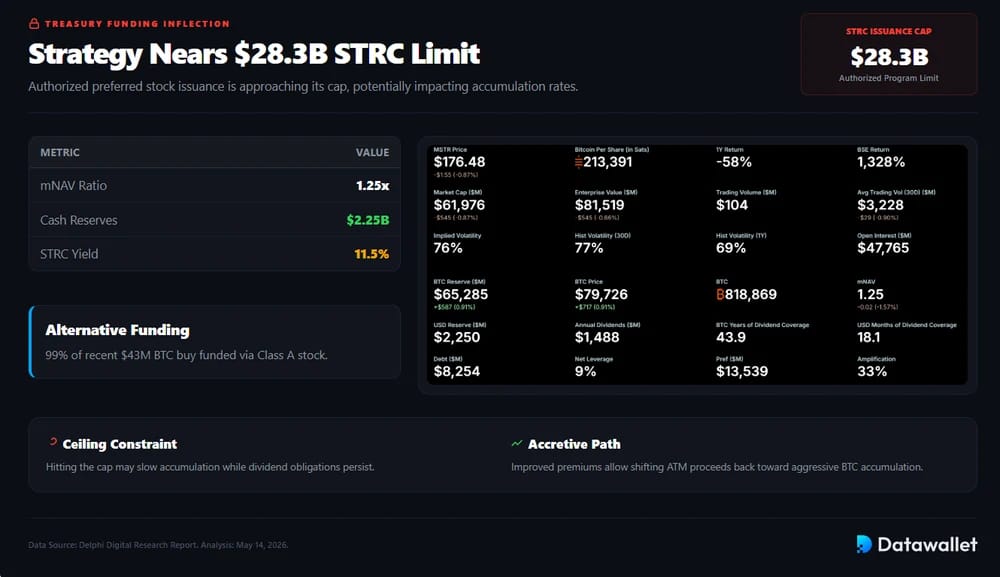
Delphi Digital said Strategy’s preferred stock engine faces a looming cap, with the STRC program authorized for roughly $28.3 billion in issuance. If that ceiling is reached without expansion, the company’s pace of Bitcoin accumulation could slow, even as dividend obligations tied to the instrument continue.
Researchers argued the company still has alternatives, especially if its market premium improves and common-stock sales become attractive again. Strategy’s latest Bitcoin buy was funded mostly through Class A stock rather than STRC, suggesting management is already leaning on other channels while preserving room in its preferred structure.
More Breaking News
- Kraken will swap LayerZero for Chainlink CCIP across kBTC and future wrapped assets, joining a post-Kelp migration wave that has already shifted more than $3 billion in value.
- Sharplink CEO Joseph Chalom said Ethereum treasury firms are drifting from Strategy’s leveraged template, arguing staking income and tokenization growth make ETH a stronger long-term treasury asset.
- Bullish shares slipped after first-quarter adjusted revenue missed estimates at $92.8 million and unrealized crypto losses swelled total net losses to $604.9 million despite strong Bitcoin options volume.
- Dune cut 25% of staff as CEO Fredrik Haga said AI tools are reshaping product development, with the firm narrowing focus around core crypto data services.
- Tether, Tron, and TRM Labs said their T3 Financial Crime Unit has frozen more than $450 million since launch, as illicit crypto flows hit a record $158 billion.
- World Liberty co-founder Zak Folkman defended a $75 million Dolomite borrowing position as modest against collateral and said the firm’s defamation case against Justin Sun is straightforward.
For the latest updates on digital asset markets, follow us on X @Datawalletcom.
For the latest updates on digital asset markets, follow us on X @Datawalletcom.
Get tomorrow’s issue in your inbox