


Login to Track Your Live Crypto Portfolio
Sign Up and Track Your Live Crypto Portfolio for Free
Forgot your password?
MegaETH Debuts MEGA Token With $1.5 Billion Valuation

This article has been reviewed and verified for accuracy by our editorial team. All claims, data points and platform details are cross-referenced against primary sources.
Some links on this page are affiliate links. Datawallet may earn a commission when you sign up through them, at no extra cost to you. This never influences our editorial ratings, rankings or recommendations.
Some links on this page are affiliate links. Datawallet may earn a commission when you sign up through them, at no extra cost to you. Ratings and rankings reflect our own testing and assessment criteria.

GM. MegaETH launched its MEGA token today with a $1.56 billion valuation, introducing a performance-based reward system that ties over half the supply to measurable network growth and technical milestones.
Meanwhile, Meta started USDC creator payouts on Solana and Polygon, Polymarket integrated Chainalysis surveillance tools following a recent insider-trading case, and World Liberty voters approved a 62 billion token unlock.
Here are the details on milestone-driven emissions, social stablecoins, and governance burns. 👇
MegaETH Debuts MEGA Token With $1.5 Billion Valuation
MegaETH launched its MEGA token with a fully diluted valuation of about $1.56 billion, opening a live test of one of crypto’s more unusual reward systems. The Ethereum Layer 2 project is betting that token emissions can be tied to measurable progress rather than the usual clockwork release schedule.
At launch, MEGA traded around $0.156, implying a market capitalization near $176 million because only 1.129 billion of the eventual 10 billion tokens are circulating. More than 5.3 billion tokens have been reserved for a performance-based rewards program, making future supply contingent on actual network traction.
The benchmarks are not cosmetic. MegaETH says additional tokens will unlock only as the network improves in areas such as ecosystem growth, total value locked, circulating USDm supply, transaction performance, and decentralization across both the project itself and Ethereum more broadly.
That mechanism turns staking into a wager on execution rather than just a source of passive dilution. Users who stake MEGA will receive rewards as milestones are reached, and those willing to lock tokens for longer periods are set to receive a larger share of the emission stream.
Meta Starts USDC Creator Payouts on Solana & Polygon
Meta has begun offering select creators direct USDC payouts to crypto wallets on Solana and Polygon, marking its first crypto payment rollout since shelving Diem in 2022. Stripe is providing the payments infrastructure. The pilot is limited to creators in Colombia and the Philippines for now.
The company stressed that it is not issuing its own stablecoin and is instead using Circle’s USDC to test real-world payout demand. Supported wallets include MetaMask, Phantom, and Binance. Meta appears to be targeting markets where crypto adoption and payment friction often make stablecoin settlement more attractive.
Polymarket Adds Chainalysis Tools After Soldier Case
Polymarket has partnered with Chainalysis to deploy market-surveillance tools designed to flag insider trading, suspicious behavior, and manipulation patterns across the platform. The effort follows the arrest of a US soldier accused of using confidential information to profit on Maduro-related markets. Polymarket said it detected and reported the activity first.
The compliance upgrade includes blockchain-verified evidence generation, threat detection, investigative services, and new monitoring models tailored to event markets. The timing is notable as Polymarket seeks a return to the US and pursues fresh funding. Weekly trading volume has hovered near or above $1 billion through much of 2026.
World Liberty Voters Approve 62 Billion Token Unlock
World Liberty Financial is on track to approve a major proposal unlocking 62 billion WLFI tokens, with early voting nearly unanimous and well beyond quorum. The plan introduces vesting for 40.7 billion insider tokens. A two-year cliff would still prevent any immediate flood of supply into the market.
Under the proposal, founders, team members, and partners would burn roughly 4.5 billion WLFI tokens before the remainder vests across five years. The vote also exposed concentrated governance power. The largest wallet commands nearly 13% of ballots cast, while the top four together control around 40% so far.
Data of the Day
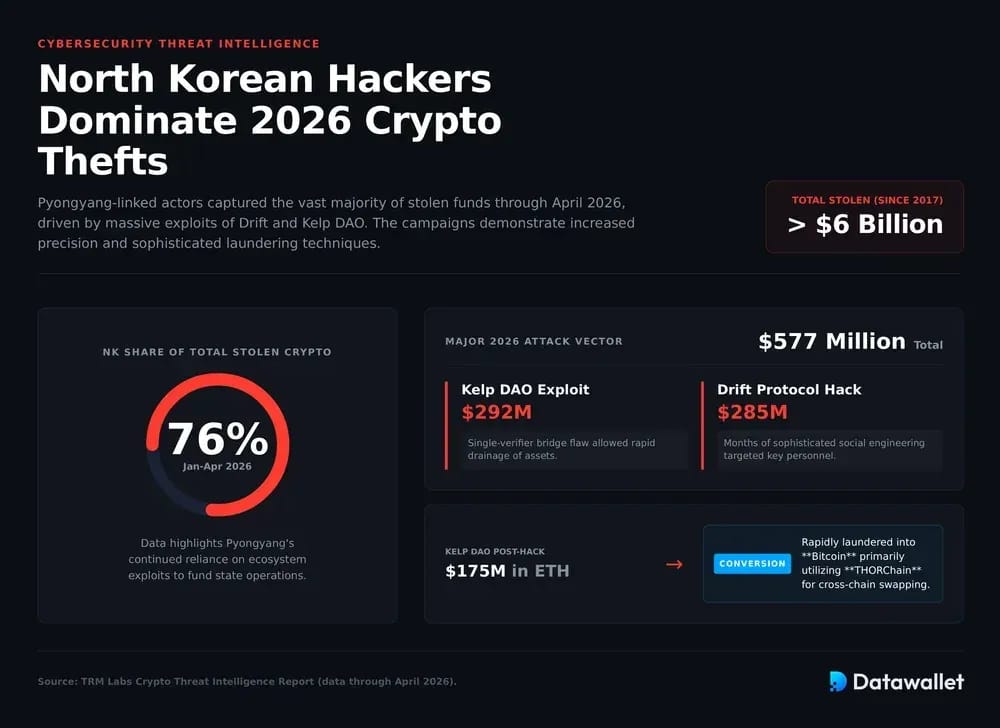
North Korean-linked hackers captured 76% of all crypto stolen in 2026 through April, according to TRM Labs, largely through the $285 million Drift and $292 million Kelp DAO attacks. Those two incidents alone totaled $577 million. TRM estimates Pyongyang-linked actors have stolen more than $6 billion since 2017.
The report says the campaigns are growing more precise, not more frequent, with one involving months of social engineering and the other exploiting a single-verifier bridge flaw. After the Kelp attack, roughly $175 million in ETH was rapidly laundered into bitcoin. THORChain again handled the bulk of that cross-chain conversion.
More Breaking News
- The Senate unanimously barred its own members from trading prediction markets, responding to insider-trading fears sharpened by the Maduro-linked Polymarket case and broader scrutiny in Washington.
- Senators Elizabeth Warren and Ron Wyden questioned Commerce Secretary Howard Lutnick over reports that Tether loaned money to a trust tied to his children.
- Coinbase and Superstate plan a tokenized share class for the CUSHY stablecoin credit fund, extending onchain fund infrastructure into institutional lending and private credit strategies.
- South Korean prosecutors requested a 20-year sentence for Delio’s chief executive over alleged fraud tied to $169 million in frozen customer crypto assets.
- Gemini secured a CFTC clearing license for its Olympus unit, adding a key piece of the derivatives stack as the exchange pushes into futures, options, and prediction markets.
- Wasabi Protocol lost about $4.55 million after attackers compromised its deployer key, extending a brutal month in which DeFi exploit losses have topped $605 million.
- OKX published an open payment protocol for AI agents, aiming to support agent-to-agent transfers, escrow, recurring payments, and autonomous commercial workflows across chains.
For the latest updates on digital asset markets, follow us on X @Datawalletcom.
For the latest updates on digital asset markets, follow us on X @Datawalletcom.
Get tomorrow’s issue in your inbox