


Login to Track Your Live Crypto Portfolio
Sign Up and Track Your Live Crypto Portfolio for Free
Forgot your password?
ZachXBT Accuses Axiom Employees Of Crypto Insider Trading

This article has been reviewed and verified for accuracy by our editorial team. All claims, data points and platform details are cross-referenced against primary sources.
Some links on this page are affiliate links. Datawallet may earn a commission when you sign up through them, at no extra cost to you. This never influences our editorial ratings, rankings or recommendations.
Some links on this page are affiliate links. Datawallet may earn a commission when you sign up through them, at no extra cost to you. Ratings and rankings reflect our own testing and assessment criteria.

GM. ZachXBT accused Axiom employees of using internal data to front-run users, alleging staff linked referral codes to influencers to mimic their trades for illicit profits.
Meanwhile, Ethereum researchers unveiled a "strawmap" with seven planned forks through 2029, the MetaMask debit card launched in the U.S., and Telegram added yield vaults.
Here are the details on insider trading, long-term roadmaps, and retail spending. 👇
ZachXBT Accuses Axiom Employees Of Crypto Insider Trading
Blockchain investigator ZachXBT alleged that multiple Axiom employees exploited internal data to front-run profitable traders by tracking their private wallet activity. Senior business development staff member Broox Bauer was specifically named as a central participant.
The formal allegations surfaced on 26 February 2026 across social networks after millions of dollars in speculative volume flooded prediction markets. These findings emerged as Axiom reached a massive $390 million in total cumulative revenue.
Management initiated an internal investigation and terminated access to customer support tools because certain staff members allegedly abused administrative privileges to map user identities. The company expressed profound disappointment that internal trust was compromised by individuals.
According to ZachXBT, staff achieved these illicit profits by linking referral codes to high-value influencers and mimicking their meme coin purchases before public promotion. Consequently, the firm now faces intense scrutiny regarding its data handling practices and employee oversight.
Ethereum Researchers Outline 7 Network Forks Through 2029
Ethereum Foundation researchers published a technical roadmap projecting seven major network upgrades by the end of the decade. The document, titled the strawmap, targets significant reductions in block slot times and finality periods to improve global scalability. This draft identifies five primary technical objectives including a post-quantum base layer utilizing hash-based cryptographic signatures.
Co-founder Vitalik Buterin described the roadmap as a vital sequence for reaching sub-second finality and 10,000 transactions per second. He noted that slot times will decrease incrementally from 12 seconds down to 3 or potentially 2 seconds through 2029. These changes aim to integrate native shielded transfers and STARK-friendly hashes to provide first-class privacy on the Ethereum mainnet.
MetaMask Debit Card Launches Across The United States
MetaMask officially launched its cryptocurrency debit card for all users across the United States this Thursday morning. The product allows customers to spend self-custodied digital assets wherever Mastercard is accepted without surrendering control of their private keys. This rollout follows a successful pilot program in the United Kingdom and Europe that demonstrated strong daily utility.
Alongside the standard free version, the firm unveiled a premium Metal Card for an annual fee of $199. This elevated physical card offers 3% cashback on the first $10,000 spent each year and features higher spending limits. MetaMask's product managers emphasize that success for the initiative involves crypto spending becoming a friction-less part of the daily routine for Americans.
Telegram Wallet Adds Yield Vaults For BTC, ETH & USDT
Telegram’s built-in crypto wallet introduced new self-custodial vaults to enable yield generation directly within the messaging interface. Users can now earn variable returns on Bitcoin, Ether, and USDT without ever needing to leave their active chat windows. The system utilizes decentralized finance infrastructure from Morpho and the TAC execution layer to simplify complex earning strategies.
The upgrade targets a massive audience of 150 million registered users by removing the technical barriers typically found in DeFi. Wallet in Telegram also announced upcoming support for native Bitcoin deposits that will automatically appear in wrapped forms for immediate transfers. This expansion follows the recent launch of a merchant toolkit designed to facilitate crypto payments for global developers.
Data of the Day
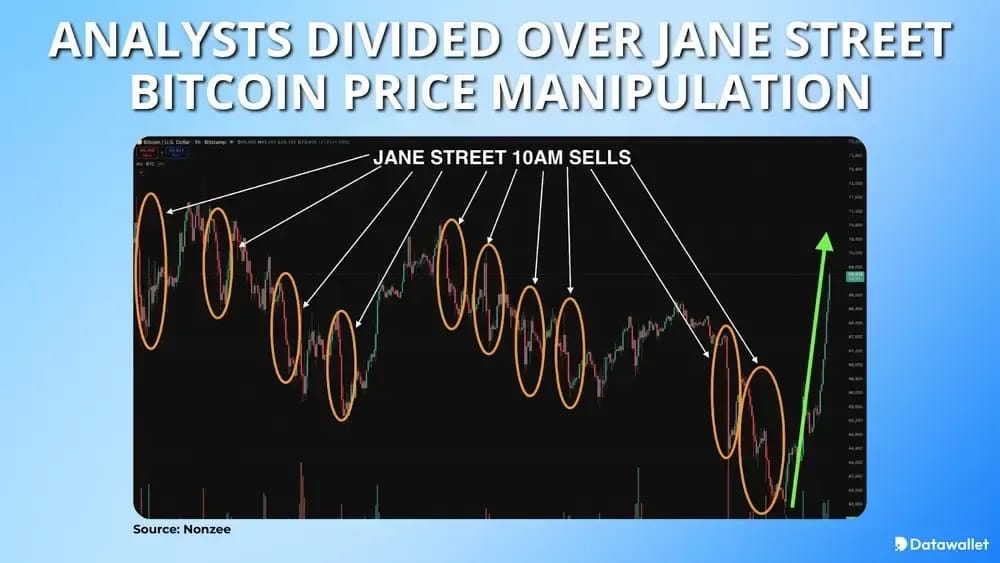
Investors accused quantitative trading firm Jane Street this week of programmatically pressuring Bitcoin prices during the US market open. Critics claim the company conducts coordinated algorithmic selling at 10 a.m. Eastern Standard Time to buy exchange-traded funds at a discount. These allegations surfaced shortly after a court-appointed administrator sued the firm for its role in the 2022 Terra collapse.
Macro analysts disputed the narrative by sharing data showing cumulative returns of 0.9% during the alleged dump window since January. Experts suggested that BTC's fluctuations at the market open often reflect broad risk-asset repricing rather than a single entity's manipulation. Geopolitical uncertainty and global liquidity conditions currently provide a better explanation for the recent period of weakness.
More Breaking News
- Trump-backed American Bitcoin reported a $153 million annual loss as new accounting rules forced a massive write-down on its crypto holdings.
- Starknet is preparing to launch strkBTC, a bitcoin-based asset designed to enable confidential decentralized finance transactions while maintaining full network composability.
- UK investors will be barred from holding crypto exchange-traded notes in tax-free ISA accounts starting April 6 due to new reclassifications.
- Convicted FTX founder Sam Bankman-Fried continues his legal battle for a new trial as the White House repeatedly rules out a pardon.
- World Liberty Financial introduced a governance proposal requiring users to stake WLFI tokens for 180 days to earn rewards and voting rights.
- ETHZilla announced a rebrand to Forum Markets, abandoning its Ethereum treasury strategy to focus on tokenizing regulated real-world assets for institutional investors.
- The OCC proposed strict new rules implementing the GENIUS Act, which would officially bar payment stablecoin issuers from offering interest or yield.
For the latest updates on digital asset markets, follow us on X @Datawalletcom.
For the latest updates on digital asset markets, follow us on X @Datawalletcom.
Get tomorrow’s issue in your inbox