






Fusaka shipped in December 2025, scaling rollup data availability through PeerDAS. Ethereum rarely pauses, and core developers have already moved to the next milestone: Glamsterdam.
Where recent upgrades quietly optimized blobs and Layer 2 economics, Glamsterdam is more fundamental. It rewrites how Ethereum builds, prices, and validates blocks at the protocol level, confirming a strategic shift over a year in the making: scaling Ethereum's own Layer 1 again, rather than leaving throughput to rollups.
Here is what you need to know about the upgrade set to define Ethereum's 2026. 👇
What is the Ethereum Glamsterdam Upgrade?
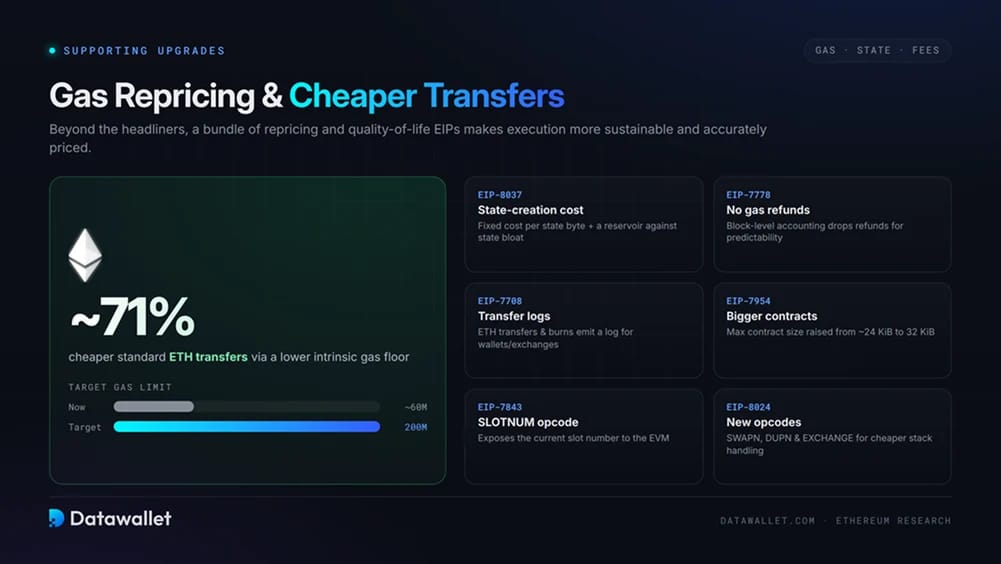
Glamsterdam is Ethereum's next coordinated hard fork and the direct successor to Fusaka. The name pairs a star with a past Devconnect host city: Gloas covers the Consensus Layer changes, Amsterdam covers the Execution Layer changes. Bundled together, they ship as one network upgrade.
It is built around two headline proposals. EIP-7732 introduces Enshrined Proposer-Builder Separation (ePBS) on the consensus side, and EIP-7928 introduces Block-Level Access Lists (BALs) on the execution side. A supporting cluster of gas-repricing, state-cost, and quality-of-life EIPs completes the package.
Core developers call it the most significant protocol change since The Merge. Ethereum Foundation engineer Parithosh Jayanthi described the current phase as the last step before hardening and shipping to public testnets. The reason is scope: ePBS reshapes block production and the MEV pipeline, while BALs rethink how the network reads and writes state.
That combination unlocks Ethereum's headline ambition for this cycle: a target gas limit of 200 million per block, roughly triple today's ~60 million, plus the throughput headroom that comes with it.
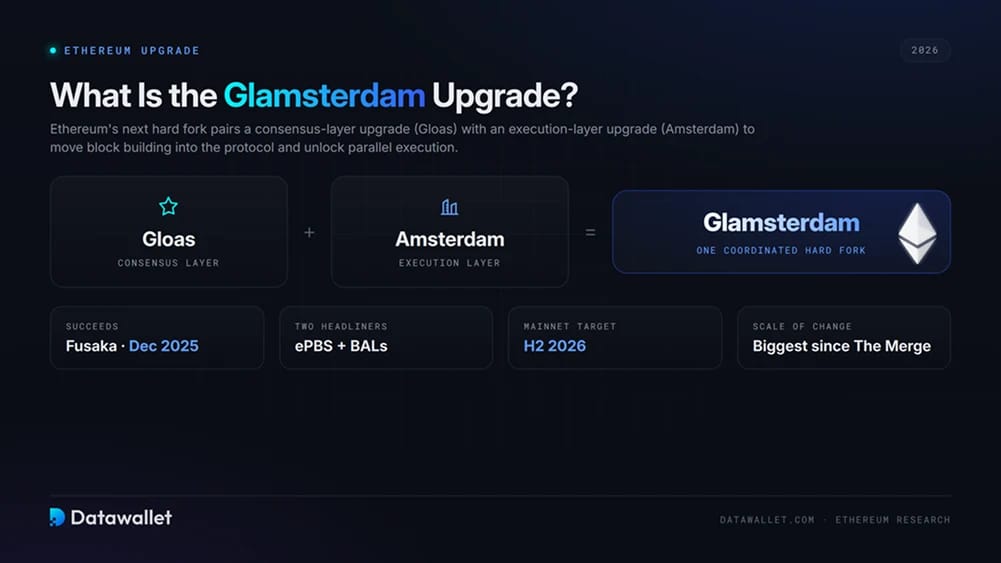
Why Glamsterdam Matters: Ethereum's Pivot Back to Scaling L1
To understand Glamsterdam, start with the strategic problem it solves.
For years Ethereum followed a rollup-centric roadmap: keep the base layer lean, push scaling to Layer 2 networks. It worked technically but created an economic side effect. As activity migrated to rollups, mainnet fee revenue and the EIP-1559 burn fell sharply. Daily L1 fees that once ran near $30 million in 2021 and 2022 have spent much of 2026 in the single-digit millions, dimming the "ultrasound money" thesis that propped up much of the ETH case.
This is the value-capture question hanging over ETH: if rollups take the users and the fees, what accrues to the base asset? In early 2026, Vitalik Buterin publicly questioned the pace of the rollup-only approach, noting that only a couple of major L2s had reached meaningful decentralization. The Ethereum Foundation's 2026 priorities reorganized the roadmap into three tracks: Scale, Improve UX, and Harden the L1.
Glamsterdam is the first engineering expression of that pivot. By making validation faster and parallel (BALs) and block production trustless and in-protocol (ePBS), it lays the groundwork for a higher base-layer gas limit, more blob capacity for rollups, and a network that can win activity back on L1. It does not settle the value-accrual debate on its own, but it changes the setup, which is why investors and builders are watching closely.
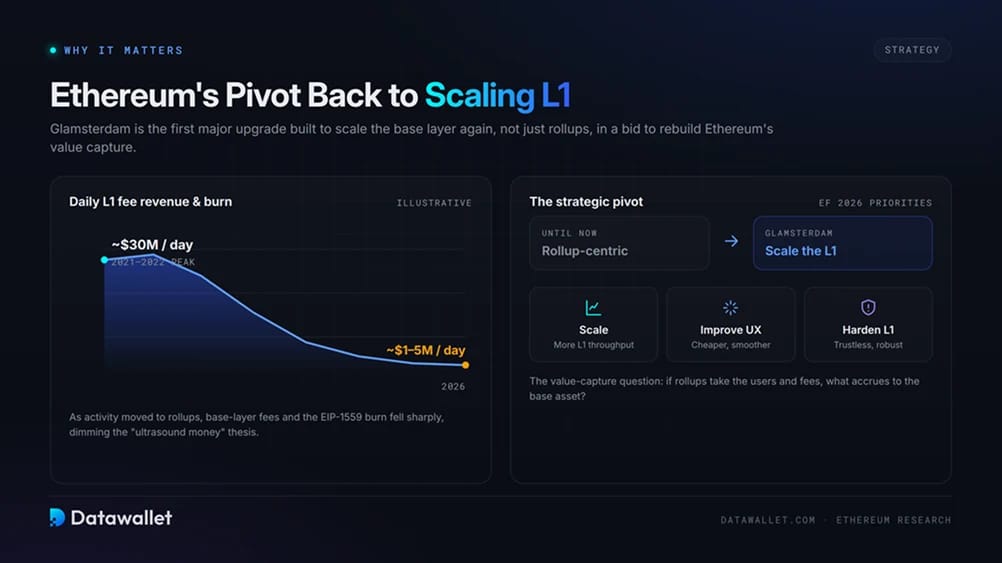
Glamsterdam's Two Headline EIPs
Every modern Ethereum upgrade names a few "headliner" EIPs to anchor scope and avoid the delays that come from bundling too much at once. Glamsterdam's two are locked in.
1. Enshrined Proposer-Builder Separation (EIP-7732)
Today most Ethereum blocks are not built by the validators who propose them. Proposers outsource construction to specialized builders through off-protocol relays, usually MEV-Boost. That works, but it inserts trusted intermediaries into the heart of block production and concentrates power in a handful of relays.
ePBS pulls that separation into the protocol. The proposer and builder each handle their own part of the block, and the handoff, including builder payment, settles natively on the consensus layer instead of through an external relay. Relays like MEV-Boost become optional rather than required.
To keep this safe, ePBS adds explicit deadlines, payload commitments, and a Payload Timeliness Committee that attests separately to the consensus block and to whether the execution payload arrived on time. It also widens the data-propagation window from roughly two seconds to around nine, the headroom that lets the network raise the gas limit without forcing validators to rush validation.
The payoff is structural: more transparent, censorship-resistant block production, less reliance on off-chain MEV infrastructure, and a base for future user protections like inclusion lists.
This is also the hardest part of the upgrade. ePBS splits block production into two parties acting in sequence inside consensus, so the protocol now has to handle non-delivery or disagreement between them. "Partial blocks" and two-party coordination touch almost the entire client stack, the main reason Glamsterdam has moved slower than Fusaka.
2. Block-Level Access Lists (EIP-7928)
Ethereum currently runs the transactions in a block one after another, because no node knows which accounts and storage slots a transaction will touch until it executes. That serial bottleneck caps how much computation safely fits in a block.
BALs attach an upfront map to every block listing the exact accounts and storage keys its transactions will access, plus the resulting post-execution state values. With that map available before execution, clients prefetch state in parallel and process non-overlapping transactions at the same time instead of replaying them in order.
BALs also enable executionless sync, letting a new node update its state from the access-list digest without re-running the entire transaction history. That lowers sync overhead and keeps state growth manageable as the chain scales.
BALs are what make a higher gas limit realistic, since faster, more predictable validation is the prerequisite for pushing block capacity toward 200 million gas and the often-cited ~10,000 TPS ceiling. Those are design targets, not guarantees. Real gains depend on client performance, validator hardware, and how much parallelism live blocks actually contain, and the gas limit itself is set by validator gas-voting over time, not flipped on by the fork.
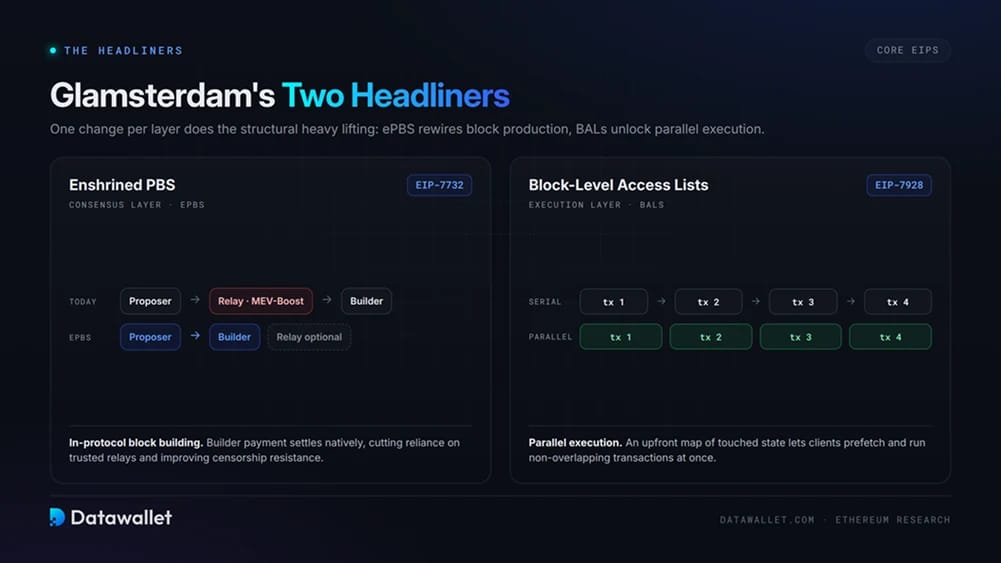
The Supporting EIPs: Gas Repricing, State Costs, and Cheaper Transfers
Beyond the headliners, Glamsterdam ships execution-layer changes that look minor but matter for sustainability and user cost.
The gas and state-cost repricing realigns the price of operations with their true long-term burden. The anchor is EIP-8037, finalized in May 2026, which sets a fixed cost per byte of new state and carves out a separate gas reservoir for state growth. That gives client teams a sustainability ceiling: room to raise the gas limit toward 200 million without bloating the database past a manageable yearly budget.
EIP-7778 then drops refunds from block-level gas accounting, making costs more predictable for builders. Together this package is Ethereum's main lever against state bloat and a direct complement to BALs.
For everyday users, the most visible change cuts the intrinsic transaction-gas floor, projected to make standard ETH transfers between existing accounts up to 71% cheaper. That strengthens Ethereum's case for routine payments, not just complex DeFi.
A few quality-of-life EIPs finish the set. EIP-7708 makes ETH transfers and burns emit a log, something wallets and exchanges have wanted for years because it removes custom transaction tracing. EIP-7954 raises the maximum contract size from roughly 24 KiB to 32 KiB. Others add opcodes (EIP-7843's SLOTNUM, EIP-8024's SWAPN, DUPN and EXCHANGE) and networking improvements that move the new block-access-list data efficiently.
What Got Cut: 6-Second Slots and Inclusion Lists
Part of what makes Glamsterdam's scope credible is what developers left out.
- EIP-7782 (6-second slots): A high-profile plan to halve Ethereum's slot time from 12 seconds to 6 was considered as a headliner. Developers declined it: it risked complicating real-time ZK proving (already nearing the 12-second target), would force timing recalibration if slot restructuring happened later anyway, and was less mature than rival proposals. It stays an active idea for a future fork.
- FOCIL / Fork-Choice Inclusion Lists (EIP-7805): This censorship-resistance mechanism lets validator committees force-include transactions. It was moved out after teams warned that combining ePBS and FOCIL in one upgrade would create too much untested interaction at mainnet scale. FOCIL is now the headliner for Hegotá, the upgrade after Glamsterdam, alongside account abstraction work.
The discipline matters. By refusing to ship everything at once, core devs kept Glamsterdam focused on the two changes that genuinely unblock L1 scaling.
Ethereum Glamsterdam Release Date
Glamsterdam reached its final devnet stage in mid-June 2026, with developers running multi-client devnets that include the full slate of planned EIPs. This is the last major engineering phase before client releases, security reviews, and public testnets.
On timing, there is no confirmed mainnet date, and the upgrade's meta specification (EIP-7773) is still in Draft. The realistic picture:
- Final devnets (now): stabilizing every EIP together across all client implementations.
- Public testnets (next): Holesky and Hoodi fork before mainnet, with stability needing to hold across multiple epochs.
- Mainnet target (H2 2026): some staking providers cite an optimistic internal target around Q3 2026. Given the two to four months of public-testnet seasoning recent forks needed, a window of roughly September to December 2026 is the firmer base case.
- Subject to change: Ethereum Foundation contributors note Glamsterdam is proving trickier and slower than Fusaka, so a slip is possible. Getting ePBS right outranks any fixed date.
Ethereum Glamsterdam EIP List
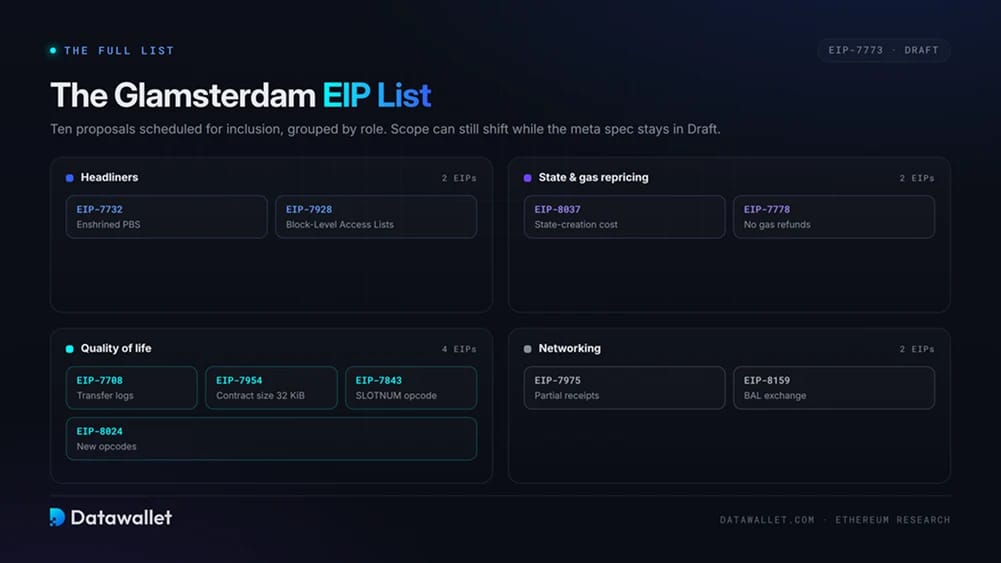
The current Scheduled for Inclusion set clusters around the two headliners plus the gas-and-state repricing bundle. Scope can still shift while EIP-7773 stays in Draft; the live status sits on Forkcast and the Glamsterdam meta thread.
The most relevant Glamsterdam EIPs by role:
- EIP-7732: Enshrined Proposer-Builder Separation (ePBS). Moves block building and builder payments into the protocol (consensus headliner).
- EIP-7928: Block-Level Access Lists (BALs). Enables parallel execution and executionless sync (execution headliner).
- EIP-8037: State-creation gas-cost increase. Fixed cost per state byte plus a dedicated reservoir for state growth (anti-state-bloat anchor).
- EIP-7778: Block gas accounting without refunds. Simplifies gas economics and improves builder predictability.
- EIP-7708: ETH transfers and burns emit a log. Removes custom transaction tracing for wallets and exchanges.
- EIP-7954: Raises the maximum contract size from ~24 KiB to 32 KiB.
- EIP-7843: Adds a SLOTNUM opcode exposing the current slot number to the EVM.
- EIP-8024: Backward-compatible SWAPN, DUPN and EXCHANGE opcodes for cheaper stack handling.
- EIP-7975 / EIP-8159: Networking upgrades that let clients exchange the new block-access-list data efficiently.
With several smaller calldata and access-list repricings, they push one theme: more predictable, accurately priced execution that scales without forcing Ethereum nodes onto expensive hardware.
What Glamsterdam Means for ETH Investors
Major Ethereum upgrades tend to be volatile events that often run a "buy the rumor, sell the news" pattern, with ETH building into a fork and pulling back after activation. That is a tendency, not a rule, and recent cycles have been messier than the clean historical cases.
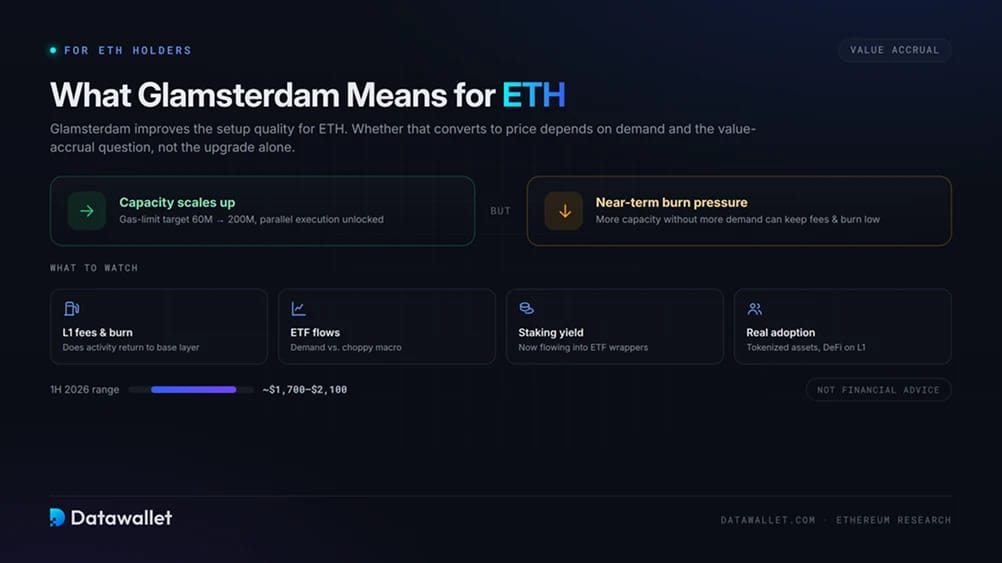
The bigger frame for Glamsterdam is structural. Through the first half of 2026, ETH underperformed, trading in a rough $1,700 to $2,100 band and slipping below $1,700 in a June risk-off move, even as spot ETH ETFs logged their strongest monthly inflows since launch in May. Healthy product demand against a soft price is the value-accrual question in action: until more on-chain activity feeds base-layer fees, burn, and staking yield, the bull case stays conditional.
There is a sharper twist. A threefold jump in L1 capacity without a matching jump in demand can keep base fees low and throttle the EIP-1559 burn in the near term, even as it scales the network. Glamsterdam expands Ethereum's long-run capacity, but it does not automatically lift the burn that ETH's monetary case leans on.
Why it still carries weight: it is the first upgrade built to scale L1 throughput and pull activity back to the base layer, and it arrives as ETF issuers begin passing staking rewards to shareholders and regulators clarify how institutions earn proof-of-stake yield. Some analysts back a constructive 2026 ETH thesis on these dynamics; others stay cautious on fee cannibalization and macro conditions. The debate is genuinely two-sided.
For long-term holders, Glamsterdam mostly improves the setup quality for ETH. Whether that converts into price depends on adoption and the macro backdrop, not the upgrade alone. None of this is financial advice, and both timelines and markets can change fast, so do your own research before allocating.
Key Risks of the Glamsterdam Upgrade
Glamsterdam reshapes block production, execution, and pricing at once, adding coordination surfaces that need exhaustive testing across clients and applications.
- ePBS complexity: splitting block production into two sequential parties inside consensus is hard. The protocol must handle builder non-delivery and disagreement cleanly, and "partial block" logic touches nearly the whole client stack, raising the risk of bugs or delays.
- Builder centralization: in-protocol PBS cuts relay trust, but capital-heavy builders could still dominate block construction. ePBS mitigates this pressure rather than removing it.
- BALs correctness: deterministic access lists demand strict agreement across clients. A mismatch in how nodes compute or validate the map could, worst case, risk a consensus split.
- Repricing fallout for dApps: changing opcode and storage costs can break smart contracts tuned to old gas assumptions, exposing latent bugs or shifting economics.
- State-growth distortion: higher storage costs may push developers toward calldata-heavy or short-lived patterns, redistributing load rather than cutting it.
- Validator operations: dropping mandatory MEV relays improves trust assumptions but adds monitoring and coordination work for staking infrastructure.
- Overscoping: combining major MEV, execution, and gas reforms in one fork raises integration risk. Deferring 6-second slots and FOCIL is a direct attempt to contain it.
Final Thoughts
Glamsterdam is where Ethereum's scaling plan turns operational, deadline-bound, and testnet-driven, and where its strategic story shifts. After years of routing throughput to rollups, core developers are scaling the base layer again, betting that a faster, more parallel, more trustless L1 keeps Ethereum central to crypto and tokenized finance.
For the protocol, ePBS and BALs are foundational plumbing that later upgrades will build on for years. For investors, Glamsterdam changes the question. The issue is no longer whether Ethereum can scale, but how well that scaling holds, and whether it finally reconnects network growth to the value of ETH.
.webp)