



Fusaka is now live, and the debate has shifted from what it would do to how well it has held up. Activated seven months after Pectra, it marked Ethereum's second hard fork of 2025 and its fastest turnaround between major upgrades since the network moved to proof-of-stake.
The release confirmed a change in tempo. Core developers replaced the old annual cadence with tighter, more frequent forks, and Fusaka was the proof of concept. Here is what actually shipped, how the network responded, and what it signals for ETH heading deeper into 2026. 👇
What Was the Ethereum Fusaka Upgrade?
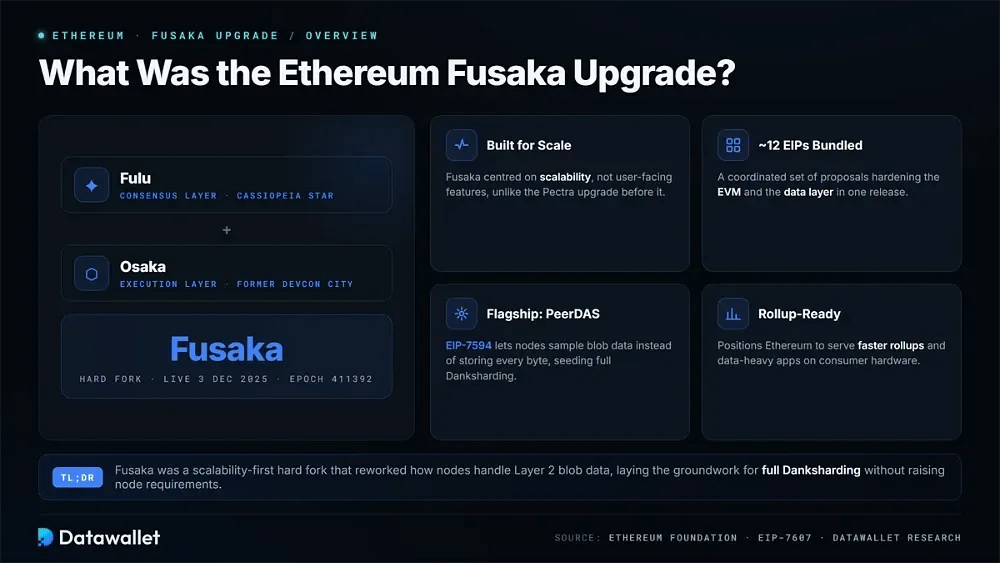
The Ethereum Fusaka upgrade was a coordinated hard fork that went live on mainnet on 3 December 2025. Following tradition, the name blends "Fulu," a star in the Cassiopeia constellation, with "Osaka," a former Devcon host city, tying the consensus and execution layers together into a single release.
Fusaka centred on scalability rather than user-facing features, unlike the Pectra upgrade that preceded it. Its flagship change, PeerDAS (EIP-7594), reworked how nodes confirm that Layer 2 blob data exists, letting them sample fragments instead of storing every byte. This laid the groundwork for full Danksharding.
The fork bundled around twelve Ethereum Improvement Proposals, most inherited from earlier scoping rounds, with a focus on hardening the Ethereum Virtual Machine and the data layer. Together, they positioned Ethereum to serve faster rollups and data-heavy applications without pushing node requirements beyond consumer hardware.
Key Benefits Fusaka Delivered
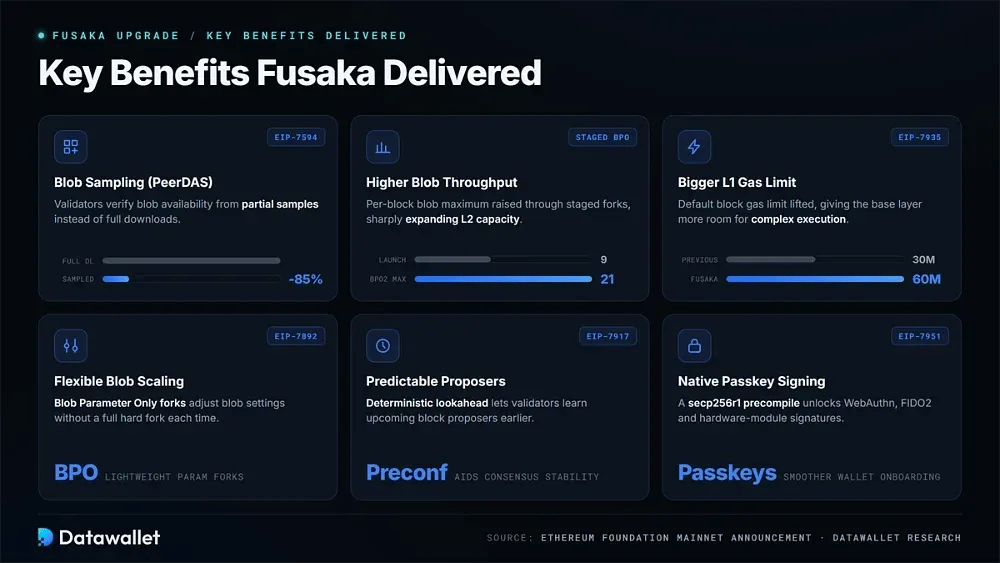
Fusaka prioritised network health and predictable scaling over headline features, reflecting the caution that shaped its final scope. The changes reshaped how Ethereum handles heavier data loads and how validators coordinate block production across the network.
The core benefits Fusaka introduced include the following:
- Blob sampling (PeerDAS): Cuts bandwidth and storage pressure on consensus nodes by roughly 85%, letting validators verify blob availability from partial samples instead of full downloads.
- Higher blob throughput: Raised the per-block blob maximum from 9 toward 21 through staged forks, sharply expanding Layer 2 capacity and lowering rollup posting costs over time.
- Bigger L1 gas limit: Lifted the default block gas limit to 60 million via EIP-7935, giving the base layer roughly 20-30% more room for transactions and complex smart-contract execution.
- Flexible blob scaling (EIP-7892): Added Blob Parameter Only forks, lightweight upgrades that adjust blob settings without a full hard fork each time developers want more capacity.
- Predictable proposers (EIP-7917): Enabled deterministic proposer lookahead, so validators learn who proposes upcoming blocks earlier, aiding preconfirmations and consensus stability.
- Native passkey signing (EIP-7951): Added a secp256r1 precompile, unlocking device-native signatures through WebAuthn, FIDO2, and hardware security modules for smoother wallet onboarding.
Fusaka PeerDAS and the EOF Decision Explained
Two components defined how Fusaka was scoped: PeerDAS, which made it into the release as the anchor feature, and EOF, which developers ultimately cut. Understanding both explains why the final upgrade looked leaner than early roadmaps suggested it would.
What is PeerDAS in Fusaka?
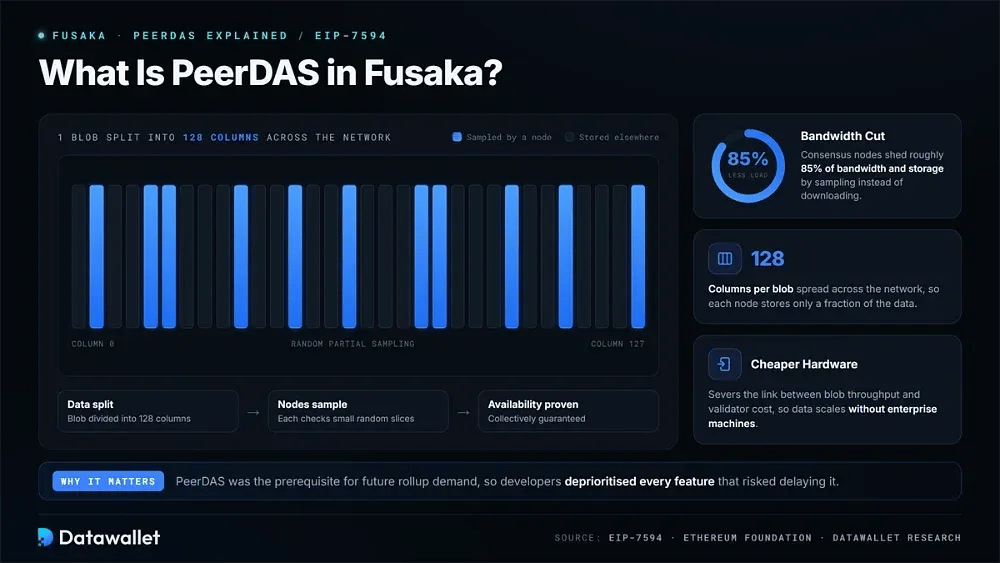
PeerDAS (Peer Data Availability Sampling) lets consensus-layer nodes confirm large blob transactions by checking small random slices rather than downloading each blob whole. Data is split into 128 columns spread across the network, so each node stores only a fraction while collectively guaranteeing availability.
This design severed the link between blob throughput and validator hardware cost, letting Ethereum scale data capacity without demanding enterprise-grade machines. Developers deprioritised every feature that risked delaying PeerDAS, since it was the prerequisite for meeting future rollup and data-availability demand as covered in our EIP-4844 explainer.
Why EOF was dropped from Fusaka
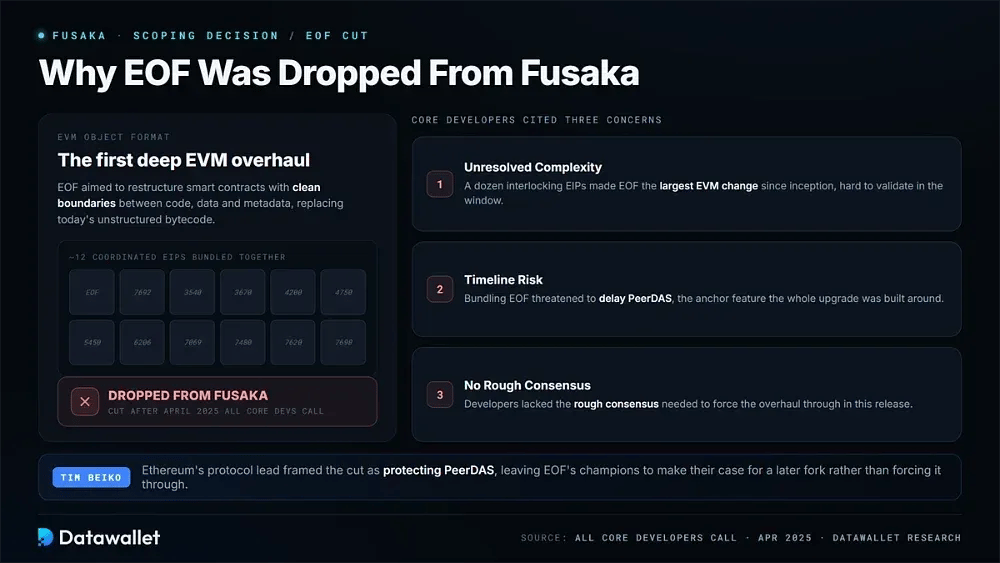
EVM Object Format (EOF) aimed to restructure smart contracts by drawing clean boundaries between code, data, and metadata, replacing the current unstructured bytecode. The plan bundled roughly a dozen coordinated EIPs into the first deep overhaul of the EVM since its inception.
Core developers removed EOF from Fusaka after an April 2025 All Core Developers call, citing unresolved complexity, timeline risk, and a lack of rough consensus. Protocol lead Tim Beiko framed the cut as protecting PeerDAS, leaving EOF's champions to make their case for a later fork rather than forcing it through.
Ethereum Fusaka Release Timeline
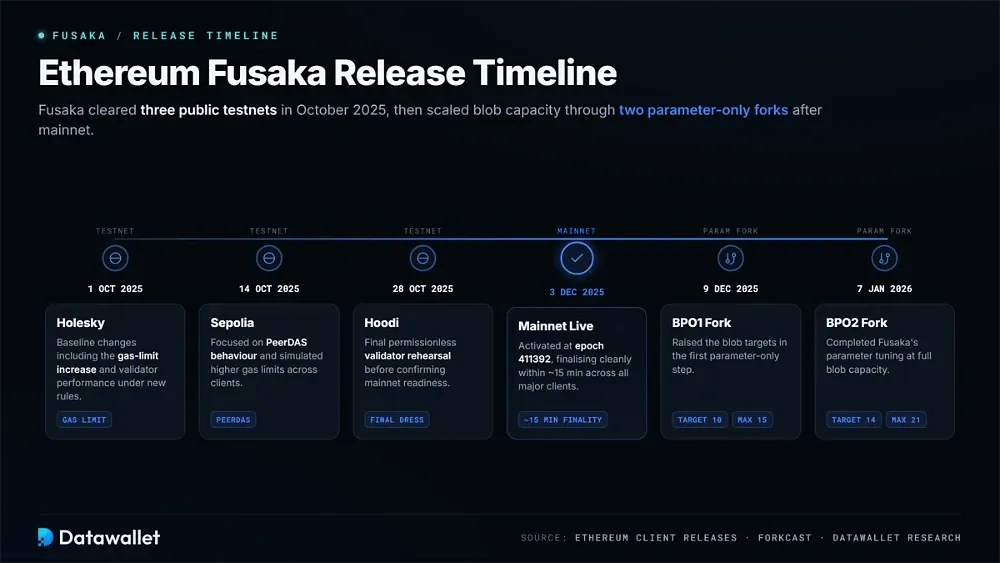
Fusaka reached mainnet on schedule after clearing three public testnets during October 2025. The rollout then continued through two parameter-only forks that scaled blob capacity in measured steps rather than all at once, a deliberately cautious approach given how new the sampling technique was.
The Fusaka rollout unfolded across these key milestones:
- Holesky testnet: Activated 1 October 2025, testing baseline changes including the gas-limit increase and validator performance under the new rules.
- Sepolia testnet: Activated 14 October 2025, focused on PeerDAS behaviour and simulated higher gas limits across client implementations.
- Hoodi testnet: Activated 28 October 2025, the final permissionless validator rehearsal before developers confirmed mainnet readiness.
- Mainnet activation: Went live 3 December 2025 at epoch 411392, finalising cleanly within roughly fifteen minutes across all major clients.
- BPO1 fork: Activated 9 December 2025, raising the blob target to 10 and the maximum to 15 per block.
- BPO2 fork: Activated 7 January 2026, lifting the target to 14 and the maximum to 21, completing Fusaka's parameter tuning.
Ethereum Fusaka EIP List
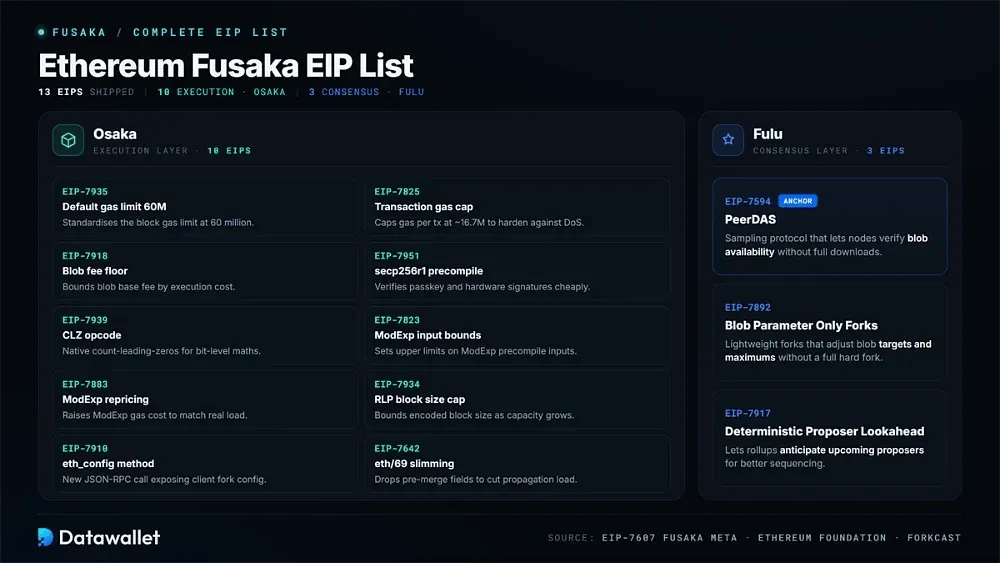
Fusaka's final EIP set targeted three goals: scaling Layer 2 data capacity, improving Layer 1 execution efficiency, and refining the developer and validator experience. Based on the Ethereum Foundation's mainnet announcement and Forkcast tracking, these were the proposals that shaped the release.
The most consequential Fusaka EIPs by role include the following:
- EIP-7594: Introduced PeerDAS, the sampling protocol that lets consensus nodes verify blob availability without full downloads, the anchor of the entire upgrade.
- EIP-7892: Enabled Blob Parameter Only forks, allowing lightweight adjustments to blob targets and maximums without a full coordinated hard fork.
- EIP-7935: Set the default block gas limit to 60 million, standardising a value across clients that validators had begun adopting even before activation.
- EIP-7825: Capped per-transaction gas at roughly 16.7 million (2²⁴), a DoS-hardening measure that also lays groundwork for parallel execution.
- EIP-7918: Bounded the blob base fee by execution cost, stopping blob prices from collapsing to 1 wei and preserving a meaningful fee signal.
- EIP-7951: Added a secp256r1 precompile, enabling passkey-style and hardware-backed signatures to be verified cheaply on-chain.
- EIP-7917: Delivered deterministic proposer lookahead, letting rollups and applications anticipate upcoming block proposers for better sequencing.
- EIP-7939: Added the CLZ (count leading zeros) opcode, giving developers a cheap native instruction for bit-level maths and cryptographic helpers.
Several smaller proposals rounded out the package, including the ModExp repricing pair (EIP-7823 and EIP-7883), the RLP block size cap (EIP-7934), and network protocol improvements (EIP-7642). These mostly tightened gas economics and propagation efficiency as block capacity grew.
How the Network Responded After Launch
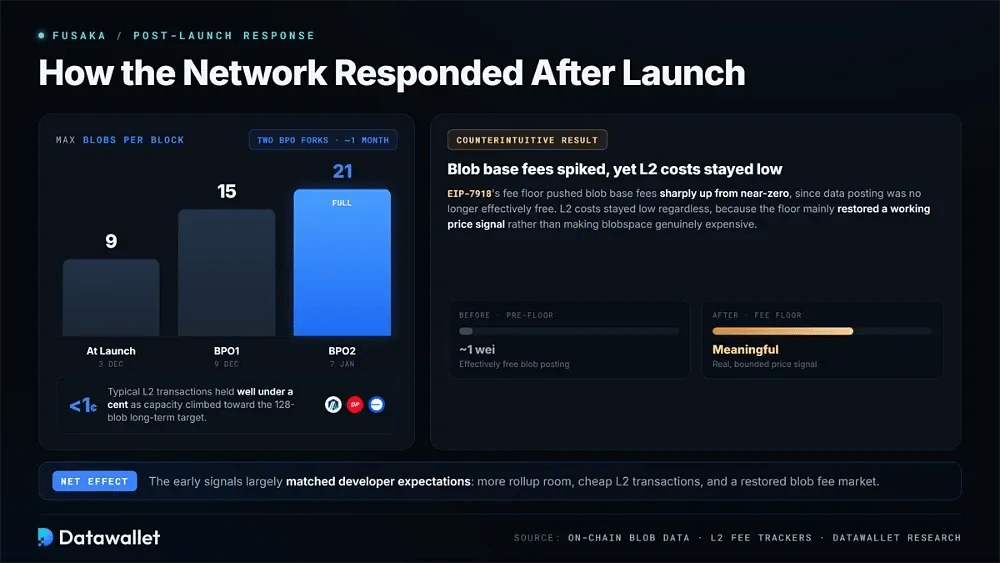
Fusaka's real test came after activation, when live blob usage and fee data replaced projections. The early signals largely matched developer expectations, though a few outcomes surprised observers watching the Ethereum gas price and blob markets in the weeks that followed.
The two BPO forks tripled maximum blob capacity within roughly a month, giving rollups substantially more room to post batches. Layer 2 fees on major networks stayed well under a cent for typical transactions, and analysts pointed to further reductions as capacity continued scaling toward the long-term 128-blob target.
One counterintuitive result stood out. EIP-7918's blob fee floor caused blob base fees to spike sharply from their previous near-zero levels, since data posting was no longer effectively free. L2 costs stayed low regardless, because the fee floor mainly restored a working price signal rather than making blobspace genuinely expensive for rollups.
Fusaka and ETH: Price Performance Since Launch
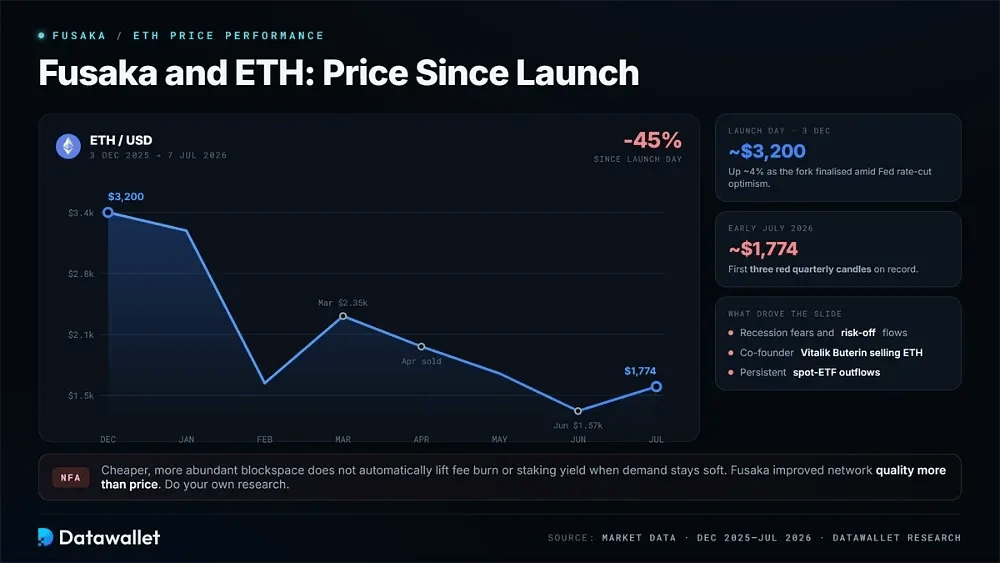
Fusaka activated into a brief bid, with ETH near $3,200 on launch day, up roughly 4% as the fork finalised amid Fed rate-cut optimism and multi-year lows in exchange reserves. That strength held only into early January, when ETH still hovered above $3,000 before broader conditions took over.
The slide then deepened. ETH fell below $1,800 by February 2026 as recession fears, co-founder Vitalik Buterin selling ETH, and persistent spot-ETF outflows converged. Spring rallies toward $2,350 in March and $2,100 in April were each sold into, and a June risk-off move pushed the price near $1,570.
The cumulative picture is sobering. ETH trades around $1,774 in early July, down roughly 45% since launch, and has logged its first three consecutive red quarterly candles on record. Fusaka cleared major technical objections, yet price moved the opposite way across the seven months that followed.
That disconnect captures the value-accrual question hanging over ETH. Cheaper, more abundant blockspace does not automatically lift base-layer fee burn or staking yield when demand stays soft, so Fusaka improved the network's quality more than its price. None of this is financial advice, so do your own research before allocating.
What Fusaka Set Up Next
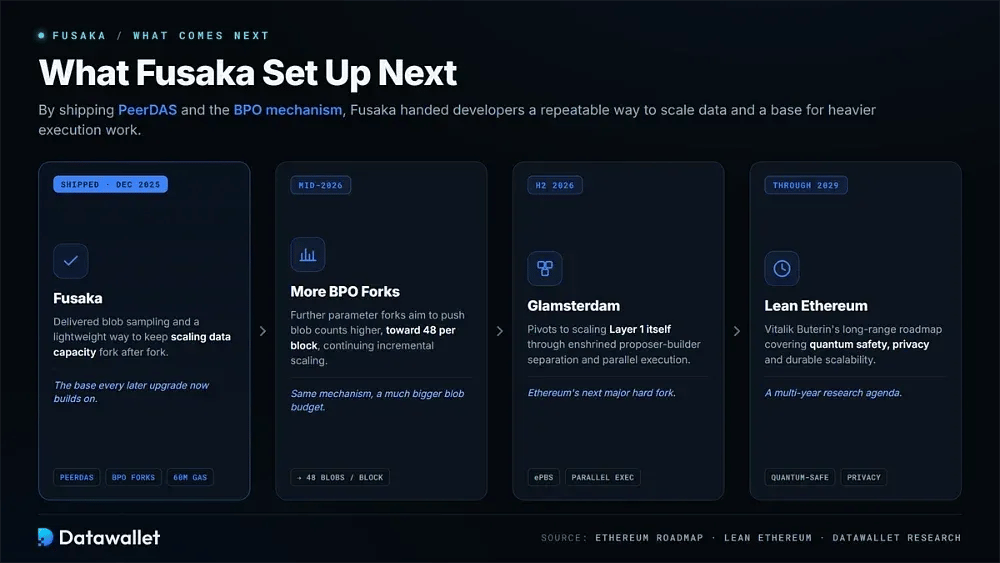
Fusaka was never an endpoint. By shipping PeerDAS and the BPO mechanism, it handed core developers a repeatable way to scale data capacity and a foundation for the more ambitious execution-layer work that follows. The roadmap after Fusaka is already taking shape.
The immediate successor is Glamsterdam, targeted for the second half of 2026, which pivots toward scaling Layer 1 itself through enshrined proposer-builder separation and parallel execution. Beyond the fork schedule, Vitalik Buterin published a "Lean Ethereum" roadmap covering quantum safety, privacy, and long-term scalability through 2029.
Further BPO forks aim to push blob counts toward 48 per block by mid-2026, continuing the incremental scaling Fusaka unlocked. Each step compounds the last, moving Ethereum steadily toward the throughput its rollup-centric roadmap has long promised.
Final Thoughts
Fusaka delivered on its central promise: it scaled Ethereum's data layer without compromising the decentralisation that node operators depend on. PeerDAS shipped cleanly, blob capacity tripled within weeks, and the network absorbed the changes with minimal disruption.
The harder question is what comes of it. Fusaka gave Ethereum the infrastructure to onboard the next wave of users, but infrastructure alone does not guarantee that activity, fees, or price follow. As Glamsterdam and the broader 2026 roadmap unfold, the network's ability to convert technical capability into durable value remains the story worth watching.