






Can You Get Free Tron Testnet Tokens?
Yes, and the Tron Foundation is unusually generous about it. The Nile Faucet hands out 2,000 TRX and 1,000 USDT per wallet per day with nothing more than a reCAPTCHA.
No signup, no mainnet balance check, no social verification, no developer account gating. That's a bigger stablecoin drip than anything on Ethereum testnets, and it reflects what Tron is actually used for.
Tron runs two public testnets, Nile and Shasta, and both have their own faucets. Nile is the one you want for almost everything: bigger drip, newer protocol features, and a proper test USDT contract that behaves like the real thing. Shasta is more conservative and useful when you need a testing environment that mirrors mainnet parameters exactly.
How to Get Testnet TRX and USDT From the Nile Faucet
Before touching the faucet, you need a wallet that can switch to Nile. TronLink is the default and what the Tron docs assume, though any wallet from our best Tron wallets roundup that exposes Nile will work.
- Install TronLink and create a fresh wallet. Use a dedicated testing wallet. Never import your mainnet seed into a testnet environment.
- Switch networks. Open TronLink, click the network dropdown, and pick TRON Nile Testnet. Copy the wallet address.
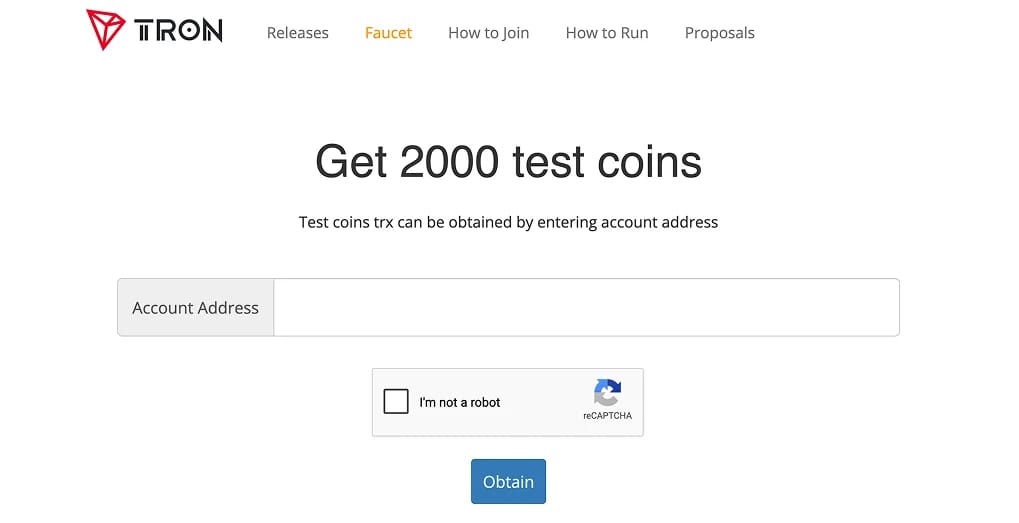
- Open the faucet. Go to nileex.io/join/getJoinPage.
- Claim 2,000 test TRX. Find the "Get 2000 test coins" section, paste your address, solve the captcha, and hit Obtain. Tokens land in under a minute.
- Claim 50,000 test USDT. Scroll to "Get 50,000 USDT test tokens" and repeat with the same address. This is the allocation most people care about.
- Add the test USDT token to TronLink. It won't always auto-detect. Tap the plus icon next to Assets and paste the test USDT contract address if needed.
If the web faucet is rate-limited or you need more than 2,000 TRX at once, Tron Protocol runs a TronFAQBot on the official Tron Telegram and Discord. Drop a message like !nile <your_address> and it sends 5,000 TRX in seconds.
What is the Tron Testnet?
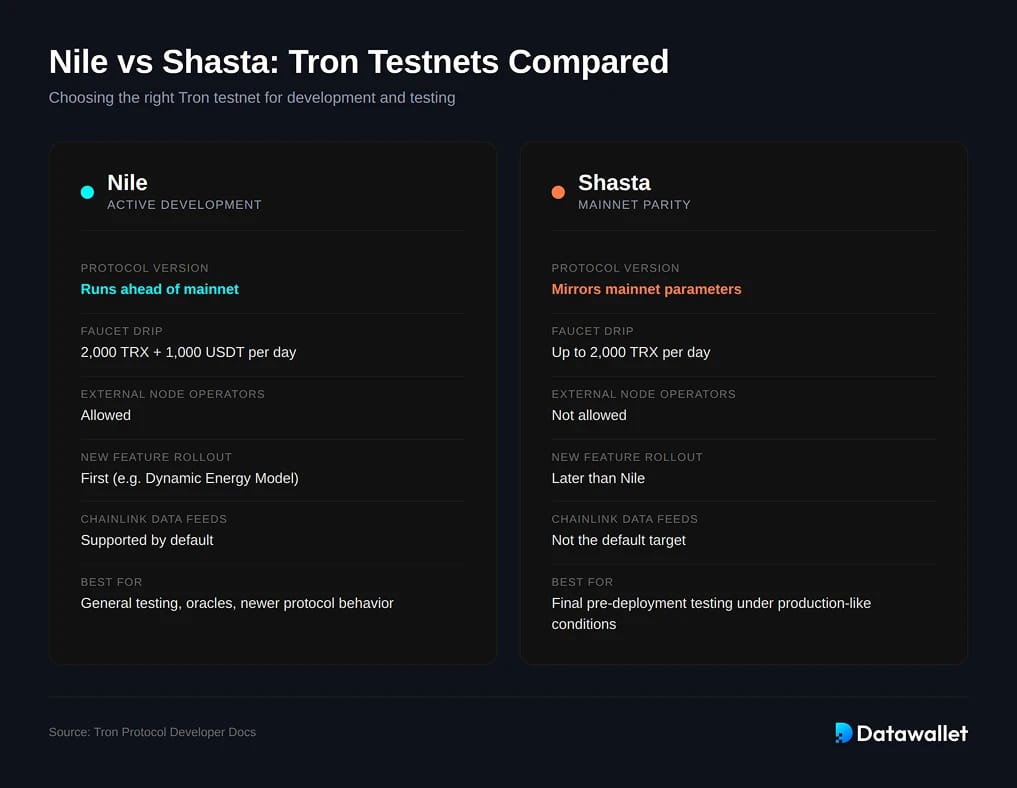
The Tron testnet is a parallel version of mainnet where TRX and TRC-20 tokens have no monetary value, letting you practice transactions, deploy contracts, and interact with dApps risk-free. Tron Protocol runs two of them: Nile and Shasta.
Nile is the active development testnet and runs ahead of mainnet. New protocol features, like the Dynamic Energy Model, ship to Nile first before rolling out to the live network. It also allows external node operators, which is why most infrastructure providers and third-party tools default to Nile. Chainlink Data Feeds on Tron target Nile out of the box, making it the standard choice for anything involving oracles or newer protocol behavior.
Shasta is the older and more conservative of the two. It mirrors Tron mainnet parameters closely, which makes it the right environment for final pre-deployment testing when you want the test network to behave identically to production. Shasta does not allow external node operators and ships new features later than Nile.
Understanding Bandwidth and Energy
Tron doesn't use gas like Ethereum. It runs on a resource model with two units: Bandwidth (transaction size) and Energy (smart contract execution). Every account gets 600 free Bandwidth points per 24 hours, enough for a few plain TRX transfers. Anything more, including a standard TRC-20 USDT transfer, needs Energy, which you get by staking TRX through Stake 2.0 or by letting the network burn TRX from your wallet to cover the shortfall.
This is why the testnet is worth using. Running a USDT transfer with an unfunded wallet versus a staked one shows the fee difference instantly, and it's the kind of thing that only clicks once you've watched it happen.
What Can You Do With Tron Testnet Tokens?
Test TRX and test USDT on Nile unlock most of what the live Tron network offers.
- Send TRC-20 transfers: The most common use case. Practice moving test USDT between wallets to get a feel for how Bandwidth and Energy actually work in practice. This is useful whether you're learning Tron for the first time or building something with USDT.
- Stake test TRX: Tron's Stake 2.0 lets you stake TRX to generate Bandwidth, Energy, and TRON Power (used for voting). You can also delegate those resources to other wallets. Testing this on Nile first means no locked real TRX if you make a mistake.
- Deploy smart contracts: The Tron Virtual Machine is largely EVM-compatible, so Solidity contracts work with minimal changes using TronBox or Tron-IDE. Deploying a simple TRC-20 token costs about 80 test TRX, comfortably within the daily faucet allocation.
- Interact with Tron dApps: Many Tron applications maintain Nile-compatible versions for testing. This is useful for trying out DeFi protocols, NFT marketplaces, or payment tools before committing mainnet funds.
- Verify transactions on TRONSCAN: Use Nile TRONSCAN or Shasta TRONSCAN to track your test transactions, inspect contracts, and see Energy and Bandwidth consumption in detail.
Other Tron Testnet Faucets
The Nile faucet is usually enough, but a few backups exist when it goes down or you hit the daily cap.
- Shasta Faucet is the other Tron-operated faucet. Up to 2,000 test TRX per day, same interface as Nile. Useful if you specifically need Shasta for mainnet parameter testing.
- TronFAQBot on Telegram and Discord. My preferred fallback. Sends 5,000 TRX, USDT, USDC, or USDD per 24 hours with a single chat command, and supports both Nile and Shasta. When the web faucets are empty this is the thing that works.
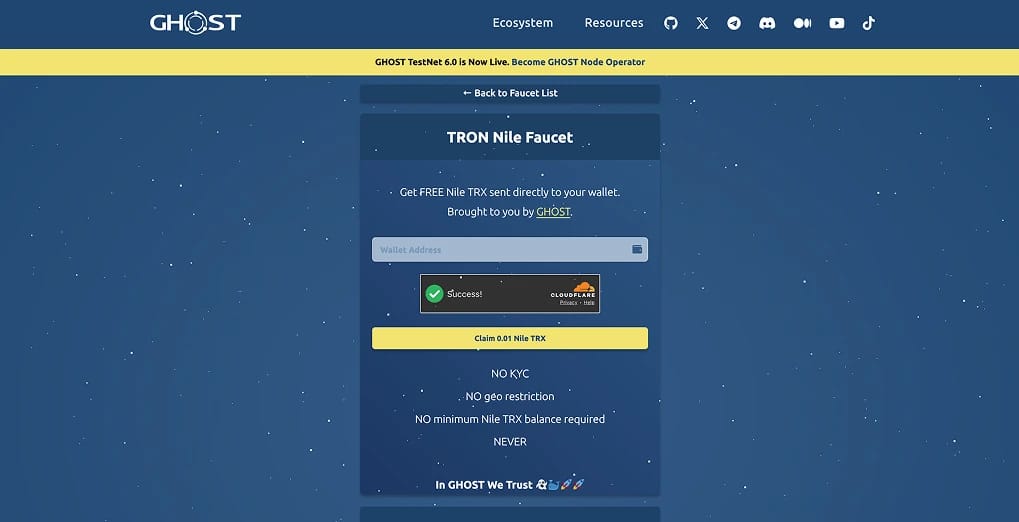
- GHOST TRON Nile Faucet is a third-party faucet maintained by the GHOST Ecosystem. Lower volume than the official options but saves you if everything else is offline.
For a wider look at testnet faucets across other networks, see our best crypto faucets roundup.
Final Thoughts
Tron's testnet is one of the more approachable in crypto. The faucets hand out meaningful amounts without gating, both Nile and Shasta are stable, and the tooling around TronLink is good enough that you can go from zero to a signed TRC-20 transfer in about five minutes.
If you're new to Tron, spending an hour on Nile sending test USDT and watching how Bandwidth and Energy get consumed is the fastest way to understand how the network actually works.
.webp)