


Login to Track Your Live Crypto Portfolio
Sign Up and Track Your Live Crypto Portfolio for Free
Forgot your password?
Coinbase Debuts Agentic Wallets For AI Bot Trading

This article has been reviewed and verified for accuracy by our editorial team. All claims, data points and platform details are cross-referenced against primary sources.
Some links on this page are affiliate links. Datawallet may earn a commission when you sign up through them, at no extra cost to you. This never influences our editorial ratings, rankings or recommendations.
Some links on this page are affiliate links. Datawallet may earn a commission when you sign up through them, at no extra cost to you. Ratings and rankings reflect our own testing and assessment criteria.

GM. Coinbase launched "Agentic Wallets" to let AI bots hold funds and trade autonomously on Base, enabling a self-sustaining machine economy through standardized financial rails.
Meanwhile, Thailand approved regulated crypto derivatives, Binance finished moving its $1 billion SAFU fund into Bitcoin, and Israel indicted two people for Polymarket insider trading.
Here are the details as we wrap up a week of bot-driven breakthroughs. 👇
Coinbase Debuts Agentic Wallets For AI Bot Trading
Software titan Coinbase inaugurated a dedicated wallet infrastructure specifically engineered for AI agents like those from Moltbook to enable autonomous machine-to-machine commerce. This strategic toolkit empowers software bots to hold funds and execute trades without direct human intervention.
The formal market debut transpired on 11 February 2026 across the Base network following a surge in agentic software popularity. This timely launch addresses the critical bottleneck where intelligent bots could analyze data but lacked payment capabilities.
Leadership deployed this specific technology to enable self-sustaining machine economies where agents pay for API access and computational resources. By utilizing the x402 protocol, the company provides a standardized financial rail for the growing bot ecosystem.
Coinbase engineers achieved this security by isolating private keys within trusted execution environments and implementing programmable spending caps for every session. Consequently, developers can fund and deploy these compliant, gasless wallets in under 2 minutes using command-line tools.
Thailand Clears Path For Regulated Crypto Derivatives
Thailand’s Cabinet approved major amendments to the Derivatives Act this Tuesday to formally include digital assets. The new framework allows cryptocurrencies like Bitcoin to serve as underlying instruments for regulated futures and options contracts. SEC Secretary-General Pornanong Budsaratragoon stated that this policy shift aims to promote market inclusiveness and improve risk management.
Regulators are currently drafting specific licensing rules for operators to offer these contracts through the Thailand Futures Exchange. Local observers noted that aligning regulation with market reality helps move digital asset activity into a clearer legal structure. This initiative follows a three-year capital markets plan that also includes the development of domestic crypto ETFs.
Binance Completes $1 Billion Shift To Bitcoin SAFU Fund
Binance finalized its 30-day plan to convert its emergency user protection fund into Bitcoin. The exchange purchased a final tranche of 4,545 BTC to bring the total SAFU holdings to 15,000 tokens. This transition effectively moves $1.01 billion in stablecoin reserves into the premier digital asset to strengthen its long-term treasury.
The firm originally established the SAFU fund to protect its global customers from unforeseen losses caused by protocol hacks. Binance also pledged to replenish the reserve if market volatility pushes the fund's total value below $800 million. Management stated that this fully Bitcoin-backed reserve underscores their confidence in the asset as a strategic store of value.
Israel Indicts Two People Over Polymarket Insider Trading
Israeli authorities indicted an IDF reservist and a civilian on Thursday for allegedly utilizing classified military secrets. Prosecutors claim the suspects placed multiple wagers on Polymarket regarding the nation's clandestine attack on Iran in June 2025. This investigation, conducted by the Shin Bet and Israel Police, uncovered striking accuracy in bets totaling roughly $150,000.
The defense establishment emphasized that placing such bets based on secret information poses a real security risk to current operations. Both defendants now face severe criminal charges including bribery, obstruction of justice, and various security offenses against the state. This case represents a rare instance of law enforcement targeting prediction market users for exploiting non-public military data.
Data of the Day
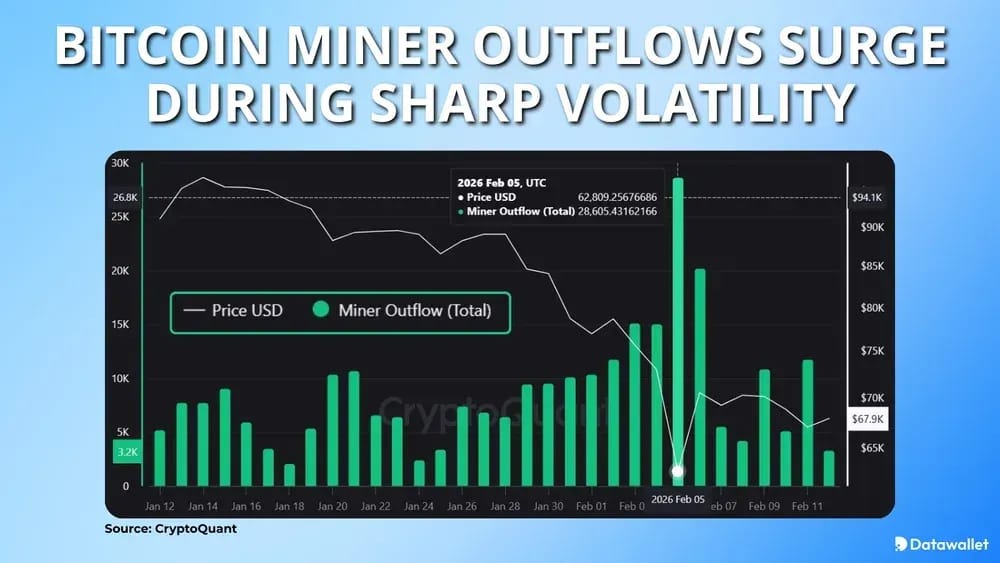
Bitcoin miner outflows reached a peak of 28,605 BTC on February 5 during a period of intense volatility. On-chain data from CryptoQuant showed that an additional 20,169 tokens left miner-linked wallets just one day later. These massive transfers, valued at approximately $3.2 billion, typically signal potential selling pressure as prices swing between $62,000 and $71,000.
Publicly listed firms reported a combined January production of only 2,377 BTC, which is far below these recent outflows. Some analysts suggest the movements may reflect internal wallet reshuffling rather than broad capitulation across the industrial mining sector. These large-scale transactions coincide with significant network difficulty adjustments following recent winter storms across major US power regions.
More Breaking News
- The UK Treasury appointed HSBC and Ashurst to lead a sovereign blockchain bond pilot, aiming to modernize the nation's digital debt infrastructure.
- Lightning Labs released a toolkit enabling AI agents to use the Bitcoin Lightning Network for autonomous, programmatic, and account-free financial transactions.
- Ripple CEO Brad Garlinghouse believes the firm could reach a $1 trillion valuation by centering its long-term growth strategy around the XRP ecosystem.
- World Liberty Financial announced plans for a blockchain-based remittance service to reduce fees for cross-border money transfers using stablecoin and DeFi infrastructure.
- Gate CEO Han Lin declared the traditional four-year Bitcoin halving cycle dead as crypto markets increasingly align with global macroeconomic and AI trends.
- ARK Invest purchased $33.8 million in Robinhood shares during a Bitcoin price dip, making it the top holding in the firm’s flagship fund.
- Coinbase shares declined as CEO Brian Armstrong's stock sales reached $545.7 million over nine months, amid broader weakness in the crypto market.
- Elon Musk announced a limited beta for X Money, aiming to transform the social media platform into a central hub for global transactions.
For the latest updates on digital asset markets, follow us on X @Datawalletcom.
For the latest updates on digital asset markets, follow us on X @Datawalletcom.
Get tomorrow’s issue in your inbox