

Login to Track Your Live Crypto Portfolio
Sign Up and Track Your Live Crypto Portfolio for Free
Forgot your password?
Documentary Claims Finney And Sassaman Created Bitcoin

This article has been reviewed and verified for accuracy by our editorial team. All claims, data points and platform details are cross-referenced against primary sources.
Some links on this page are affiliate links. Datawallet may earn a commission when you sign up through them, at no extra cost to you. This never influences our editorial ratings, rankings or recommendations.
Some links on this page are affiliate links. Datawallet may earn a commission when you sign up through them, at no extra cost to you. Ratings and rankings reflect our own testing and assessment criteria.

GM. A new documentary titled "Finding Satoshi" premiered today, claiming that Bitcoin was a joint creation by the late cryptographers Hal Finney and Len Sassaman after a four-year investigation.
Meanwhile, Base launched its Azul upgrade on testnet to shorten withdrawal times, Justin Sun sued World Liberty Financial over frozen tokens, and Russia's Duma approved a bill for crypto trade settlements.
Here are the details on Satoshi’s identity, network security, and sovereign legal frameworks. 👇
Documentary Claims Finney And Sassaman Created Bitcoin
Directed by Tucker Tooley, a new documentary asserts that Satoshi Nakamoto was actually two people, the late cryptographers Hal Finney and Len Sassaman. The film follows a four year investigation that utilized deductive reasoning and linguistic analysis to link these cypherpunks to the world's first cryptocurrency.
Finney reportedly composed the functional code while Sassaman handled the written white paper before their respective deaths in 2014 and 2011. Investigators cross referenced online activity and motivations with the help of a former FBI agent who previously captured the Unabomber during a high stakes manhunt.
Famous finance figures like Michael Saylor and Bill Gates appear in the footage, though directors claim they downplayed the importance of Satoshi’s identity. The project also reveals that a long interview with Sam Bankman-Fried was cut from the final version due to his recent criminal fraud conviction.
While other Satoshi candidates like Adam Back and Nick Szabo are discussed, researchers eliminated them based on specific discrepancies in their posting history during critical events. The documentary serves as a tribute to the digital underground that fostered the privacy technology necessary for Bitcoin to survive and thrive.
Base Azul Upgrade Adds Multiproof Security
Base launched its Azul upgrade on testnet to introduce a multiproof system combining execution environments with zero knowledge technology. This update allows either proof type to finalize proposals independently, while their agreement can shorten withdrawal times to one day. The network intends to activate this new client stack on mainnet during May.
Engineers simplified the underlying software by making a new consensus client the primary execution node for all operations. Recent tests show empty blocks decreased by 99 percent while the infrastructure sustained bursts of 5,000 transactions per second. Developers are now running a 250,000 audit competition to verify the security of these internal changes.
Justin Sun Sues WLFI Over Frozen Tokens
Justin Sun sued World Liberty Financial in California federal court, alleging the Trump-backed project froze his WLFI tokens, stripped his voting rights, and threatened to burn his holdings. Sun says he invested $75 million and became the largest holder. He argues the action came without notice, cause, or recourse.
The case could test how far projects marketed as decentralized can rely on hidden administrative powers embedded in smart contracts. Sun previously accused WLFI of maintaining a secret backdoor allowing freezes. Legal analysts say courts may focus on whether those powers were clearly disclosed and applied consistently.
Russia Passes Bill For Foreign Crypto Trading
Russia’s State Duma passed a crypto bill in its first reading, creating a framework for licensing market participants while limiting how digital assets can be used. The Bank of Russia would oversee exchanges, brokers, and other approved operators. The proposal still needs further readings before it can become law.
Under the bill, cryptocurrency would be recognized as property, protected in court, and permitted for cross-border trade settlements, but barred from domestic payments. Non-qualified investors would face a 300,000 ruble purchase cap under the earlier plan. Officials say the foreign-trade carveout could help Russian firms bypass sanctions barriers.
Data of the Day
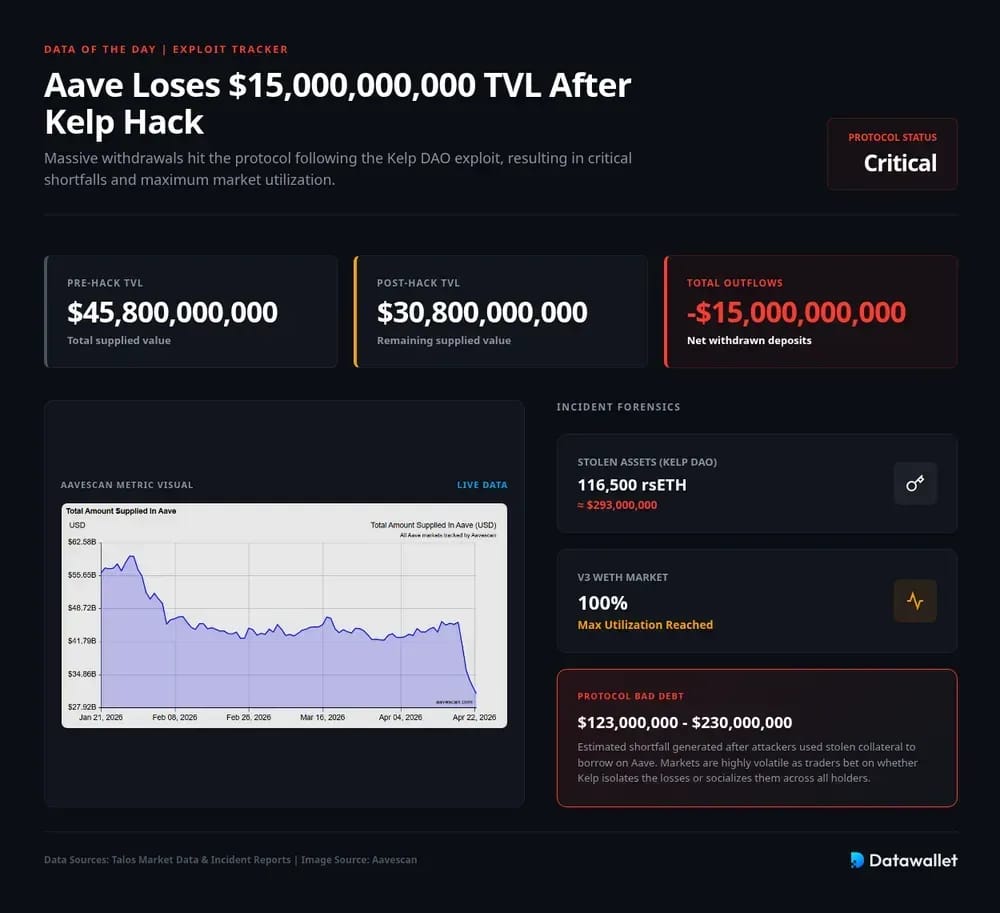
Aave has seen about $15 billion in deposits withdrawn since the Kelp DAO exploit, with total supplied value falling from $45.8 billion to $30.8 billion. The outflows followed the theft of about 116,500 rsETH worth roughly $293 million. Part of the stolen collateral was then used to borrow on Aave.
The protocol’s incident report estimated a shortfall between $123 million and $230 million, depending on how losses are ultimately allocated. Talos said the bad debt briefly pushed Aave’s v3 WETH market to 100% utilization. Traders are now betting on whether Kelp socializes losses across holders or isolates them.
More Breaking News
- Kelp DAO’s attacker laundered about $80 million in ETH, with most of it routed through THORChain as the protocol’s 24-hour swap volume jumped to $394 million.
- Kraken said it filed 56 million crypto tax forms for 2025, with roughly one-third covering transactions below $1 and exposing the reporting burden from micro-payments and staking.
- Kalshi tapped Pyth for a new Commodities Hub, adding gold, oil, lithium, and other event markets as prediction platforms push further into round-the-clock price exposure.
- American Bitcoin shares jumped 13% after the Trump-backed miner activated 11,298 machines in Alberta, lifting owned hash rate to 28.1 EH/s across 89,242 miners.
- Input Output submitted nine Cardano treasury proposals for 2026, seeking far less funding than last year while centering Leios, a scaling upgrade targeting 10x to 65x throughput gains.
- The UK FCA raided eight illegal London crypto hubs in its first coordinated crackdown on unregistered peer-to-peer trading operations accused of bypassing anti-money laundering controls.
- BinanceUS cut spot trading fees across all listed cryptocurrencies to 0% for makers and 0.02% for takers, aiming to revive a platform still trailing major U.S. rivals.
- UK retail investors regained tax-free access to crypto ETNs after Stratiphy secured IFISA approval, opening a compliant route into 21Shares products on the London Stock Exchange.
- French police are investigating a home invasion in which armed intruders forced a family to transfer about $820,000 in crypto, extending a wave of violent attacks.
For the latest updates on digital asset markets, follow us on X @Datawalletcom.
For the latest updates on digital asset markets, follow us on X @Datawalletcom.
Get tomorrow’s issue in your inbox