


Login to Track Your Live Crypto Portfolio
Sign Up and Track Your Live Crypto Portfolio for Free
Forgot your password?
Kalshi Closes $1 Billion Round Doubling Valuation To $22 Billion

This article has been reviewed and verified for accuracy by our editorial team. All claims, data points and platform details are cross-referenced against primary sources.
Some links on this page are affiliate links. Datawallet may earn a commission when you sign up through them, at no extra cost to you. This never influences our editorial ratings, rankings or recommendations.
Some links on this page are affiliate links. Datawallet may earn a commission when you sign up through them, at no extra cost to you. Ratings and rankings reflect our own testing and assessment criteria.

GM. Kalshi secured a $1 billion investment at a $22 billion valuation today, doubling its market worth in just three months to cement its dominance in prediction markets.
Meanwhile, Coinbase launched stock perps for non-US users, Grayscale filed for a Hyperliquid ETF, and Gemini shareholders filed a class-action lawsuit over a "prediction market pivot."
Here are the details on billion-dollar rounds, synthetic equities, and exchange legal woes. 👇
Kalshi Closes $1 Billion Round Doubling Valuation To $22 Billion
Prediction market titan Kalshi secured a $1 billion investment round to clinch a staggering $22 billion valuation from private backers, according to WSJ. This capital infusion effectively doubles the firm's market worth since its previous funding milestone just 3 months ago.
The deal came to light via major financial outlets following a period of explosive growth within the event-based wagering sector. These proceedings occurred as global investors aggressively pursued exposure to high-growth decentralized forecasting platforms.
Coatue Management initiated this specific multibillion dollar commitment because they seek to capitalize on a projected 46.8% compound annual growth rate. By securing these funds, the startup aims to cement its dominance over rivals like Polymarket.
Executives achieved this massive valuation leap by navigating complex regulatory hurdles and successfully launching high-volume election contracts across 140 countries. Consequently, Kalshi now commands more than double the $9 billion valuation of its nearest competitor.
Coinbase Launches Stock Perpetual Futures For Non-US Users
Coinbase introduced stock perpetual futures for eligible retail and institutional traders located outside the United States. This new offering provides synthetic leveraged exposure to elite technology stocks like Nvidia, Tesla, and Apple on a centralized platform. By utilizing crypto rails, the exchange enables global participants to speculate on traditional equities with constant 24/7 market availability.
The expansion aligns with Coinbase's long-term strategy to build a complete everything exchange for various asset classes. These contracts offer up to 20x leverage on major indices and are settled exclusively using the USDC stablecoin. This rollout follows a recent derivatives push in Europe where the firm began offering hybrid equity and crypto indexed products.
Grayscale Files For New Hyperliquid Token Index Fund
Major asset manager Grayscale filed a formal application to list an exchange-traded fund tracking the HYPE token. If the SEC grants approval, the fund will trade on the Nasdaq under the ticker symbol GHYP to provide institutional exposure. The underlying Hyperliquid network currently operates as the largest decentralized venue for on-chain perpetual futures trading in the crypto industry.
The filing specifically names Coinbase Custody as the primary protector of the fund's digital assets and uses CoinDesk pricing data. While the project is currently barred to American users, the recently formed Hyperliquid Policy Center is actively lobbying regulators in Washington. This move follows similar filings from 21Shares and Bitwise as competition for decentralized exchange index funds intensifies.
Gemini Shareholders File Lawsuit Over Prediction Market Pivot
Investors filed a class-action lawsuit against Gemini this week alleging that the firm failed to disclose a major strategic pivot. The federal suit claims the Winklevoss twins materially misled the public about the viability of their core crypto business before going public. Shareholders argue that the company improperly concealed plans to prioritize its new prediction market platform over its traditional exchange operations.
The legal complaint links these alleged omissions to a precipitous 85% decline in the value of the company’s stock since last autumn. Gemini recently laid off a quarter of its workforce and exited several international markets to improve its overall corporate efficiency. Despite reporting stable revenue streams, the firm recorded a massive $582.8 million net loss throughout the 2025 fiscal year.
Data of the Day
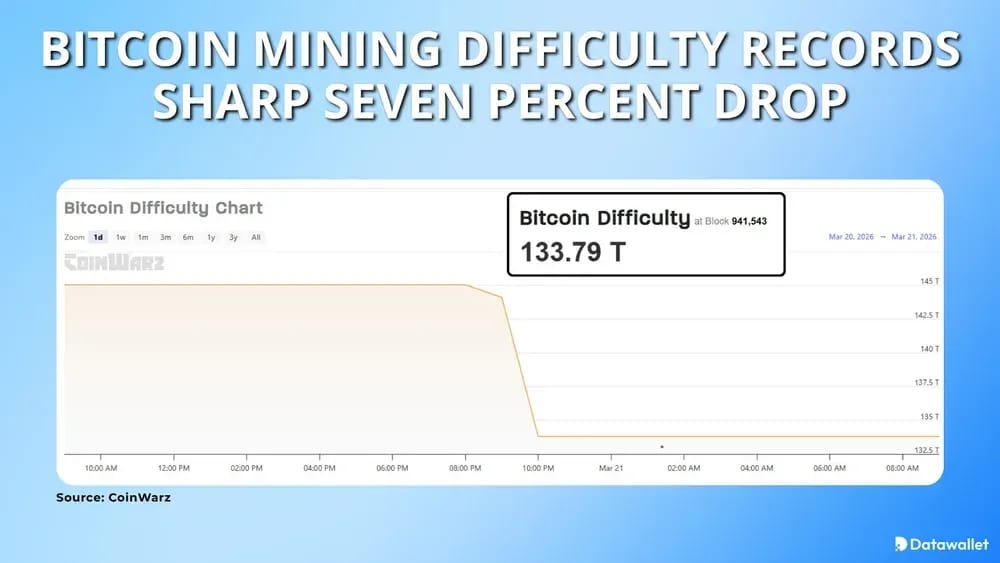
Bitcoin’s mining difficulty fell by 7.7% on March 20, marking the most noticeable downward adjustment for the network since February. This recalibration occurred at block 941,472 after average block times slowed to over 12 minutes due to lower active computing power. The change eases conditions for remaining operators by reducing the computational work required to earn the same fixed block rewards.
Many listed miners are currently reallocating their data-center capacity toward artificial intelligence workloads to find steadier financial returns. Firms like Core Scientific and MARA Holdings have shifted resources as rising power costs impact the profitability of traditional Bitcoin extraction. This trend has led some analysts to argue that AI infrastructure has become the primary competitor for global electricity supplies.
More Breaking News
- Brazil's finance minister is delaying crypto tax updates until after the 2026 election to avoid pushing divisive policies during the presidential race.
- Nevada became the first state to ban Kalshi, temporarily halting its sports and political prediction markets following a gaming board legal challenge.
- A Hong Kong retiree lost $840,000 after being targeted by three successive crypto scams promising guaranteed profits and stolen fund recovery assistance.
- Analysts warn that Strategy's new preferred stock funding tool STRC carries hidden risks for investors if the company exercises its broad dividend discretion.
- Social media influencer Hailey Welch expressed trauma following the collapse of the HAWK meme coin, warning others to be careful with crypto promotions.
For the latest updates on digital asset markets, follow us on X @Datawalletcom.
For the latest updates on digital asset markets, follow us on X @Datawalletcom.
Get tomorrow’s issue in your inbox