


Login to Track Your Live Crypto Portfolio
Sign Up and Track Your Live Crypto Portfolio for Free
Forgot your password?
New eCash Fork Rekindles Battle Over Satoshi’s Bitcoins

This article has been reviewed and verified for accuracy by our editorial team. All claims, data points and platform details are cross-referenced against primary sources.
Some links on this page are affiliate links. Datawallet may earn a commission when you sign up through them, at no extra cost to you. This never influences our editorial ratings, rankings or recommendations.
Some links on this page are affiliate links. Datawallet may earn a commission when you sign up through them, at no extra cost to you. Ratings and rankings reflect our own testing and assessment criteria.

GM. Paul Sztorc announced a Bitcoin hard fork called eCash, sparking controversy with plans to reassign Satoshi Nakamoto’s dormant tokens to early investors for sidechain development.
Meanwhile, Polymarket is reportedly seeking CFTC approval to return to the US, Jack Dorsey’s Block disclosed 28,355 BTC in reserves, and ZetaChain paused transactions after a smart contract attack.
Here are the details on Satoshi forks, regulatory comebacks, and proof of reserves. 👇
New eCash Fork Rekindles Battle Over Satoshi’s Bitcoins
LayerTwoLabs founder Paul Sztorc announced a controversial Bitcoin hard fork called eCash that intends to reassign $1.1 million in tokens believed to belong to Satoshi Nakamoto. This August launch will create a new network mirroring the original history while gifting holders an equivalent number of these new assets.
The project serves as a testing environment for the long delayed Drivechains proposal meant to expand sidechain functionality across the ecosystem. By redirecting 500,000 of the creator's tokens toward seeding the environment, developers hope to attract fresh contributors and prevent the network from becoming a dormant zombie project.
Critics slammed the plan as a violation of fundamental property rights despite Sztorc's insistence that existing Bitcoin balances remain entirely untouched by the fork. The reassignment targets the famous Patoshi pattern coins which have remained motionless for over a decade while the community debates the project's long term ethics.
This technical split allows participants to evaluate the viability of Sztorc's sidechain vision without compromising the security of the primary network. Supporters argue that stagnant coins, like those of Satoshi, should provide utility for the next generation of builders as the industry prepares for this high stakes ideological battle in late summer.
Polymarket Seeks CFTC Approval For US Return of Main App
Polymarket is reportedly seeking approval from the CFTC to reopen its main prediction market app to U.S. users, ending a ban imposed after its 2022 settlement. The company has discussed the matter with agency officials in recent weeks. A return would sharpen competition with Kalshi in the domestic market.
The request lands amid widening legal conflict over event contracts, with states attacking prediction platforms as gambling operations and the CFTC insisting federal law preempts them. A recent insider-trading case added fresh scrutiny after a soldier allegedly used a VPN. Polymarket itself has not publicly commented on the talks.
Jack Dorsey's Block Discloses 2.2 Billion In Bitcoin Reserves
Jack Dorsey’s fintech firm published a third party audit revealing 28,355 Bitcoin held within its corporate and customer accounts recently. The disclosure confirms that the company manages $1.5 billion for users alongside a $692 million treasury. These verified holdings rank among the largest corporate reserves.
Auditors used cryptographic signatures to allow independent verification of these assets to rebuild trust after high profile industry failures. While some critics argue that publishing addresses reduces security, the firm maintains that transparency is essential for modern finance. This report precedes the company's upcoming quarterly earnings.
ZetaChain Pauses Network After Smart Contract Attack
Developers at ZetaChain halted all cross-chain transactions after identifying a sophisticated attack on its GatewayEVM smart contract earlier this week. The incident specifically targeted internal team wallets and resulted in $300,000 in losses according to recent data. Technicians successfully mitigated the threat to protect users.
No customer funds were compromised during the breach as the team works on a detailed post mortem for the community. The ZetaChain network remains offline while investigators track the exploited assets across several compatible chains. This security event follows several major hacks within the decentralized finance sector.
Data of the Day
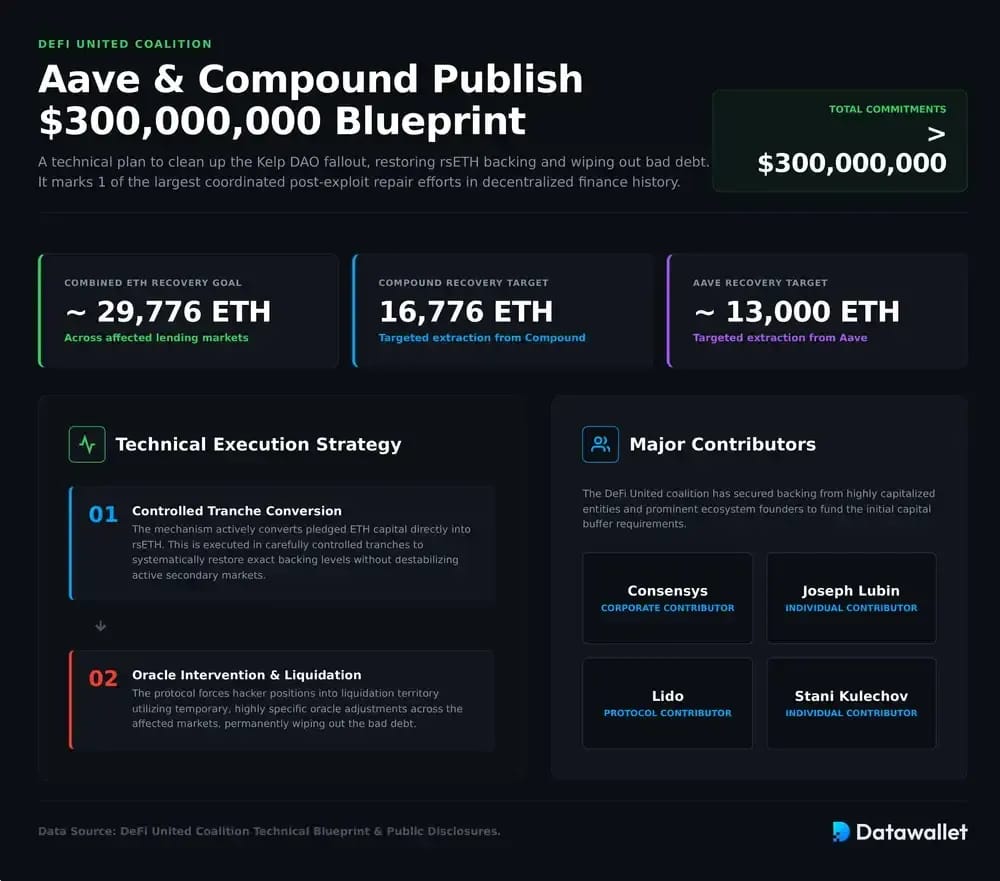
Aave, Compound, and the DeFi United coalition published a technical plan to clean up the Kelp DAO fallout by restoring rsETH backing and wiping out bad debt. The effort now has more than $300 million in commitments. Major contributors include Consensys, Joseph Lubin, Lido, and Stani Kulechov.
The mechanism converts pledged ETH into rsETH in controlled tranches, then liquidates hacker positions through temporary oracle adjustments across affected markets. The goal is to recover about 13,000 ETH from Aave and 16,776 ETH from Compound. It marks one of DeFi’s largest coordinated post-exploit repair efforts.
More Breaking News
- TON Tech launched Telegram-linked AI trading agents that can execute transfers, swaps, staking, and DeFi actions from funded wallets as TON activity remains far below late-2024 peaks.
- Ondo Finance added proxy voting for holders of more than $700 million in tokenized stocks and ETFs, extending governance tools to over 250 blockchain-based securities.
- The CFTC sued Wisconsin to stop state action against prediction markets, opening a fifth federal lawsuit in a month as regulators battle over sports event contracts.
- Tether unveiled modular bitcoin mining hardware with Canaan and ACME Swisstech, aiming to let operators upgrade compute, power, and cooling systems without replacing full rigs.
- Galaxy Digital posted a $216 million first-quarter loss as crypto prices weakened, even as its Helios data center expansion in Texas stays on schedule for revenue ramp.
- A Saipan woman received 71 months in prison for a bitcoin fraud scheme targeting older women, with restitution and forfeiture orders totaling more than $1.4 million.
- OKX added BlackRock’s BUIDL fund to its Standard Chartered collateral framework, letting institutions use tokenized Treasury exposure as trading margin while assets stay in regulated custody.
For the latest updates on digital asset markets, follow us on X @Datawalletcom.
For the latest updates on digital asset markets, follow us on X @Datawalletcom.
Get tomorrow’s issue in your inbox