


What is Ondo Finance?
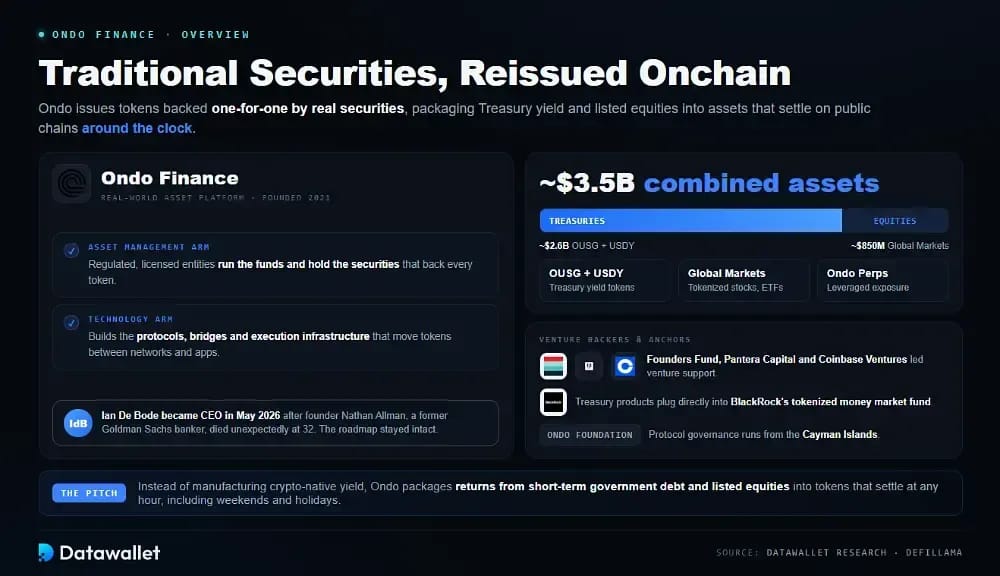
Ondo Finance is a real-world asset platform that issues blockchain tokens backed one-for-one by traditional securities. Instead of manufacturing crypto-native yield, it packages returns from short-term government debt and listed equities into tokens that settle on public chains at any hour of the day, including weekends and holidays.
The business splits into two halves that rarely sit under one roof. A regulated asset-management arm runs the funds and holds the securities through licensed entities, while a technology arm builds the protocols, bridges and execution infrastructure that move those tokens between networks and applications.
Three product lines carry the weight in 2026. OUSG and USDY deliver Treasury yield, Ondo Global Markets lists tokenized stocks and ETFs, and Ondo Perps adds leveraged exposure on top. Combined assets sat near $3.5 billion, split roughly $2.6 billion in Treasuries against $850 million in equities.
Leadership changed abruptly in May 2026. Founder Nathan Allman, a former Goldman Sachs banker who started the company in 2021, died unexpectedly at 32. Ian De Bode, previously president and chief strategy officer, took over as chief executive with immediate effect and has kept the roadmap intact.
Its backers still read like a traditional finance roster. Venture support came from Founders Fund, Pantera Capital and Coinbase Ventures, while the Treasury products plug directly into BlackRock's tokenized money market fund, and the Ondo Foundation oversees protocol governance from its base in the Cayman Islands.
How Does Ondo Finance Work?
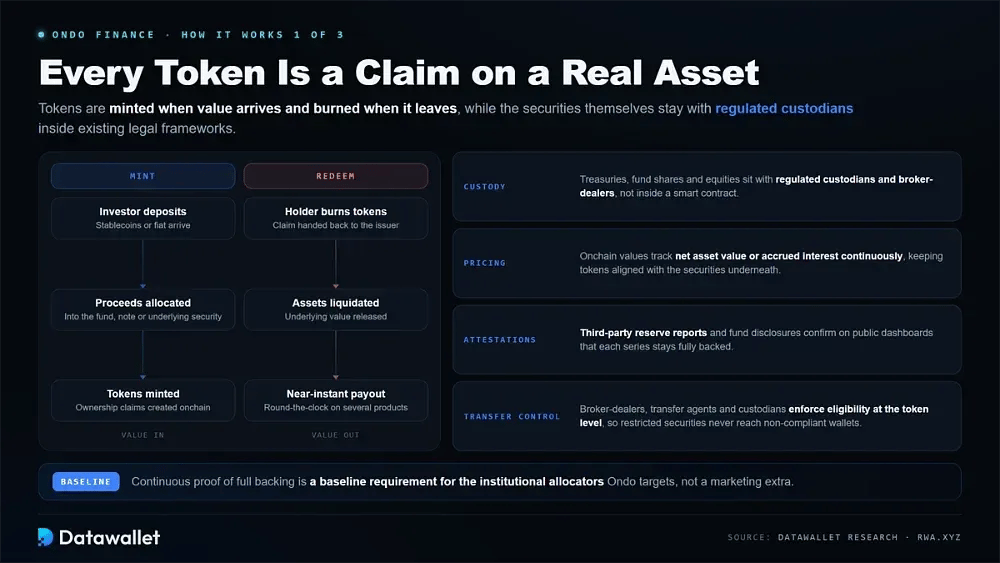
The model is deliberately simple. Every token Ondo issues represents a claim on a real asset held off-chain by a regulated custodian, minted when value arrives and burned when it leaves, with pricing that tracks whatever sits underneath.
1. Tokenization and Backing
Each product wraps a pool of regulated assets and mints tokens representing ownership claims against it. That structure keeps the onchain token tethered to the value of the securities held in traditional custody.
Here is how the backing model works across Ondo's products:
- Custody: Treasuries, fund shares and equities sit with regulated custodians and broker-dealers instead of inside a smart contract, which keeps the assets within existing legal frameworks.
- Minting: Tokens get created when investors deposit stablecoins or fiat, with the protocol allocating those proceeds into the relevant fund, note or underlying security position.
- Redemption: Holders burn tokens to reclaim the underlying value, and several products now support near-instant round-the-clock redemption instead of the traditional settlement windows measured in business days.
- Pricing: Onchain values track net asset value or accrued interest continuously, which keeps every token closely aligned with the securities backing it at any given moment.
- Attestations: Third-party reserve reports and fund disclosures confirm on public dashboards that each series stays fully backed, a baseline requirement for the institutional allocators Ondo targets.
- Transfer control: Broker-dealers, transfer agents and custodians enforce eligibility rules at the token level, so restricted securities can never reach wallets that fail their underlying compliance checks.
2. How Yield Reaches Holders
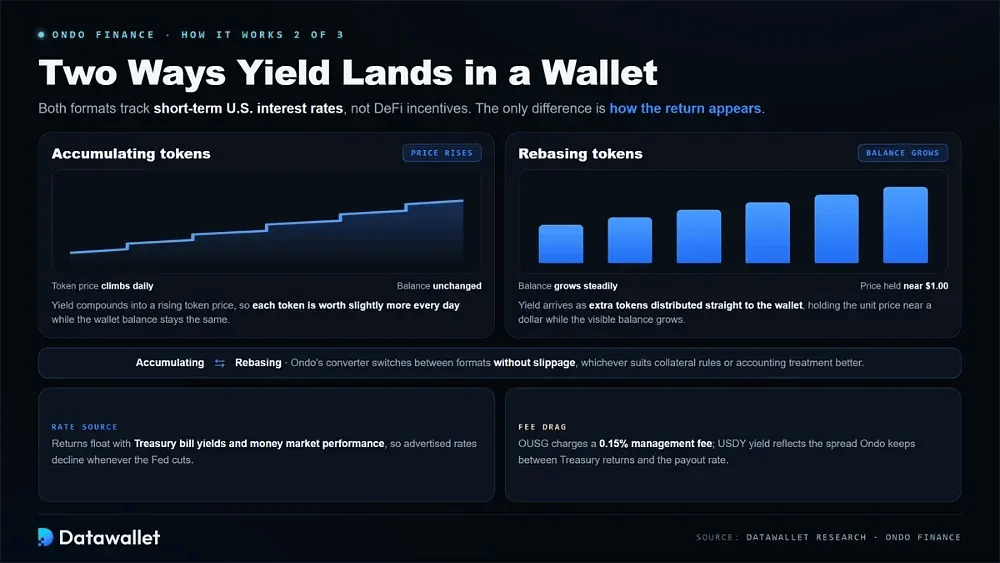
Ondo's Treasury products pay yield in two formats, and the difference changes how returns appear inside a wallet. Both track short-term U.S. interest rates rather than any DeFi incentive program.
Here is how the two yield mechanics differ in practice:
- Accumulating tokens: Yield compounds into a rising token price, so each token is worth slightly more each day while the wallet balance itself stays completely unchanged.
- Rebasing tokens: Yield arrives as extra tokens distributed straight to the wallet, holding the unit price near a dollar while the visible balance in your wallet grows steadily.
- Conversion: Holders switch between accumulating and rebasing versions through Ondo's converter without slippage, picking whichever format suits their collateral requirements or internal accounting treatment better.
- Rate source: Returns float with Treasury bill yields and money market fund performance, so advertised rates decline whenever the Federal Reserve cuts its benchmark policy rate.
- Fee drag: OUSG charges a 0.15% management fee against fund assets, while USDY yield reflects the spread Ondo retains between actual Treasury returns and the rate paid out.
3. Eligibility and Access
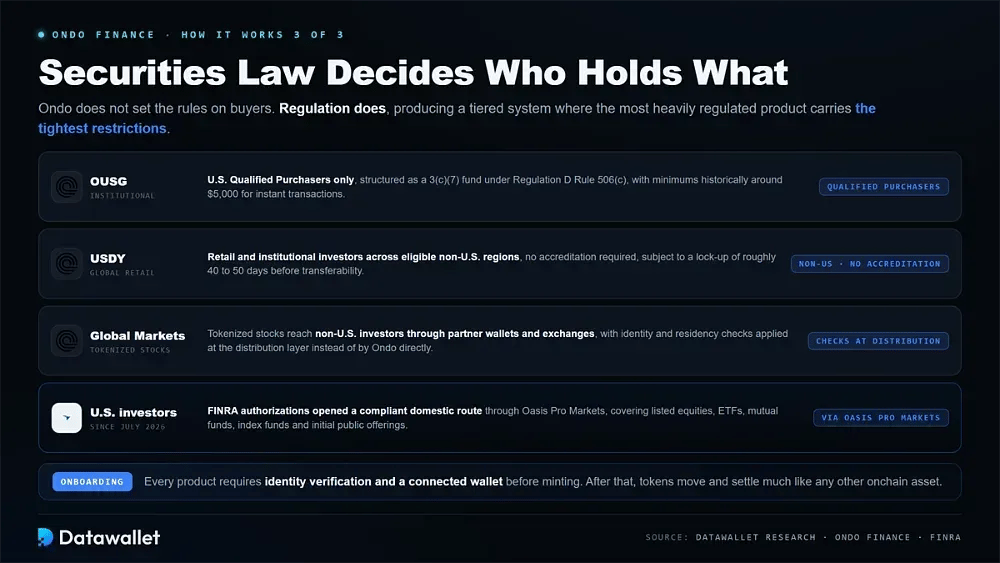
Securities law, and not Ondo itself, dictates who can hold each token. That produces a tiered system in which the most heavily regulated product also carries the tightest restrictions on buyers.
Access to each product splits along the following lines:
- OUSG: Restricted to U.S. Qualified Purchasers, structured as a 3(c)(7) fund under Regulation D Rule 506(c), with a minimum investment historically around $5,000 for instant transactions.
- USDY: Open to retail and institutional investors across eligible non-U.S. regions without accreditation, subject to a lock-up of roughly 40 to 50 days before transferability.
- Global Markets: Tokenized stocks reach non-U.S. investors through partner wallets and exchanges, with identity and residency checks applied at the distribution layer instead of by Ondo directly.
- U.S. investors: July 2026 FINRA authorizations opened a compliant domestic route through Oasis Pro Markets, covering listed equities, ETFs, mutual funds, index funds and initial public offerings.
- Onboarding: Every product requires identity verification and a connected wallet before minting, after which the resulting tokens move and settle much like any other onchain asset.
Ondo Finance's Core Products
The catalog has grown from two Treasury wrappers into a full-stack platform covering cash management, equities, derivatives and lending. The four products below hold almost all of the platform's assets and account for its trading activity.
1. OUSG: Tokenized U.S. Treasuries
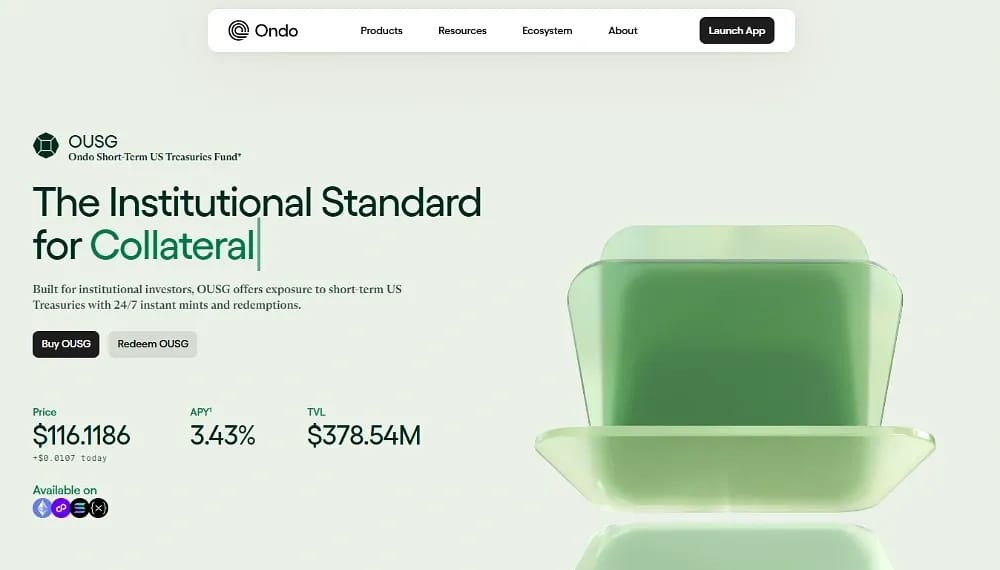
OUSG is the institutional cash-management product, handing qualified investors tokenized exposure to short-dated government debt, with minting and redemption available continuously instead of only during the conventional banking hours of a business day.
Here is what defines the OUSG product heading through 2026:
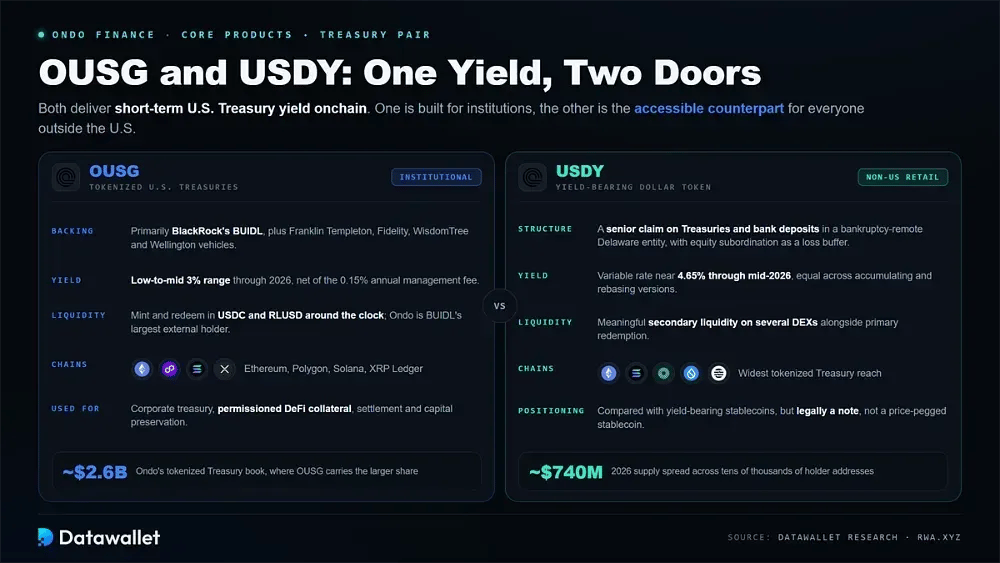
- Backing: OUSG allocates primarily into BlackRock's BUIDL fund, alongside Franklin Templeton, Fidelity, WisdomTree and Wellington vehicles, plus stablecoins and bank deposits held on hand to service redemptions.
- Yield: Returns float with short-term Treasury rates, landing in the low-to-mid 3% range through 2026, and they are calculated net of the fund's 0.15% annual management fee.
- Liquidity: Subscriptions and redemptions clear in USDC and Ripple's RLUSD around the clock, while Ondo remains the single largest external holder of BlackRock's own BUIDL fund.
- Reach: The token is live across Ethereum, Polygon, Solana and the XRP Ledger, and it carries the larger share of Ondo's roughly $2.6 billion tokenized Treasury book.
- Use cases: Institutions hold OUSG for corporate treasury management, permissioned DeFi collateral, bilateral settlement and cash strategies that prioritize capital preservation ahead of higher headline returns.
2. USDY: A Yield-Bearing Dollar Token
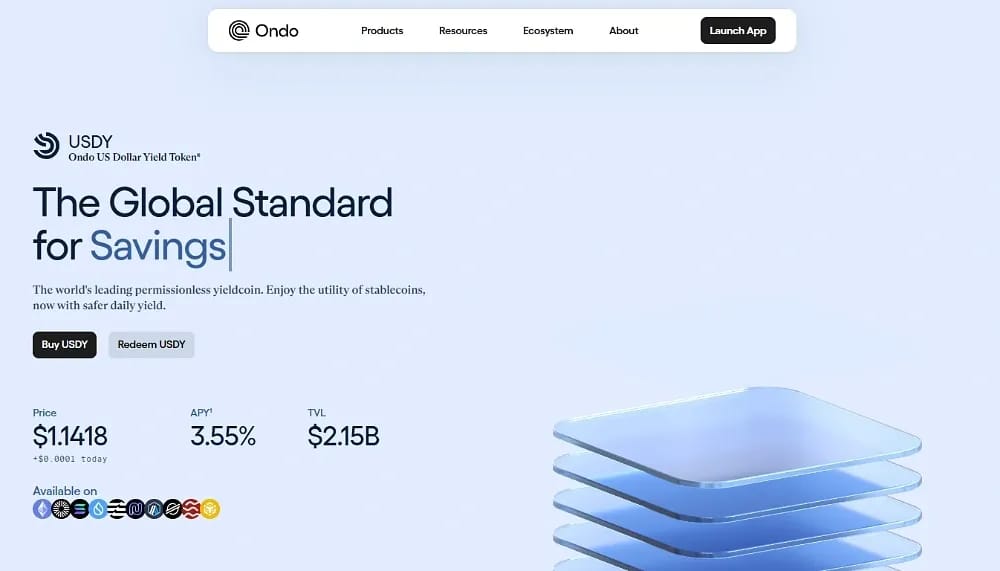
USDY is the accessible counterpart to OUSG, a tokenized note delivering dollar yield to non-U.S. investors who cannot meet the qualified-purchaser thresholds that gate access to institutional products like OUSG.
These are the details that matter for USDY:
- Structure: USDY is a senior claim on short-term Treasuries and bank deposits held by Ondo USDY LLC, a bankruptcy-remote Delaware entity with equity subordination as a loss buffer.
- Yield: The variable rate tracks short-term Treasury yields, sitting near 4.65% through mid-2026, and it applies equally across both the accumulating and the rebasing versions.
- Distribution: USDY is the most widely spread tokenized Treasury product by network, with supply live on Ethereum, Solana, Mantle, Sui and Aptos for cross-chain dollar yield.
- Scale: Supply ran near $740 million during 2026 spread across tens of thousands of separate holder addresses, alongside meaningful secondary liquidity on several decentralized exchanges.
- Positioning: The token frequently appears in comparisons of yield-bearing stablecoin alternatives, although USDY is legally structured as a note instead of a price-pegged stablecoin like USDC.
3. Ondo Global Markets: Tokenized Stocks and ETFs
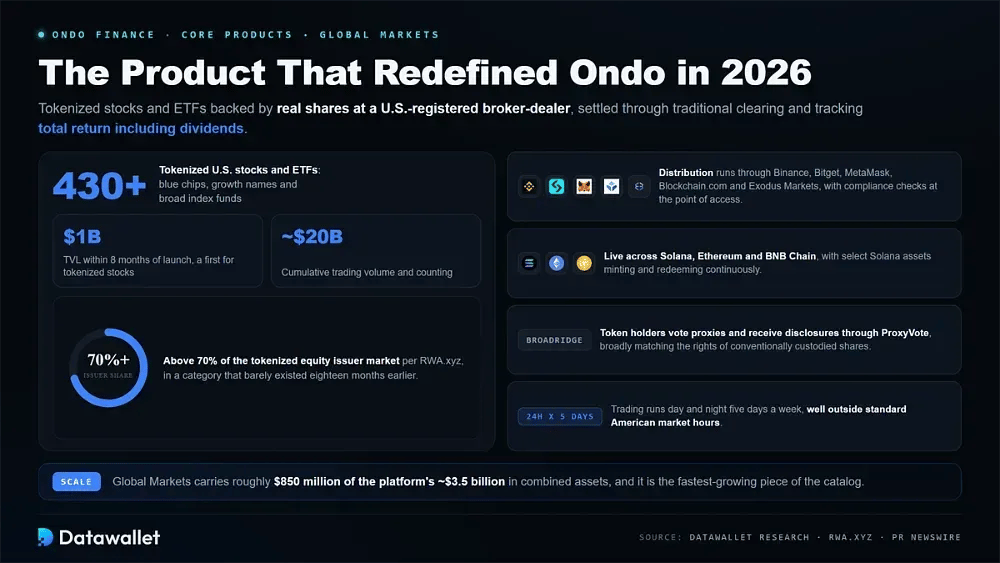
Ondo Global Markets is the product that redefined the company during 2026. It offers tokenized stocks and ETFs backed by real shares held with a U.S.-registered broker-dealer and settled through traditional clearing infrastructure.
Here is how Ondo Global Markets breaks down today:
- Catalog: The platform lists more than 430 tokenized U.S. stocks and ETFs, spanning blue chips, growth names and broad index funds, each tracking total return including dividends.
- Scale: Global Markets crossed $1 billion in TVL within eight months of launch, a first for tokenized stocks, with cumulative trading volume approaching $20 billion.
- Market share: Ondo holds above 70% of the tokenized equity issuer market according to RWA.xyz, in a product category that barely existed at all eighteen months earlier.
- Distribution: Tokens reach users through Binance, Bitget, MetaMask, Blockchain.com and Exodus Markets across Solana, Ethereum and BNB Chain, with compliance checks applied at the point of access.
- Shareholder rights: A Broadridge integration lets token holders vote proxies and receive regulatory disclosures through ProxyVote, which broadly matches the rights attached to shares held in conventional custody.
- Availability: Trading runs 24 hours across five days, with select Solana assets supporting continuous minting and redemption even well outside the standard American market hours.
4. Ondo Perps and Supporting Infrastructure
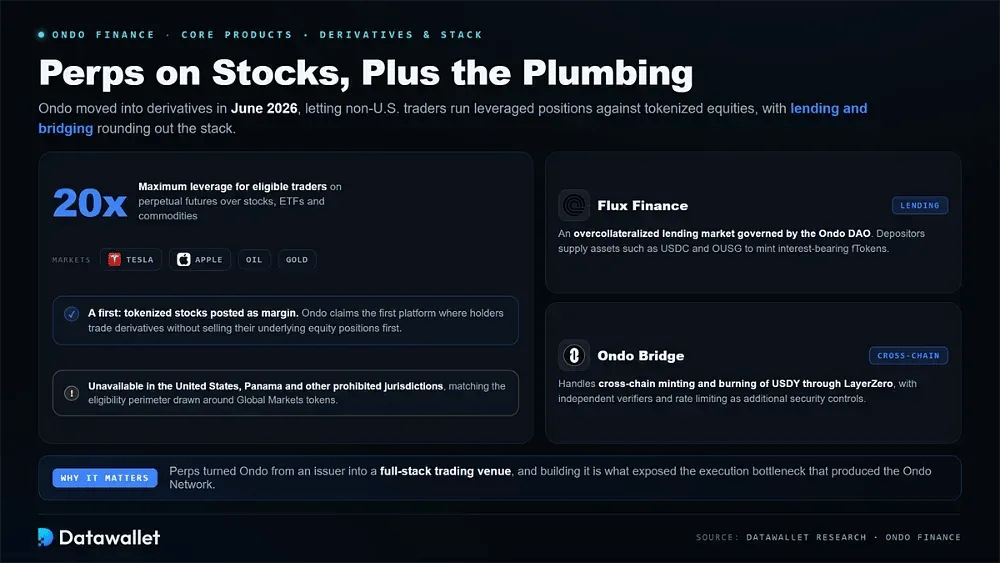
Ondo moved into derivatives during June 2026 with Ondo Perps, which lets non-U.S. traders take leveraged positions against tokenized equities. Lending and bridging products round out the supporting stack around it.
The wider product stack includes the following components:
- Ondo Perps: Offers perpetual futures on stocks, ETFs and commodities including Tesla, Apple, oil and gold, with leverage reaching as high as 20x for eligible traders.
- Tokenized collateral: Ondo claims the first platform allowing tokenized stocks to be posted as margin, which lets holders trade derivatives without first selling their underlying equity positions.
- Restrictions: Perpetuals stay unavailable to residents of the United States, Panama and other prohibited jurisdictions, which matches the eligibility perimeter drawn around Global Markets tokens.
- Flux Finance: An overcollateralized lending market governed by the Ondo DAO, where depositors supply assets such as USDC and OUSG in order to mint interest-bearing fTokens.
- Ondo Bridge: Handles the cross-chain minting and burning of USDY through LayerZero, with a set of independent verifiers and rate limiting applied as additional security controls.
Ondo Network Explained
The most consequential technical decision of 2026 was walking away from a plan the company had promoted for eighteen months. Ondo Chain is now gone, replaced by something structurally different that already runs a live trading product.
Why Ondo shelved its Layer 1
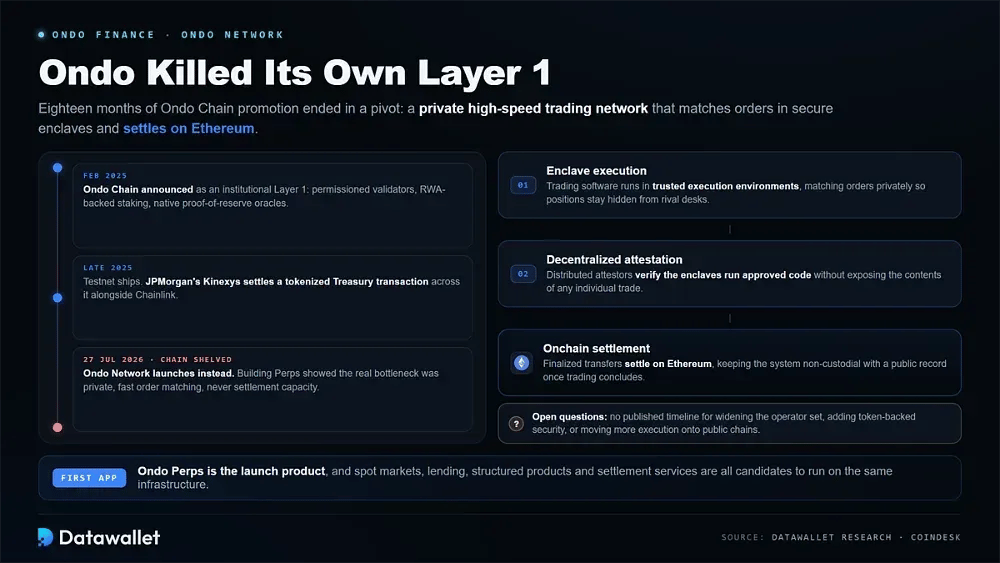
Ondo announced Ondo Chain in February 2025 as an institutional Layer 1, with a permissioned validator set, RWA-backed staking and native proof-of-reserve oracles built into the protocol. A testnet followed later that year, and JPMorgan's Kinexys settled a tokenized Treasury transaction across it alongside Chainlink.
Building Ondo Perps changed the diagnosis. Conversations with prospective institutional users showed that settlement capacity was never the constraint, since the real bottleneck sat in how quickly and how privately orders could be matched, well before anything ever reached a public ledger for final settlement.
So the company pivoted. On 27 July 2026 it launched the Ondo Network, which chief executive Ian De Bode framed as the direct continuation of Ondo Chain instead of a replacement product, while confirming that the two systems would never operate in parallel with each other.
How the Ondo Network works
The architecture splits jobs that a conventional blockchain bundles together. Execution, verification and settlement each run in a different place, which is what allows exchange-grade speed without handing custody to an operator.
Here is how the Ondo Network is structured:
- Enclave execution: Trading software runs inside trusted execution environments, matching orders privately and quickly so that positions and order flow stay hidden from rival trading desks.
- Decentralized attestation: A distributed set of attestors verifies that those enclaves run approved code, giving users cryptographic assurance without exposing the contents of any individual trade.
- Onchain settlement: Finalized asset transfers settle on Ethereum for now, which keeps the whole system non-custodial and leaves a public record of transfers once trading concludes.
- First application: Ondo Perps is the launch product on the network, with tokenized equities usable as collateral against perpetual futures that track stocks, ETFs and commodities.
- Planned scope: Ondo has signaled that spot markets, lending, structured products and settlement services could all run on the same infrastructure as the network gradually matures.
- Open questions: The company has published no timeline for widening its operator set, adding token-backed security, or moving more of the execution process onto public chains.
Ondo's US Expansion and Regulatory Position
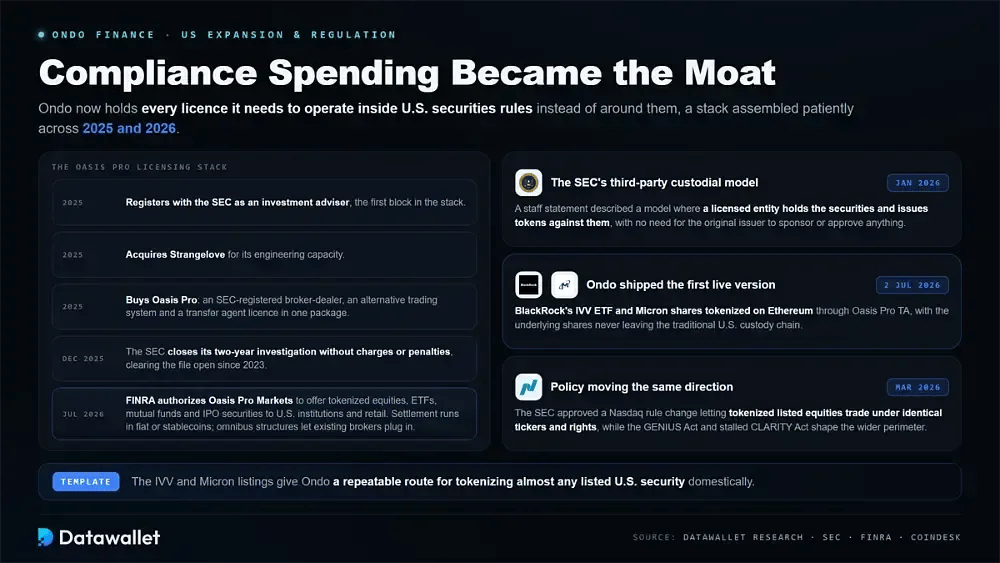
Tokenized securities live or die on regulation, and 2026 turned Ondo's compliance-first spending into a competitive moat. The company now holds all the licences it needs to operate inside U.S. securities rules instead of around them.
The Oasis Pro licensing stack
Groundwork for that was laid patiently across 2025. Ondo registered with the SEC as an investment adviser, then acquired Strangelove for its engineering capacity, then bought Oasis Pro, which carried an SEC-registered broker-dealer, an alternative trading system and a transfer agent licence in one package.
That package matured in July 2026, when Oasis Pro Markets received FINRA authorizations to offer tokenized equities, ETFs, mutual funds and IPO securities to American institutions and retail investors. Settlement can run in fiat or supported stablecoins, and omnibus structures let existing brokers plug in.
An older overhang had already cleared before any of it. The SEC closed its two-year investigation into the company during December 2025 without charges or financial penalties, which removed the enforcement risk that had shadowed the business since the previous administration first opened the file in 2023.
Tokenized securities under the new SEC framework
In a January 2026 staff statement, the SEC described a third-party custodial model in which a licensed entity holds the underlying securities and then issues tokens representing an entitlement to them, without requiring the original issuer of those securities to sponsor or approve anything at all.
Ondo shipped the first live version of it. On 2 July 2026 the company tokenized BlackRock's IVV ETF and Micron shares on Ethereum through Oasis Pro TA, its registered transfer agent, with the underlying shares never leaving the traditional U.S. custody chain at any point.
Policy has moved the same direction. The SEC approved a Nasdaq rule change in March 2026 letting tokenized versions of listed equities trade under identical tickers and rights, while the GENIUS Act and the currently stalled CLARITY Act continue shaping the wider regulatory perimeter around the sector.
ONDO Tokenomics
The ONDO token launched in January 2024 on Ethereum with a fixed maximum supply of 10 billion units. It governs the Ondo DAO and Flux Finance, with voting power proportional to holdings and delegable to other addresses.
Allocation and Unlocks
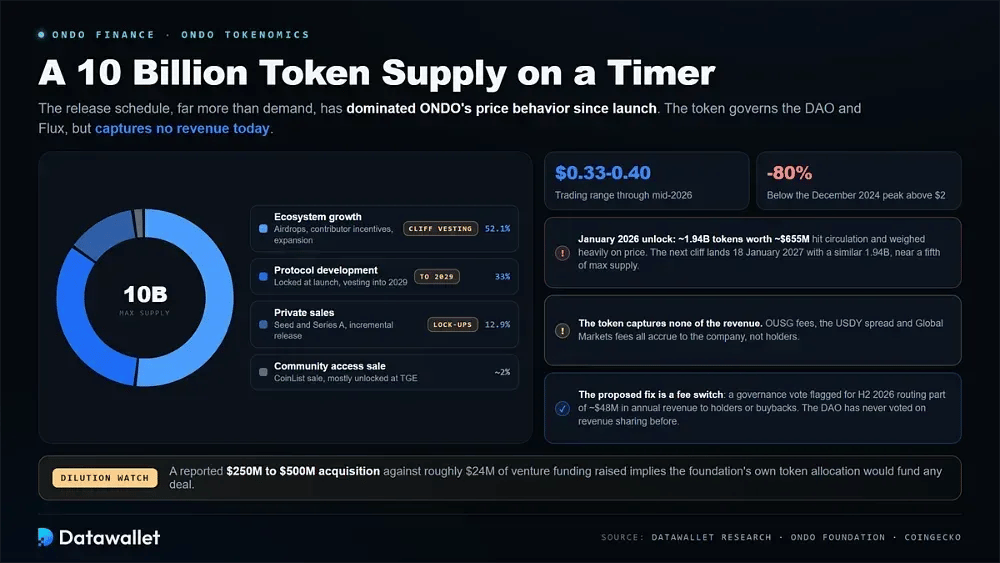
ONDO's supply tilts heavily toward ecosystem and development buckets that vest across several years. That release schedule, far more than demand, has dominated the token's price behavior ever since its launch.
The maximum supply is allocated across the following buckets:
- Ecosystem growth: Roughly 52.1% funds airdrops, contributor incentives and expansion programs, much of it on cliff vesting that releases through large scheduled unlock events each year.
- Protocol development: Around 33% supports infrastructure and product building, locked entirely at launch and then unlocked gradually across a multi-year vesting schedule that runs into 2029.
- Private sales: Approximately 12.9% went to seed and Series A investors, with all of it subject to lock-ups followed by incremental release over the subsequent years.
- Community access sale: About 2% reached early supporters through a CoinList sale, and the vast majority of that allocation unlocked immediately at the token generation event itself.
- Recent unlock: A January 2026 event released roughly 1.94 billion tokens worth about $655 million, which expanded circulating supply sharply and weighed heavily on the token price afterwards.
- Next cliff: The following annual unlock arrives on 18 January 2027, releasing a similar 1.94 billion tokens, close to a fifth of the entire maximum supply.
Utility and the Value-Capture Debate
The central tension in ONDO's design is that the token captures none of the revenue the business generates. Management fees on OUSG, the spread retained on USDY and the transaction fees collected from Global Markets all accrue to the company rather than to any token holders.
That gap goes a long way toward explaining the disconnect between the business and its token. ONDO traded near $0.33 to $0.40 through mid-2026, roughly 80% below its December 2024 peak above $2, even as platform assets under management and protocol revenue both climbed steadily throughout that same period.
The proposed fix is a fee switch, a governance vote flagged for the second half of 2026 that would route part of an estimated $48 million in annual revenue toward holders or programmatic buybacks. The DAO has never actually voted on revenue sharing before now.
Dilution complicates the investment case even further. Ondo is reportedly weighing an acquisition worth somewhere between $250 million to $500 million against roughly $24 million of venture funding raised since 2021, which strongly implies that the foundation's own token allocation would have to fund any eventual deal.
Institutional Backing and Partnerships
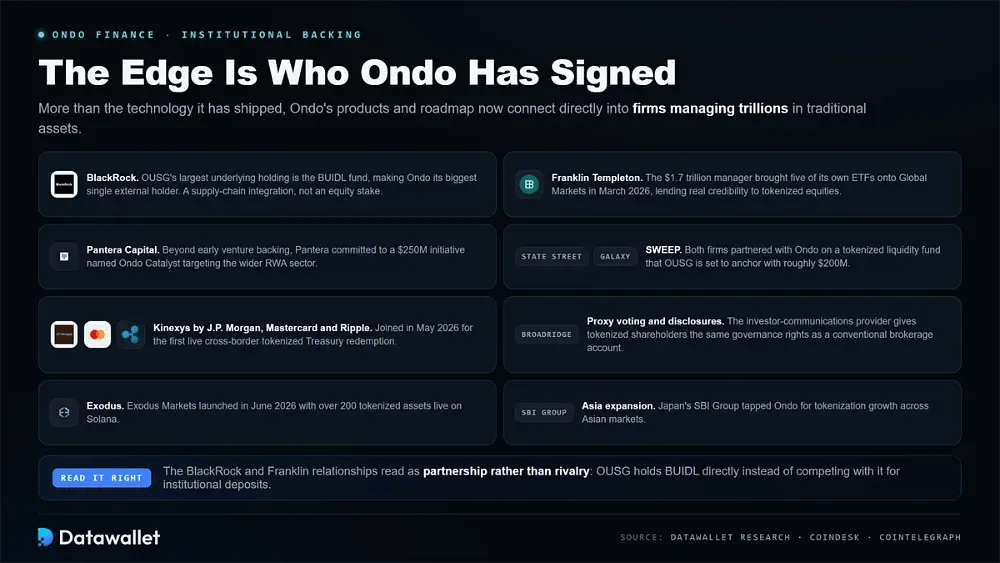
Ondo's real edge is the institutions it has signed rather than the technology it has shipped. Its products and roadmap now connect directly into firms managing trillions in traditional assets.
These are the partnerships that anchor the platform today:
- BlackRock: OUSG's largest underlying holding is the BUIDL fund, making Ondo its biggest single external holder, a supply-chain integration rather than any direct equity investment.
- Franklin Templeton: The $1.7 trillion manager brought five of its own ETFs onto Global Markets in March 2026, lending significant credibility to the tokenized equity product.
- Pantera Capital: Beyond its early venture backing, Pantera committed to a $250 million initiative named Ondo Catalyst, targeting new investments right across the wider real-world asset sector.
- State Street and Galaxy: Both firms partnered with Ondo on a tokenized liquidity fund called SWEEP, which OUSG is set to anchor with a commitment of roughly $200 million.
- Cross-border settlement: Ondo joined Kinexys by J.P. Morgan, Mastercard and Ripple during May 2026 to complete what they described as the first live cross-border tokenized Treasury redemption.
- Broadridge: The investor-communications provider supplies proxy voting and disclosure delivery, which gives tokenized shareholders the same governance rights they would hold through a conventional brokerage account.
- Exodus and SBI: Exodus Markets launched in June 2026 with over 200 tokenized assets on Solana, while Japan's SBI Group tapped Ondo for tokenization expansion across Asia.
How Ondo Compares to Other RWA Platforms
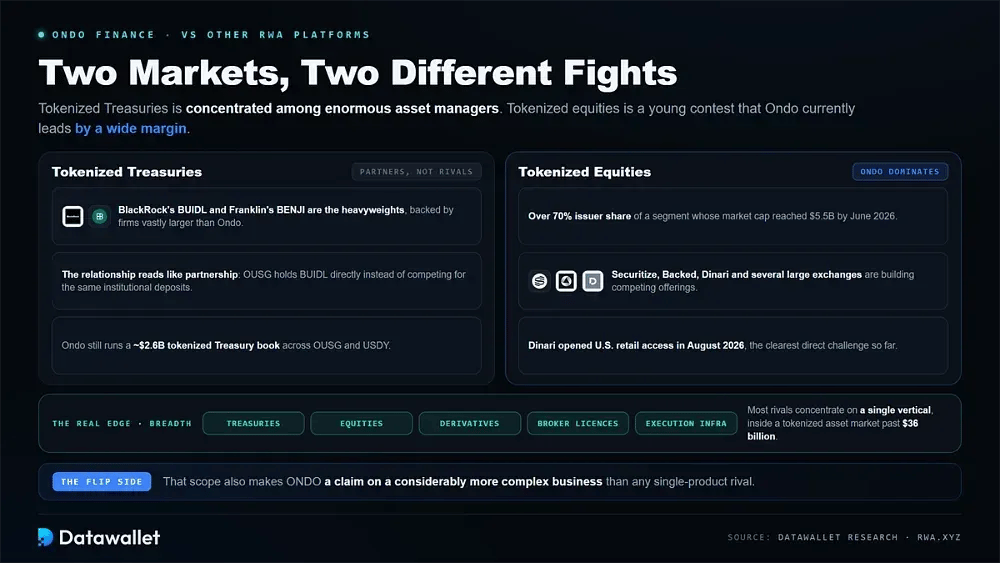
Ondo competes across two separate markets simultaneously, and it faces an entirely different set of opponents in each of them. Tokenized Treasuries is concentrated among a handful of enormous asset managers, while tokenized equities remains a young and fast-moving contest that Ondo currently leads by a wide margin.
On the Treasury side, BlackRock's BUIDL and Franklin Templeton's BENJI are the heavyweights, backed by firms vastly larger than Ondo. The relationship there reads more like partnership than rivalry, since OUSG holds BUIDL directly instead of competing against the fund for the same institutional deposits.
In tokenized equities Ondo dominates, with over 70% issuer share of a segment whose total market capitalization reached $5.5 billion by June 2026. Securitize, Backed, Dinari and several large exchanges are all building competing offerings, and Dinari opened its own U.S. retail access during August 2026.
Breadth is the real differentiator. Where most rivals concentrate on a single vertical, Ondo spans Treasuries, equities, derivatives, brokerage licences and execution infrastructure, inside a tokenized asset market that has grown past $36 billion. That scope also makes ONDO a claim on a considerably more complex business.
Is Ondo Finance Safe?
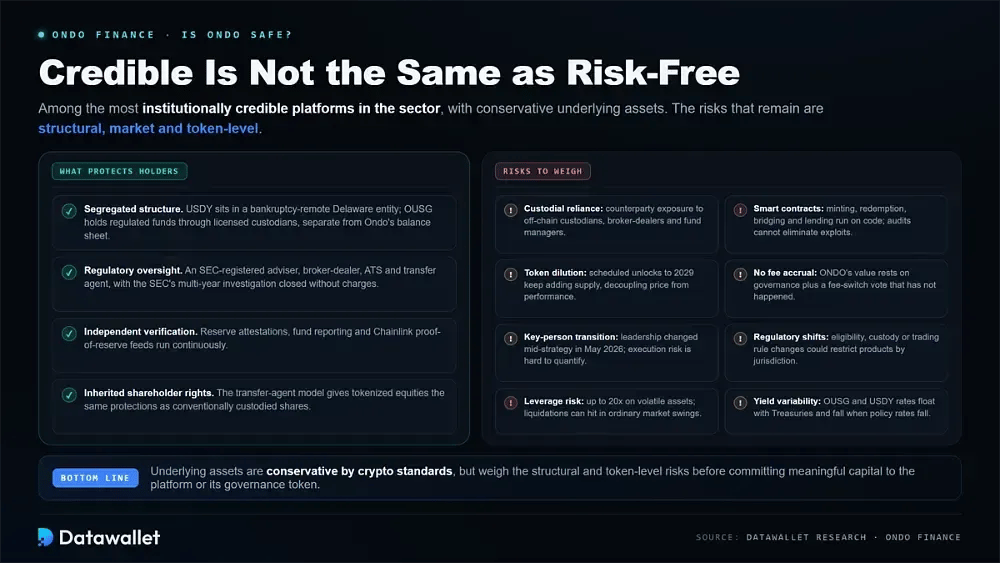
Ondo ranks among the most institutionally credible platforms in the sector, with segregated client assets, third-party attestations and a complete U.S. licensing stack. Credibility, however, is not the same thing as an outright absence of risk.
What protects holders
Structure does most of the protective work here. USDY sits inside a bankruptcy-remote Delaware entity with equity subordination beneath it, while OUSG holds regulated money market funds through licensed custodians, which keeps client assets entirely separate from Ondo's own corporate balance sheet at all times.
Regulatory oversight adds a second layer on top. The company now operates through an SEC-registered investment adviser, a broker-dealer, an alternative trading system and a transfer agent, and the SEC closed its multi-year investigation in December 2025 without ever bringing any charges or financial penalties against it.
Independent verification runs continuously alongside all of that. Reserve attestations, ongoing fund reporting and Chainlink proof-of-reserve feeds all let holders confirm the backing for themselves, and the transfer-agent model means that tokenized equities inherit exactly the same shareholder protections that conventionally custodied shares already carry.
Risks of Using Ondo
The underlying assets are conservative by crypto standards, though structural, market and token-level risks all deserve close attention before anyone commits meaningful capital to either the platform or its governance token.
The main risks worth weighing include the following:
- Custodial reliance: Every token depends on off-chain custodians, broker-dealers and fund managers, so holders inherit counterparty exposure that extends well beyond just the smart contracts themselves.
- Smart contracts: Minting, redemption, bridging and lending all run on code, and audits alone cannot fully eliminate the risk of bugs, oracle failures or outright exploits.
- Token dilution: Scheduled unlocks running to 2029 keep adding supply, and January 2026 showed how sharply that pressure can decouple the token price from actual platform performance.
- No fee accrual: ONDO captures no protocol revenue today, so its value rests entirely on governance rights plus a fee-switch vote that has not actually happened yet.
- Key-person transition: The founder's death in May 2026 handed leadership to a successor mid-strategy, and the execution risk around that handover is genuinely difficult to quantify from outside.
- Regulatory shifts: Tokenized securities rules keep evolving quickly, and any change to eligibility, custody or trading frameworks could restrict access to individual products in particular jurisdictions.
- Leverage risk: Ondo Perps offers up to 20x leverage on volatile equities and commodities, where leveraged positions can be liquidated rapidly during otherwise ordinary market swings.
- Yield variability: OUSG and USDY rates float with Treasury yields, so displayed returns are never fixed and they will decline whenever central bank policy rates start falling.
The Future of Ondo Finance
The roadmap now points toward infrastructure and distribution instead of new asset wrappers. The Ondo Network is the piece to watch, since spot markets, lending and structured products are all candidates to run on the same execution layer that already powers its perpetual futures product today.
American expansion is the second thread worth tracking. FINRA clearance lets Oasis Pro Markets serve U.S. institutions and retail investors directly, while the third-party custodial model proven with IVV and Micron gives the company a repeatable template for tokenizing almost any listed U.S. security domestically.
Consolidation may accelerate all of it. Reports of a wealthtech acquisition worth up to $500 million suggest Ondo intends to buy distribution instead of building it slowly, though the company has publicly stated that it holds no active conversations with any counterparty at the moment.
Value capture remains the unresolved question. If Global Markets scales into the tens of billions and the fee switch finally routes revenue toward holders, the gap between the business and its token could close meaningfully. If unlocks keep outpacing demand instead, that gap simply widens.
Final Thoughts
Ondo Finance is the clearest working example of regulated tokenization operating at genuine scale. It combines conservative fully-backed products with a licensing stack and a partnership roster that almost no other crypto-native competitor can currently match, and the underlying numbers continue to support that positioning today.
The harder question sits with the token instead of the platform. Strong product growth has not translated into ONDO performance, because the token governs a protocol whose revenue flows somewhere else entirely, and the long-promised fee-switch vote remains the single pivot most worth tracking closely.
For anyone following the real-world asset narrative closely, Ondo now looks like the clear category leader by most of the available measures. Whether that leadership eventually converts into token value depends on governance decisions, the pace of unlocks, and how markets learn to price tokenized-finance infrastructure.