


Login to Track Your Live Crypto Portfolio
Sign Up and Track Your Live Crypto Portfolio for Free
Forgot your password?
Solana Begins Testing Massive Alpenglow Consensus Overhaul

This article has been reviewed and verified for accuracy by our editorial team. All claims, data points and platform details are cross-referenced against primary sources.
Some links on this page are affiliate links. Datawallet may earn a commission when you sign up through them, at no extra cost to you. This never influences our editorial ratings, rankings or recommendations.
Some links on this page are affiliate links. Datawallet may earn a commission when you sign up through them, at no extra cost to you. Ratings and rankings reflect our own testing and assessment criteria.

GM. Solana developers launched the Alpenglow consensus upgrade on a community test cluster today, targeting near real-time settlement speeds by replacing the existing TowerBFT system with a more efficient framework.
Meanwhile, the American Bankers Association lobbied for stricter stablecoin reward limits, Australia proposed ending the 50% capital gains tax discount, and the SEC delayed 24 prediction market ETFs for a second time.
Here are the details on consensus overhauls, regulatory lobbying, and tax reform. 👇
Solana Begins Testing Massive Alpenglow Consensus Overhaul
Solana developer Anza launched the Alpenglow consensus upgrade on a community test cluster this week to begin final evaluations before a mainnet rollout. This architecture seeks to replace the existing TowerBFT system with a redesigned framework that targets near real-time speeds for global transaction settlement.
Economic experts noted that the switch could reduce time to finality by 100 times to make decentralized apps feel snappier for users. Validators approved the proposal with a 98% majority to ensure the network can support traditional financial rails while maintaining superior performance during periods of heavy demand.
Co-founder Anatoly Yakovenko indicated the full release could arrive as early as next quarter if community testing with external operators remains successful. Developers are currently monitoring the transition between protocols on the test cluster to verify security and prevent the outages that previously impacted network stability.
Markets reacted with optimism as the SOL token stabilized near $97 despite remaining below historical highs from last year. This milestone represents a shift from early innovation toward a mature phase where consistency and timing precision define Solana’s utility for large scale financial systems and institutional users globally.
Bankers Lobby Presses For Strict Stablecoin Reward Limits
American Bankers Association chief Rob Nichols urged bank executives to press senators for stricter limits on stablecoin rewards before the Senate Banking Committee votes. He warned the current compromise still leaves room for deposit flight. The message cast the debate as an urgent fight over financial stability.
Bank groups argue crypto platforms could mimic interest-bearing accounts through loosely defined activity rewards, even if direct stablecoins yield remains prohibited under the bill. Crypto firms say tougher language would choke innovation and consumer choice. The White House answered that bankers skipped earlier meetings meant to resolve the dispute.
Australia Proposes Ending 50% Capital Gains Discount
Australia is reportedly preparing to replace its 50% capital gains tax discount with an inflation-indexed model that would hit long-term crypto investors harder. The shift would arrive through the fiscal 2027 budget. Assets bought after May 10 would face a transition period before the new approach applies.
Critics say the change could steer capital away from productive investment and toward tax-favored housing, especially for higher earners with modest real gains. Supporters argue investors would still pursue strong returns despite higher tax bills. The debate now centers on whether reform broadens fairness or weakens market incentives.
SEC Delays Launch Of 24 Prediction ETFs Again
The Securities and Exchange Commission again delayed more than 20 prediction market ETFs from Bitwise, Roundhill, and GraniteShares, extending scrutiny of election and macro event funds. Bloomberg analyst Eric Balchunas said the setback looked procedural. Regulators appear focused on disclosures rather than issuing a final rejection.
The products would package wagers on presidential races, Senate control, House control, and economic outcomes into listed instruments for brokerage accounts. Supporters see a precedent-setting bridge between event contracts and mainstream finance. The SEC’s slower review reflects caution around how these prediction market vehicles should be framed for investors.
Data of the Day
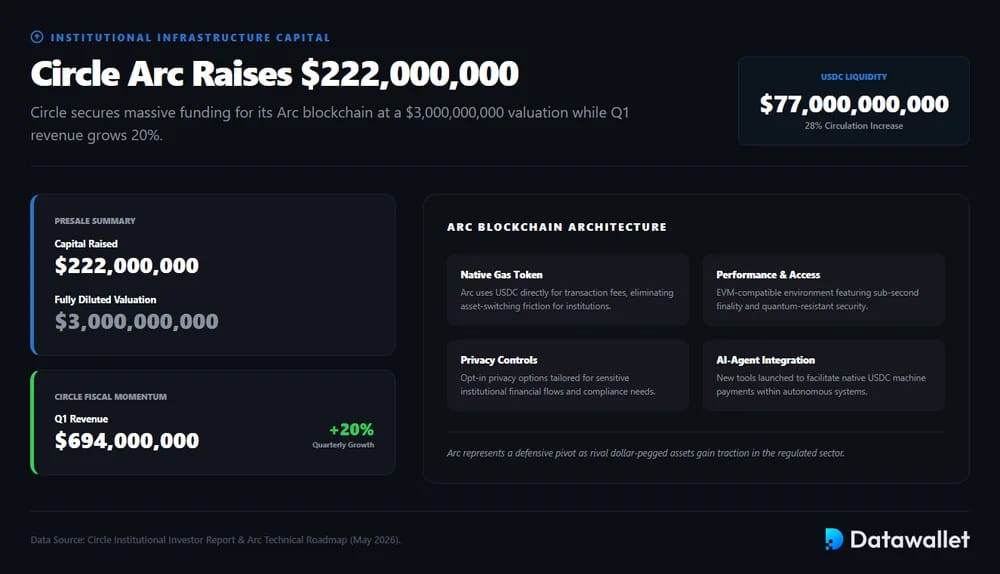
Circle raised $222 million in a presale for its Arc institutional blockchain at a $3 billion fully diluted valuation, while first-quarter revenue climbed 20% to $694 million. The round drew a heavyweight syndicate. USDC circulation rose 28% to $77 billion as transaction volume accelerated sharply.
Arc is designed as an EVM-compatible public chain for institutions, using USDC as native gas and promising sub-second finality, opt-in privacy, and quantum-resistant wallet options. The bet is partly defensive as rivals prepare competing dollar tokens. Circle also launched AI-agent tools to deepen USDC’s role in machine payments.
More Breaking News
- Ronin will hard fork into an OP Stack Ethereum Layer 2 after about 10 hours of downtime, cutting RON inflation below 1% four years after the $625 million hack.
- MoonPay acquired Dawn Labs and launched Dawn CLI, letting traders turn plain-English prompts into automated strategies for Polymarket as the company deepens its AI trading push.
- Strategy bought 535 bitcoin for $43 million after a one-week pause, lifting holdings to 818,869 BTC, or more than 3.9% of the fixed supply.
- BitMine slowed its Ethereum buying pace to 26,659 ETH worth about $62 million, though the treasury firm still controls more than 4.3% of circulating supply.
- CryptoCom secured the only UAE central bank SVF license held by a virtual asset platform, unlocking crypto payments for Dubai government services and future merchant integrations.
- Bank of England Governor Andrew Bailey warned a crisis could push US dollar stablecoins into Britain, setting up a regulatory clash over redemption standards and financial stability.
For the latest updates on digital asset markets, follow us on X @Datawalletcom.
For the latest updates on digital asset markets, follow us on X @Datawalletcom.
Get tomorrow’s issue in your inbox