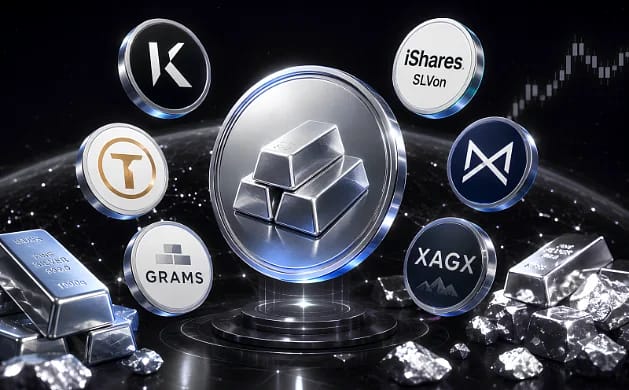




Compare Top Tokenized Silver Assets
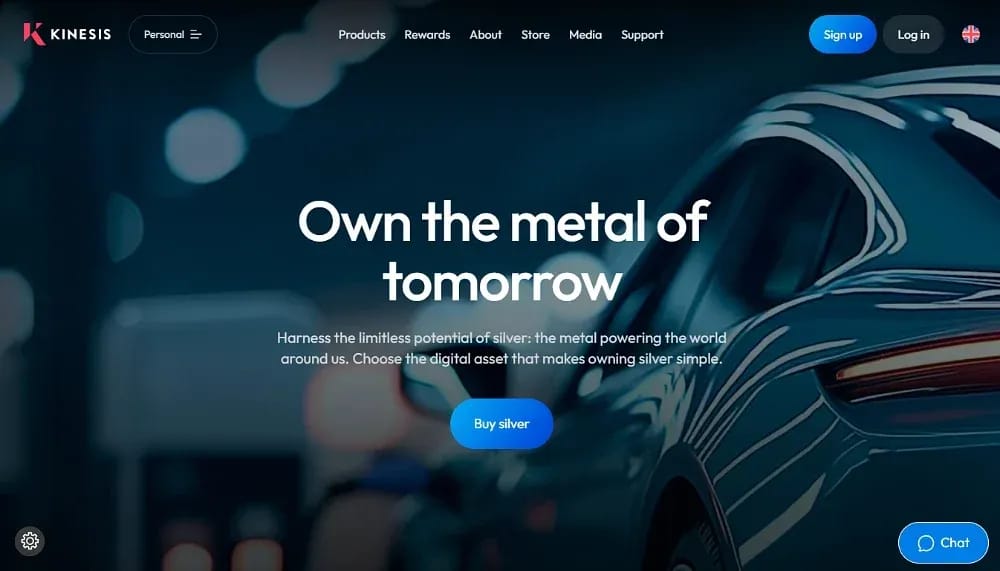
1. Kinesis Silver (KAG)
Kinesis Silver is the largest tokenized silver asset by market capitalization. It is also the only one that pays holders an income. One token represents one troy ounce of allocated 999-fineness bullion held in insured vaults across six continents.
Its yield is the main reason we rank it first. Each month, holders receive silver funded by a 15% share of Kinesis transaction fee revenue, rather than rewards in a separate token.
The main drawback is the redemption threshold. Physical delivery is available only in multiples of 200 ounces through Kinesis vaulting hubs, which puts bars beyond the reach of most retail buyers. Trading is also concentrated on the Kinesis exchange.
Pros
- Holders earn a monthly yield funded by platform transaction fees, paid directly in silver.
- Vaulting and insurance carry no storage charge, unlike traditional bullion custody arrangements.
- Reserves face independent audits twice yearly, with allocated bars held across six continents.
Cons
- Physical redemption starts at 200 ounces, well beyond what most retail holders would buy.
- Liquidity sits mainly on the Kinesis exchange rather than across major venues.
- The issuer controls minting and vaulting, which conflicts with strict decentralisation principles.
2. iShares Silver Trust (SLVon)
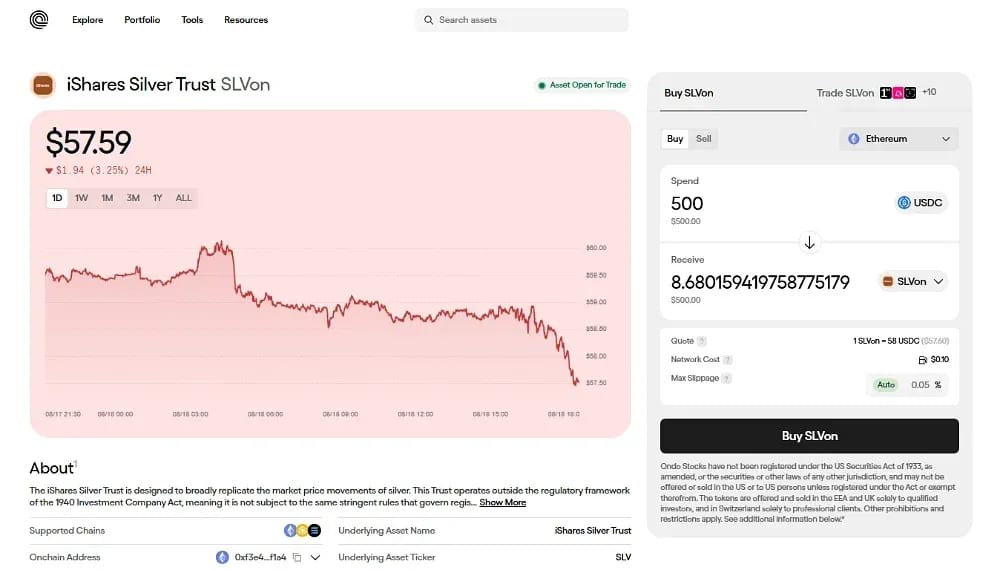
SLVon, issued onchain by Ondo Finance, represents a tokenized share of the iShares Silver Trust, the largest silver ETF. Each token tracks one SLV share instead of giving the holder a claim on physical metal that can be collected.
That structure determines where the product fits. Buyers receive regulated ETF exposure with weekend trading. Ondo also accepts SLVon as collateral for perpetual futures, allowing the same position to provide both price exposure and margin.
Momentum accelerated after the Binance Alpha listing. Transfer volume reached roughly $117 million in December 2025, up twelvefold month over month. United States residents cannot purchase SLVon, and holders have no right to redeem it for bullion.
Pros
- Delivers round-the-clock access to the largest silver ETF without waiting for market hours.
- Doubles as margin collateral on Ondo perpetual futures, freeing capital that would sit idle.
- Backed by BlackRock trust custody, giving institutional oversight that crypto-native tokens lack.
Cons
- Unavailable to United States residents because of securities restrictions on tokenized ETF shares.
- Confers no right to physical metal, leaving holders exposed to ETF and issuer structure.
- Circulating supply stays modest against physically backed silver tokens, thinning secondary market depth.
3. Matrixdock Silver (XAGm)
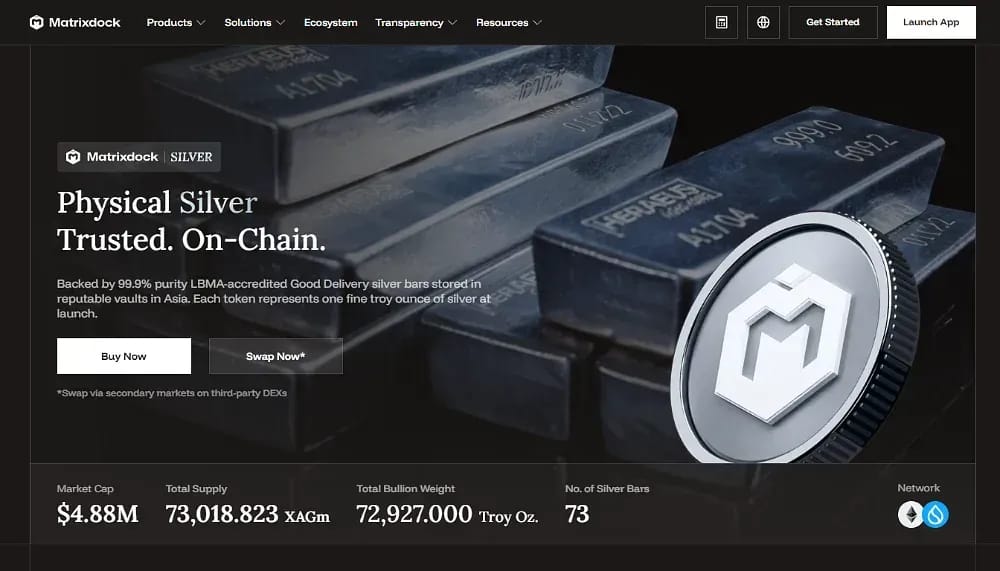
Matrixdock Silver applies institutional custody standards to onchain silver. Each token is fully allocated against London Bullion Market Association accredited bars, with independent verification covering every vaulted unit.
Its move onto Sui made XAGm the first institutional-grade silver asset issued natively on that network. The Sui Foundation committed treasury capital, and OSL in Hong Kong later listed Matrixdock's gold and silver tokens together.
We see it as a better fit for treasuries than retail buyers. Direct minting requires identity verification and a minimum of $10,000. Smaller investors therefore need to use secondary markets or choose a gram-denominated alternative.
Pros
- Fully allocated against LBMA accredited bars with independent verification of every vaulted unit.
- Works as collateral across lending and trading applications rather than sitting passively in a wallet.
- Regulated venue access improved after OSL listed the token in Hong Kong.
Cons
- Direct minting requires a $10,000 minimum and full identity checks, excluding most retail buyers.
- Promotional zero minting fees are temporary, so future cost structures remain uncertain.
- Secondary liquidity remains thinner than gold equivalents from the same issuer.
4. Silver (GRAMS)
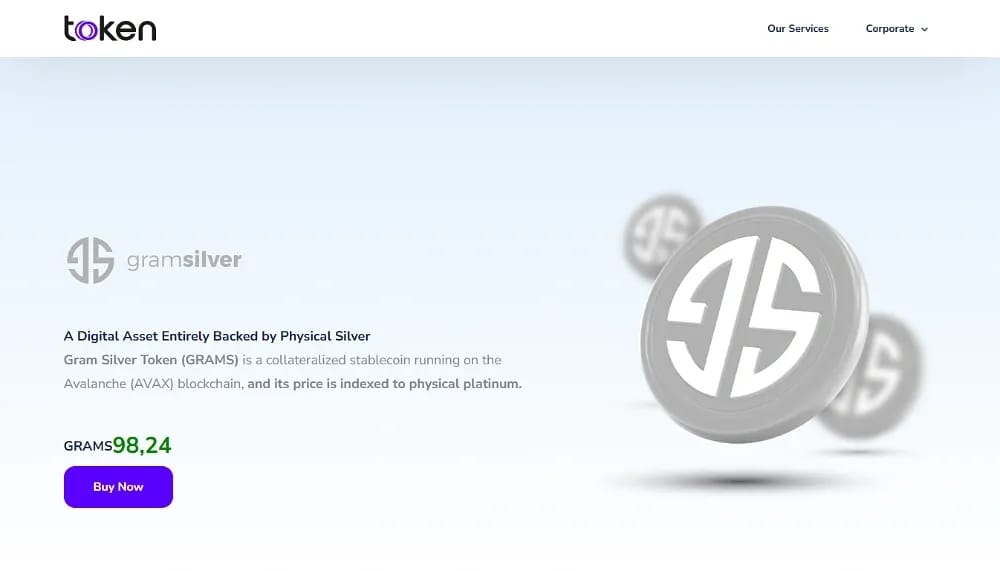
GRAMS is a Token Teknoloji product pegged to one gram of 999-fineness bullion. Because each unit represents only a gram, buyers can enter with a few dollars instead of committing to a full ounce.
Supply is kept in line with vaulted reserves through a mint-and-burn mechanism. Tokens are minted when metal enters the vault and destroyed when it leaves, so circulating supply reflects verified holdings rather than issuer promises.
GRAMS runs on both Avalanche and Polygon, giving holders two settlement networks to choose from. Liquidity remains concentrated on a small number of venues. Reserve transparency also depends on periodic issuer audits rather than continuous onchain proof.
Pros
- Gram pricing lets buyers start with a few dollars instead of a full troy ounce.
- Runs on both Avalanche and Polygon, letting holders pick the cheaper settlement network.
- Smart contracts enforce a strict one-to-one peg through automated minting and burning.
Cons
- Modest circulating supply caps how much size institutional buyers can move at once.
- Trading depth sits on a small number of venues, widening spreads on larger orders.
- Reserve verification relies on periodic issuer audits rather than continuous public attestation.
5. Dominion Silver (SILV)
Dominion Silver brings allocated bullion to Solana. Each token represents one fine troy ounce held in an LBMA-standard vault in Fort Worth, Texas, and bars are segregated and identified by serial number rather than pooled.
Minting happens at spot plus a 1.5% fee, and the token trades across Orca, Raydium, and Sunrise. First-day volume passed $3 million and accounted for roughly 60% of tokenized commodity trading on Solana, giving it unusual depth for a young asset.
Two caveats matter before buying. Physical redemption is not yet live and the issuer targets three to six months after launch, while a SolidProof review confirms it holds freeze and permanent delegate powers over balances.
Pros
- Bars are allocated and segregated by serial number, so holdings are identifiable rather than pooled into a communal reserve.
- Deep integration across Orca, Raydium, and Sunrise gives it stronger day-one liquidity than most newly launched metal tokens.
- Solana settlement delivers sub-cent transaction costs and near-instant finality for holders moving positions frequently.
Cons
- Physical redemption has not opened yet, so the bullion claim remains untested in practice.
- The issuer retains freeze authority and permanent delegate powers, meaning balances can be frozen or clawed back.
- A market capitalisation near $6 million leaves it far smaller than the established silver tokens listed above.
What are Tokenized Silver Assets?
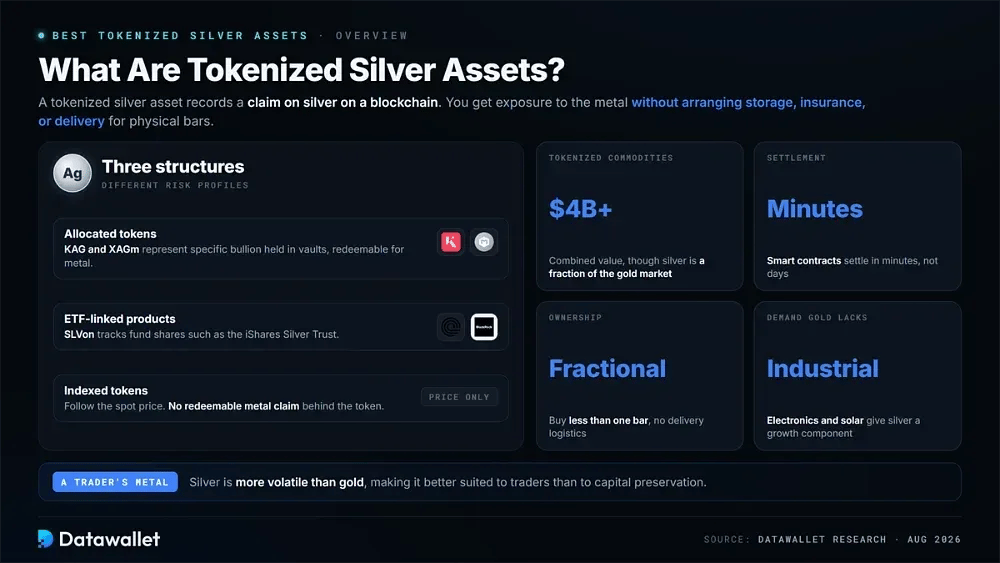
A tokenized silver asset records a claim on silver on a blockchain. By buying one, you gain exposure to the price of the metal without having to arrange insurance, storage, or delivery for physical bars.
The category is dominated by three structures with different risk profiles. Allocated tokens such as KAG and XAGm represent specific bullion held in vaults. ETF-linked products such as SLVon track fund shares, while indexed tokens follow the spot price without providing a redeemable metal claim.
Issuance and transfers are handled through smart contracts, which support fractional ownership and settlement in minutes rather than days. Tokenized commodities now exceed $4 billion in combined value, although silver still accounts for only a fraction of the gold market.
Silver does not behave like gold in every respect. Demand from electronics and solar manufacturing gives it an industrial growth component that gold lacks. It is also more volatile, making it better suited to traders than to capital preservation.
The Silver Shock and What It Taught Holders
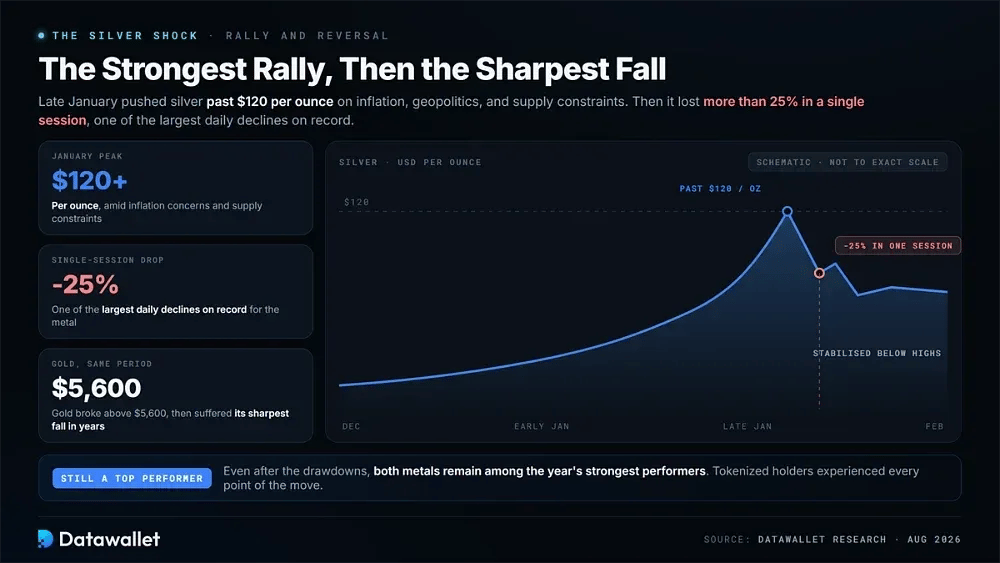
Silver produced both the strongest rally and the sharpest single-day decline in its recent trading history. Tokenized holders experienced the full extent of those moves, making the episode important context when sizing a position.
How the Rally and Reversal Unfolded
Late January brought a surge across both precious metals. Silver pushed past $120 per ounce amid inflation concerns, geopolitical risk, and supply constraints. Gold moved above $5,600 during the same period.
Then came the reversal. Silver lost more than 25% in a single session, marking one of the largest daily declines on record for the metal. Gold also suffered its sharpest fall in years before stabilising below its previous highs.
Even after those drawdowns, both metals remain among the year's strongest performers. For token holders, the lesson was straightforward: secure vaulting does not reduce the volatility inherited from silver itself.
Why Tokenized Silver Held Up Structurally
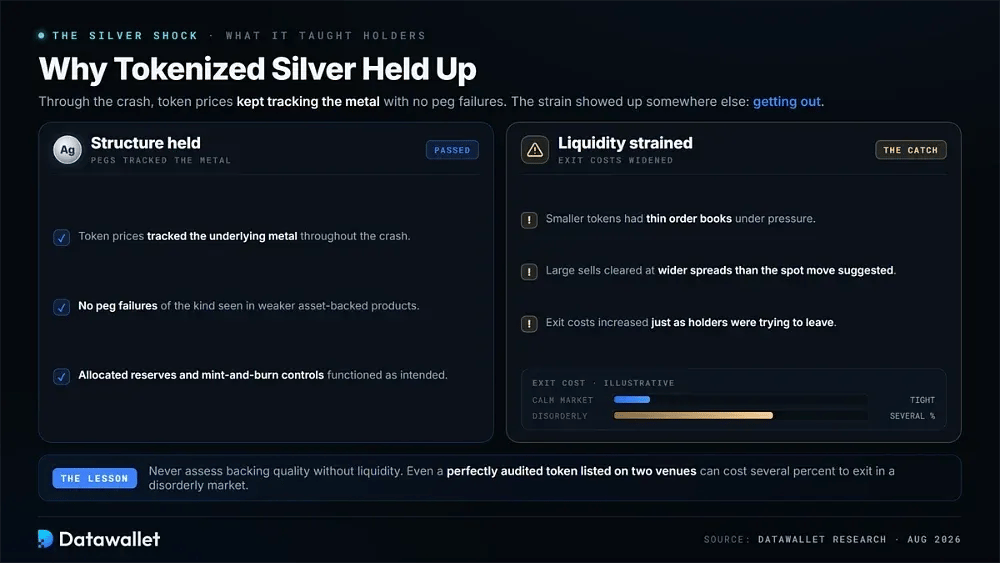
Through the crash, token prices continued tracking the underlying metal without the peg failures seen in weaker asset-backed products. Allocated reserves, together with mint-and-burn controls, functioned as intended.
Liquidity was more difficult. Smaller tokens had thinner order books, so large sell orders cleared at wider spreads than the underlying spot move suggested. Exit costs therefore increased just as holders were trying to leave.
Backing quality should not be assessed without liquidity. Even a perfectly audited token listed on only two venues can cost several percent to exit in a disorderly market.
How to Choose a Tokenized Silver Asset
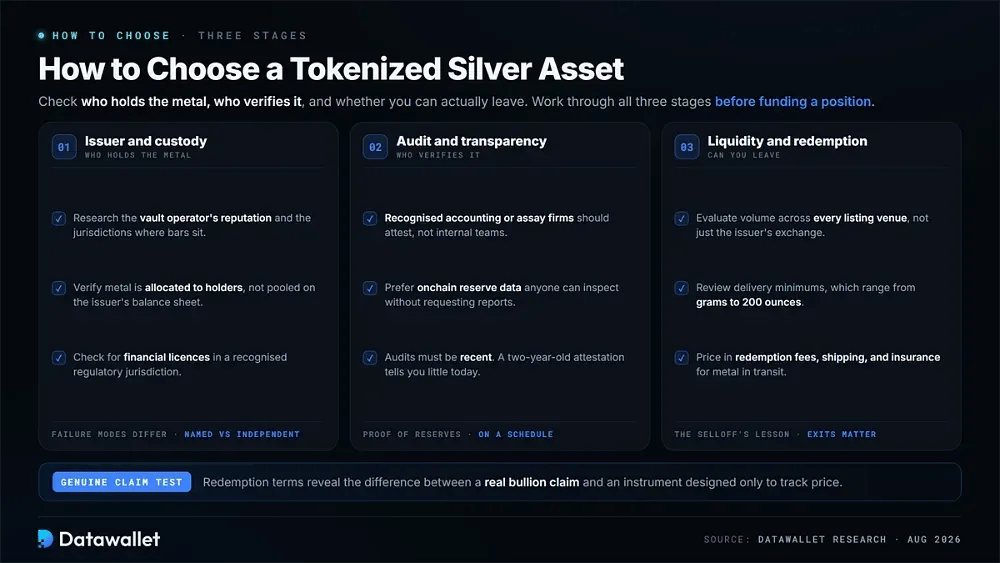
Choosing a silver token requires checking who holds the underlying metal and who verifies it. You also need to know whether physical delivery is possible. Work through the three stages below before funding a position.
Step 1: Evaluate the Issuer and Custody
Start by deciding whether you are comfortable with a named custodian or would rather use an asset whose reserves are kept independently of the issuer. Both structures can work, but their failure modes differ.
Examine the security protocols and vaulting locations:
- Research the vault operator's reputation and the jurisdictions where bars are stored.
- Verify whether metal is allocated to token holders or pooled across the issuer's balance sheet.
- Check whether the issuer holds financial licences in a recognised regulatory jurisdiction.
Step 2: Analyse Audit and Transparency
Independent proof of reserves provides regular confirmation that each token still corresponds to metal held in a vault. The assets covered here vary considerably in how often that verification takes place.
Look for frequent third-party verification of metal reserves:
- Confirm that recognised accounting or assay firms conduct the attestations rather than internal teams.
- Seek platforms publishing onchain reserve data that holders can inspect without requesting reports.
- Ensure published audits are recent, since a two-year-old attestation tells you little today.
Step 3: Assess Liquidity and Redemption
The selloff showed why exiting deserves as much attention as entering. Redemption terms also reveal the difference between a genuine bullion claim and an instrument designed only to track price.
Check trading volumes and the physical delivery process:
- Evaluate daily volume across every venue listing the token, not just the issuer's own exchange.
- Review minimum quantities for physical delivery, which range from grams to 200 ounces.
- Investigate redemption fees, shipping costs, and the insurance arrangements covering metal in transit.
Tokenized Silver Assets Regulation
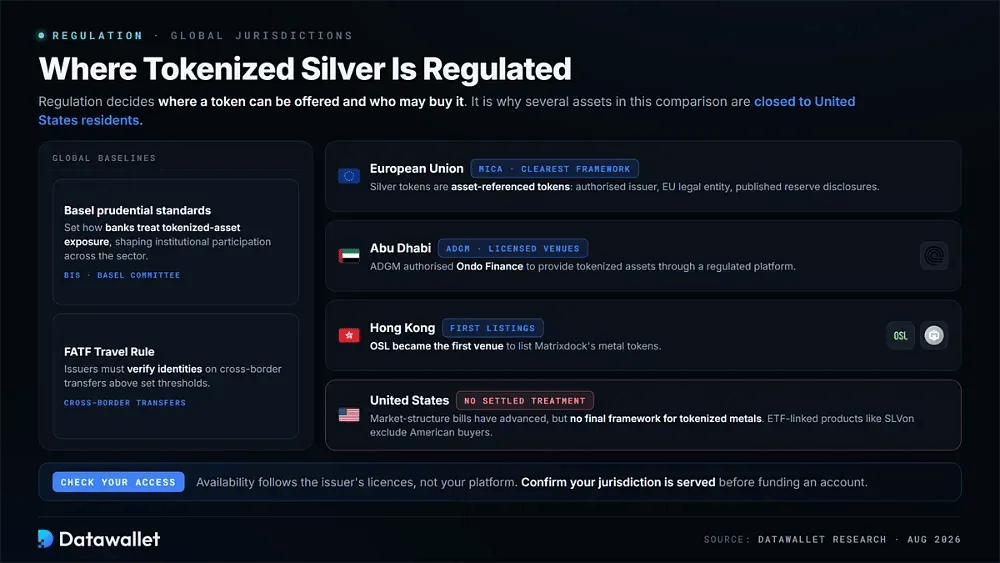
Regulation determines both where a token can be offered and who may legally buy it. Rules differ across jurisdictions, which is why several assets in this comparison are not available to United States residents.
The Basel Committee's prudential standards set out how banks treat exposure to tokenized assets, influencing institutional participation throughout the sector. Issuers also have to meet FATF Travel Rule obligations by verifying identities on cross-border transfers above specified thresholds.
Global Jurisdictions and Frameworks
The clearest framework comes from the European Union's Markets in Crypto-Assets regulation. Commodity-referencing silver tokens fall into the asset-referenced token category. Issuers must be authorised, maintain an established legal entity within the bloc, and publish reserve disclosures.
Regulators in the Gulf and Asia moved quickly toward licensing venues rather than banning them. Abu Dhabi's ADGM authorised Ondo Finance to provide tokenized assets through a regulated platform. In Hong Kong, OSL became the first venue to list Matrixdock's metal tokens.
The United States still lacks settled treatment for commodity-referenced tokens. Congress has advanced market structure legislation, but no final framework for tokenized metals has emerged. That uncertainty is why ETF-linked products including SLVon exclude American buyers.
Compliance and Security Standards
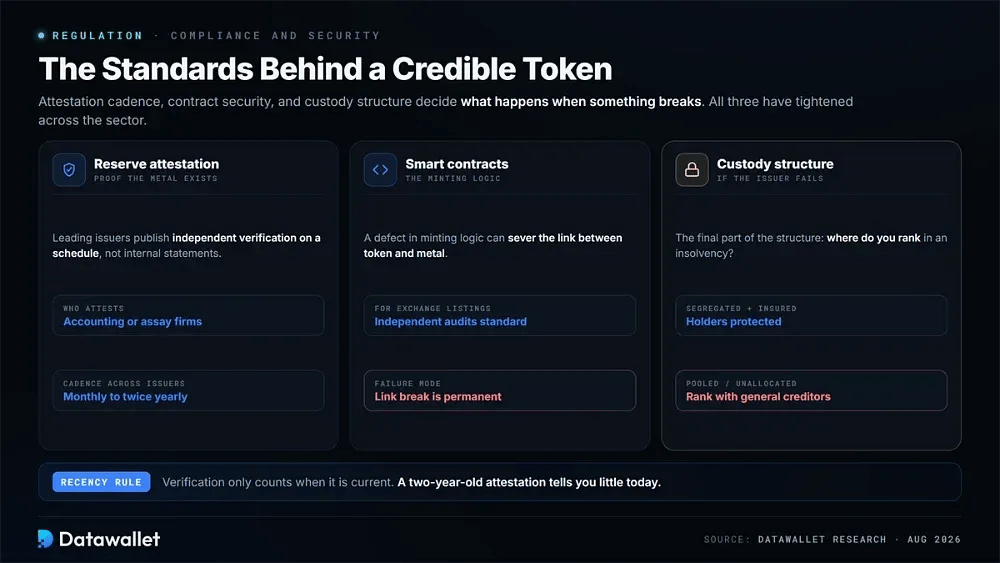
Reserve attestation standards have become stricter across the sector. Leading issuers now publish independent verification on a schedule rather than relying on internal statements, although the frequency ranges from monthly to twice yearly.
Smart contract security matters just as much. A defect in minting logic can sever the link between a token and its underlying metal. For issuers seeking exchange listings, independent smart contract audits have therefore become standard practice.
Custody is the final part of the structure. Segregated, insured vaulting protects holders if the issuer fails. With pooled or unallocated storage, holders may instead rank alongside other creditors during insolvency.
How to Buy Tokenized Silver
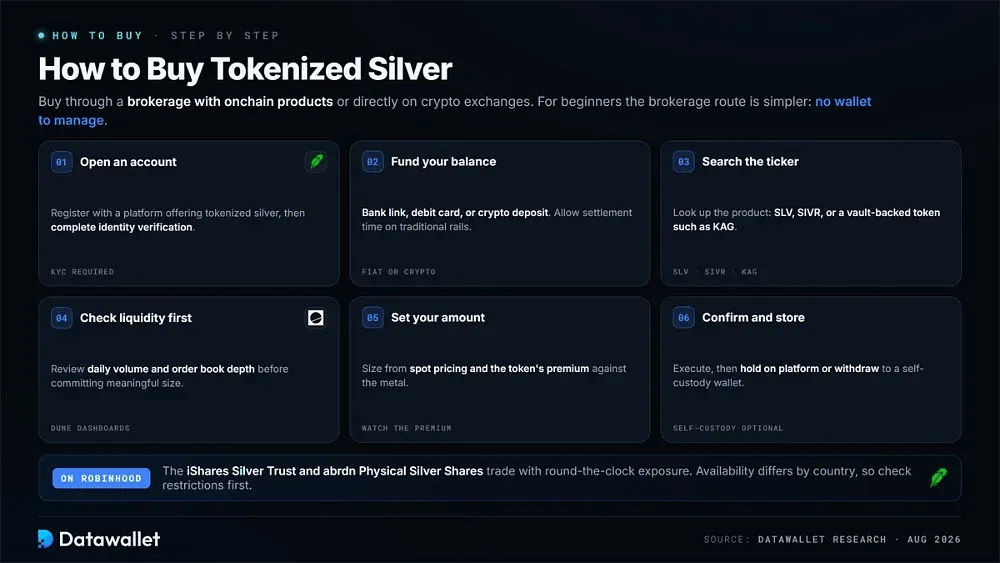
Tokenized silver can be purchased either through a brokerage that offers onchain products or directly on crypto exchanges where the tokens are listed. For beginners, the brokerage route is simpler because it removes the need to manage a wallet.
Follow these steps to make your first purchase:
- Open an account: Register with a platform such as Robinhood that offers tokenized silver products, then complete identity verification.
- Fund your balance: Transfer capital by bank link, debit card, or crypto deposit, allowing settlement time on traditional rails.
- Search the ticker: Look up the specific product you want, whether that is SLV, SIVR, or a vault-backed token such as KAG.
- Check liquidity first: Review daily volume and order book depth using Dune analytics before committing meaningful size.
- Set your amount: Decide quantity based on spot pricing and the premium the token trades at against metal.
- Confirm and store: Execute the order, then decide whether to hold on the platform or withdraw to a self-custody wallet.
Robinhood users have access to the iShares Silver Trust as well as the abrdn Physical Silver Shares ETF, both with round-the-clock exposure. Country availability differs, so check the relevant restrictions that apply before opening an account.
Tokenized Silver Assets Risks
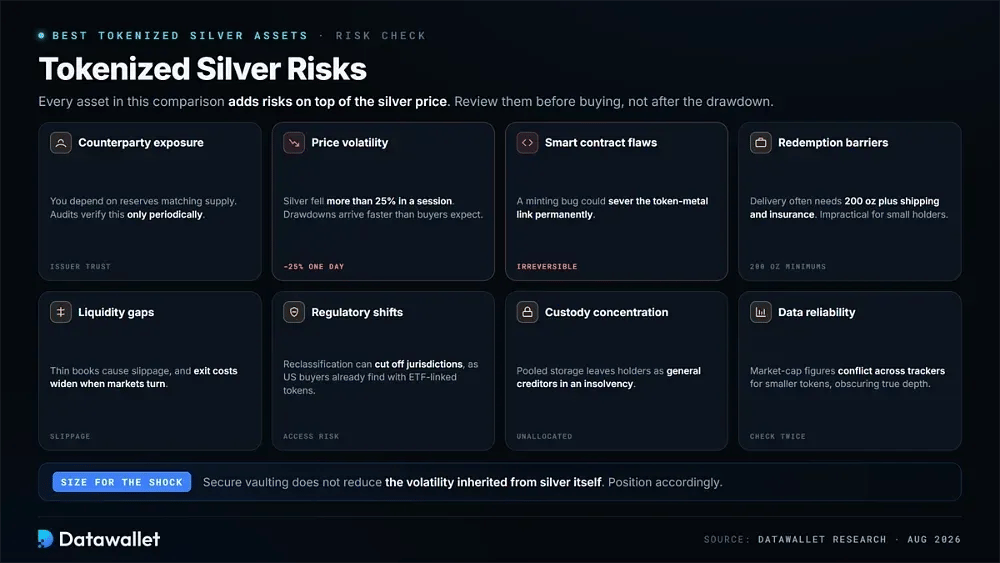
Every asset in this comparison adds risks on top of movements in the silver price. Reviewing those risks before buying can prevent losses that otherwise catch holders unprepared.
Consider the following risk factors before investing:
- Counterparty exposure: You depend on the issuer maintaining reserves that match circulating supply, and independent audits verify this only periodically.
- Price volatility: Silver fell more than 25% in a single session during the reversal, so drawdowns arrive faster than most buyers expect.
- Smart contract flaws: Vulnerabilities in minting or transfer logic could sever the link between tokens and vaulted metal permanently.
- Redemption barriers: Physical delivery often requires 200 ounces plus shipping and insurance costs, making bars impractical for smaller holders.
- Liquidity gaps: Thin order books cause slippage on larger orders, and exit costs widen exactly when markets turn disorderly.
- Regulatory shifts: Changing classification rules can restrict access by jurisdiction, as United States buyers already find with ETF-linked tokens.
- Custody concentration: Pooled or unallocated storage leaves holders ranking as general creditors if an issuer enters insolvency.
- Data reliability: Market capitalization figures conflict across trackers for smaller tokens, obscuring the true depth available to traders.
Final Thoughts
Tokenized silver offers exposure to the metal without requiring buyers to deal with vaults or bullion dealers. The market has matured enough to provide meaningful choice among backing structures. Kinesis leads on scale and yield; SLVon is better suited to buyers seeking regulated ETF exposure.
Choose the structure that fits the intended use. Long-term holders are better served by allocated tokens with redemption rights. ETF-linked and indexed products are more appropriate for traders who need only price exposure.
Liquidity deserves the same attention as the asset's backing. Check current volume and verify the audit schedule before buying, while keeping in mind that the underlying asset remains a volatile commodity inside an emerging market structure.
Our Methodology
We ranked these assets using issuer documentation, reserve attestations, and market data from CoinMarketCap and CoinGecko instead of relying on promotional material. Any asset without verifiable backing arrangements was excluded.
Six criteria shaped the ranking:
- Backing quality: We checked whether tokens represent allocated bullion, fund shares, or price indexation, since the distinction determines what holders own.
- Audit transparency: We reviewed who performs reserve verification, how often attestations appear, and whether holders can inspect them.
- Redemption rights: We examined minimum quantities, fees, and jurisdictions for physical delivery, treating practical access as more useful than theoretical entitlement.
- Liquidity depth: We compared trading volume across venues rather than headline figures, weighting assets that trade beyond their issuer's own platform.
- Network access: We assessed settlement networks and wallet compatibility, favouring tokens usable across established chains rather than closed systems.
- Regulatory standing: We considered licensing, jurisdictional availability, and how each issuer responds to compliance obligations in major markets.
Silver prices and token supply change constantly. The figures were checked against issuer disclosures and market trackers before publication, but current data should still be confirmed before committing capital.