







Can I Bridge to World Chain?
Yes, bridging into World Chain is straightforward because it is an OP Stack rollup. That means it inherits Ethereum security through optimistic rollup technology and plugs into Superchain standard bridge contracts, so any EVM wallet that works with Optimism or Base works here with zero extra setup.
ETH is the native gas token, with a growing list of supported ERC-20s. The biggest recent change worth flagging: Circle now issues native USDC directly on World Chain via CCTP, which ended the wrapped USDC workarounds people dealt with in 2024. That upgrade cleaned up my own stablecoin transfers and removed a layer of third-party risk.
One nuance most guides miss: verified World ID users get priority blockspace and a recurring gas allowance, so if you plan to use World App regularly, it is worth getting verified at an Orb before you start bridging.
How to Bridge to World Chain (Any Chain)
The most practical path from any EVM chain is Across Protocol, an intents-based bridge that uses a competitive relayer network to fill transfers in seconds rather than waiting on canonical settlement. Worth noting: Across integrated with World Chain at mainnet launch and is the officially endorsed path from the World team.
Follow these steps to bridge using Across:
- Connect your wallet: Open the Across app and connect an EVM wallet like MetaMask, Rabby, or Coinbase Wallet. Verify you are on app.across.to before signing.
- Select source and destination: Pick your origin (Ethereum, Arbitrum, Base, Optimism, Polygon, zkSync, Linea, and more are supported) and set World Chain as the destination. The dropdown will show the World Chain logo tagged with chain ID 480.
- Choose token and amount: Select ETH, USDC, WBTC, or another supported asset and enter the amount. I always test with roughly $20 first before committing larger size.
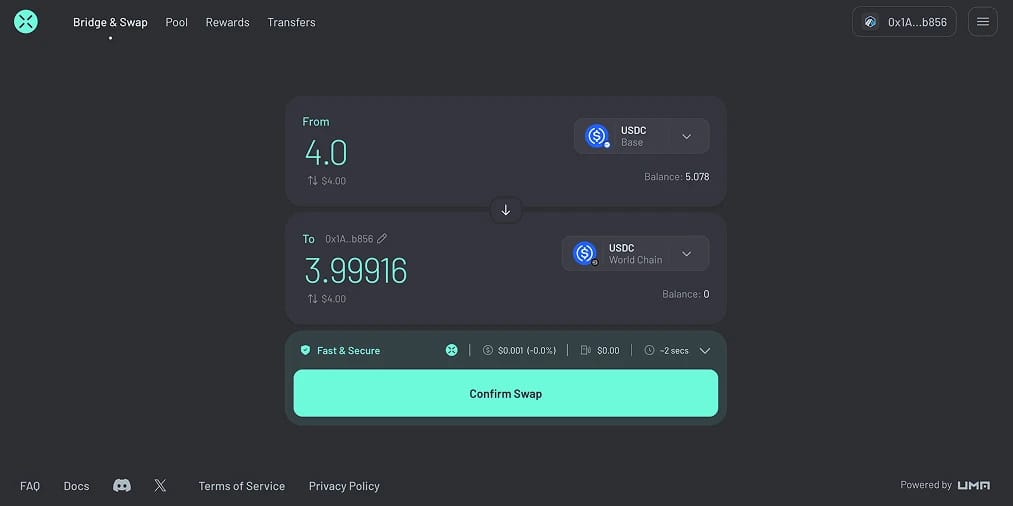
- Review the quote: Across shows you the exact amount you will receive, the relayer fee, estimated arrival time, and source gas. Read it carefully, since gas eats into small transfers disproportionately.
- Approve and confirm: Sign the ERC-20 approval if needed, then confirm the bridge. L2-to-L2 fills typically land within a few seconds in my testing, while mainnet origins take slightly longer due to finality waits.
- Switch networks: Once complete, switch your wallet to World Chain. If you have not added the network yet, follow our guide on how to add World Chain to MetaMask.
What Are the World Chain Bridging Fees?
Bridging costs split into three parts: source chain gas, the protocol fee, and destination gas. World Chain itself is cheap, with most transactions costing well under a cent thanks to OP Stack architecture and post-Dencun blob data savings.
Here is what I have actually paid across different origin chains using Across:
- From Ethereum mainnet: $3 to $12 in source gas, plus a small relayer fee that usually lands around 0.05% of the transfer amount. A $1,000 transfer typically costs between $4 and $15 all in.
- From an L2 like Arbitrum, Base, or Optimism: Typically under $0.50 in source gas plus the relayer fee. Total for a $1,000 transfer is usually under $1, and fills are near-instant.
- From Polygon or other alt-L1s: Source gas is negligible, and relayer fees stay competitive. These are the cheapest transfers in my testing.
The canonical Superbridge interface charges gas only (no protocol fee) but takes around 12 minutes on deposits, and the optimistic rollup challenge window means L1 withdrawals take 7 days before funds are claimable on Ethereum. That delay catches a lot of first-time L2 users off guard, so for liquid exits, use third-party bridges that abstract it away with pre-funded liquidity.
Best World Chain Bridges Compared
The table below reflects what I have tested in production. Fees are indicative and shift with network conditions.
For stablecoin transfers, use a CCTP-powered bridge so you receive native Circle-issued USDC on the destination rather than a wrapped version. Across integrates CCTP directly on supported pairs, which removes wrapped token risk entirely.
World Chain Bridge Risks
Bridging carries tail risk, even with audited, battle-tested protocols. Here is what I actively watch for:
- Smart contract risk: Every bridge depends on code that could contain bugs. Prefer protocols with multiple independent audits and a public bug bounty. Across, Superbridge, and the Superchain contracts all clear this bar.
- Phishing and fake URLs: Bridge clones are one of the most common ways users get drained. Bookmark official URLs and never click bridge links from Twitter or Telegram. The official interface list lives at docs.world.org.
- Wrong network mistakes: OP Stack chains share address formats. Sending to an ENS or raw address without confirming the destination chain in your wallet has cost people real money. Verify chain ID 480 is selected before signing.
- Withdrawal delays: Canonical withdrawals from World Chain to Ethereum enforce the full 7-day optimistic rollup window. For faster exits, third-party bridges pre-fund liquidity on Ethereum and charge a small premium.
- Relayer capacity: Intents-based bridges like Across depend on an active relayer network. During extreme volatility, fills can slow from seconds to minutes, or large transfers may get filled in pieces.
- Token compatibility: Not every ERC-20 on Ethereum exists on World Chain. Before bridging a niche token, confirm the contract is deployed on the destination via worldscan.org.
About World Chain
World Chain is an Ethereum Layer 2 built on the OP Stack by the Worldcoin team, designed around the idea that verified humans should get priority blockspace over bots. It went live in late 2024 and has grown into one of the largest Superchain members by transaction volume, with most activity coming from World App users sending USDC, claiming WLD, and interacting with mini-apps.
Technically, it is EVM-equivalent, uses ETH for gas, has roughly 2-second block times, and settles to Ethereum through the standard OP Stack fault proof system. Chain ID is 480, and the official RPC is documented at docs.world.org. Alchemy runs the RaaS layer, and Reth operates in shadow mode for execution redundancy.
What makes it genuinely different is the proof-of-personhood integration. World ID verified users get a priority mempool lane and a recurring free gas allowance for basic transactions, which shifts the economics for consumer apps targeting casual users. Whether that design wins long term is still an open question, but the combination of cheap L2 fees, 27M+ onboarded users, and a built-in Sybil resistance primitive is a genuinely novel pitch in the Layer 2 landscape.
Final Thoughts
Bridging to World Chain is a short, cheap process if you pick the right tool. For almost every use case I recommend Across, which settles in under a minute with sub-dollar fees from L2 origins and was integrated officially at mainnet launch. Superbridge's canonical interface is there when you want maximum security assumptions, but the 7-day withdrawal window on exits is a real constraint to plan around.
Start with a small test transfer, confirm arrival on worldscan.org, and scale from there. Once funds land, you can explore the growing list of mini-apps inside World App, participate in WLD-related DeFi, or keep native USDC on hand for cheap global transfers to the 27M+ people already using the network.
For wallet setup before your first bridge, see our guide on adding World Chain to MetaMask. For a broader look at the bridging landscape, check our list of the best crypto bridges.
.webp)