

Compare Highest No KYC Withdrawal Limit Exchanges
1. BloFin
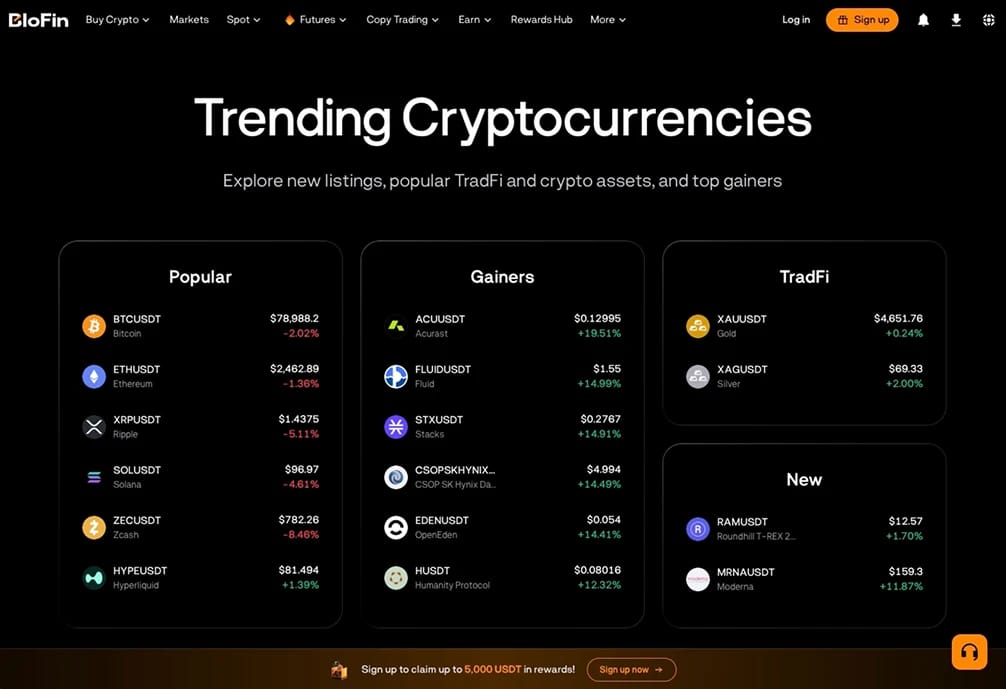
BloFin users start on the Basic tier, which allows withdrawals of up to 20,000 USDT per day without identity documents. The allowance resets daily and has no monthly ceiling. It covers crypto withdrawals only because BloFin does not provide fiat services. Basic-tier users face no trading penalty. They retain access to the full futures suite, copy trading, and leverage up to 150x.
Despite its polished presentation, BloFin is relatively young. The company launched in September 2019, is registered in the Cayman Islands, and operates in more than 150 countries. Fireblocks handles custody, and the exchange has no recorded hack. Standard derivative fees remain at 0.02% for makers and 0.06% for takers. Level 1 verification increases the daily withdrawal cap to 1,000,000 USDT, while Level 2 doubles it.
Our unverified test account worked as documented. A 5,000 USDT withdrawal over TRC-20 cleared within minutes without manual review, and the withdrawal screen correctly updated the remaining daily allowance. Availability varies by location, so check our BloFin restricted countries page before registering.
Pros
- Its 20,000 USDT daily allowance is the largest fully unverified cap we confirmed on a major derivatives platform in 2026.
- Basic-tier accounts can trade futures at full leverage without product restrictions.
- Clearly documented verification tiers show the requirements for higher limits before you deposit funds.
Cons
- Limits are denominated in USDT, making them better suited to stablecoin transfers than large BTC withdrawals.
- Fiat deposits and withdrawals are unavailable at every tier.
- BloFin excludes some regions and may request verification when activity appears unusual.
2. CoinEx
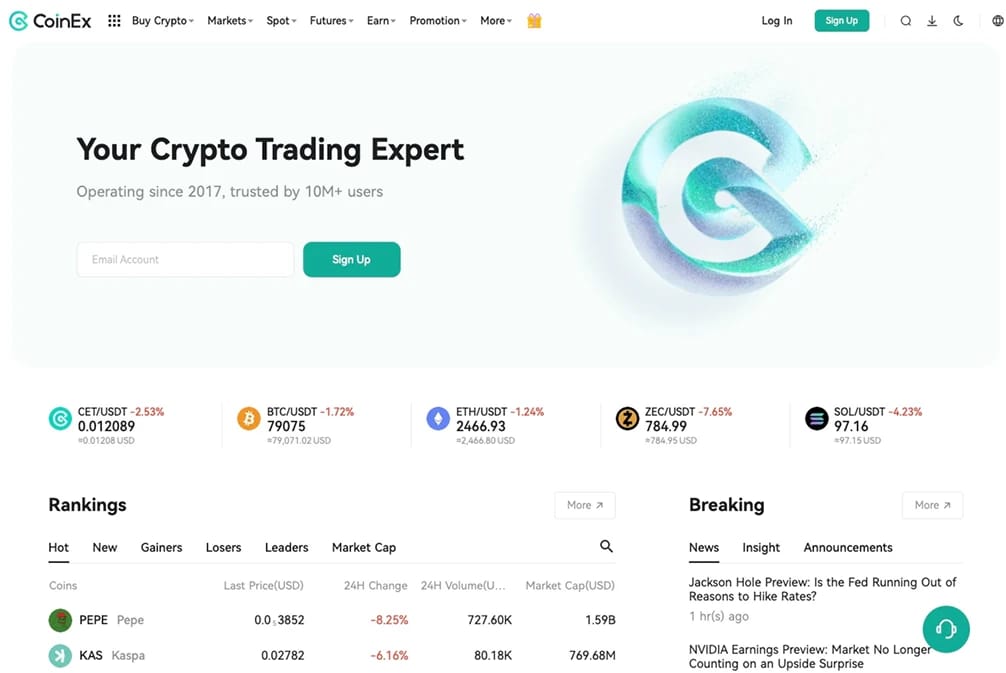
CoinEx applies two limits to unverified withdrawals. Accounts without ID can move up to $10,000 during any 24-hour period, subject to a rolling 30-day ceiling of $50,000. Primary verification removes the monthly restriction and raises the daily limit to $1,000,000. The Seychelles-based exchange has operated since 2017 and reports 10 million users.
Its public proof of reserves shows that customer deposits are matched one-to-one, supported by wallet addresses that anyone can inspect. More than 1,200 assets are available, while futures fees are 0.03% for makers and 0.05% for takers. CoinEx has the strongest Trustpilot rating in this comparison. Its 3.2 out of 5 score is based on more than 500 reviews.
Limit tracking was particularly clear during our testing. The dashboard and withdrawal pages consistently displayed both used and remaining allowances, making transfers across several days easy to plan. Our full CoinEx review examines the platform’s features, its security measures and history, fees and much more.
Pros
- CoinEx publishes its daily and 30-day unverified limits without relying on vague “risk-based” wording.
- Onchain proof of reserves provides verifiable evidence that customer deposits are backed.
- Primary verification offers a documented route to a $1,000,000 daily allowance.
Cons
- The $50,000 monthly ceiling limits customers who regularly move large amounts.
- Starting spot fees of 0.2% exceed those charged by most derivatives-focused competitors.
- Certain assets and services may still require verification, regardless of withdrawal value.
3. KCEX
KCEX falls into a separate category as it does require some form of KYC. An email address is enough to create an account, but the headline 30 BTC daily allowance becomes available only after a basic identity check. KCEX does not publish a limit for customers who avoid verification completely, making it KYC-light rather than a true no-KYC exchange.
For traders prepared to complete that check, the capacity is difficult to match. At current prices, 30 BTC represents millions of dollars in daily withdrawals, far above every other published limit in this comparison. Almost all spot pairs carry no trading fee. Futures limit orders are also free, while market orders cost 0.01%, and the exchange lists more than 900 assets.
Disclosure is the main weakness. KCEX is a relatively new exchange with limited information about its corporate structure, and independent reviewers have struggled to verify its licensing claims. During testing, we kept our balance small and withdrew promptly. We recommend the same approach with any young offshore platform.
Pros
- The 30 BTC daily limit far exceeds every fully unverified allowance in this ranking.
- Zero-fee spot trading and near-zero futures fees keep overall costs low.
- Registration requires only an email address or phone number.
Cons
- Basic identity verification is required for the headline limit, so it is not genuinely no-KYC.
- Corporate transparency remains limited for an exchange that holds customer assets.
- KCEX’s terms permit withdrawal limits to change under its risk policies at any time.
.webp)
4. BTCC
BTCC has the most conservative offer in this ranking: a daily allowance of 10,000 USDT for unverified accounts. In return, customers get an exchange that has matched orders since 2011, with no recorded security breaches. Few platforms in any category can claim 15 years of uninterrupted operation, and none of the other exchanges here comes close.
Verification increases the limit through a defined set of stages. Submitting an identity document raises daily withdrawals to 100,000 USDT. Facial verification takes the cap to 1,000,000 USDT. BTCC focuses on derivatives, listing more than 370 futures contracts with up to 500x leverage on selected contracts. Fees are 0.025% for makers and 0.045% for takers.
That focus on security is visible during withdrawals. BTCC repeated the destination address and network details before confirming our requests, and it warned that unusual activity could lead to manual review. The deliberate process is better suited to savers than traders trying to capture a short arbitrage window.
Pros
- BTCC has operated for 15 years without a breach on record, the longest history in this comparison.
- Each verification tier has an exact published limit rather than a discretionary range.
- Verified strategies receive broad futures coverage and leverage up to 500x.
Cons
- Its 10,000 USDT unverified allowance is half BloFin’s limit.
- Manual security reviews may delay flagged withdrawals.
- The spot selection of roughly 250 tokens is limited compared to platforms listing more than 1,000.
.webp)
5. WEEX
WEEX treats identity verification as genuinely optional. Unverified accounts begin with a daily withdrawal allowance of 10,000 USDT, but higher VIP trading volumes increase the cap without requiring documents. At the highest tier, an unverified customer can withdraw 500,000 USDT per day. It lists more than 1,000 spot assets. Futures offer leverage up to 400x, with maker fees of 0.02% and taker fees of 0.08%.
The exchange publishes 1:1 proof of reserves and maintains a 1,000 BTC protection fund for unexpected losses. Founded in Singapore in 2018 and now operated from Dubai, WEEX reports more than 6.2 million registered users across over 130 countries. It has also filed money services business registrations with FinCEN and FINTRAC.
The volume-based system mainly benefits active traders because passive accounts remain on the base cap indefinitely. WEEX also excludes several major markets, including the United States, Canada, and Singapore. Our WEEX restricted countries page tracks the full list.
Pros
- WEEX is the only platform here where trading activity alone can raise an unverified cap to 500,000 USDT per day.
- It publishes 1:1 proof of reserves and maintains a 1,000 BTC protection fund.
- Only fiat purchases require identity verification.
Cons
- Low-volume customers remain on the 10,000 USDT base limit permanently.
- Extensive regional restrictions exclude several major markets.
- The 0.08% futures taker fee is higher than those charged by BloFin and KCEX.

6. MEXC
MEXC ranks last because its formerly generous unverified tier now permits roughly 1,000 USDT in daily withdrawals across most markets. The exchange began tightening verification in mid-2024 and has since expanded mandatory checks across additional regions. Primary verification increases the cap to 80 BTC per day, while Advanced verification allows 200 BTC.
The surrounding trading service still earns MEXC a place on this list. It adds new tokens faster than almost any competitor, charges no maker fee on futures, and operates some of the industry’s deepest altcoin order books. The unverified tier remains workable for traders making small, regular transfers.
Use MEXC primarily for trading rather than as a withdrawal channel. Our unverified test withdrawal of 900 USDT processed quickly, but larger amounts require documents. The exchange may also impose verification based on account location or behavior. Our MEXC available countries page explains how regional policies differ.
Pros
- MEXC offers a vast asset selection, often listing tokens months before larger regulated exchanges.
- Its 0% futures maker fee benefits high-frequency traders and passive limit-order strategies.
- Our small unverified withdrawal cleared quickly without a security hold.
Cons
- The 1,000 USDT daily allowance is easily the smallest unverified cap in this ranking.
- MEXC may retroactively require verification and restrict features until the documents are provided.
- Regional differences mean published limits may not match those shown on your account.
Do I Need to KYC on DEXs?
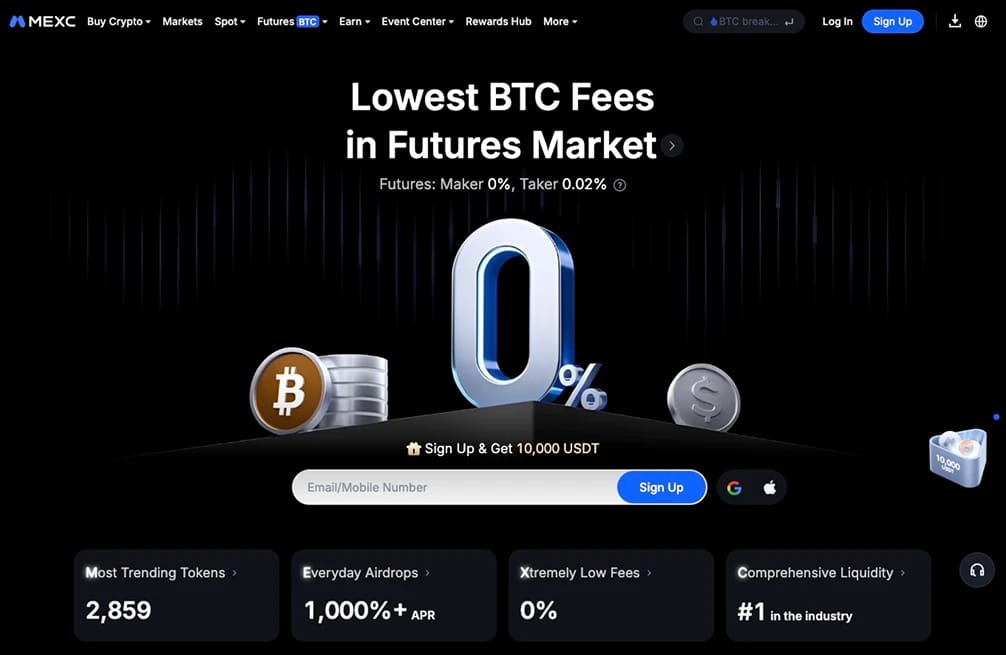
The largest change in this market has occurred outside centralized exchanges. A decentralized exchange (DEX) has no customer accounts or withdrawal department, so there is no cap to enforce. Assets remain in your wallet, and trades settle through smart contracts. Moving $50 away from the venue requires the same type of signed transaction as moving $5 million.
Hyperliquid is the clearest example of this structure for derivatives. Onboarding consists entirely of connecting a wallet, with no identity upload at any point. The platform now processes billions of dollars in daily perpetual futures volume. Our Hyperliquid explainer describes how its chain operates, while our best decentralized perpetuals exchanges guide compares the broader market.
The risks remain substantial, but they take a different form. No support team can reverse an incorrect transfer, and smart contract risk replaces the danger of leaving assets with a custodian. Stablecoin entry points also connect to the banking system somewhere upstream. For traders concerned specifically about withdrawal ceilings, self-custody removes the restriction.
How to Choose a No-KYC Exchange for Large Withdrawals
A published limit tells only part of the story. Before trusting a platform with a meaningful balance, we apply the following checks:
- Read the limit from the exchange’s own pages: Caps can change without notice, while third-party articles often fall behind. Check the platform’s current verification documentation on the day you deposit.
- Look for a rolling monthly ceiling: A high daily allowance may conceal a restrictive 30-day total, as CoinEx’s $50,000 limit demonstrates. Work out the actual monthly capacity before scheduling repeated withdrawals.
- Check proof of reserves before size matters: Verifiable backing from exchanges such as CoinEx and WEEX provides evidence, not assurances. If a platform fails, an unverified customer has no legal identity associated with their account when seeking compensation.
- Test the process with a small withdrawal first: Send a modest amount to your own wallet before committing substantial funds. The test will reveal actual processing times, security checks, and whether the platform honors its published cap.
- Understand what triggers a forced verification: VPN use, rapid deposits followed by withdrawals, and flagged counterparty addresses can freeze an optional-KYC account pending verification. Read the risk-review terms alongside the limits table.
.webp)
Buying Crypto Without KYC in 2026
Buying crypto anonymously presents a separate challenge from withdrawing it because most exchanges in this ranking accept crypto deposits only. Three methods remain available in 2026.
Decentralized Exchanges
A decentralized exchange (DEX) swaps assets directly between wallets through smart contracts. Since no operator takes custody of an account, there is no identity request. Once you already hold crypto, the standard process is:
- Install a self-custody wallet: Select a wallet where only you control the recovery phrase.
- Fund it with crypto: Send assets from an existing wallet or one of the exchanges listed above.
- Connect and swap: Link the wallet to a platform such as Uniswap, then approve the trade on-chain.
Our best decentralized exchanges ranking compares the leading platforms across different networks.
Peer-to-Peer (P2P) Marketplaces
Peer-to-peer (P2P) marketplaces connect individual buyers with sellers, who arrange payment between themselves while escrow protects the transaction. Bisq operates as desktop software without a central operator. Hodl Hodl provides a similar browser-based escrow system.
Filter listings for cash or bank-transfer offers that do not request ID. Keep initial trades small, and use our best P2P crypto exchanges guide to compare platforms. Stablecoin buyers can also consult our buy USDT without KYC page.
Bitcoin ATMs
Physical kiosks exchange cash for Bitcoin immediately, and many still permit small purchases using only a phone number. Coin ATM Radar can help locate nearby machines. Before visiting, check the operator’s verification threshold and expect fees well above those charged online, commonly between 5% and 15% per purchase.
Requirements differ by country and continue to tighten in the United States. The phone-number tier is best treated as a convenient way to buy small amounts, not a long-term strategy.
.webp)
Pros and Cons of No KYC Exchanges
Trading without identity verification exchanges legal protection for greater privacy. The balance looks like this:
Final Thoughts
High no-KYC withdrawal allowances remain available at a small number of offshore exchanges, but that group continues to contract. BloFin’s 20,000 USDT daily limit is the largest fully unverified cap we confirmed. CoinEx combines practical allowances with verifiable reserves, while KCEX offers unmatched capacity after one basic identity check.
The same operating rules apply to whichever platform you use. Leave funds on an exchange only while a trade requires them, distribute larger positions across multiple venues, and keep everything else in self-custody. Our broader best no-KYC crypto exchanges guide ranks platforms by overall quality rather than withdrawal capacity alone, making it a useful companion to this page.
The regulatory direction is clear. CARF reporting is active, the EU will prohibit anonymous accounts in 2027, and enforcement agencies increasingly target unregistered exchanges. Privacy-focused traders should expect fewer centralized choices and build their setup around wallets they control.
Our Methodology
Withdrawal capacity without verification was the main ranking factor. We then assessed whether each platform could be trusted with the amounts permitted under its limit. Six criteria determined the results:
- Published limits: We checked each allowance against the exchange’s verification documentation in August 2026. Platforms using vague or discretionary policies received lower scores.
- Tested behavior: Where permitted, we opened accounts without submitting documents, deposited USDT, and withdrew it to self-custody. This confirmed whether published limits matched actual account behavior.
- Security record: Trust scores reflected operating history, previous incidents, proof of reserves, and protection funds.
- Trading costs: We compared maker and taker fees, spreads on major pairs, and withdrawal charges to determine the real cost of using each allowance.
- Transparency: Platforms that disclose their corporate structure, reserve backing, and policy changes ranked above those providing little information.
- Stability of access: We considered restricted-country lists, forced-verification triggers, and regulatory exposure because so many no-KYC exchanges closed this year.
Limits and policies change faster in this category than in any other we cover. Always verify the current figures on the exchange’s own pages before transferring significant funds.