







Compare Top Peruvian Cryptocurrency Exchanges
1. Bybit
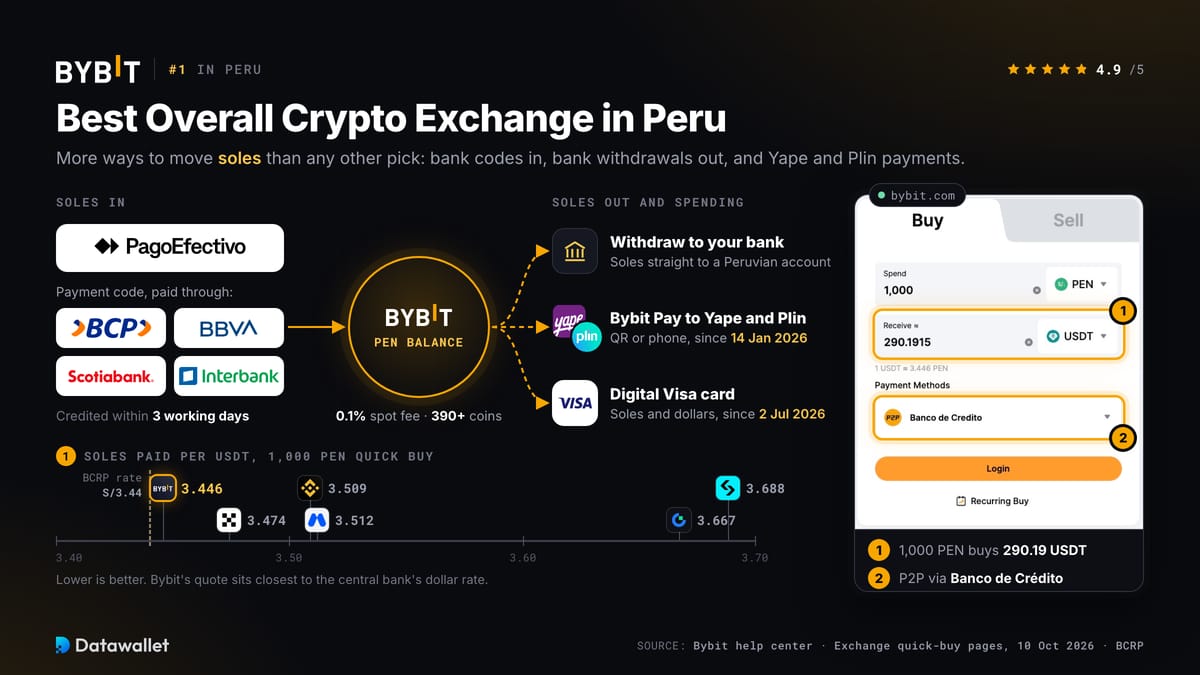
Bybit ranks first for offering more ways to move soles than any other platform here. Its help center lists PagoEfectivo deposits in soles, paid with a code through BCP, BBVA, Scotiabank, or Interbank. Bybit Pay has supported Yape and Plin since 14 January 2026. Scan a Yape QR code or send to a Plin phone number, and the recipient receives soles. A digital Visa prepaid card followed on 2 July, with balances in soles and US dollars for customers in Peru.
Popular features include spot, futures, options, and now TradFi trading. There is a 0.1% trading fee applied to every spot order. Paying in MNT, Bybit’s native token, cuts the spot fee by 25%. The futures maker fee starts at 0.02% and the taker fee starts at 0.055%. Additional services include copy trading, trading bots, Earn, advanced Earn, lending and borrowing, TradeGPT, Bybit AI and demo trading.
Bybit's security record includes the largest exchange theft reported so far. Hackers took Ether worth roughly $1.5 billion from one of its wallets in February 2025, an attack the FBI attributed to North Korea. Bybit kept withdrawals open and replaced the missing Ether within days. Security firm Hacken verifies its monthly reserve reports; the September 2026 report put Bitcoin at 104% of customer balances. Our Bybit review gives a full account of the incident.
Pros
- PagoEfectivo deposits at BCP, BBVA, Scotiabank and Interbank, plus bank withdrawals in soles.
- Bybit Pay settles Yape and Plin payments in soles, and a digital Visa card holds soles and dollars.
- A 0.1% spot fee and monthly reserve reports verified by Hacken.
Cons
- Bank code deposits can take up to three working days.
- Bybit covered the February 2025 loss, but the theft remains part of its security record.
- No Peruvian authority supervises the account. Complaints are handled under Bybit's terms.
2. Binance
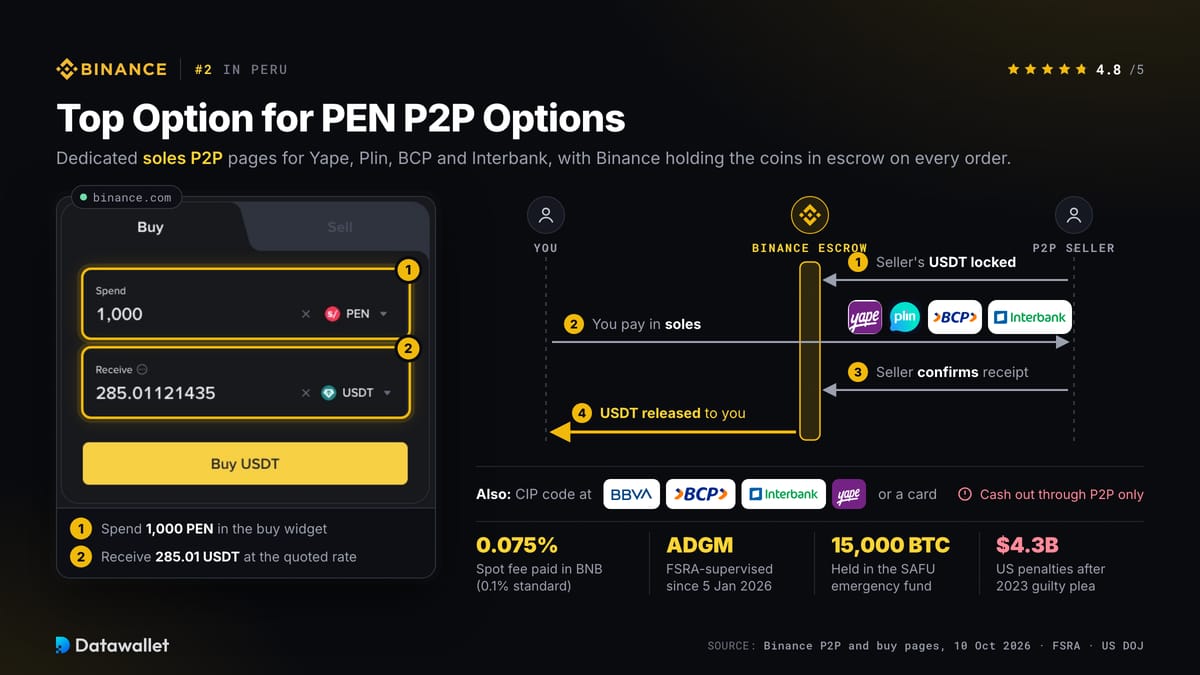
Binance gives Peruvian buyers two ways to pay in soles besides card deposits. Dedicated P2P pages list Yape, Plin, BCP and Interbank. On every order, Binance holds the coins in escrow until the seller confirms receipt of the soles. The second method is a CIP payment code payable at BBVA, BCP, Interbank, or through Yape. We found no documented bank withdrawal in soles. Most users therefore sell through P2P to return money to a Peruvian account.
Paying spot fees with BNB lowers the usual 0.1% rate to 0.075%. As the largest crypto exchange by traded volume, Binance usually executes large orders near the quoted price. Three companies supervised by the FSRA have operated the global platform since 5 January 2026. The FSRA is the financial regulator of the Abu Dhabi Global Market (ADGM), giving Peruvian users a named foreign supervisor. Complaints still cannot be filed in Peru.
Binance's US guilty plea in November 2023 brought about $4.3 billion in penalties for weak anti-money-laundering controls. Our Binance review examines the compliance program that followed. Since February 2026, the SAFU emergency fund has held 15,000 Bitcoin. Additional features include a robust copy trading marketplace, trading bots, staking, crypto loans, and stock trading.
Pros
- P2P pages for Yape, Plin, BCP and Interbank, with escrow on every order.
- CIP payment codes and card purchases in soles as alternatives to P2P.
- ADGM regulation since January 2026 and a SAFU fund of 15,000 Bitcoin.
Cons
- About $4.3 billion in penalties after its US guilty plea in 2023.
- No documented bank withdrawal in soles, so P2P is the usual way to cash out.
- Reserve reports are published by Binance, with no named outside auditor.
3. OKX
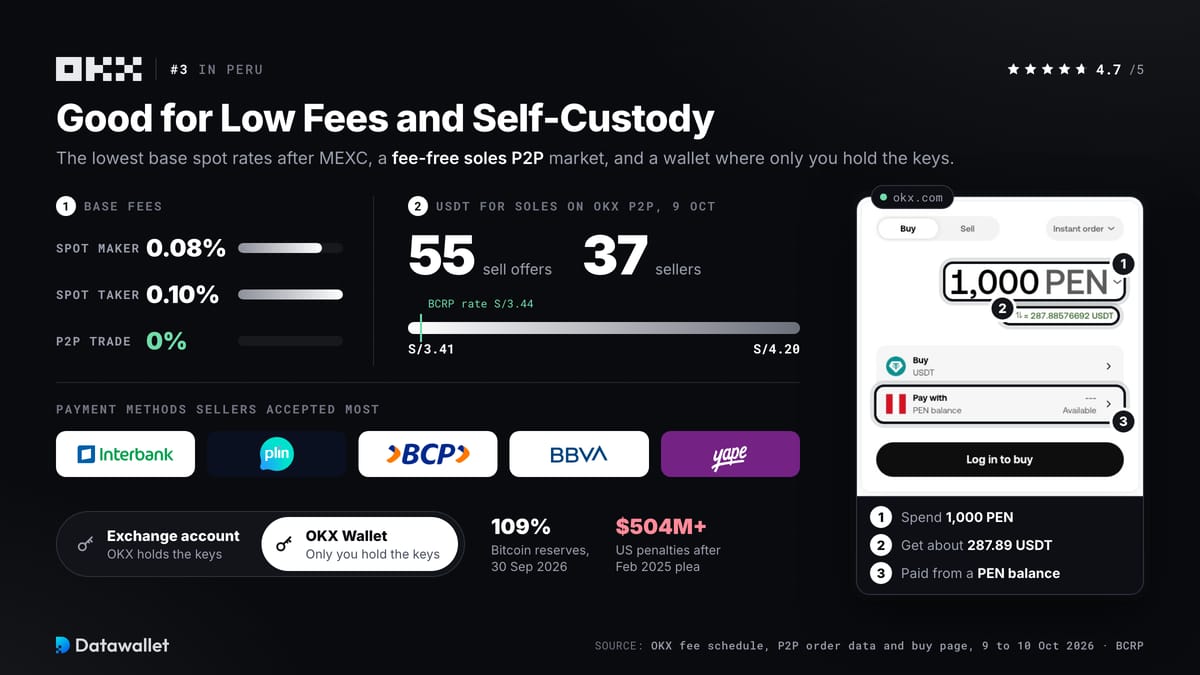
OKX has the lowest base spot rates here after MEXC, with a 0.08% fee for makers and a 0.10% fee for takers. Its soles P2P market was the only one we could measure directly. Public order data on 9 October 2026 showed at least 55 offers from 37 sellers to sell USDT for soles. USDT is a stablecoin designed to hold a value of one US dollar. Interbank, Plin, BCP, BBVA and Yape were the payment methods sellers accepted most often.
OKX charges no P2P trading fee, but bank deposits in soles are unavailable. The app also contains a self-custody wallet whose keys remain with the user alone. Our OKX Wallet review explains how it differs from an exchange account. Under terms updated on 17 September 2026, a company in El Salvador may provide certain products to Peruvian residents, while a Seychelles company provides the rest.
In February 2025, the Seychelles operator admitted running a money transmitting business without a US license. The case resulted in more than $504 million in penalties. Bitcoin reserves stood at 109% of customer balances in the monthly report published on 30 September 2026. The full record appears in our OKX review, alongside a breakdown of the exchange’s services.
Pros
- Base spot rates of 0.08% and 0.10%, with no fee on P2P trades.
- At least 55 USDT sell offers for soles on 9 October 2026, covering Yape, Plin and the four largest banks.
- An in-app self-custody wallet and monthly reserve reports.
Cons
- No direct bank deposit in soles, but various P2P methods supported.
- More than $504 million in US penalties following its operator's February 2025 guilty plea.
- Peruvian accounts are split between companies in El Salvador and Seychelles under its terms.
4. Gate
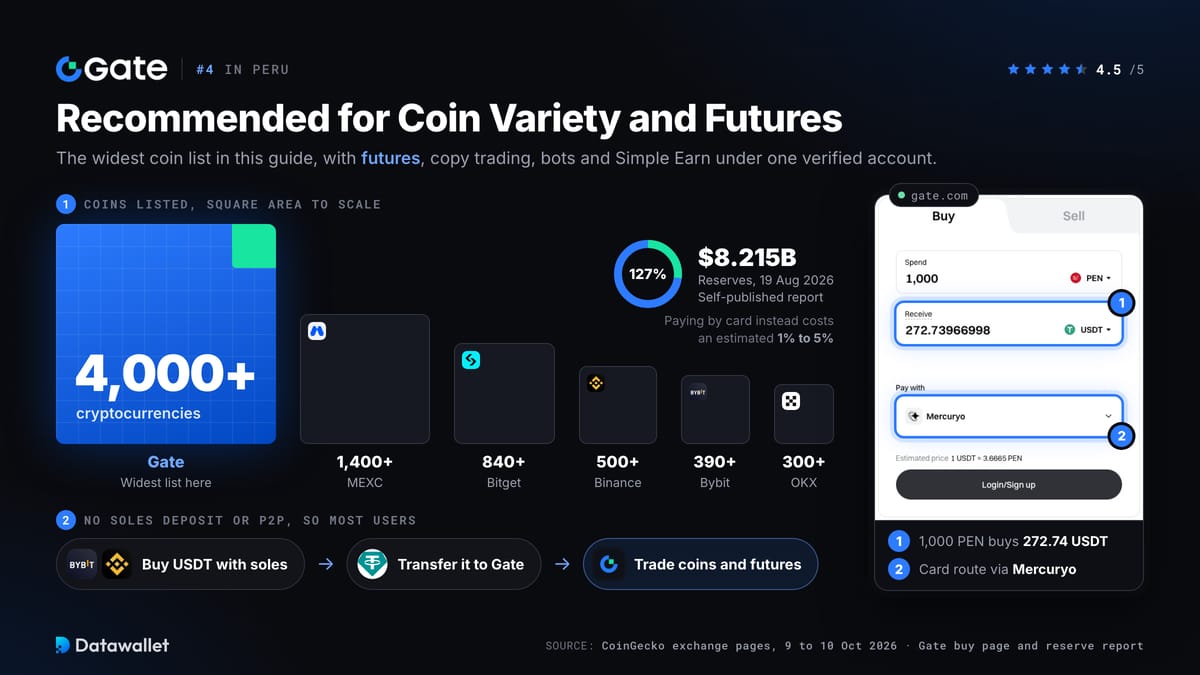
Gate supports 4,000+ cryptocurrencies, the widest selection in this guide. A verified account also gives access to futures and copy trading, with automated bots and the Simple Earn savings section available under the same account. Gate's spot trading fee starts at 0.1% for both makers and takers. Holding the exchange's GT token or trading larger volumes reduces the fee. Check your personal rate after logging in, as it is only visible then.
We could not confirm a bank deposit or P2P market for soles. Gate's public buying guide names neither Peru nor the sol, though it lists Visa and Mastercard purchases at an estimated cost of 1% to 5%. Most Peruvian users will buy USDT on Bybit or Binance and transfer it to Gate. We recommend visiting our Gate review, which covers the supported products in detail.
The reserve snapshot dated 19 August 2026 reported $8.215 billion, which Gate calculates as 127% of what it owes customers. Gate publishes its own reports. Licensed companies in Malta and Dubai serve those regions; accounts opened from Peru belong to the global platform. Its predecessor Bter lost 7,170 Bitcoin to theft in 2015. Our Gate safety assessment examines that loss and later incidents.
Pros
- More than 4,000 coins, the largest spot selection here.
- Reported August 2026 reserves of $8.215 billion, a ratio of 127%.
- Access to Simple Earn, bots, copy trading and futures from one account.
Cons
- There are no direct bank deposit options available for Peruvian investors.
- No confirmed soles P2P market or bank deposit.
- Small tokens can be slow to sell when few traders are active.
5. MEXC
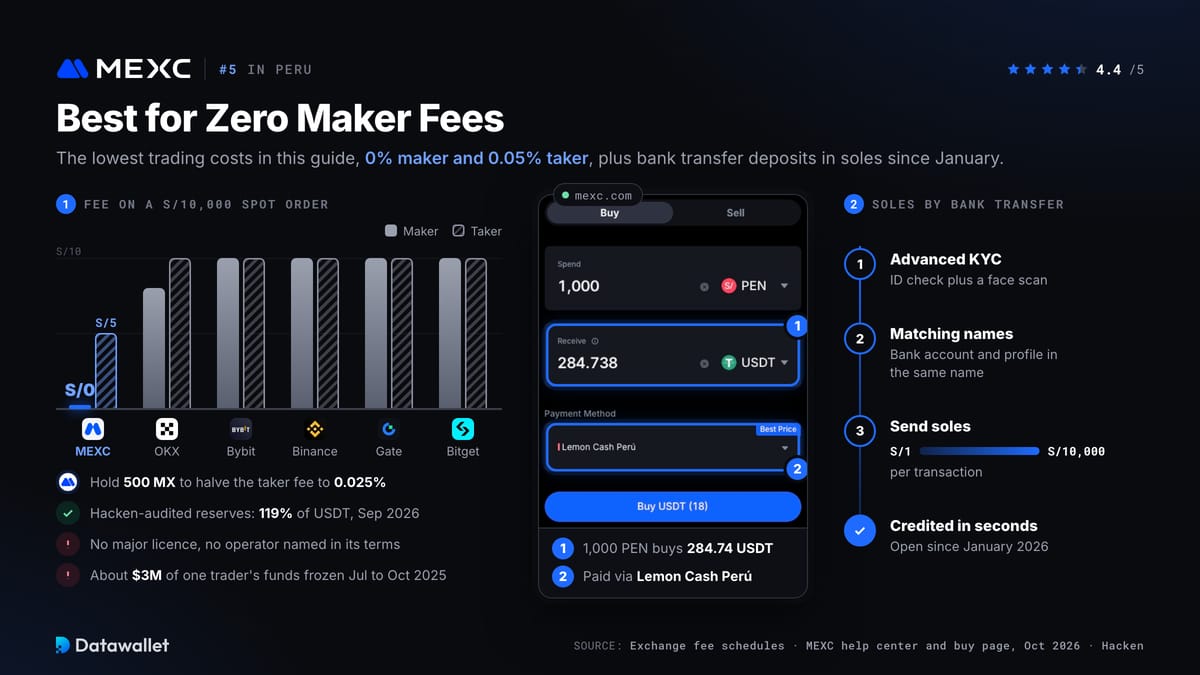
MEXC offers the lowest trading costs in this article. Its published spot schedule charges makers nothing and takers 0.05%. Holding 500 MX tokens halves the taker rate, though rates vary by region and should be checked in your account. Every level is listed in our MEXC fees guide. It is frequently in the top 10 largest exchanges globally for both spot and futures trading volume.
Bank transfer deposits in soles opened in January 2026, with limits of S/1 to S/10,000 per transaction. Customers must first complete advanced KYC. KYC stands for Know Your Customer; the advanced level adds a face scan. The verified profile and bank account must have the same name. Once confirmed, the deposit is credited within seconds.
MEXC has no license from a major financial regulator, nor does its user agreement name an operating company. It froze about $3 million of one trader's money in July 2025, then released the funds in October with a public apology. Its September 2026 reserve report, audited by Hacken, put USDT at 119% of customer balances. Before sending larger amounts, read our MEXC review.
Pros
- No maker fee and a 0.05% taker fee on the published spot schedule.
- Soles bank deposits from S/1 to S/10,000 per transaction.
- Reserve reports audited by Hacken and published monthly.
Cons
- No license from a major regulator, and no operating company named in the user agreement.
- About $3 million belonging to one trader remained frozen for over three months in 2025.
- Infrequent trading in many small tokens can leave a wide gap between buy and sell quotes.
6. Bitget
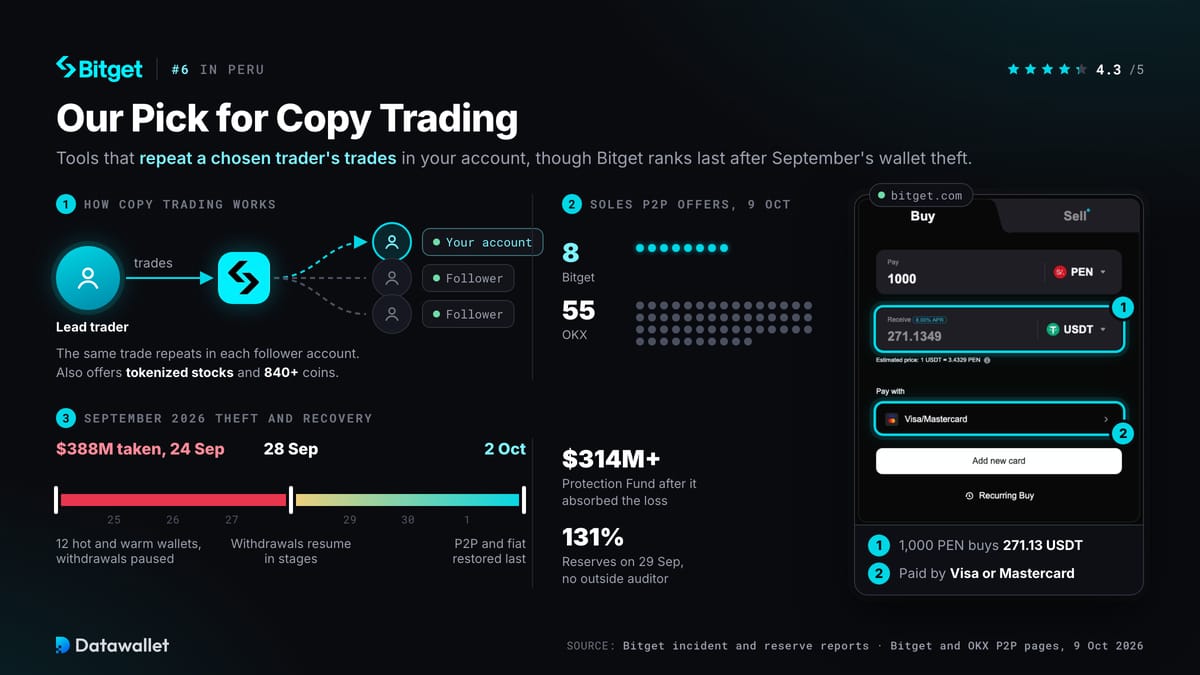
Bitget is known for its copy trading tools, which repeat selected traders' trades in a follower's account. On 24 September 2026, attackers took about $388 million from 12 hot and warm wallets, which the exchange keeps connected for daily withdrawals. Bitget's incident report attributes the attack to a flaw in third-party security software.
Withdrawals stopped during the investigation. They resumed in stages from 28 September to 2 October, with P2P and fiat services restored last. Bitget says its Protection Fund absorbed the loss, leaving customer balances unaffected, and the same report now values the fund above $314 million. Assets stood at 131% of customer balances in its 29 September reserve report. No outside auditor signs these reports.
The standard spot fee is 0.1%, reduced to 0.08% when paid in Bitget's BGB token. Eight offers appeared on its soles P2P page on 9 October, accepting BCP, BBVA, Interbank, Scotiabank, Yape and Plin. Bitget expanded its tokenized stocks in June. These tokens follow share prices, and access depends on the user's country. For more information on the exchange, our Bitget review covers fees and features in full.
Pros
- Copy trading tools and tokenized stocks alongside more than 840 coins.
- P2P sellers accepting Yape, Plin and the main Peruvian banks.
- Withdrawals restored within eight days of the theft, with the Protection Fund still above $300 million.
Cons
- About $388 million stolen from its wallets in September 2026.
- Only eight soles P2P offers on 9 October 2026 and no direct bank deposit.
- Reserve reports published without an outside auditor.
How to Choose a Crypto Exchange in Peru
No platform in this comparison is licensed or supervised in Peru. Before sending soles, check these five practical points.
- Decide how your soles will arrive: Bybit and Binance issue bank payment codes, while MEXC accepts bank transfers. OKX and Bitget depend on P2P sellers. Gate is usually funded with USDT bought elsewhere. Faster card purchases typically cost 2% to 4%. Our P2P exchange comparison explains how escrow protects both sides.
- Compare the P2P price with the bank dollar rate: On 5 October 2026, the central bank's closing rate was about S/3.44 per US dollar. USDT should cost close to that amount, yet OKX sell offers on 9 October ranged from S/3.41 to S/4.20. Compare several sellers before paying.
- Pay from your own account and check the seller: The name on your DNI must match your bank or wallet account, as exchanges reject payments from other people. Look for sellers with long order histories.
- Check reserves and legal protection: Bank deposits have coverage of up to S/123,000 under Peru's deposit insurance fund. Crypto held on an exchange is excluded. Reserve reports show whether a platform holds enough assets to cover customer balances.
- Test a small round trip: Buy about S/100 of USDT, sell it again and return the soles to your account by the same route. This reveals name mismatches, slow sellers, and unexpected charges before you make a larger payment.
BCP, Interbank, BBVA Perú and Scotiabank Perú are the banks most often listed for payments on these platforms. None sells crypto to the general public.
Crypto and Bitcoin Regulation in Peru
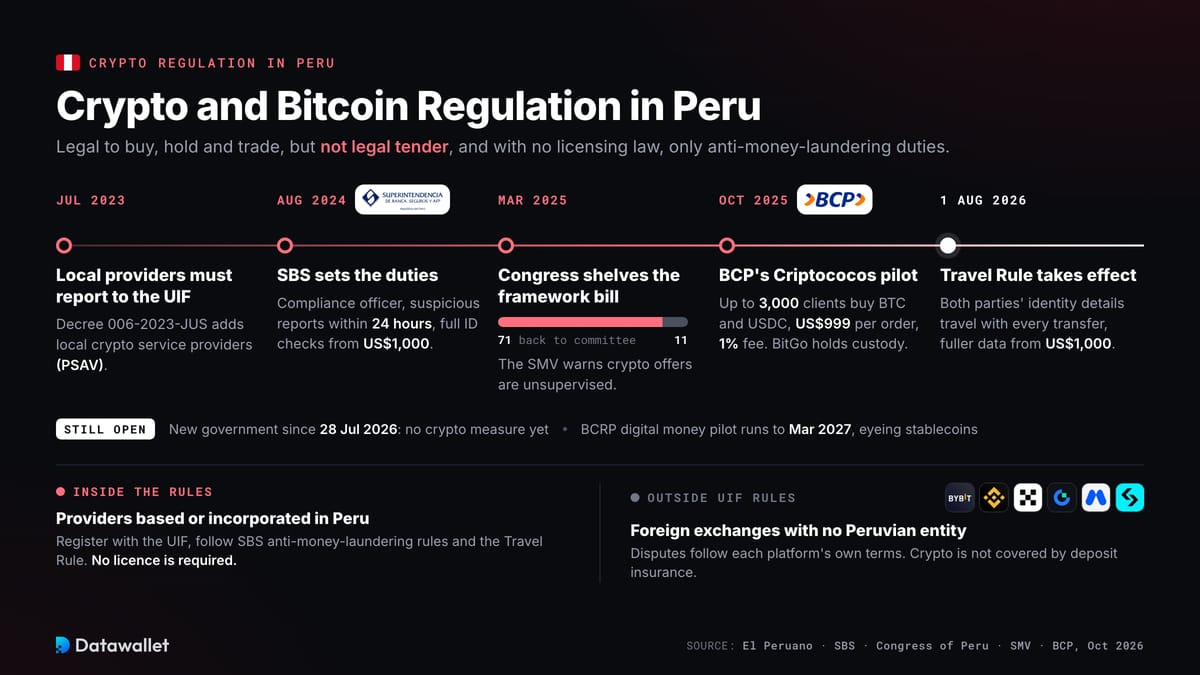
Peru permits buying, holding and trading crypto without granting it legal tender status. In October 2025, the head of the SBS told Congress that Peru does not regulate cryptoassets and that companies need no license to offer them. Local providers face anti-money-laundering obligations in place of a licensing law.
- July 2023: Supreme Decree 006-2023-JUS added cryptoasset service providers, known by the Spanish acronym PSAV, to the businesses required to report to the UIF. It applies to providers domiciled or incorporated in Peru.
- August 2024: Detailed duties are set out in SBS Resolution 02648-2024. Registered providers must appoint a compliance officer and identify customers. Once an operation is classified as suspicious, providers must report it within 24 hours. Full identity checks cover cash of any amount and other payments of US$1,000 or more.
- March 2025: By 71 votes to 11, Congress returned the crypto framework bill to committee. Bill 1042/2021-CR would have set rules for selling cryptoassets. The securities regulator SMV also warned the public that month that crypto and token offers are unsupervised.
- October 2025: BCP launched the Criptococos pilot within the SBS test program for new business models. Up to 3,000 approved clients can buy Bitcoin and the USDC stablecoin, with BitGo providing custody. Purchases have a US$999 limit per operation and each trade costs 1%. Coins cannot leave the platform.
- 1 August 2026: The 2024 resolution's Travel Rule took effect. For every transfer, local providers must send and receive both parties' identity details, with fuller data required from US$1,000. If a customer uses a self-custody wallet, the provider must ask them for the other party's details.
By October 2026, the government that took office on 28 July 2026 had announced no crypto-specific measure. Foreign exchanges with no Peruvian company or branch fall outside UIF rules, leaving disputes subject to each platform's terms. Separately, the central bank (BCRP) is running a digital money pilot until March 2027 and wants closer monitoring of stablecoins.
How Is Crypto Taxed in Peru?
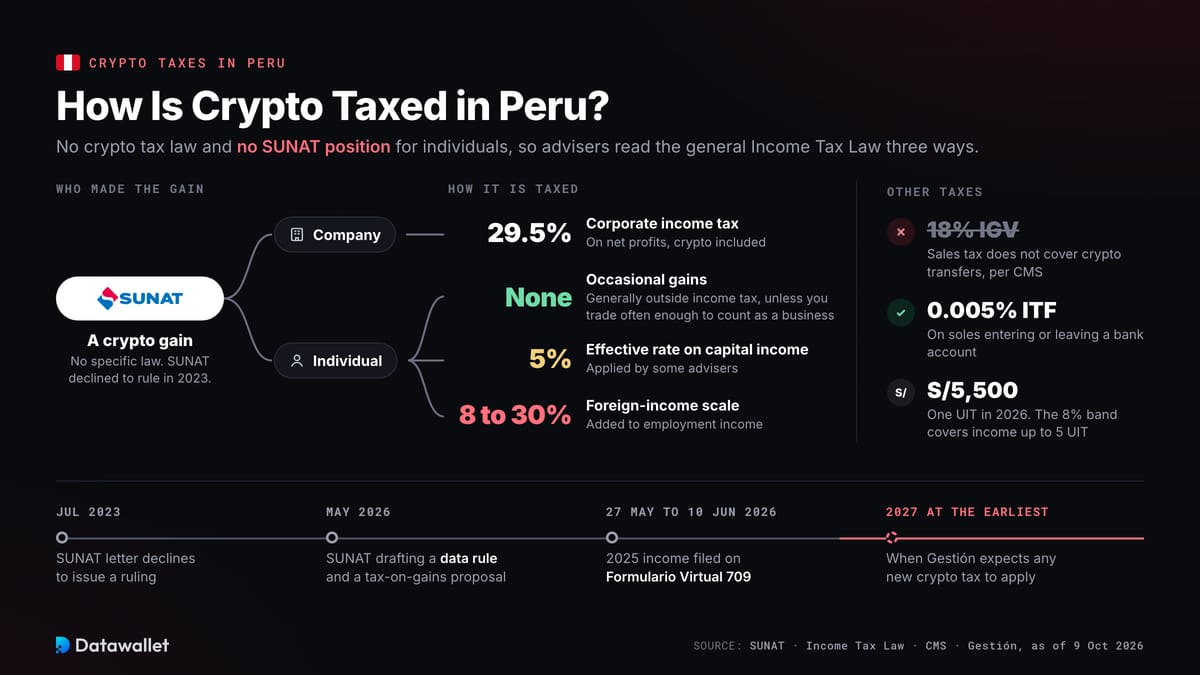
Peru has no tax law specifically addressing crypto. SUNAT has issued no official position on individuals' gains and, in a July 2023 letter, declined to give a ruling because the law contains no specific provisions. Advisers reach different conclusions when applying the general Income Tax Law.
- Individuals: Occasional gains generally fall outside income tax unless someone trades frequently enough to be treated as a business. Other advisers use the 5% effective rate applied to some capital income or the progressive scale for foreign income.
- Foreign income scale: Residents add net foreign-source income to employment income and pay tax at 8% to 30%. Income up to 5 UIT falls in the first band. One UIT, the tax unit, is S/5,500 for 2026.
- Companies: Peruvian companies pay a 29.5% corporate income tax on net profits, including crypto profits.
- Sales tax and bank tax: CMS says crypto transfers fall outside the 18% general sales tax (IGV) because the law does not cover intangible assets of this kind. Soles entering or leaving a bank account attract the ITF, a 0.005% tax on bank account movements.
- Changes in preparation: SUNAT's head said in May 2026 that the authority is drafting a rule to receive crypto transaction data and a proposal to tax gains, which Gestión expects from 2027 at the earliest. As of 9 October 2026, we found no published rule.
- Annual return: Individuals file Formulario Virtual 709. For 2025 income, deadlines fall between 27 May and 10 June 2026.
For every purchase, sale, and swap, record the counterparty and date, plus the amount in soles. This is general guidance. Consult a Peruvian tax adviser before filing, and see our countries with low crypto taxes guide for comparisons with other regimes.
Cryptocurrency Adoption in Peru
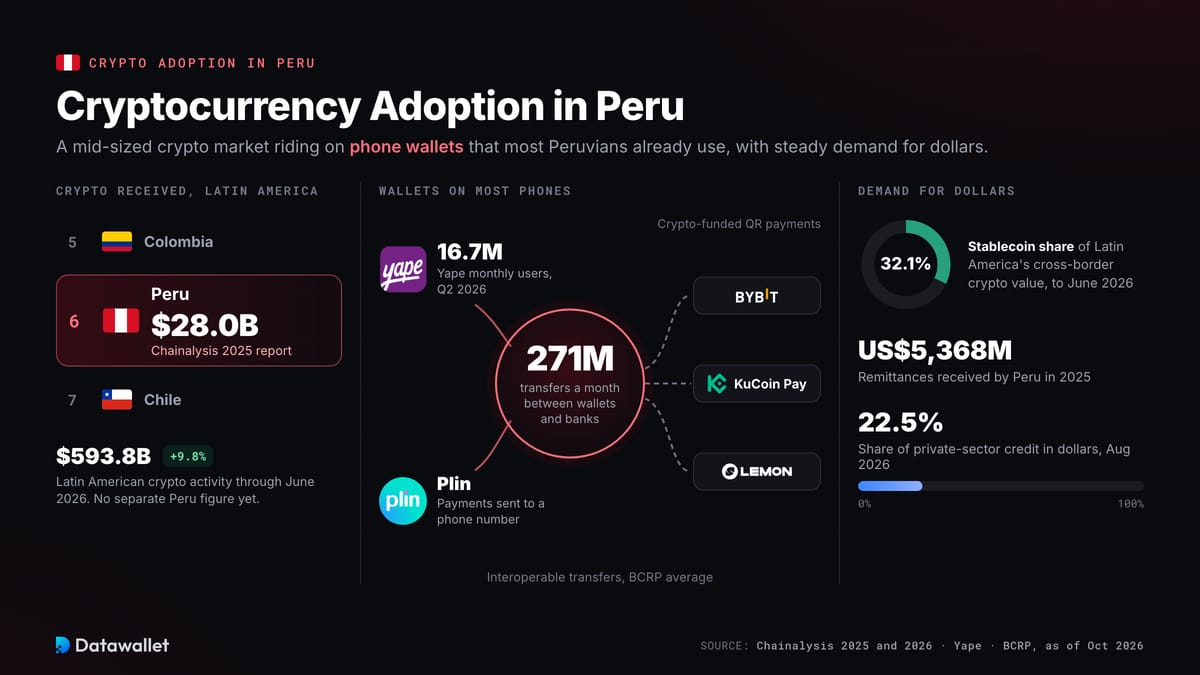
Published figures show three trends in Peru's growing use of crypto alongside digital payments.
- Sixth-largest market in the region: Peru received $28.0 billion in crypto value, behind Colombia and ahead of Chile, according to the 2025 regional report from Chainalysis. Its 2026 report recorded $593.8 billion in Latin American crypto activity through June 2026, up 9.8%. It gave no separate figure for Peru.
- Wallets on most phones: In the second quarter of 2026, Yape reported 16.7 million monthly active users. BCRP data puts transfers between different wallets and banks at an average of 271 million a month. Bybit Pay, KuCoin Pay and Lemon use this network for crypto-funded QR payments.
- Stablecoins lead demand: Stablecoins accounted for 32.1% of Latin America's cross-border crypto value by June 2026. Remittances received by Peru totaled US$5,368 million in 2025. As of August 2026, dollars still accounted for 22.5% of credit to the private sector.
For global context, see our crypto adoption statistics and stablecoin statistics.
How to Buy Bitcoin in Peru
For your first purchase, have your ID ready and a Peruvian bank account or wallet registered in your name. Set aside about S/100 for a test. The five steps below use Bybit.
- Open an account: Register with Bybit and set Peru as your country of residence.
- Verify your identity: Upload a DNI or passport, then complete the face scan. Foreign residents can use a residence permit such as the carné de extranjería.
- Deposit soles: Select PEN on the fiat deposit screen, then PagoEfectivo. Pay the code from your own account through BCP, BBVA, Scotiabank or Interbank. Deposits usually arrive within three working days. P2P with Yape or Plin is faster.
- Buy with a limit order: First convert your soles balance to USDT using the method Bybit displays for fiat balances. Open the BTC/USDT spot market and set the maximum price you will pay. Quick-purchase screens add a margin.
- Move long-term holdings to your own wallet: With a self-custody wallet, you control the private keys. Our best crypto wallets page ranks hardware devices. Check that the network matches on both sides and make a small test transfer before sending the full amount.
Reverse the steps to sell and withdraw soles to your own bank account. For P2P sales, release coins only after the soles appear in your banking or wallet app. An image sent in chat is not proof of payment.
Final Thoughts
Bybit ranks first in Peru because customers can use bank payment codes, withdraw soles, and pay through Yape and Plin. Binance offers another bank code alongside P2P pages for local payment methods, while OKX pairs low fees with a measurable P2P market. Gate has the widest coin list at a higher fee, and MEXC combines the lowest fees with bank transfers. Bitget remains a choice for copy trading but ranks last following the September theft.
Rules are tightening in Peru without a licensing law. Local providers must now follow the Travel Rule, and SUNAT is preparing to collect data. Congress has not revived the framework bill. Crypto on any exchange remains outside deposit insurance.
Start with a small deposit and withdrawal. Record every trade in soles, and keep long-term coins in your own wallet. Our rankings for Colombia, Argentina and Brazil cover neighboring markets.
Our Methodology
We applied six criteria to the services a resident of Peru could use in October 2026.
- Trust Score: Each rating out of 5 reflects foreign regulation and reserve reporting, together with security incidents and the platform's response.
- Funding in soles: The platform's help pages and terms provided information on bank codes, bank transfers, cards, and P2P. We recorded limits and stated processing times.
- P2P market activity: We counted live soles offers on OKX and Bitget on 9 October 2026. Binance, Bybit and Gate did not publish offers in a form we could count.
- Total cost: For a complete purchase and sale, we compared spot fees, token discounts, card charges, and P2P price gaps.
- Security and enforcement: The review covered thefts, account freezes, court cases and regulator notices through October 2026.
- Products and language: Coin counts came from CoinGecko's exchange pages on 9 and 10 October 2026. We also recorded payment tools and cards, plus copy trading and Spanish-language help pages.
We completed these checks on 10 October 2026 by placing test trades. Sources included El Peruano, the SBS, SUNAT, the BCRP, the US Department of Justice and platform help centers. The full process is set out in our editorial methodology.
.webp)