


Login to Track Your Live Crypto Portfolio
Sign Up and Track Your Live Crypto Portfolio for Free
Forgot your password?
SEC And CFTC Declare Most Crypto Assets Not Securities

This article has been reviewed and verified for accuracy by our editorial team. All claims, data points and platform details are cross-referenced against primary sources.
Some links on this page are affiliate links. Datawallet may earn a commission when you sign up through them, at no extra cost to you. This never influences our editorial ratings, rankings or recommendations.
Some links on this page are affiliate links. Datawallet may earn a commission when you sign up through them, at no extra cost to you. Ratings and rankings reflect our own testing and assessment criteria.

GM. The SEC and CFTC issued joint guidance today declaring that most digital assets are not securities, marking a historic shift away from "regulation by enforcement."
Meanwhile, Stripe and Paradigm launched the Tempo L1 mainnet, Hyperliquid debuted licensed S&P 500 perps, and American Bitcoin’s BTC holdings surpassed Galaxy Digital.
Here are the details on regulatory pivots, machine economies, and treasury flips. 👇
SEC And CFTC Declare Most Crypto Assets Not Securities
The Securities and Exchange Commission and Commodity Futures Trading Commission issued a joint 68-page guidance clarifying the legal status of cryptocurrencies. This landmark interpretation asserts that most digital assets do not qualify as investment contracts.
The regulatory overhaul occurred during the DC Blockchain Summit in Washington D.C. to provide immediate market clarity. This formal taxonomy represents a stark departure from the aggressive enforcement strategies utilized by previous administrations.
SEC Chair Paul Atkins initiated this specific policy because he seeks to delineate clear boundaries between digital commodities and securities. By establishing a functional crypto system framework, the agencies aim to resolve a decade of legal uncertainty.
Regulators achieved this clarity by exempting stablecoins, digital tools, and protocol staking from federal securities oversight unless specific managerial promises exist. Consequently, the new guidelines utilize the Howey Test to protect investors without stifling decentralized innovation.
Stripe-Backed Tempo Network Launches Global Mainnet
The payments giant Stripe and venture firm Paradigm launched the Tempo layer-1 mainnet. The network provides essential infrastructure for the agentic economy by introducing a new open standard for machine transactions. The Machine Payments Protocol allows AI agents to coordinate, authorize, and settle programmatic payments without relying on traditional or outdated banking rails.
Early partners like Visa and Lightspark have already extended the protocol to support card-based payments and Bitcoin transactions. This system enables AI agents to pay for digital resources autonomously through a specialized directory of compatible services. By utilizing secure payment sessions, the network simplifies how automated machines interact with tools from major companies like OpenAI and Google.
Hyperliquid Launches Official S&P 500 Perpetual Futures
Hyperliquid traders gained access to officially licensed S&P 500 perpetual futures through a new partnership. The agreement between S&P Dow Jones Indices and Trade[XYZ] allows international investors to trade the index around the clock. These contracts are settled in USDC stablecoins and provide leveraged exposure to the largest publicly traded companies in the United States.
Traditional finance institutions are increasingly exploring onchain derivatives as global demand for perpetual futures continues to grow. While crypto pairs still dominate Hyperliquid, index-based products recently commanded over 5% of total trading volume. This launch arrives as federal regulators prepare a new framework to bring similar regulated derivative products to the domestic American market.
American Bitcoin Surpasses Galaxy Digital In BTC Holdings
The mining firm American Bitcoin climbed to the 16th rank among public holders after increasing its treasury. The company now owns 6,899 BTC valued at roughly $491 Million following a period of aggressive accumulation. This surge allowed the Trump-affiliated entity to edge past Galaxy Digital as firms compete to build the largest digital asset reserves globally.
While some competitors are directing capital toward AI infrastructure, this firm has doubled down on its Canadian mining operations. The recent purchase of 11,298 ASIC miners is expected to boost its total network capacity by approximately 12%. This strategic expansion ensures the company remains a top player in the sector while maintaining a strong balance sheet for future growth.
Data of the Day
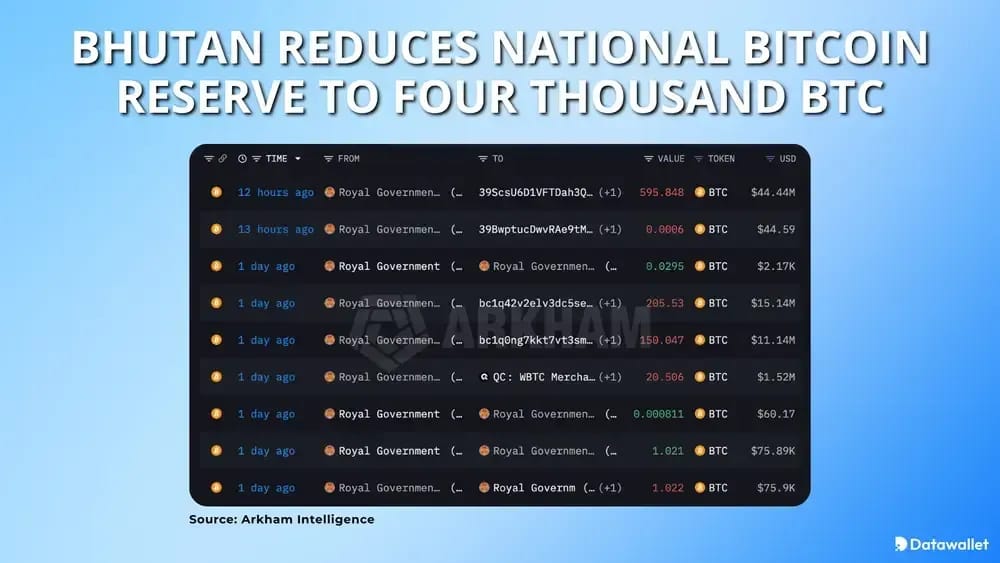
The Kingdom of Bhutan transferred over $72.3 Million in Bitcoin from its national wallets during the last 24 hours. State-owned investment company Druk Holding and Investments moved 973 BTC across six separate transactions as part of its ongoing management strategy. The recent activity leaves the landlocked nation with roughly 4,400 BTC currently valued at more than $322 Million.
Analysts suggest that the lack of recent inflows indicates the country may have significantly curtailed its local mining operations. Bhutan previously utilized its renewable energy sources to build a massive reserve that peaked at over 13,000 coins in 2024. These liquidated funds are reportedly intended to support long-term economic development projects like the ambitious Gelephu Mindfulness City.
More Breaking News
- Canada’s financial intelligence unit revoked the registrations of 23 crypto-related firms, marking a major escalation in national anti-money laundering enforcement efforts.
- Bitcoin's hash rate dropped 8% as the Iran war drove up global energy costs, potentially signaling a new phase of miner capitulation.
- Visa Crypto Labs launched a command-line tool allowing AI bots to make secure, automated payments without the need for human API management.
- Polymarket acquired crypto startup Brahma to improve user experience and boost liquidity for niche, thinly traded prediction market contracts across its platform.
- Circle’s policy chief told UK lawmakers that Britain should merge the best elements of the EU's MiCA and the US GENIUS Act.
- Research firm K33 warned that Strategy's aggressive Bitcoin accumulation using STRC preferred stock introduces structural risks sensitive to shifting market sentiment and pricing.
- A UK parliamentary committee urged an immediate moratorium on crypto political donations to prevent foreign interference risks ahead of the next election.
- Kenya’s National Treasury proposed new rules requiring stablecoin issuers to maintain 30% of their reserves in segregated accounts at local commercial banks.
- Arizona’s Attorney General filed criminal gambling charges against Kalshi, as the platform maintains it should only be subject to federal CFTC oversight.
For the latest updates on digital asset markets, follow us on X @Datawalletcom.
For the latest updates on digital asset markets, follow us on X @Datawalletcom.
Get tomorrow’s issue in your inbox