


Login to Track Your Live Crypto Portfolio
Sign Up and Track Your Live Crypto Portfolio for Free
Forgot your password?
SEC Prepares Regulatory Framework for Tokenized Stock Trading

This article has been reviewed and verified for accuracy by our editorial team. All claims, data points and platform details are cross-referenced against primary sources.
Some links on this page are affiliate links. Datawallet may earn a commission when you sign up through them, at no extra cost to you. This never influences our editorial ratings, rankings or recommendations.
Some links on this page are affiliate links. Datawallet may earn a commission when you sign up through them, at no extra cost to you. Ratings and rankings reflect our own testing and assessment criteria.

GM. The SEC is reportedly preparing a sweeping "innovation exemption" proposal to allow trading platforms to offer digital, tokenized versions of publicly traded equities on public blockchains.
Meanwhile, Echo Protocol suffered a $76 million exploit on its Monad deployment after an admin-key compromise, the CFTC and DOJ joined forces to sue Minnesota over its new prediction market ban, and Senator Elizabeth Warren challenged the OCC over its recent approval of national trust charters for major crypto companies.
Here are the details on tokenized stock frameworks, key-compromise exploits, and federal-state regulatory clashes. 👇
SEC Prepares Regulatory Framework for Tokenized Stock Trading
The United States Securities and Exchange Commission is about to release a sweeping regulatory proposal allowing trading platforms to offer digital versions of publicly traded equities. This strategic shift introduces a lighter compliance structure called an innovation exemption designed to help platforms modernize traditional market plumbing through public blockchain networks.
The pending framework reconfigures how global participants interact with the $126 trillion equity market by taking an unexpected stance on asset issuance. According to regulatory sources, the agency is leaning toward permitting the listing of tokens created completely without the explicit consent of the corporations whose underlying shares they track.
Traditional financial powerhouses have moved quickly to position themselves for this structural transformation ahead of the federal announcement. The Depository Trust and Clearing Corporation intends to launch limited production trades of tokenized stocks this July to achieve instant settlement before a broader system rollout across the market in October.
SEC Chairman Paul Atkins has aggressively driven this agenda as part of an administrative campaign to integrate distributed ledger technology into core domestic financial infrastructure. Atkins argued that existing securities rules do not fit automated protocols that combine exchange, clearing, and settlement functions into a single system.
Echo Protocol Suffers $76 Million Exploit on Monad
Echo Protocol was hit on its Monad deployment after an attacker used a compromised admin key to mint 1,000 unauthorized eBTC worth roughly $77 million. The exploiter borrowed against part of that position. Echo said around $816,000 was ultimately lost and laundered through Tornado Cash.
The team said Monad itself was unaffected, burned the remaining 955 eBTC still under attacker control, and paused cross-chain functions tied to the deployment. Aptos exposure appears untouched for now. The breach follows the same admin-key pattern haunting DeFi, where one offchain credential can rupture an entire minting system.
CFTC Sues Minnesota Over Prediction Markets Ban
The Commodity Futures Trading Commission joined forces with the Department of Justice to sue Minnesota officials over a newly signed bill prohibiting prediction markets. Federal prosecutors argue that the state is unlawfully attempting to criminalize derivatives products that fall exclusively under federal financial jurisdiction.
The complaint notes this statute constitutes the first outright ban on event contracts within the United States market infrastructure. Regulators claim the law wrongfully exposes banks, media organizations, and professional sports leagues to severe criminal liability. The legal battle escalates an ongoing jurisdictional clash over who polices prediction market binary swaps.
Sen. Warren Challenges OCC Over Crypto Banking Charters
Elizabeth Warren told the Comptroller of the Currency that recent national trust charters for crypto firms unlawfully stretch the National Bank Act. She argued those businesses function like banks. Her letter named Coinbase, Circle, Ripple, BitGo, and others now entering the federal trust framework.
Warren said the approved firms appear to be handling custody, payments, lending, and stablecoin activities without the obligations traditional banks face. She wants documents, correspondence, and legal reasoning. The senator also renewed scrutiny around whether Trump-linked crypto interests received favorable treatment during the charter approval process.
Data of the Day
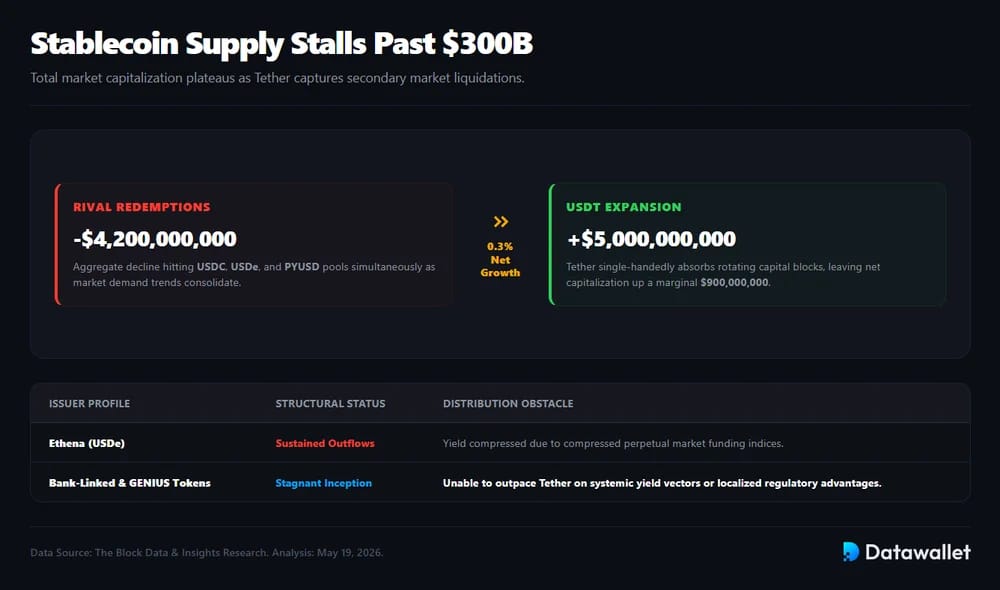
Stablecoin supply climbed past $300 billion, but category growth has nearly flatlined as Tether added more than $5 billion while rivals shrank. Net expansion was roughly $900 million. That amounts to just 0.3% growth, suggesting fresh demand is not meaningfully broadening across issuers.
USDC, USDe, and PYUSD together lost about $4.2 billion over the same span, leaving USDT to absorb nearly all incremental share. Ethena’s USDe kept sliding. New bank-linked and GENIUS Act compliant entrants have yet to prove they can beat Tether on yield, distribution, or regulatory advantage.
More Breaking News
- Minnesota signed a law letting banks and credit unions offer crypto custody from August 1, with segregation, risk controls, and 60-day notice requirements built in.
- Polymarket partnered with Nasdaq Private Market to launch contracts on startup valuations, IPO timing, and secondary activity, opening a $5 trillion private-company arena to retail traders.
- Bernstein said bitcoin miners control more than 27 gigawatts of planned power, positioning names like IREN and CleanSpark to capture upside from $90 billion in AI deals.
- The Federal Reserve said 10% of Americans used or invested in crypto in 2025, the highest share in three years, though still below 2021’s retail peak.
- Japan’s ruling party approved an AI and blockchain finance blueprint backing 24/7 agentic commerce, tokenized deposits, yen stablecoins, and a five-year public-private roadmap.
- Bitcoin ETFs lost $649 million in one session, yet analysts said persistent long-term holder accumulation is still putting a floor under deeper downside.
- Ostium said Nasdaq data will power its equity perpetuals, making it the first onchain protocol offering self-custodial exposure to U.S. stock products with exchange-grade inputs.
- A South Korean funeral company is carrying a $33 million unrealized hit after placing customer funds into leveraged Ether ETFs, reviving scrutiny of weak industry oversight.
For the latest updates on digital asset markets, follow us on X @Datawalletcom.
For the latest updates on digital asset markets, follow us on X @Datawalletcom.
Get tomorrow’s issue in your inbox