




Polymarket trading is the new trenches, surpassing the intense, cutthroat action of perpetuals and meme coin speculation. This shift requires advanced data-driven strategies for success. Here, your data advantage becomes tradable alpha for systemic gains.
The real money is made through correlated asset lag (e.g., betting on a cabinet pick after a presidential win) or real-world hedging (insuring a crypto portfolio against an ETF denial). This shift rewards deep knowledge over impulsive, emotional trades.
Start reading now to discover the top strategies for trading prediction markets. 👇
Best Polymarket Trading Strategies Compared
We assessed each Polymarket trading approach on expected value after fees rather than on historical accuracy alone, because the sweeping March 2026 fee rollout quietly killed several strategies that only worked when execution was free. Every method was tested against live order books.
The table compares how each strategy behaves on risk, cost sensitivity and automation potential:
1. Binary Complement Arbitrage
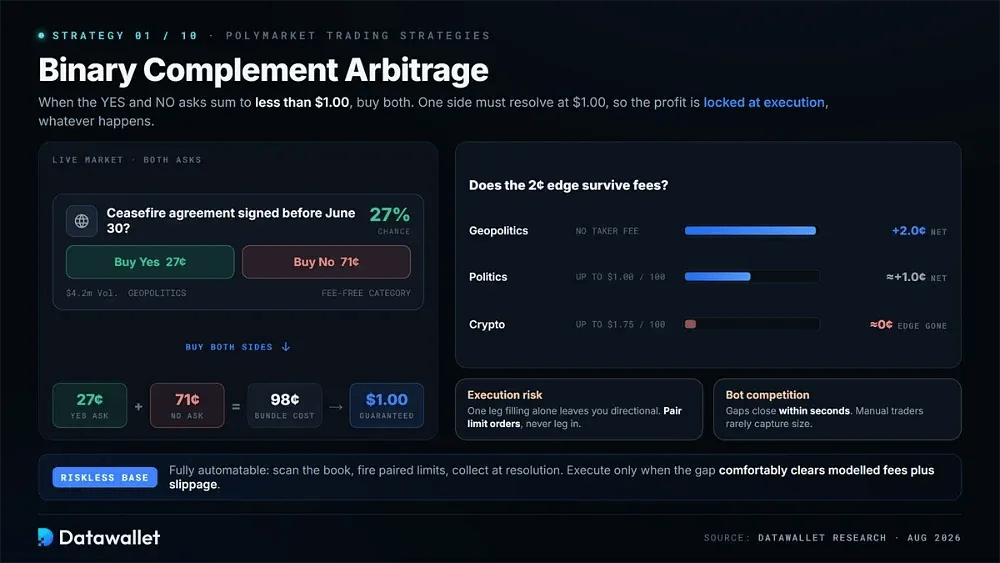
The foundation of riskless prediction market trading is buying both sides of a binary market when their combined ask price sits below one dollar. Because exactly one outcome must resolve to $1.00, owning both shares guarantees a payout that exceeds your entry cost regardless of what actually happens.
The 2026 complication is that this edge must now clear fees. On a politics market charging up to $1.00 per 100 shares, a two-cent gross spread becomes roughly one cent net, so we only execute when the gap comfortably exceeds modelled fees plus slippage.
Example: On a market where YES asks at 27 cents and NO asks at 71 cents, the bundle costs 98 cents for a guaranteed $1.00 payout. That two-cent gross edge survives on a fee-free geopolitics market but disappears entirely on crypto markets charging up to $1.75 per 100 shares.
Pros
- Mathematically riskless: One outcome always resolves at one dollar, so the profit is locked at execution rather than predicted.
- Fully automatable: Order book scanning and paired limit execution run without discretion, making this ideal for systematic bot deployment.
- Fee-free markets exist: Geopolitics contracts carry no taker fee, preserving the entire gross spread for arbitrageurs willing to specialise.
Cons
- Fees eat thin spreads: A two-cent gap that was pure profit in 2025 can now net close to zero after category taker fees apply.
- Execution risk: One leg filling without the other leaves you directionally exposed, which is why paired limit orders matter enormously.
- Rapid competition: Bots close these gaps within seconds, so manual traders realistically never capture them at meaningful size.
2. Multi-Outcome Bundle Arbitrage
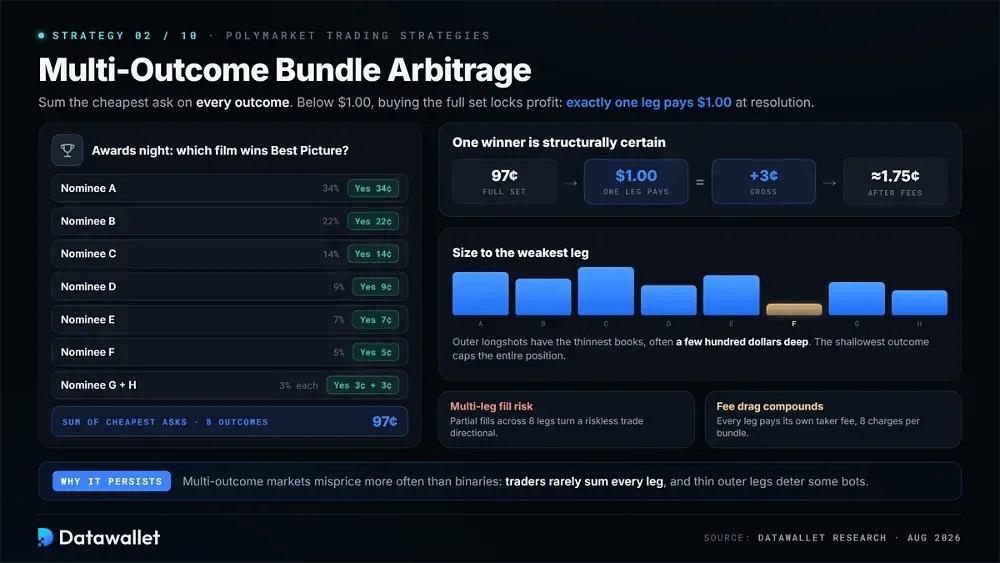
The same logic extends to markets with several possible winners. Sum the cheapest ask across every outcome, and if that total falls below one dollar, buying the complete set guarantees profit because precisely one outcome must resolve in your favour at resolution.
Execution difficulty scales with the number of legs. A ten-candidate market requires ten simultaneous fills, and your size is capped by the shallowest book among them. We size to the weakest leg rather than legging in, a discipline covered in our prediction markets guide.
Example: In an awards market, imagine every nominee's ask sums to 97 cents across eight outcomes. Buying one share of each guarantees $1.00 back, yielding three cents gross. After a $1.25 per 100 share culture-category fee, roughly 1.75 cents survives per bundle.
Pros
- Larger gross spreads: Multi-outcome markets misprice more often than binaries, since traders rarely sum every leg manually.
- Guaranteed resolution: Exactly one outcome pays out, so the bundle's return is structurally certain once every leg fills.
- Less bot competition: Complexity and thin outer legs deter some automated players, leaving gaps open marginally longer than binaries.
Cons
- Depth-capped sizing: Your entire position is limited by the shallowest outcome's order book, often just a few hundred dollars.
- Multi-leg execution risk: Partial fills across many legs leave unbalanced exposure that can turn a riskless trade directional.
- Compounding fee drag: Every leg pays its own taker fee, so an eight-outcome bundle absorbs eight separate charges.
3. US and Global Cross-Venue Arbitrage
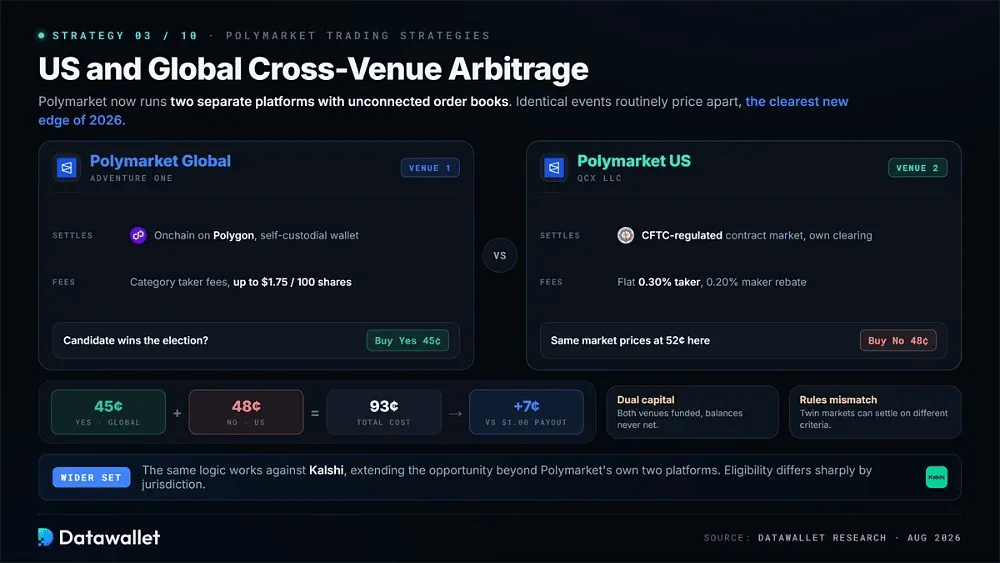
Polymarket now operates two completely separate platforms with different rules. The global venue runs on Polygon under Adventure One, while Polymarket US operates as QCX LLC, a CFTC-regulated designated contract market carrying its own order books, liquidity and customer balances.
Those books are not connected, so identical events routinely price differently. We treat this as the clearest new opportunity of 2026, since the US platform's flat 0.30% taker fee and 0.20% maker rebate create a materially different cost base from the global category model.
Example: A political market trades at 45 cents on the global platform and 52 cents on the US exchange. Buying YES globally and NO domestically costs 93 cents against a guaranteed dollar, though you need funded accounts on both venues and must account for each platform's separate fee schedule.
Pros
- Structurally separate books: Two unconnected order books on the same events create persistent, repeatable pricing divergence between venues.
- Different fee models: The US flat rate versus global category rates means one venue is often materially cheaper per trade.
- Kalshi extends it: The same logic applies against Kalshi, widening the opportunity set beyond Polymarket's own two platforms.
Cons
- Dual capital requirement: You must fund and maintain positions on both venues, tying up capital that cannot be netted across them.
- Access restrictions: Eligibility differs sharply by jurisdiction, and our Polymarket restricted countries guide shows how many are excluded outright.
- Resolution mismatch: Superficially identical markets can settle on different criteria, turning a supposed arbitrage into genuine directional risk.
4. Maker Rebate Tier Farming
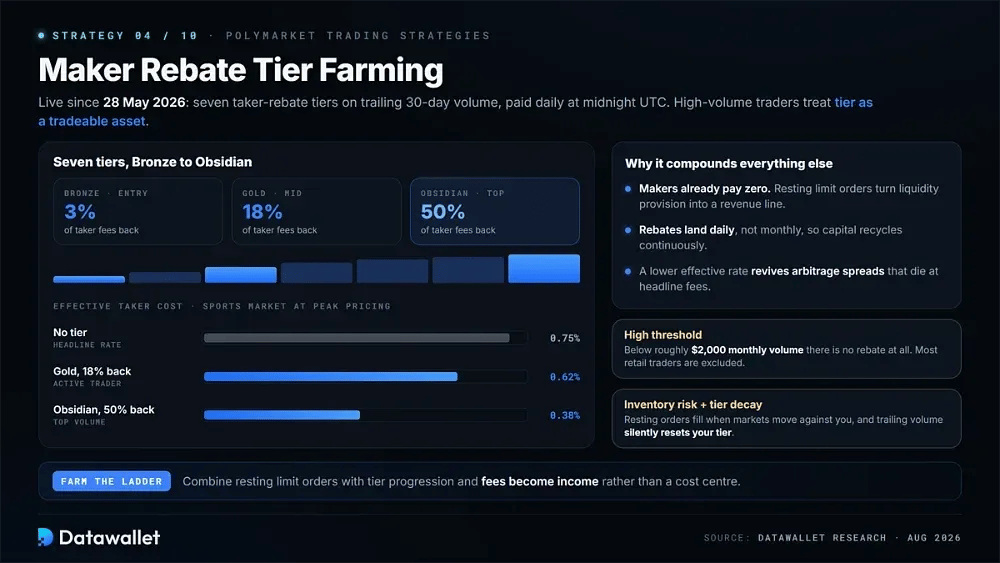
Polymarket activated a tiered taker rebate programme on 28 May 2026, running seven distinct levels from Bronze at 3% back through to Obsidian at 50% back, assigned on trailing 30-day weighted volume. Rebates pay daily at midnight UTC into your balance.
The strategic implication is that high-volume traders should treat rebate tier as a tradeable asset. Makers already pay zero fees, so combining resting limit orders with tier progression turns liquidity provision into a revenue line rather than a cost centre for active participants.
Example: A Gold-tier trader receiving 18% back pays roughly 0.62% net on a sports market where the headline rate is 0.75%. At Obsidian, that same trade costs about 0.38%, halving the drag on every strategy in this article that requires taking liquidity.
Pros
- Turns cost into income: Makers pay nothing and can earn rebates, so providing liquidity generates returns independent of directional accuracy.
- Compounds other strategies: A lower effective fee rate revives arbitrage spreads that would otherwise be unprofitable after standard taker charges.
- Daily settlement: Rebates arrive every day rather than monthly, improving capital efficiency for traders recycling funds continuously.
Cons
- High volume threshold: Traders below roughly $2,000 monthly receive no rebate at all, excluding most retail participants entirely.
- Inventory risk: Resting limit orders fill when markets move against you, leaving positions you did not actively choose to hold.
- Tier decay: Rebate levels reset on trailing volume, so reduced activity silently raises your effective cost base.
5. Fee-Free Geopolitics Trading
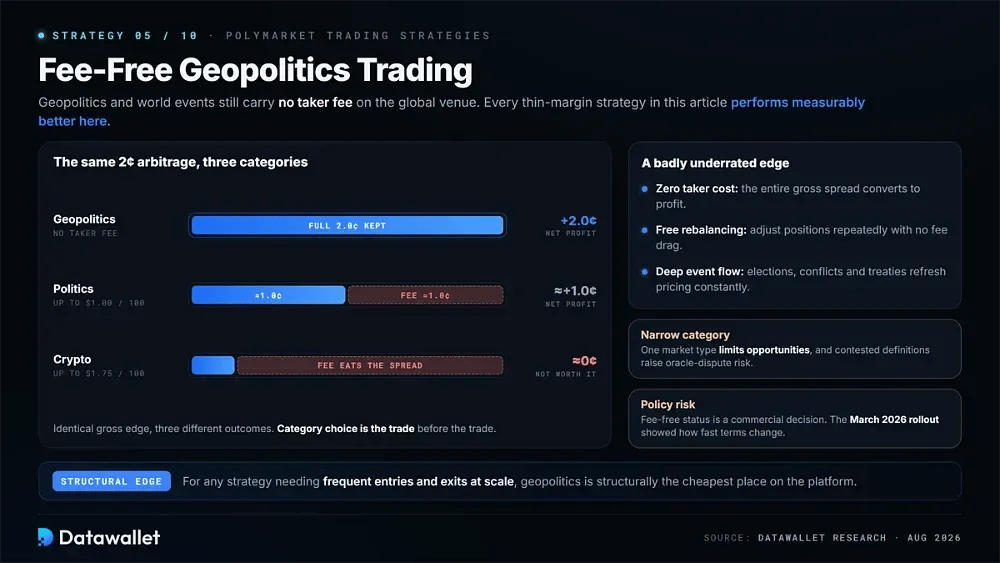
Not every category on the platform charges a taker fee. Geopolitics and world events markets remain completely free on the global venue, which makes them structurally the most attractive category for any strategy requiring frequent entries and exits at meaningful scale.
We treat this as a badly underrated structural edge. Every arbitrage and momentum approach in this article performs measurably better inside a genuinely zero-fee category, since the entire gross spread converts directly to profit, a dynamic visible across prediction market statistics.
Example: A two-cent complement arbitrage on a crypto market charging $1.75 per 100 shares nets close to nothing after fees. The identical two-cent gap on a fee-free geopolitics contract delivers the full two cents, making the same trade genuinely worth executing.
Pros
- Zero taker cost: The full gross spread converts to profit, reviving thin-margin strategies that other categories no longer support.
- Frequent rebalancing: Free execution means positions can be adjusted repeatedly without accumulating the fee drag other categories impose.
- Deep event flow: Geopolitical markets refresh constantly around elections, conflicts and treaties, providing continuous fresh pricing opportunities.
Cons
- Narrow category: Restricting yourself to one market type sharply limits the number of tradeable opportunities available at any moment.
- Resolution ambiguity: Geopolitical outcomes often hinge on contested definitions, raising the risk of disputed settlements through the oracle.
- Policy risk: Fee-free status is a commercial decision Polymarket can reverse, and the March 2026 rollout showed how quickly terms change.
6. Settlement Rules Edge
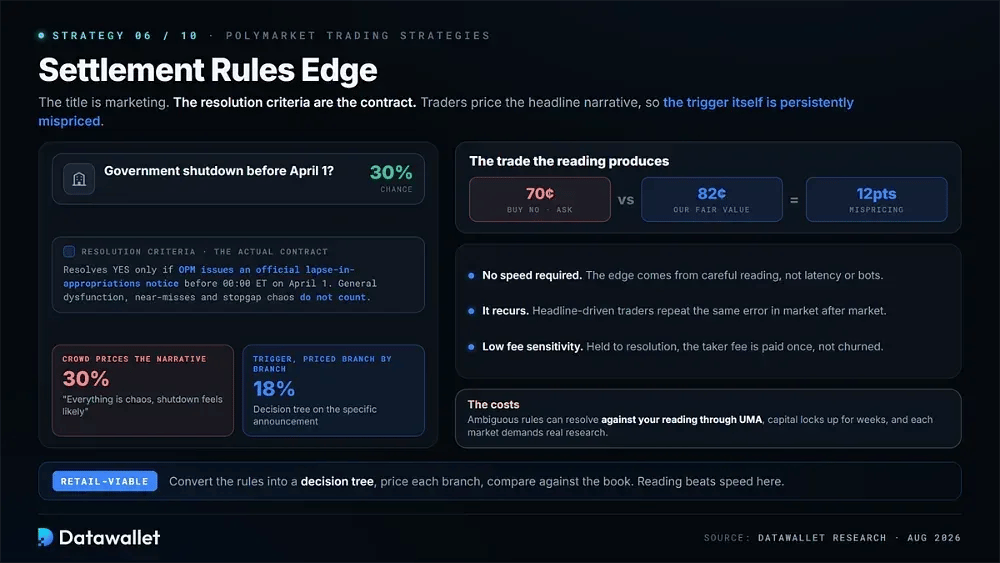
The market title is marketing, while the resolution criteria form the actual binding contract. Mispricings appear consistently when traders price the headline narrative rather than the specific trigger that determines settlement, and that persistent gap is where disciplined analysis genuinely pays.
We convert the resolution rules into a decision tree, assign probabilities to each branch, then compare our resulting number against the order book. Because this edge comes from careful reading rather than raw speed, retail traders can genuinely execute it against professionals.
Example: A government shutdown market may settle on one specific administrative announcement rather than on general political dysfunction. If traders price the chaos narrative at 30% while the actual trigger probability sits nearer 18%, buying NO around 70 cents captures a twelve-point mispricing.
Pros
- No speed requirement: The edge comes from careful reading rather than latency, making it accessible without bots or infrastructure.
- Durable mispricing: Headline-driven traders repeat the same error across markets, so the opportunity recurs rather than closing permanently.
- Low fee sensitivity: Positions are held to resolution rather than churned, so taker fees are paid once instead of repeatedly.
Cons
- Oracle dispute risk: Ambiguous rules can be resolved against your reading through UMA, turning a correct analysis into a losing position.
- Slow capital turnover: Holding to resolution locks funds for weeks or months, reducing how often capital can be redeployed.
- Research intensive: Each market demands genuine work, so the strategy does not scale across many positions simultaneously.
7. Catalyst Momentum
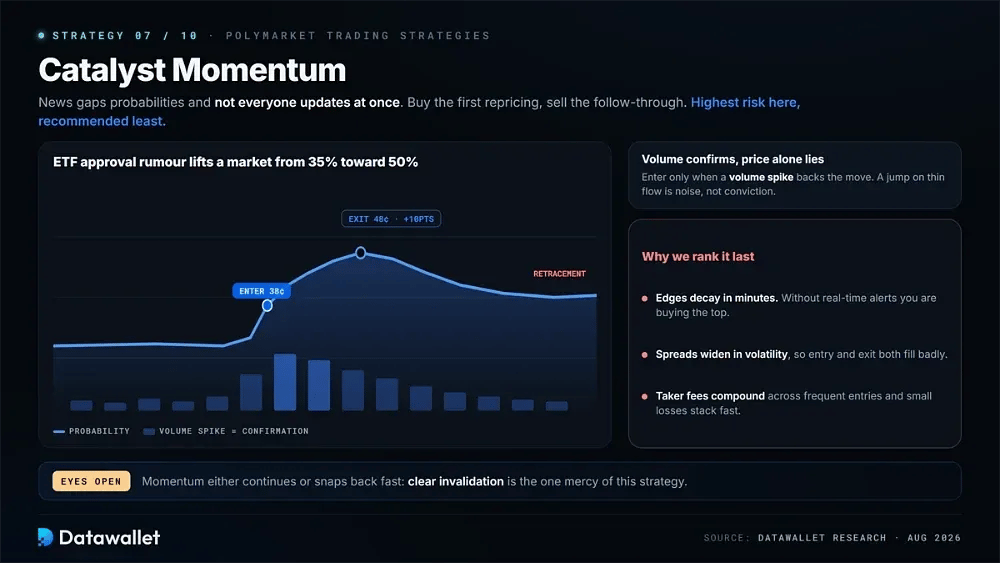
Probabilities gap violently after breaking news, and not every participant updates their view simultaneously. Momentum trading buys that first repricing and sells into the follow-through, using volume spikes rather than price movement alone as confirmation that the move carries genuine conviction.
This is the highest-risk strategy here and we recommend it least. Edges decay within minutes, spreads widen exactly when you need liquidity, and the taker fees required for fast entry compound quickly against you, a pattern documented across decentralised prediction markets.
Example: An ETF approval rumour lifts a market from 35% toward 50%. Buying at 38 cents into thin rising bids and exiting near 48 cents captures ten points, but only if the news holds and your exit executes before the inevitable retracement.
Pros
- Large fast moves: Repricing after genuine news can deliver ten or more points within minutes, far exceeding arbitrage margins.
- Frequent opportunities: News flows continuously across politics, crypto and sport, providing regular setups for traders monitoring actively.
- Clear invalidation: Momentum either continues or snaps back quickly, so losing trades reveal themselves fast rather than bleeding slowly.
Cons
- Rapid edge decay: Advantages disappear within minutes, so anyone without real-time alerting is systematically buying the top of moves.
- Worst spreads: Liquidity thins precisely during volatility, meaning your entry and exit both execute at unfavourable prices.
- Fee compounding: Frequent taker entries accumulate charges quickly, and a string of small losses erodes capital faster than expected.
8. Favourite Compounding
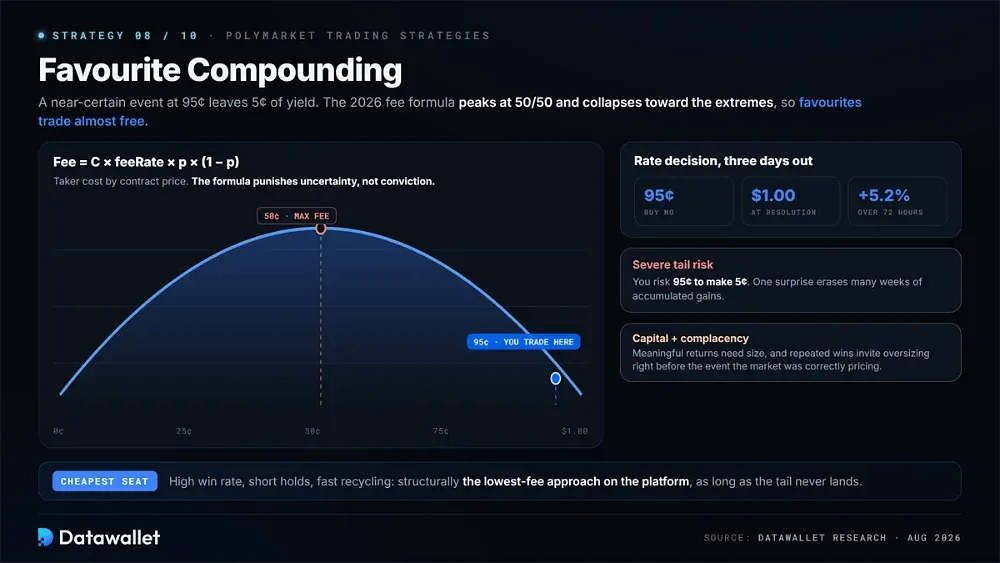
Grinding high-probability outcomes generates small, reliable returns that compound through repetition. When a market prices a near-certain event at 95 cents, the remaining five cents represents genuine yield if your assessment of the residual risk is more accurate than the crowd's.
The 2026 fee structure improved this particular strategy quite meaningfully. Because the fee formula peaks at the 50/50 price point and falls away toward both extremes, trading at 95 cents costs dramatically less than trading the identical market at 50 cents.
Example: A rate decision trades at 5 cents for the unlikely outcome, so NO costs 95 cents. With data pointing firmly toward no change and resolution three days away, that position yields roughly 5.2% over 72 hours at minimal fee cost.
Pros
- Low fee drag: The pricing formula charges least at extreme probabilities, so favourite trading is structurally the cheapest approach available.
- High win rate: Most positions resolve favourably, which suits traders who find frequent small losses psychologically difficult to sustain.
- Short duration: Near-certain events usually resolve quickly, allowing capital to recycle rapidly rather than sitting locked for months.
Cons
- Severe tail risk: A single unexpected outcome erases many weeks of accumulated gains, since you risk 95 cents to make five.
- Capital intensive: Meaningful returns require large positions, because a 5% yield on small size is not worth the execution effort.
- Complacency danger: Repeated wins encourage oversizing precisely before the low-probability event that the market was correctly pricing.
9. Longshot Bias Fade
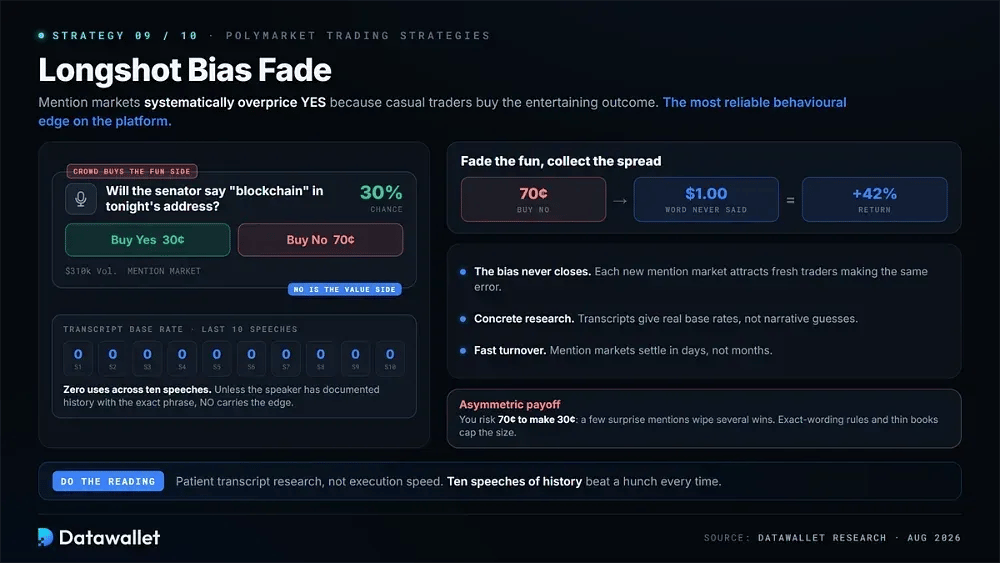
Markets asking whether a public figure will say a specific word systematically overprice YES, because casual traders buy the entertaining outcome. Unless the speaker has a documented history of using that exact phrase, the NO side carries measurable statistical advantage.
We consider this the most reliable behavioural edge available anywhere on the platform today. It requires patient transcript research rather than execution speed, and the longshot bias recurs continuously because each new market attracts fresh participants making the identical psychological error.
Example: A market asks whether a politician will say a particular word during an address, trading YES at 30 cents. Transcript analysis of ten recent speeches shows zero uses. Buying NO at 70 cents returns roughly 42% when the word never appears.
Pros
- Persistent bias: Retail overpricing of exciting outcomes recurs in every new mention market rather than being arbitraged away permanently.
- Researchable edge: Transcript history provides genuine base rates, so the analysis is concrete rather than speculative or narrative-driven.
- Short resolution: Mention markets settle within days rather than months, keeping capital turnover high compared with long-dated political contracts.
Cons
- Asymmetric payoff: You risk 70 cents to make 30, so a handful of surprise mentions wipes out several successful positions.
- Phrasing disputes: Exact wording rules create resolution ambiguity, and near-misses can be settled against your reading unexpectedly.
- Thin liquidity: These markets rarely support large position sizes, capping the strategy's total capacity well below what arbitrage approaches allow.
10. Whale Copy Trading
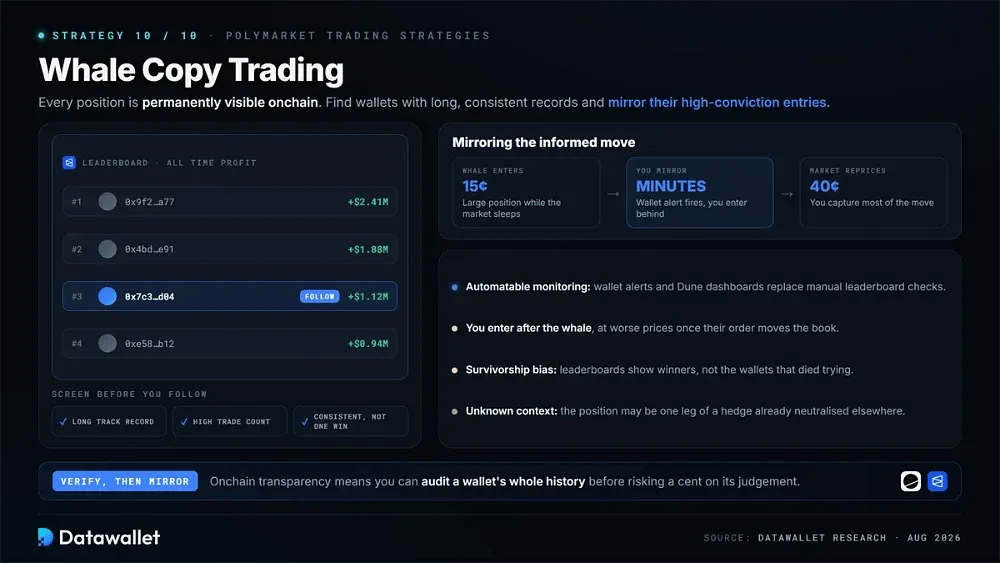
Blockchain transparency makes every single position permanently visible, so identifying consistently profitable wallets and then mirroring their high-conviction entries is genuinely viable. The Polymarket leaderboard and public Dune dashboards both surface addresses demonstrating sustained performance rather than a single lucky outcome.
Filtering matters considerably more than simply following. We screen for wallets with long track records, high trade counts and consistent returns rather than one outsized win, applying the same discipline we use when evaluating copy trading platforms elsewhere in crypto.
Example: A top-ranked wallet places a large position on a political outcome at 15 cents while the broader market remains largely inattentive. Mirroring that entry within minutes and exiting once the market reprices toward 40 cents captures most of the informed move.
Pros
- Full transparency: Every onchain position is public, so you can verify a wallet's genuine history rather than trusting claimed results.
- Information shortcut: Following genuinely informed traders provides exposure to research and modelling you could not replicate independently.
- Automatable monitoring: Wallet alerts and dashboards make tracking systematic rather than requiring constant manual leaderboard checking throughout each day.
Cons
- Entry price slippage: You necessarily enter after the whale, often at worse prices once their order has already moved the book.
- Survivorship bias: Leaderboards showcase winners while hiding the far larger population of wallets that lost money entirely.
- Unknown context: A whale's position may be one leg of a hedge, so copying it in isolation carries risk they have already neutralised.
Polymarket's 2026 Regulatory and Structural Shift
Polymarket changed more between 2025 and 2026 than in its entire prior history under founder Shayne Coplan. It moved from an offshore venue barred from the United States into a dual-structure business with a CFTC-regulated American exchange alongside the global market.
How Polymarket Re-Entered the United States
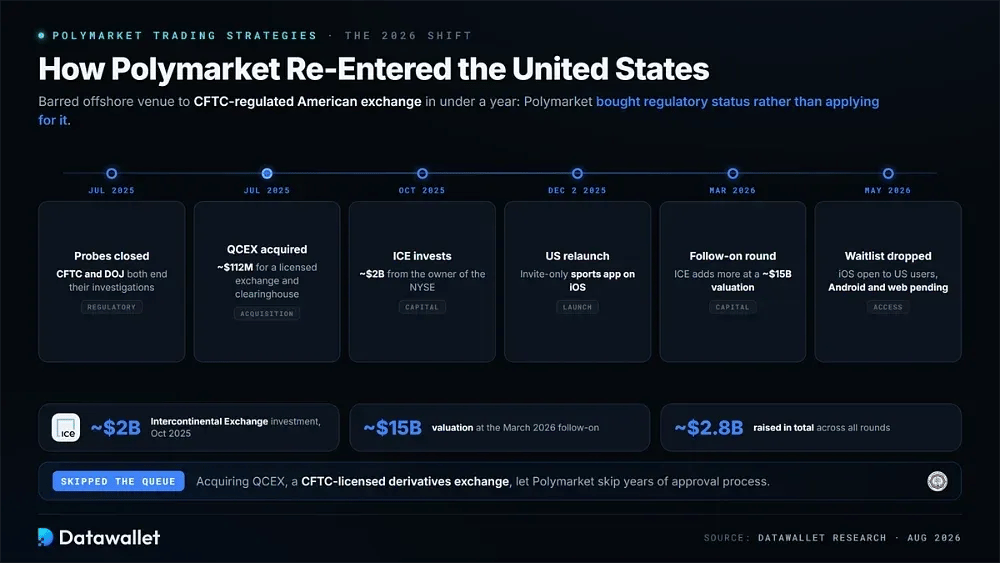
The turning point came in July 2025, when the CFTC and Department of Justice both closed their investigations. Days later, Polymarket acquired QCEX, a CFTC-licensed derivatives exchange and clearinghouse, for roughly $112 million, buying regulatory status rather than applying for it.
That structure let the company skip years of approval process. The US platform relaunched on 2 December 2025 as an invite-only sports application, then dropped its waitlist in May 2026, opening iOS access to American users while Android and web remained pending.
Institutional capital followed very quickly. Intercontinental Exchange, the owner of the New York Stock Exchange, invested around $2 billion in October 2025 and added a March 2026 follow-on valuing Polymarket near $15 billion against roughly $2.8 billion raised in total.
Why Two Separate Platforms Matter
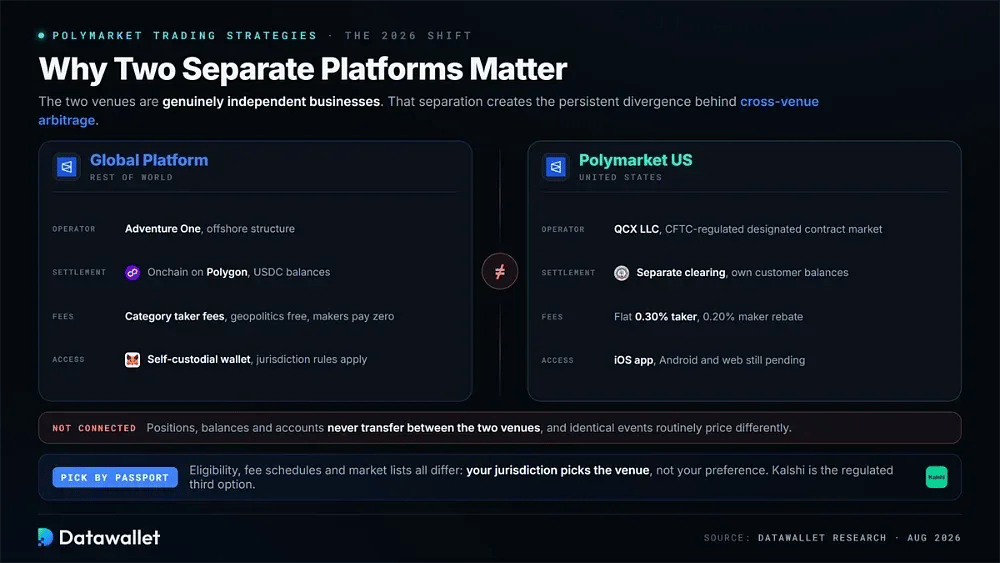
The critical detail for traders is that these two venues are genuinely independent. The global platform settles on Polygon through Adventure One, while Polymarket US runs as QCX LLC with separate clearing, and positions, balances and accounts never transfer between them.
That separation creates the persistent price divergence underpinning strategy three above. It also means eligibility rules, fee schedules and available markets all differ between them, so the correct venue depends entirely on your jurisdiction rather than on personal preference or interface familiarity.
For anyone weighing up the regulated alternatives, our Polymarket and Kalshi comparison covers how the two CFTC-regulated venues differ on fees and market coverage, since Kalshi charges symmetric fees on both sides of every trade where Polymarket charges takers only.
What Are the Fees on Polymarket in 2026?
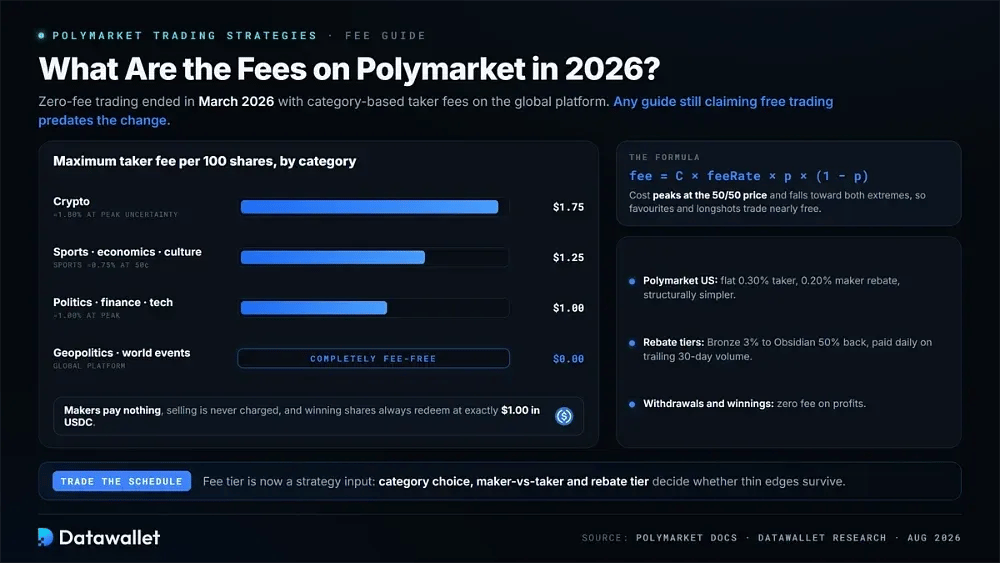
Polymarket ended zero-fee trading in March 2026, rolling out category-based taker fees right across the global platform. Any guide still claiming the platform is entirely free to trade clearly predates that change, as Polymarket's own published fee documentation now confirms.
Fees follow the formula fee = C × feeRate × p × (1 − p), meaning cost peaks at the 50/50 price point and falls toward both extremes. Here is what each component actually costs traders in practice:
- Politics, finance, tech: Taker fees reach a maximum of $1.00 per 100 shares, roughly 1.00% at the peak uncertainty price point.
- Sports, economics, culture, weather: Maximum $1.25 per 100 shares, with sports working out near 0.75% at the fifty-cent price.
- Crypto markets: The most expensive category at $1.75 per 100 shares, approaching 1.80% effective cost at peak uncertainty.
- Geopolitics and world events: Completely fee-free on the global platform, making them the cheapest venue for high-frequency strategies.
- Maker orders: Resting limit orders pay nothing at all, and selling is never charged a taker fee on either platform.
- Polymarket US: A flat 0.30% taker fee with a 0.20% maker rebate, structurally simpler than the global category model.
- Rebate tiers: Seven levels from Bronze at 3% to Obsidian at 50% back, paid daily on trailing thirty-day volume.
- Winnings and withdrawals: Zero fee on profits, with winning shares always redeeming at exactly $1.00 in USDC.
How to Start Trading on Polymarket
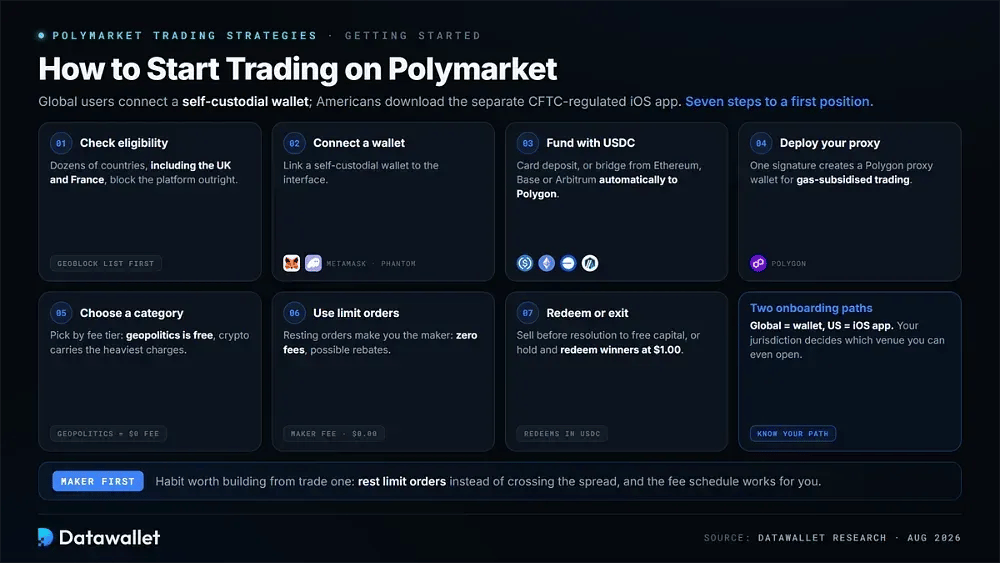
Getting started depends on where you live, since the global platform and the US exchange have entirely different onboarding paths. Global users connect a self-custodial wallet, weighing up options like MetaMask versus Phantom, while American traders download the separate CFTC-regulated iOS application instead.
Work through these steps to place your first position safely:
- Check eligibility: Confirm your jurisdiction permits access, since dozens of countries including the UK and France block the platform entirely.
- Connect a wallet: Global users link a self-custodial wallet such as MetaMask or Phantom to the Polymarket interface.
- Fund with USDC: Deposit via card through the integrated provider, or bridge USDC from Ethereum, Base or Arbitrum automatically to Polygon.
- Deploy your proxy: Sign a one-time transaction creating your Polygon proxy wallet, which enables gas-subsidised trading and secure fund custody.
- Choose a category: Select markets deliberately by fee tier, since geopolitics costs nothing while crypto markets carry the heaviest charges.
- Use limit orders: Place resting orders rather than market orders wherever possible, since makers pay zero fees and may earn rebates.
- Redeem or exit: Sell shares before resolution to free capital, or hold to settlement and redeem winners at one dollar each.
How Much Money Can You Make on Polymarket?
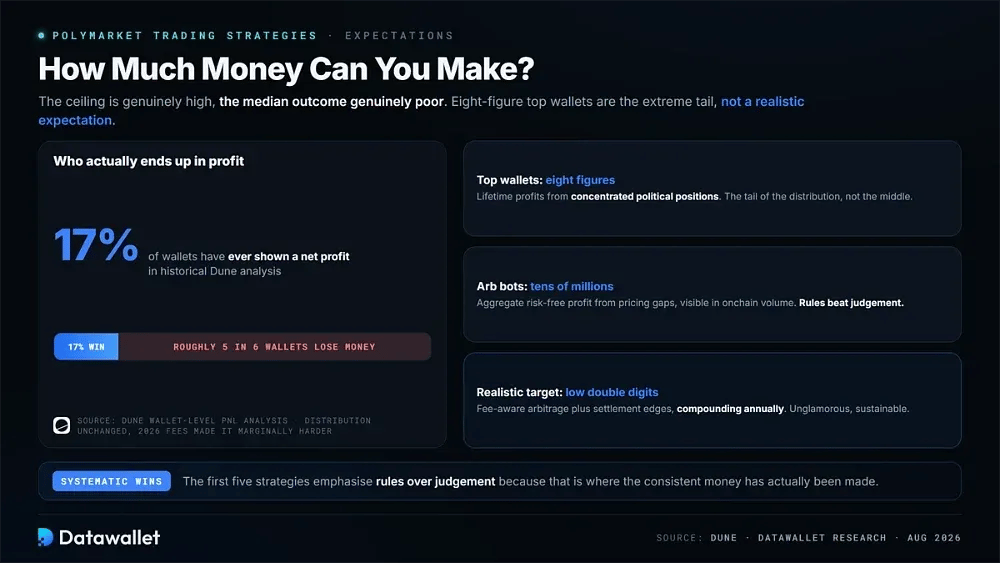
The ceiling is genuinely high while the median outcome remains genuinely poor. Top wallets have accumulated eight-figure lifetime profits through concentrated political positions, but those figures represent the extreme tail of the distribution rather than any realistic expectation for a new trader.
Historical Dune analysis found that only around 17% of wallets ever showed a net profit, meaning roughly five in six participants lost money. That distribution has not fundamentally changed, and 2026's taker fees made the arithmetic marginally harder for active traders.
Systematic approaches perform far better than discretionary betting. Arbitrage bots have captured tens of millions in aggregate risk-free profit by exploiting pricing gaps continuously, visible in onchain volume data, which is why the first five strategies here emphasise rules over judgement.
Realistic expectations matter far more here than the headline numbers ever suggest. A disciplined trader running fee-aware arbitrage alongside settlement-edge positions might target consistent low double-digit annual returns on deployed capital, which sounds unglamorous but compounds meaningfully across several years.
Risks of Trading on Polymarket
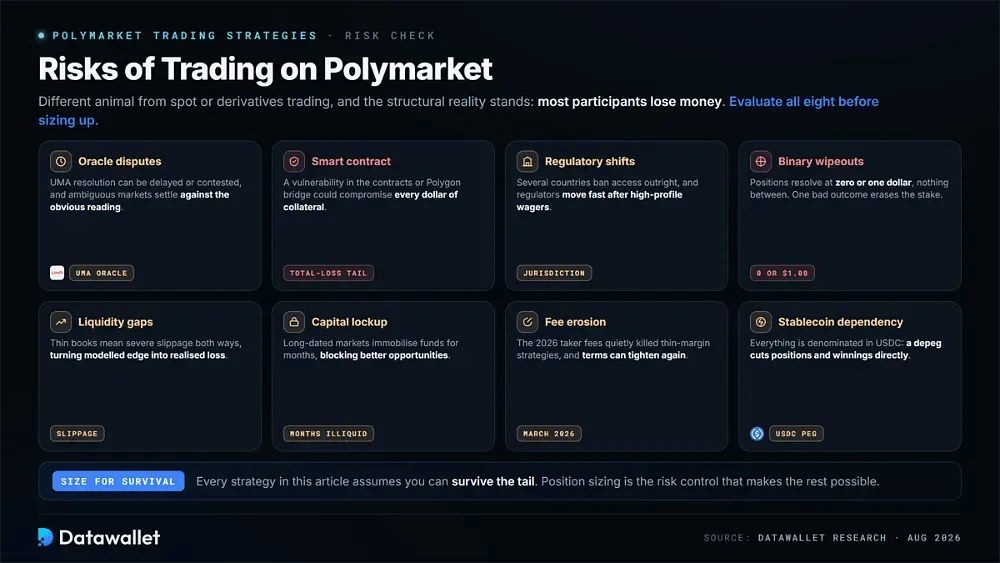
Prediction markets carry risks that differ substantially from ordinary spot or derivatives trading, spanning smart contract exposure, contested oracle disputes, sudden regulatory shifts, extended capital immobilisation, and the uncomfortable structural reality that the large majority of participants ultimately lose money.
Evaluate each of these carefully before deploying meaningful capital:
- Oracle disputes: UMA resolution can be delayed or contested, and ambiguous markets sometimes settle against the reading most traders considered obvious.
- Smart contract exposure: Vulnerabilities in the platform's audited contracts or the Polygon bridge could permanently compromise every dollar of deposited collateral.
- Regulatory restrictions: Several countries have banned access outright, and national regulators have acted quickly following high-profile political wagers.
- Binary wipeouts: Positions resolve at zero or one dollar with nothing between, so a single adverse outcome erases the entire stake.
- Liquidity gaps: Thin books cause severe slippage on entry and exit, frequently turning a modelled edge into a realised loss.
- Capital lockup: Long-dated markets immobilise funds for months at a time, preventing redeployment into better opportunities as they emerge elsewhere.
- Fee erosion: The 2026 taker fees quietly invalidated thin-margin strategies, and further changes could compress remaining edges further.
- Stablecoin dependency: Balances are denominated in USDC, so any depeg event would directly reduce the value of positions and winnings.
Final Thoughts
Polymarket in 2026 is a considerably more legitimate and more expensive venue than the platform most traders remember using. Regulatory clarity, ICE backing and a CFTC-licensed American exchange all arrived alongside the taker fees that ended its zero-cost trading era.
The strategies that survived the transition are the disciplined ones. Arbitrage still works wherever spreads exceed fees, settlement-edge analysis rewards careful reading, and maker rebates now turn liquidity provision into genuine revenue, much as they do on Kalshi's perpetual markets.
Treat everything here as a framework rather than a guarantee. Roughly five in six wallets lose money, edges decay as competition improves, and the single most valuable habit is calculating your true net cost before entering rather than after settlement.
Our Methodology
We evaluated each strategy against live order books rather than relying on historical backtests alone, modelling realistic execution costs under the post-March 2026 fee schedule, and discarding any approach whose historical edge no longer survives the current category taker charges.
Five criteria shaped the final selection:
- Post-fee expected value: We recalculated each strategy's margin under current category rates rather than relying on pre-2026 profitability figures.
- Execution realism: We assessed whether retail traders can genuinely capture the edge, or whether bots close the gap first.
- Capacity and depth: We examined how much capital each approach absorbs before slippage erodes returns beyond the point of viability.
- Repeatability: We prioritised rules-based methods that recur systematically, discounting one-off situational trades that depend on unusual and unrepeatable market conditions.
- Risk transparency: We documented failure modes honestly, including oracle disputes, tail risk and the strategies we would not recommend.
Polymarket's fee schedule, platform structure and regulatory status all changed materially during 2026, so our research cycle ran from March through to July 2026, with every single figure independently verified against official platform documentation and public onchain Dune data before publication.