


Login to Track Your Live Crypto Portfolio
Sign Up and Track Your Live Crypto Portfolio for Free
Forgot your password?
Saylor's Strategy Abandons "Never Sell Bitcoin" Pledge

This article has been reviewed and verified for accuracy by our editorial team. All claims, data points and platform details are cross-referenced against primary sources.
Some links on this page are affiliate links. Datawallet may earn a commission when you sign up through them, at no extra cost to you. This never influences our editorial ratings, rankings or recommendations.
Some links on this page are affiliate links. Datawallet may earn a commission when you sign up through them, at no extra cost to you. Ratings and rankings reflect our own testing and assessment criteria.

GM. Strategy abandoned its "never sell" pledge today after a $12 billion quarterly loss, with Michael Saylor signaling the firm may now sell Bitcoin if the move improves its per-share accretion or funds dividends.
Meanwhile, Kraken launched 10x regulated margin trading in the US, a massive XRP Ledger pilot moved $610 million in tokenized Treasury funds, and Y Combinator moved crypto interviews to Manhattan.
Here are the details on treasury pivots, domestic leverage, and institutional settlement. 👇
Saylor's Strategy Abandons "Never Sell Bitcoin" Pledge
Strategy signaled it may sell Bitcoin when doing so improves Bitcoin per share, abandoning the absolutist language that defined its treasury playbook since 2020. The shift came after the company reported a $12.54 billion first-quarter net loss. Most of that damage reflected a $14.46 billion unrealized hit on its holdings.
The company holds 818,334 BTC, worth about $66.8 billion and equal to roughly 3.9% of Bitcoin’s fixed supply, making any policy change symbolically potent. President and chief executive Phong Le framed sales as conditional. He said Strategy would consider selling Bitcoin to buy dollars or retire debt if accretive.
Michael Saylor sharpened the message by describing Strategy as a Bitcoin development company that buys cheap and sells dear, not a shrine to permanent hoarding. He even floated selling some BTC to fund a dividend for STRC. That language jolted a market trained to read Strategy as perpetual demand, not eventual supply.
Analysts argued the greater risk lies in psychology, not market plumbing, because Bitcoin ETF flows and institutional demand could likely absorb any measured sale without lasting damage. The deeper test is corporate conviction. If Bitcoin’s most famous accumulator starts managing inventory more actively, treasury imitators may rethink their own supposedly rigid doctrines.
Kraken Opens 10x Regulated Margin Tradeing in the US
Kraken rolled out CFTC-regulated spot margin trading for US retail users, filling a gap that had long pushed leveraged crypto activity toward offshore venues. The product arrives just after Payward closed its Bitnomial deal. Users can borrow against existing crypto holdings and trade with leverage of up to 10x.
The launch is the first visible product tied to Bitnomial’s merchant, contract, and clearing licenses, which Kraken says will support broader derivatives expansion. Perpetuals and options are expected later. The exchange is also widening its institutional footprint ahead of a potential listing and after its NinjaTrader acquisition.
XRP Ledger Pilot Moves $610 Million Treasury Fund
Ripple, JPMorgan, Mastercard, and Ondo Finance tested a cross-border workflow that redeemed Ondo’s tokenized Treasury fund on XRP Ledger and delivered dollars into Ripple’s Singapore account. The pilot linked public blockchain rails with banking infrastructure. It showed how tokenized funds can be cashed out in one integrated process.
Mastercard’s multi-token network routed instructions through JPMorgan’s Kinexys platform, while Ondo’s OUSG fund provided the tokenized Treasury exposure at the center of the transaction. OUSG offers a 3.48% yield. The exercise expands a growing series of experiments aimed at making institutional settlement continuous, faster, and natively cross-border.
Y Combinator Takes Crypto Interviews to Manhattan
Y Combinator will hold fintech and crypto startup interviews in New York for the first time, aiming to meet founders where stablecoin and tokenization ecosystems are gathering. The selected teams will join Summer 2026. YC’s standard deal remains $500,000 for 7%, with a USDC funding option also available.
The accelerator says New York is becoming a focal point for startups building trading systems, agentic commerce, and blockchain-based capital markets. Interviews are scheduled for May 21. Since backing Coinbase in 2012, YC has invested in more than 150 crypto and fintech companies across the sector.
Data of the Day
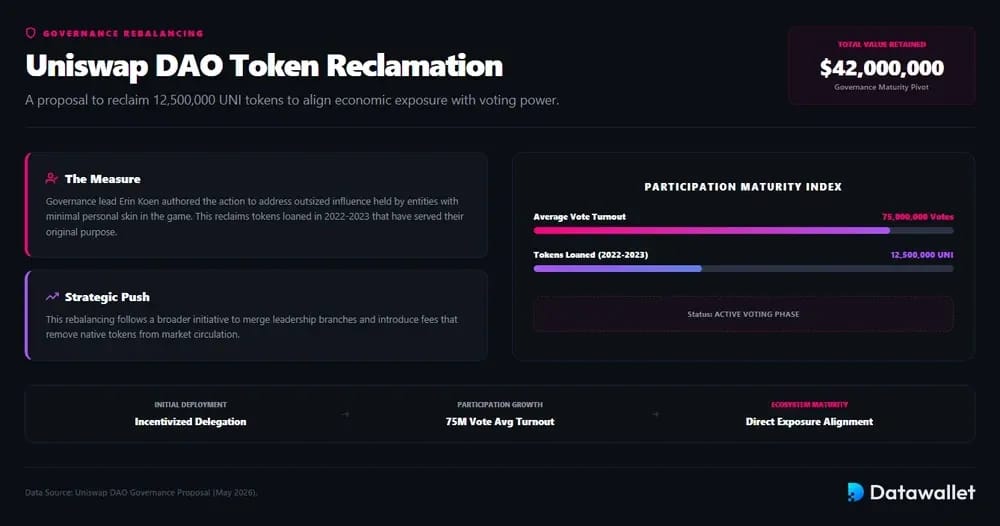
The Uniswap digital cooperative is currently voting on a proposal to take back 12.5 million governance tokens previously loaned to delegates and the foundation. These assets were distributed between 2022 and 2023 to boost participation but officials claim they have finally served their original purpose. Returning the $42 million in tokens aims to align economic exposure with voting power across the entire ecosystem.
Governance lead Erin Koen authored the measure to address concerns regarding outsized influence held by entities with little personal skin in the game. Current data shows that environment has matured as turnout for passed proposals now averages 75 million votes per individual session. This action follows a broader push to merge leadership branches and introduce fees that remove native tokens from market circulation.
More Breaking News
- Colombia is exploring bitcoin mining on its Caribbean coast using surplus renewable energy, as President Gustavo Petro pitches indigenous co-ownership and a Paraguay-style path to new hashpower.
- OKX plans perpetual futures tied to OpenAI, SpaceX, and Anthropic valuations, giving traders synthetic pre-IPO exposure without equity ownership, dividends, voting rights, or shareholder protections.
- Ledger is rolling out Hyperliquid perpetuals trading through Yield.xyz, letting about 20% of users in eligible regions access leveraged onchain derivatives from hardware wallets.
- KelpDAO blamed LayerZero for the $292 million exploit, said the disputed verifier setup was approved, and announced a migration to Chainlink as a $71 million court battle continues.
- Zcash jumped nearly 30% as Multicoin disclosed a significant position, triggering about $60 million in short liquidations and reviving bets that privacy demand is becoming structural.
- CME plans to launch regulated Bitcoin Volatility futures in June, giving institutions a CFTC-cleared way to trade implied BTC volatility instead of outright price direction.
For the latest updates on digital asset markets, follow us on X @Datawalletcom.
For the latest updates on digital asset markets, follow us on X @Datawalletcom.
Get tomorrow’s issue in your inbox