


Login to Track Your Live Crypto Portfolio
Sign Up and Track Your Live Crypto Portfolio for Free
Forgot your password?
Federal Judge Dismisses Class Action Against Uniswap Labs

This article has been reviewed and verified for accuracy by our editorial team. All claims, data points and platform details are cross-referenced against primary sources.
Some links on this page are affiliate links. Datawallet may earn a commission when you sign up through them, at no extra cost to you. This never influences our editorial ratings, rankings or recommendations.
Some links on this page are affiliate links. Datawallet may earn a commission when you sign up through them, at no extra cost to you. Ratings and rankings reflect our own testing and assessment criteria.

GM. A federal judge dismissed the class action against Uniswap Labs, ruling that developers aren't liable for scams on decentralized protocols.
Meanwhile, MARA Holdings signaled potential sales from its $3.6 billion Bitcoin stash, Binance won Abu Dhabi approval for tokenized stocks, and the Aave Chan Initiative is winding down.
Here are the details on legal wins, miner shifts, and governance changes. 👇
Federal Judge Dismisses Class Action Against Uniswap Labs
Judge Katherine Polk Failla dismissed a long-running class action lawsuit against Uniswap Labs and its founder Hayden Adams on Monday. This ruling effectively shields the decentralized exchange from liability regarding fraudulent tokens traded on its open protocol.
The final legal victory occurred on 2 March 2026 within the United States District Court for the Southern District of New York. This judgment concludes years of litigation that initially sought damages for losses from various schemes.
The court rejected these specific claims because plaintiffs failed to prove that providing a trading platform constitutes substantial assistance of fraud. Consequently, the magistrate ruled that Uniswap developers cannot be held responsible for the misuse of smart contracts.
Engineers secured this precedent-setting outcome by demonstrating that the protocol operates as neutral, open-source code rather than a deceptive enterprise. This decision sparked a 6% rally for the native UNI token as market confidence improved.
MARA Holdings May Sell Massive Bitcoin Reserves
Publicly traded miner MARA reported that it might sell more from its $3.6 billion Bitcoin stash. The firm previously held all produced tokens as long-term investments but recently shifted strategy to fund its expanding operations. This revised approach allows for the sale of balance sheet assets in addition to current production throughout the 2026 calendar year.
The company is currently evolving beyond traditional mining to establish a significant presence in energy and AI infrastructure. MARA held 53,822 BTC at the close of 2025 and sold roughly $413 million worth of assets last year. Despite these potential sales, management expects their total holdings to generally increase over time through continued domestic production and strategic purchases.
Binance Wins Abu Dhabi Approval For Tokenized Stocks
Abu Dhabi regulators granted Binance official approval this Tuesday to trade Ondo Finance’s tokenized equities on its regulated platform. The Financial Services Regulatory Authority cleared nine major US stocks and ETFs, including Nvidia and Tesla, for non-US investors. This milestone marks the first time the jurisdiction has permitted tokenized securities trading under its formal Multilateral Trading Facility framework.
The approval provides Binance with a fully regulated venue to expand its asset offerings to hundreds of millions of global users. Ondo Finance has already processed more than $11 billion in cumulative volume since launching its equity-linked notes six months ago. These blockchain-based versions of traditional stocks allow for easier movement across decentralized finance protocols and established institutional trading venues.
Aave Delegate ACI Winds Down After Funding Vote
The Aave Chan Initiative announced that it will wind down operations following a controversial governance vote. Founder Marc Zeller stated that the organization will complete its current obligations over four months before transferring infrastructure to the DAO. This decision was triggered by a successful funding proposal that allocates $42.5 million in stablecoins and 75,000 AAVE tokens to Aave Labs.
Zeller expressed concern that independent service providers no longer have a clear role when major budget recipients hold undisclosed voting power. The ACI plans to cancel its GHO funding stream and cut its vesting rewards once the transition period concludes. Aave remains one of the largest protocols with $26.5 billion in total value locked across its various lending markets.
Data of the Day
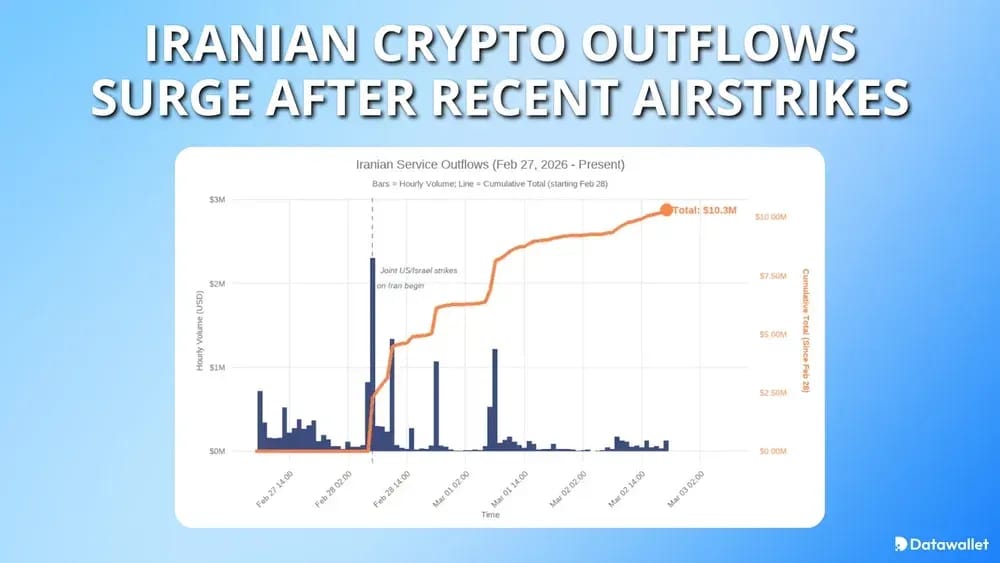
Onchain data revealed that Iranian crypto exchanges experienced a sharp burst of outflows following the February 28 airstrikes. Roughly $10.3 million in digital assets left major platforms as users sought to protect their wealth during the height of geopolitical unrest.
Hourly withdrawal volumes approached $2 million as news of the strikes broke, reflecting a recurring pattern of crisis response in the region. Chainalysis noted that these spikes typically coincide with a weakening national currency and fears of potential government-imposed internet blackouts.
Many local traders moved their funds into self-custody crypto wallets to maintain financial access before any connectivity restrictions could be implemented. While some funds landed on overseas exchanges, a considerable portion was routed through unknown addresses to reduce overall visibility.
More Breaking News
- Pumpfun added mobile support for non-native assets, allowing users to trade Wrapped Bitcoin and tokens from rival Solana platforms.
- Trump-backed American Bitcoin purchased 11,298 ASIC miners, increasing its capacity by 12% while other publicly traded competitors pivot toward artificial intelligence infrastructure.
- Cryptocom launched a US-based individual retirement account allowing users to invest in both stocks and over 400 cryptocurrencies within tax-advantaged accounts.
- Federal court rulings remanded prediction market disputes to Nevada state court, exposing Polymarket and Kalshi to potential injunctions against their sports contracts.
- TCS Blockchain integrated PayPal USD to provide truckers with same-day funding for invoices, aiming to resolve long-standing cash flow challenges in transportation.
- SoFi Technologies partnered with Mastercard to enable stablecoin settlement in SoFiUSD, allowing for 24/7 clearing of global debit and credit card transactions.
- The US government moved $23,000 in Bitcoin from a seizure wallet, marking a rare transfer as federal officials implement a reserve policy.
- Visa and Stripe-owned Bridge expanded their stablecoin card program to 18 countries, with plans to support onchain settlement and custom business assets.
- Changpeng Zhao backed YZi Labs invested $100 million into Hash Global’s BNB fund to provide institutions with regulated access to the Binance ecosystem.
For the latest updates on digital asset markets, follow us on X @Datawalletcom.
For the latest updates on digital asset markets, follow us on X @Datawalletcom.
Get tomorrow’s issue in your inbox