

Login to Track Your Live Crypto Portfolio
Sign Up and Track Your Live Crypto Portfolio for Free
Forgot your password?
Justin Sun Alleges Hidden Backdoor In World Liberty Contract

This article has been reviewed and verified for accuracy by our editorial team. All claims, data points and platform details are cross-referenced against primary sources.
Some links on this page are affiliate links. Datawallet may earn a commission when you sign up through them, at no extra cost to you. This never influences our editorial ratings, rankings or recommendations.
Some links on this page are affiliate links. Datawallet may earn a commission when you sign up through them, at no extra cost to you. Ratings and rankings reflect our own testing and assessment criteria.

GM. Justin Sun accused World Liberty Financial of embedding a "backdoor" to freeze assets today, claiming the project locked his 545 million tokens without recourse as valuations plummeted.
Meanwhile, the ECB backed centralized oversight under ESMA, Bittensor's co-founder refuted subnet abuse claims, and Brian Armstrong supported the revised Clarity Act.
Here are the details on protocol feuds, EU regulations, and quantum-safe puzzles. 👇
Justin Sun Alleges Hidden Backdoor In World Liberty Contract
Tron founder Justin Sun accused World Liberty Financial of embedding an undisclosed backdoor to freeze assets and hijack property rights. The former advisor claimed himself a prime victim after his 545 million tokens were locked without recourse.
The digital confrontation erupted on 12 April 2026 across social networks after the project’s valuation plummeted toward recent record lows. These allegations surfaced as Sun reaffirmed his political support for Donald Trump despite attacking the project’s leadership.
Sun initiated this aggressive public broadside because he seeks to expose what he describes as illegitimate governance and unauthorized fee extraction. By labeling the contract a trap, he intends to reclaim control over his frozen $80 million WLFI stash.
The project punched back by threatening immediate litigation and dismissing the billionaire's claims as baseless attempts to mask personal misconduct. Consequently, both parties now prepare for a courtroom battle while retail investors face continued token unlock delays.
ECB Backs Centralized Crypto Oversight Under ESMA
The European Central Bank recently endorsed a plan to centralize the supervision of major digital asset service providers. This proposal moves the primary oversight of systemically important cross-border players to the Paris-based European Securities and Markets Authority. Regulators believe a unified approach will prevent financial risks from spilling into traditional banking systems across the region.
National regulators in Ireland and Malta currently handle licensing for major exchanges like Gemini and OKX through local frameworks. The ECB recommended a phased transition to avoid operational disruptions while requesting a non-voting seat on the executive board. This shift intends to eliminate jurisdictional forum-shopping and harmonize capital market standards throughout the entire European Union.
Bittensor Co-Founder Refutes Claims Of Subnet Abuse
Jacob Steeves recently denied allegations that he manipulated network emissions to force a major developer off the platform. The Covenant AI founder accused Steeves of maintaining effective control over governance through unilateral infrastructure changes and visible token sales. Steeves countered by stating that his sales represented less than 1% of his total holdings and aligned with standard market participation.
The dispute caused the native TAO token to plummet over 65% below its previous all-time high price last week. Steeves argued that his actions did not involve any special privileges beyond those available to all regular token holders. This conflict underscores the ongoing tensions between project founders and independent developers regarding the true nature of decentralized network management.
Coinbase CEO Supports Passage Of Clarity Act
Brian Armstrong publicly backed the Clarity Act this week following a call for digital asset rules from Treasury Secretary Scott Bessent. The exchange previously withheld support for earlier versions of this legislation due to unresolved debates over stablecoin yield provisions. Armstrong expressed gratitude for the bipartisan work conducted by senators to transform the proposal into a solid and effective framework.
The bill aims to establish a clear market structure for the crypto industry while addressing anti-money laundering risks. Coinbase officials believe the current draft is very close to reaching an agreement that integrates digital assets into the domestic banking system. This evolving stance signals a potential alignment between major industry players and Washington policymakers to finalize comprehensive federal regulations.
Data of the Day
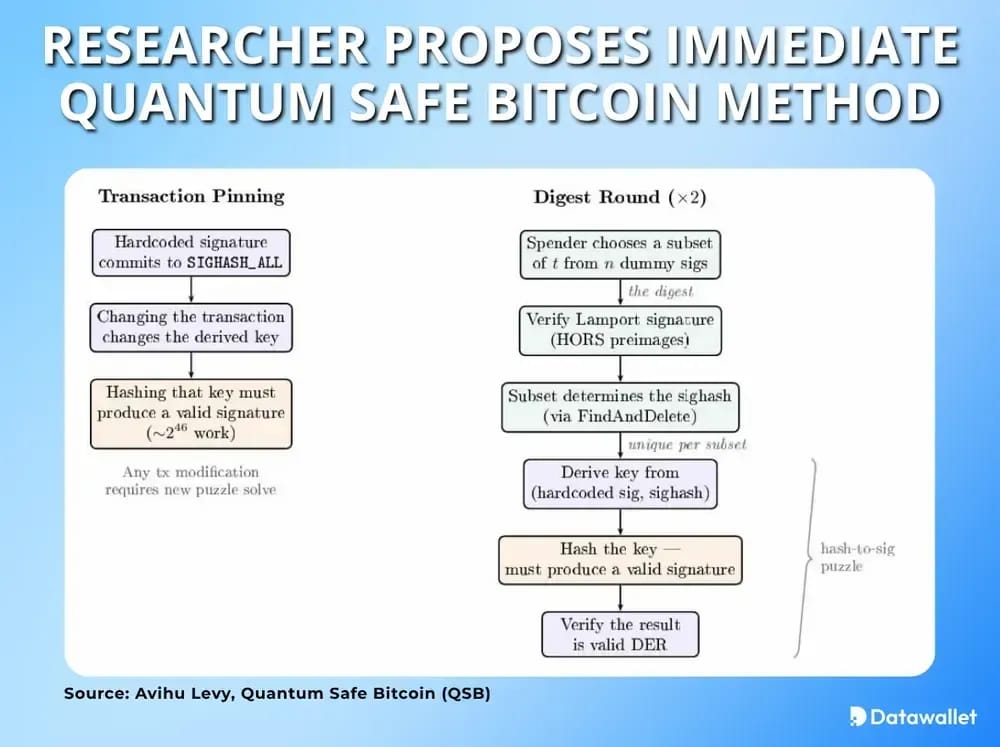
A StarkWare researcher recently unveiled a method to enable quantum-safe Bitcoin transactions without requiring any protocol upgrades. The proposal replaces traditional proof-of-work signatures with a complex hash-to-sig puzzle that remains secure against advanced computational attacks. Spenders must find specific inputs that resemble valid signatures through brute-force work that even the most powerful quantum computers cannot shortcut.
The primary drawback of this scheme is the high cost of approximately $150 in GPU compute per transaction. Critics argue the plan fails to protect dormant wallets or early addresses that do not utilize modern script constraints. While the solution offers a temporary escape hatch for large transfers, experts maintain that long-term protocol changes remain the preferred security path.
More Breaking News
- Polymarket links briefly appeared alongside mainstream news outlets in Google News for event-driven queries before Google removed them, citing a technical error.
- Bitwise filed an updated registration for its proposed Hyperliquid ETF, seeking to offer investors exposure to HYPE with a staking component.
- World announced it will decrease the daily unlock rate of its WLD token by 43% in July to reduce long-term supply pressure.
- SpaceX reported holding 8,285 BTC worth $603 million despite a nearly $5 billion loss in 2025 driven by heavy investments in xAI.
- Japan's cabinet approved a bill to reclassify cryptocurrencies as financial products, a move intended to strengthen oversight and prohibit illegal insider trading.
- A federal judge temporarily blocked Arizona from bringing criminal gambling charges against Kalshi, finding the state’s laws may be preempted by federal authority.
- Changpeng Zhao claimed in his new memoir that US crypto rivals paid millions in lobbying fees to block his October presidential pardon.
- Michael Saylor signaled that Strategy is preparing to buy more Bitcoin despite the company reporting nearly $14.5 billion in first-quarter unrealized losses.
For the latest updates on digital asset markets, follow us on X @Datawalletcom.
For the latest updates on digital asset markets, follow us on X @Datawalletcom.
Get tomorrow’s issue in your inbox