


Login to Track Your Live Crypto Portfolio
Sign Up and Track Your Live Crypto Portfolio for Free
Forgot your password?
World Liberty Sues Sun Over WLFI Defamation And Shorting

This article has been reviewed and verified for accuracy by our editorial team. All claims, data points and platform details are cross-referenced against primary sources.
Some links on this page are affiliate links. Datawallet may earn a commission when you sign up through them, at no extra cost to you. This never influences our editorial ratings, rankings or recommendations.
Some links on this page are affiliate links. Datawallet may earn a commission when you sign up through them, at no extra cost to you. Ratings and rankings reflect our own testing and assessment criteria.

GM. World Liberty sued Justin Sun in Florida state court today, accusing the Tron founder of orchestrating a coordinated shorting campaign and using defamatory public threats to crash the WLFI token's price.
Meanwhile, Aave moved to lift a federal freeze on $73 million in recovered ether, Western Union launched its USDPT stablecoin on Solana, and the SEC delayed 24 prediction market ETFs.
Here are the details on the fractured Trump-Sun alliance, recovered asset disputes, and legacy remittance pivots. 👇
World Liberty Sues Sun Over WLFI Defamation And Shorting
World Liberty and Justin Sun are now in open legal warfare after the Trump family’s crypto venture sued the Tron founder, accusing him of engineering a coordinated short campaign against WLFI and then defaming the company once his tokens were frozen. The suit was filed in Florida state court.
The case follows Sun’s own recent lawsuit, which alleges World Liberty improperly froze his holdings and abused investor rights. World Liberty says the freeze was allowed under Sun’s unlock agreement and was necessary to stop further damage. Sun has already dismissed the new filing as a meritless public relations stunt.
According to the complaint, Sun privately threatened litigation that would set the firm on fire and send WLFI’s price collapsing, then amplified those claims in public posts and through influencers and bot accounts. The company says those statements were defamatory. Sun has said he intends to defeat the allegations in court.
The fight matters because Sun was once among the biggest financial backers of the Trump family’s expanding crypto empire, buying tens of millions in WLFI and millions more in the president’s TRUMP memecoin. That alliance has since fractured badly. The lawsuit now turns a political crypto partnership into a high-stakes reputational war.
Aave Fights Order Freezing 73 million Stolen Ether
Aave asked a federal court to lift an order freezing roughly $73 million in ether recovered after the Kelp DAO exploit, arguing the assets belong to harmed users. The motion targets a May 1 restraint. Plaintiffs in older terrorism cases want the same funds redirected as restitution.
The lender says that claim rests on unproven assumptions linking the exploit to Lazarus and confuses temporary possession with legal ownership. Arbitrum had intercepted 30,766 ETH after the hack. Aave wants the freeze vacated or a bond of at least $300 million imposed while the dispute continues.
Western Union Launches USDPT Stablecoin Across 40 Markets
Western Union launched USDPT, a Solana-based dollar stablecoin issued by Anchorage Digital, and said it will use the token for settlement, listings, and consumer payments. The company also previewed Stable by Western Union. That spending product is slated for rollout across more than 40 countries in 2026.
The remittance giant said USDPT will sit inside a network already spanning more than 200 countries and territories and serving about 100 million users. Anchorage stressed the regulated banking structure behind issuance. Western Union is positioning the stablecoin as a faster cross-border settlement rail with broader retail ambitions.
SEC Delays 24 ETFs Tied To Prediction Markets
The SEC delayed 24 prediction market ETFs from Bitwise, Roundhill, and GraniteShares that had been expected to begin trading this week, according to Reuters. The products would have tracked election odds, recession chances, and tech layoff outcomes. Regulators intervened before the automatic approval clock expired.
The pause lands as federal and state officials are still fighting over how prediction markets fit inside existing securities and gambling rules. The CFTC has sued several states over restrictions. Rising volume on Polymarket and Kalshi has intensified pressure on regulators to define the boundaries before wider retail access arrives.
Data of the Day
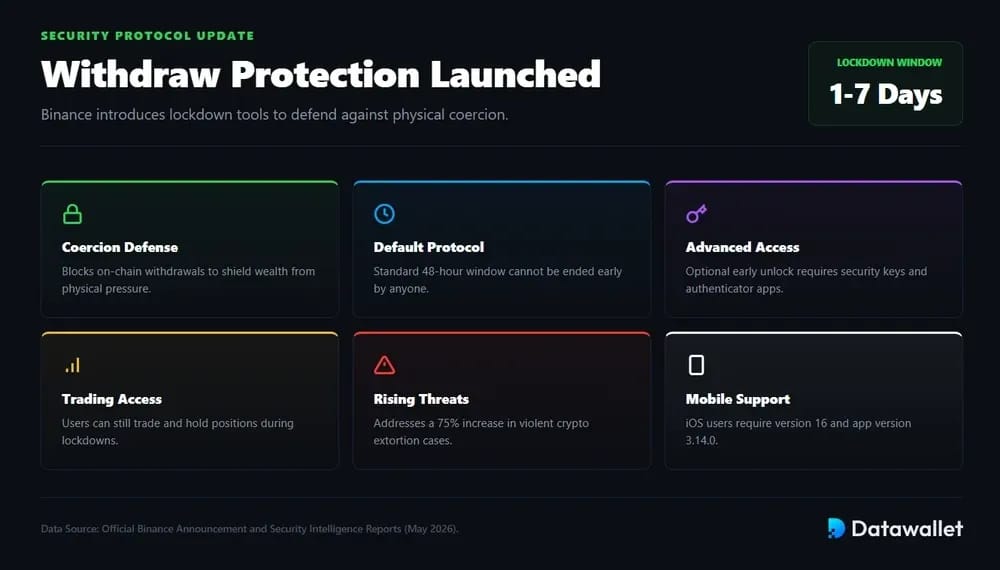
Binance introduced a withdrawal lockdown feature that lets users block onchain withdrawals for between one and seven days to defend against physical coercion attacks. The exchange said conventional cyber protections do not address in-person threats. Users can still choose early unlock options with added authentication checks.
The move comes as real-world crypto extortion cases keep mounting, especially in France, where investigators have tied dozens of violent incidents to digital assets. CertiK reported a 75% jump in such attacks during 2025. Binance is framing the tool as a practical shield for wealth exposed to offline pressure.
More Breaking News
- Upbit partnered with Optimism to launch GIWA Chain, a self-managed Ethereum layer 2 that gives the exchange direct sequencer control for its 13 million users.
- BitMine bought another 101,745 ETH worth more than $240 million, extending its three-week streak above 100,000 ETH as Tom Lee declared crypto spring underway.
- Base added Succinct’s zero-knowledge virtual machine to shorten finality toward one day, giving Coinbase’s layer 2 a hybrid model combining optimistic and ZK security.
- Kraken parent Payward sued former custody partner Etana and its chief, alleging a Ponzi-like scheme misused more than $25 million in client reserve funds.
- North Korea rejected reports of state-backed crypto theft as political slander, even as TRM data tied DPRK-linked actors to $577 million stolen in 2026.
- New analysis challenged OFAC’s Iran attribution for wallets holding more than $340 million, suggesting some seizure targets may fit other state-linked actors better than Tehran.
For the latest updates on digital asset markets, follow us on X @Datawalletcom.
For the latest updates on digital asset markets, follow us on X @Datawalletcom.
Get tomorrow’s issue in your inbox