Войдите, чтобы отслеживать свой криптовалютный портфель в реальном времени
Зарегистрируйтесь и бесплатно отслеживайте свой криптовалютный портфель в реальном времени
Забыли пароль?
Бутерин обрисовал переход Ethereum за пределы блокчейна к 2030 году

Эта статья была проверена нашей редакционной командой на предмет точности. Все утверждения, точки данных и сведения о платформах сверяются с первоисточниками.
Некоторые ссылки на этой странице являются партнерскими. Datawallet может получать комиссию при регистрации по ним, без каких-либо дополнительных затрат для вас. Это никак не влияет на наши редакционные рейтинги, позиции или рекомендации.
Некоторые ссылки на этой странице являются партнерскими. Datawallet может получать комиссионные, когда вы регистрируетесь по ним, без каких-либо дополнительных затрат для вас. Рейтинги и позиции отражают наши собственные критерии тестирования и оценки.
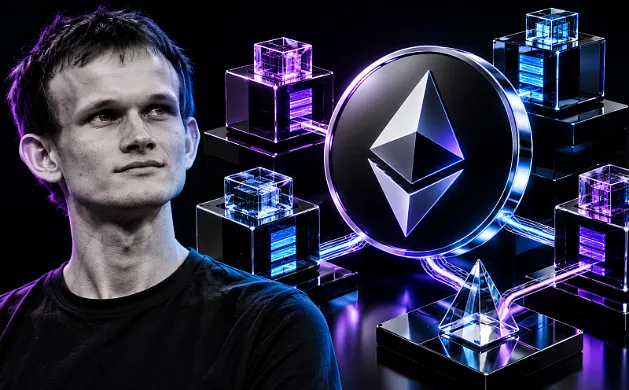
GM. Vitalik Buterin sketched an Ethereum for 2030 that leans on cryptographic proofs and off-chain computers, letting the network do far more without every machine repeating identical work.
Elsewhere, SEC staff said token buybacks need not make a crypto asset a security, Strategy proposed daily preferred dividends, and Bitget's hacker moved $83 million in unfreezable XRP.
Читайте полный выпуск ниже. 👇
Бутерин обрисовал переход Ethereum за пределы блокчейна к 2030 году
Vitalik Buterin described a 2030 network that may still carry the blockchain label while working very differently, combining cryptographic proofs with computers operating outside the chain. He titled the post "The cryptographic world computer."
The constraint he targets is repetition. Every full node currently redoes the calculations behind each transaction, so adding machines never raises capacity, whereas a prover could produce a short mathematical receipt others verify far faster than recomputing the original work.
Developers wanted this a decade ago but lacked verification, he wrote. Machines could now handle separate jobs simultaneously while checking one another, with proof systems combined to shrink what gets recorded on the chain itself.
Privacy extends to wallet queries, since checking a balance tells the server operator which accounts someone follows. Buterin expects Hegotá to be the last normal fork, with payments finalising in roughly eight to 32 seconds thereafter.
SEC Staff Says Token Buybacks Need Not Create Securities
The Division of Corporation Finance published FAQs stating that once a crypto system is functional, announcing a buyback programme does not amount to promising essential managerial efforts under the Howey test. Non-functional networks pitching buybacks as yield could still trip securities law.
MetaLeX attorney Gabriel Shapiro called it a loophole, writing that securities laws now look opt-in as applied to crypto. The guidance carries no legal force and follows the Clarity Act's Senate failure, meaning a future commission could reverse it.
Strategy Proposes Daily Dividends on Four Preferred Stocks
Strategy is seeking shareholder approval for daily dividend record dates on STRC, STRD, STRF, and STRK, including weekends and holidays. Rates and total obligations stay unchanged, with STRC switching first from November 1 if approved.
The proposal aims to support price stability, liquidity, and demand, Michael Saylor wrote. STRC already moved from monthly to semi-monthly payments in June after dropping below $75, prompting a repurchase programme since doubled to $2 billion.
Bitget Hacker Moves $83 Million in Unfreezable XRP
The attacker behind Bitget's $387.5 million breach moved roughly $83 million out of three holding wallets, leaving about $75 million in accounts nobody can freeze. The ledger lets issuers freeze tokens they create, but that power excludes XRP itself.
Circle and Tether froze about $320,000 in connected stablecoins, whose contracts permit blacklisting. Bitget said its protection fund covers the loss, with bitcoin withdrawals resuming September 28 and other tokens by October 2.
Данные дня
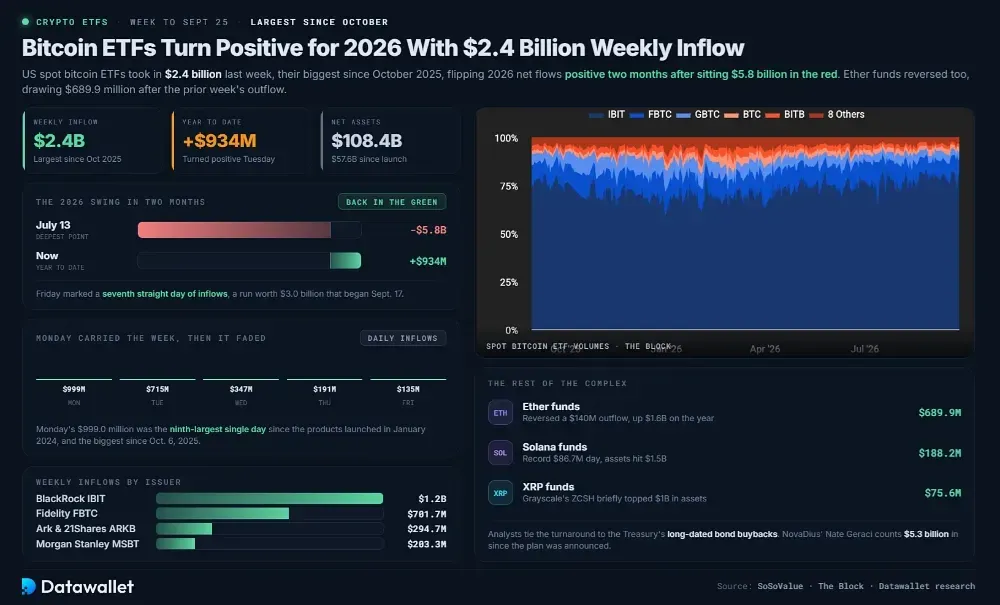
US spot bitcoin funds drew $2.4 billion last week, their strongest since October 2025, flipping 2026 net flows positive at $934.1 million after sitting $5.8 billion underwater in July. Monday alone brought $999 million.
BlackRock's IBIT led with $1.2 billion and Fidelity's FBTC added $701.7 million, while ether products reversed course with $689.9 million. Analysts tied the turn to Treasury buybacks of long-dated bonds. Track daily flows on our bitcoin ETF tracker.
Другие срочные новости
- Alpenglow reached both test networks, targeting 150 millisecond finality against 12.8 seconds, though SOL has no mainnet date and the figure remains simulated.
- KelpDAO's developer filed suit over April's $292 million exploit, alleging LayerZero endorsed the single-verifier setup in writing before blaming it publicly.
- Aave V4 accepted seven stocks as collateral on Base, letting non-US users borrow USDC against tokenized equities under a $29 million cap.
- Magic Eden предупредила об уязвимости листингов на Ethereum после того, как в результате операции whitehat удалось спасти 23 155 NFTs стоимостью свыше $5,7 миллиона из-за уязвимости в платежном шлюзе.
- Шестой апелляционный суд поддержал два штата, применяющих законы об азартных играх против Kalshi, что оставляет за ней счет один из трех в окружных судах на фоне приближающегося рассмотрения в Верховном суде.
- Хестер Пирс призвала положить конец слежке в рамках KYC на своей предпоследней неделе в должности, утверждая, что zero-knowledge proofs могут подтверждать факты без создания подверженных взломам хранилищ данных.
- CFTC подала в суд на Cash FX в связи с предполагаемой валютной финансовой пирамидой на сумму $950 миллионов, заявив, что участники потеряли по меньшей мере $406 миллионов, в то время как ответчики обещали 15 % недельной доходности.
- Утекший в сеть код указывает на Pro Max, тарифный план ChatGPT стоимостью $500 в месяц, ориентированный на ускорение работы инструментов агентов, а не на объемы использования, в противовес лимиту Anthropic в $200.
Следите за последними обновлениями на рынках цифровых активов на нашей странице в X @Datawalletcom.
Получайте завтрашний выпуск в свой почтовый ящик