


تسجيل الدخول لتتبع محفظتك للعملات الرقمية مباشرة
أنشئ حساباً وتتبع محفظتك المشفرة الحية مجاناً
هل نسيت كلمة المرور؟
Zcash تُفعل ترقية Ironwood بعد مخاوف التزييف

تمت مراجعة هذه المقالة والتحقق من دقتها بواسطة فريقنا التحريري. تتم مطابقة جميع الادعاءات ونقاط البيانات وتفاصيل المنصة مع المصادر الأساسية.
بعض الروابط الموجودة على هذه الصفحة هي روابط إحالة. قد تكسب Datawallet عمولة عندما تقوم بالتسجيل من خلالها، دون أي تكلفة إضافية عليك. هذا لا يؤثر أبداً على تقييماتنا التحريرية أو تصنيفاتنا أو توصياتنا.
بعض الروابط الموجودة على هذه الصفحة هي روابط تابعة. قد تحصل Datawallet على عمولة عندما تقوم بالتسجيل من خلالها، دون أي تكلفة إضافية عليك. تعكس التقييمات والتصنيفات معايير الاختبار والتقييم الخاصة بنا.
صباح الخير. فعلت Zcash ترقية Ironwood الخاصة بها، مما أدى إلى إحالة مجموعة Orchard المحمية المعرضة للخطر إلى التقاعد وحجز أي عملات مزيفة بشكل دائم بعد أن أدت ثغرة تعود إلى أربع سنوات إلى إطلاق موجة بيع بنسبة 38%.
وفي أماكن أخرى، أطلقت Ondo شبكة تنفيذ جديدة تدعم بورصة perps الخاصة بها، وفتحـت 1inch طبقة السيولة المشتركة Aqua للجميع، وحظر قاضٍ حظر أسواق التنبؤ في مينيسوتا.
اقرأ الإصدار الكامل أدناه. 👇
Zcash تُفعل ترقية Ironwood بعد مخاوف التزييف
Zcash activated Ironwood, retiring the Orchard shielded pool holding roughly 3.7 million ZEC worth about $1.7 billion and migrating users into a fresh private pool. The upgrade introduces new accounting rules for circulating supply while preserving the network's privacy guarantees.
The road began in May when researcher Taylor Hornby, using Claude Opus 4.8, surfaced a four-year-old flaw that could have minted counterfeit ZEC. Developers patched it in June, though shielded transactions hide their details, leaving no way to prove whether anyone exploited it.
That uncertainty triggered a 38% rout as investors questioned whether the supply could be trusted. Founder Zooko Wilcox answered with a turnstile accounting system that blocks more ZEC leaving the old pool than was verifiably deposited, stranding any fakes permanently.
Ironwood also brings quantum-resistant transaction records and a formally verified proof circuit. Privacy provider Nym warns the forced migration could briefly link IP addresses to wallet balances, prompting developers to advise patience and tools like Tor while moving funds.
Ondo تطلق شبكة تنفيذ وتصفها بأنها تطور السلسلة
Ondo Finance unveiled the Ondo Network, an execution layer pairing centralized-exchange speed with non-custodial trading and onchain settlement. CEO Ian De Bode called it the evolution of Ondo Chain, confirming the company will not run both systems in parallel going forward.
The firm concluded that execution, rather than settlement, was the real bottleneck while building its perps exchange. Ondo separates execution from verification using secure hardware enclaves policed by decentralized attestors, with transfers settling on Ethereum and further chains planned.
1inch تفتح طبقة السيولة المشتركة Aqua للجميع
1inch opened Aqua to all users across 13 EVM chains including Ethereum, Arbitrum, Base, and Robinhood Chain, eight months after a developer-only release. The layer works as a registry rather than a pool, so providers approve balances instead of depositing tokens.
Tokens move only when a swap matches a position's terms, with proceeds and fees returned atomically. Every trade executes against a verified counterparty checked onchain, and the foundation committed 10 million 1INCH in rewards after eight independent audits.
قاضٍ يحظر فرض ولاية مينيسوتا لحظر أسواق التنبؤ
A federal judge granted a preliminary injunction barring Minnesota from enforcing its new prediction market ban, letting Kalshi and Polymarket keep operating while litigation proceeds. The statute, passed earlier this year, had been scheduled to take effect on August 1.
Judge Katherine Menendez wrote the law is likely partially preempted because the CFTC holds exclusive jurisdiction over swaps traded on designated markets. The win contrasts with New York, where another judge again declined to shield Kalshi from state gambling enforcement.
بيانات اليوم
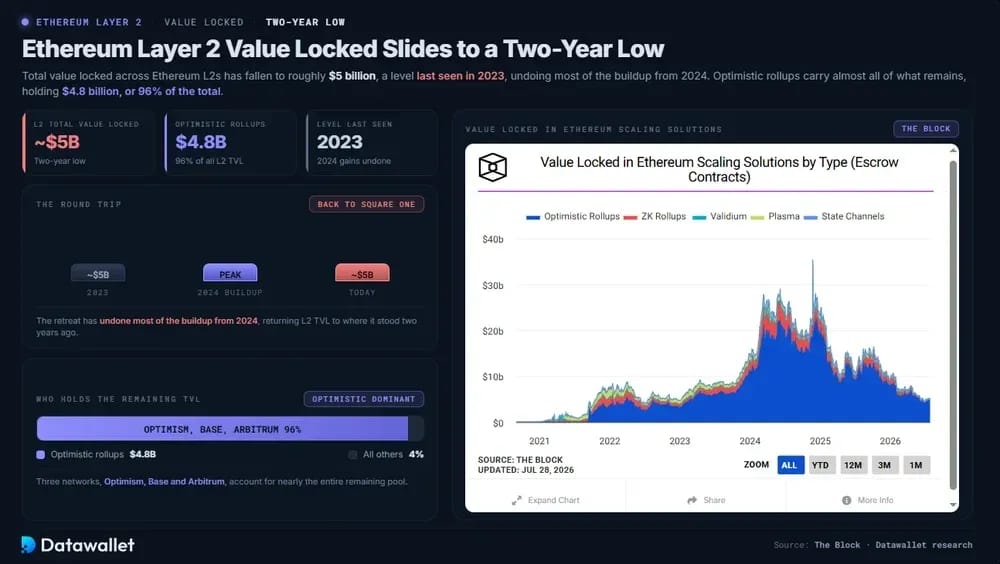
Total value locked across Ethereum Layer 2 networks has slid to roughly $5 billion, a level last seen in 2023, undoing most of the buildup from 2024. Optimistic rollups including Optimism, Base, and Arbitrum hold $4.8 billion, or 96% of that total.
The retreat lines up with a rough stretch for Ethereum, which lost several senior foundation leaders alongside broader layoffs this year. Stablecoins remain the exception, as USDC and USDT still settle predominantly on the network and its rollups.
المزيد من الأخبار العاجلة
- The Bank of Russia published draft rules creating regulated digital depositories for crypto firms, with capital requirements between 50 million and 250 million rubles.
- BitMine lifted its holdings to 5.79 million ETH worth about $11.3 billion, nearing its goal of controlling 5% of supply while staking 4.9 million through its validator network.
- Lido began migrating more than 8 million staked ether onto a leaner design, a shift the staking giant expects to cut Ethereum's validator count by a third.
- The IMF warned that Brazil's stablecoin activity is outpacing traditional capital flows, noting purchases are two to three times more sensitive to global shocks than portfolio investment.
- Circle acquired nearly 1,000 blockchain patents from IBM, becoming the largest holder of such patents in the United States to support USDC and its Arc blockchain.
- تُواجه Apple دعوى قضائية من ثلاثة عملاء فقدوا معاً 1.8 مليون دولار بعد إدخال عبارات استرجاعية في تطبيق محفظة مزيف من طراز Sparrow.
- يضع متداولو أسواق التنبؤ احتمالات تقارب 78% لإصدار عام لنموذج GPT-6 بحلول 30 سبتمبر، بارتفاع حاد من 14% في بداية الشهر.
- أصبح رجل من أتلانتا أول أمريكي يُوجه إليه اتهام فيدرالي بزعم تفعيله كلمة مرور الإكراه في نظام GrapheneOS، مما أدى إلى مسح هاتفه أثناء تفتيش حدودي بدون مذكرة.
للحصول على آخر التحديثات حول أسواق الأصول الرقمية، تابعنا على X @Datawalletcom.
للحصول على آخر التحديثات حول أسواق الأصول الرقمية، تابعنا على X @Datawalletcom.
احصل على عدد الغد في صندوق بريدك