






Can I Buy USDT in Kazakhstan?
Yes. Buying, holding, and trading USDT is legal under the Law "On Digital Assets in the Republic of Kazakhstan" (Law No. 193-VII), in force since 1 April 2023 and substantially amended by Law No. 231-VIII in November 2025. Crypto is not legal tender, but individuals can own and trade digital assets through licensed channels.
The legal channel sits inside the Astana International Financial Centre (AIFC) under Astana Financial Services Authority (AFSA) oversight. As of late 2025, the AIFC hosts 27 licensed crypto firms and 12 authorised exchanges. Trading volume on those platforms reached $6.8 billion in January to September 2025, with 192,400 active clients.
November 2025 amendments ended the AIFC monopoly, allowing licensed activity outside the centre, but the AFSA framework remains the most mature track and the one every serious retail user defaults to. Offshore platforms like Gate, Bitget, and KuCoin are reachable but sit outside AFSA jurisdiction. That gap matters: the Agency for Financial Monitoring shut 22 unlicensed exchanges and froze ~20,000 bank cards in 2025 tied to illegal cash-out activity.
For a regulated user with a Halyk Bank account, the right choice in 2026 is the licensed onshore channel via Bybit Kazakhstan.
How to Buy Tether (USDT) in Kazakhstan
The practical setup is a Bybit Kazakhstan account paired with a Halyk Bank card. Halyk is currently the only second-tier bank supported on the Bybit Kazakhstan P2P platform during initial rollout, with other AIFC-partnered institutions expected to follow.
The first time we tested an order, the name field caught us out. Bybit Kazakhstan asks for your full name in both Latin and Cyrillic, and the Halyk record must match exactly. A single missing patronymic is enough for the Maker to cancel and trigger a 3 to 5 business day refund on your transferred tenge.
Steps to buy USDT on Bybit Kazakhstan via Halyk Bank:
- Create a Bybit Kazakhstan account. Sign up at Bybit and complete KYC with your Kazakhstan passport or national ID. You will need your IIN (Individual Identification Number), full name in both Latin and Cyrillic, IBAN, and the phone number linked to your Halyk Bank card.
- Add Halyk Bank as a payment method. Under P2P settings, add Halyk Bank, IIN, IBAN, and linked phone number. Verify the Bybit profile name matches your Halyk records character for character. This single check prevents most cancellations.
- Open the P2P market. Select Buy Crypto, then P2P Trading. Set asset to USDT and fiat to KZT. Filter Makers by completion rate (Bybit Kazakhstan's licensed institutional Makers run near 100% by design) and pick an offer within your tenge budget.
- Send KZT through the Halyk Bank app. In Halyk, go to Transfers, paste the Maker's recipient phone number from the Bybit order screen, and send the exact KZT amount. Save the receipt as a screenshot.
- Confirm payment and receive USDT. In Bybit Kazakhstan, click Payment Completed and upload the screenshot. The Maker verifies receipt against your IIN and bank details, then releases USDT to your Funding Account, typically within minutes.
Two limits worth knowing before sizing a first order: Bybit Kazakhstan caps single P2P transactions at 2.5 million tenge and daily volume at 5 million tenge, with all fiat moving through the Maker's corporate AIFC-licensed account.
KZT to USDT Fees
Bybit Kazakhstan charges zero P2P fees on both sides, a clean structural advantage over offshore P2P books and the legacy AIFC trading channel that priced through Bybit Global.
Deposits
- Halyk Bank P2P (recommended): 0% Bybit fee. Halyk app transfers between Kazakh accounts are typically free for retail users. The cost you pay is the Maker's spread against the live USDT rate, which has run 0.3% to 1% during weekday banking hours. No KZT minimum on most listed offers.
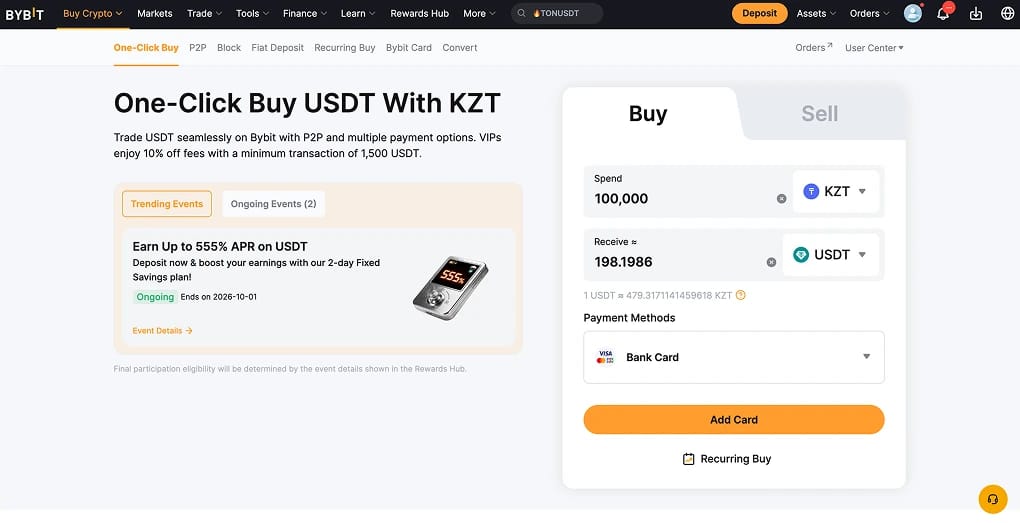
- Bybit One-Click Buy via card: 2% to 4% all-in including processor markup. Useful for sub-100,000 KZT amounts where speed matters more than cost. Visa and Mastercard from Kazakh banks (Kaspi, Halyk, Forte, Jusan, BCC) process without blocks given Bybit's onshore licensing.
- Crypto deposit and convert: Sending USDT in from another wallet skips the fiat leg entirely. Network fees apply per the rails listed below.
Trading and Conversion
- Spot Maker/Taker on Bybit: 0.10%/0.10% baseline, with VIP tier and BIT/MNT discounts.
- USDT withdrawal network fees: TRC20 around $1, BEP20 under $1, Solana SPL under $0.10, Arbitrum and Polygon $0.10 to $0.50, ERC20 $1 to $10 depending on Ethereum gas.
Off-Ramp Back to KZT
Selling USDT back to KZT on Bybit Kazakhstan P2P mirrors the buy side: the licensed Maker sends tenge to your verified Halyk card, you confirm receipt, and the platform releases your USDT. Round-trip cost on a Halyk loop typically lands under 1% during regular hours, materially cheaper than parallel-market FX and faster than international SWIFT.
.webp)
Best USDT Exchanges in Kazakhstan
The table below ranks the top crypto exchanges in Kazakhstan for USDT, weighted on KZT funding access, AFSA licensing, fees, and operational maturity.
The practical hierarchy in 2026 is Bybit Kazakhstan for the licensed P2P channel, Binance Kazakhstan for global liquidity inside the AFSA perimeter, and Bitget or Bitunix for users wanting broader P2P bank coverage at the cost of going offshore.
Regulatory Status of USDT in Kazakhstan
Kazakhstan runs one of Central Asia's more developed crypto frameworks, with 2025 to 2026 an unusually active period of reform. The regime sits on two pillars: the Law "On Digital Assets" (2023, amended 2025) and the AIFC's constitutional framework, which gives AFSA primary jurisdiction over licensed crypto activity.
Five authorities have a role in the current setup:
Three 2025 shifts changed the working environment materially. First, Law No. 231-VIII (signed by President Tokayev on 17 November 2025) ended the AIFC monopoly, permitting nationwide circulation under licensed intermediaries and dropping the requirement that miners sell 75% of output through AIFC exchanges. Second, late December 2025 banking law amendments brought "Digital Financial Assets" (including fiat-backed stablecoins like USDT) into formal banking categories. Third, AFSA updated its capital markets, digital asset, and crowdfunding frameworks effective 1 January 2026.
USDT itself already sits on the AFSA Green List and trades freely on Bybit Kazakhstan and Binance Kazakhstan. The AFSA-Bybit MoU signed at Astana Finance Days in September 2025 went further, enabling stablecoin payment of AIFC regulatory fees and putting Kazakhstan among a small group of jurisdictions integrating stablecoins into government settlement.
Tax Implications of USDT in Kazakhstan
Kazakhstan's individual income tax regime changed materially from 1 January 2026, and crypto users now operate under a new progressive structure. The shape is well-defined but the application to retail USDT trading sits in a less-tested area worth understanding before scaling.
- Personal income tax is progressive from 2026. Individuals pay 10% on taxable income up to 8,500 MCI (Monthly Calculation Index) and 15% on the excess. With the 2026 MCI set at KZT 4,325, the bracket lands at KZT 36,762,500.
- Capital gains on digital assets are taxable. Residents are assessed on worldwide income, including gains from selling USDT for KZT, swapping it for another crypto, or using it for payment. The taxable amount is the positive difference between sale value and acquisition cost.
- Non-residents pay 20% on Kazakh-source income. This matters for expats and the meaningful population of Russians who relocated post-2022 without establishing tax residency under the 183-day rule.
- VAT exemption narrowed in 2026. Under the new Tax Code effective 1 January 2026, the VAT exemption is restricted to services provided by AIFC-licensed digital asset exchanges. Other transfers of digital assets may fall under the standard 16% VAT rate.
- Mining output has a separate audit trail. Licensed mining entities historically sold a large share through AIFC-licensed exchanges, creating records that feed back to tax authorities. November 2025 amendments dropped the 75% mandatory AIFC sale requirement, but the audit trail for licensed miners remains.
- Onshore exchanges report. Bybit Kazakhstan and Binance Kazakhstan operate under AFSA's reporting framework, meaning transaction history is available to authorities through formal channels. Assuming activity on licensed platforms is private is the wrong starting position.
💡 For active users: Bybit Kazakhstan provides downloadable CSV trade history that maps cleanly onto KGD filing requirements. A Kazakhstan-licensed tax accountant familiar with the 2026 IIT changes is worth consulting before scaling beyond casual trading. This sits firmly in "general information, not advice" territory.
Why Kazakhs Hold USDT
USDT demand in Kazakhstan tracks three pressures the formal financial system handles unevenly. Which one applies decides whether the operational effort of running a licensed onshore P2P account is worth it.
- Tenge volatility hedge. USD/KZT hit an all-time high of 549.90 in July 2025, and the Prime Minister's revision of the 2026 base forecast from KZT 475 to KZT 540 per USD triggered further depreciation. Inflation sat at 11.70% in February 2026 against an 18% policy rate. USDT is the cheapest dollar-pegged asset to acquire outside opening a USD bank account, which carries meaningful minimums at Halyk, Forte, or Kaspi.
- Cross-border remittance and trade. Kazakhstan sits at the intersection of CIS corridors with Russia, China, Turkey, Iran, and the Central Asian republics. Traditional rails are slow and costly: SWIFT to Russia is effectively closed for sanctioned counterparties, KZT-RUB transfers route through a narrow set of correspondent banks, and Chinese supplier settlement runs at a noticeable FX markup. USDT solves the corridor problem in a single TRC20 transfer at around $1, which is why Kazakhstan has become a critical stablecoin hub in the post-2022 reordering of Eurasian trade.
- Trading and yield access. Bybit Kazakhstan lists USDT pairs against most of the 113 assets on the AFSA Green List, plus access to the broader Bybit Global universe. Centralised exchange earn products on USDT typically quote 4% to 8% APY for flexible deposits, above the 14% to 16% on KZT term deposits at Halyk or Kaspi once you adjust for tenge depreciation against the dollar.
The calculus has tightened over the past 18 months as the regulated channel matured. For users where one of these three drivers is real, the onshore Bybit Kazakhstan setup is now the path of least operational risk.
Final Thoughts
Bybit is the working answer for Kazakh USDT buyers in 2026. The AFSA license, licensed-Maker P2P architecture, zero-fee structure, and Halyk integration combine to make it the only venue offering a fully regulated end-to-end fiat-to-USDT path in the country. Binance covers a similar profile with broader global liquidity but a thinner local P2P story, and is the natural backup for active traders wanting a second AFSA-licensed venue.
The playbook is straightforward: open a Bybit Kazakhstan account, complete KYC, link your Halyk Bank card with names matching exactly across Cyrillic and Latin fields, run a small first trade to test the Halyk app mechanics, and scale from there. Keep records for tax, particularly with the January 2026 IIT changes now in effect.
The picture may shift again as post-November 2025 amendments produce new venues outside the AIFC and the National Bank's licensing track produces its first authorised Digital Financial Asset operators. For now, the onshore AFSA-licensed channel remains the right default.
%20(1)%20(1).webp)