


What is the Artificial Superintelligence Alliance?
The Artificial Superintelligence Alliance, announced in March 2024, is the largest token merger in crypto history and an attempt to build a credible open-source alternative to centralized AI labs. The founding thesis was that decentralized AI projects occupied complementary layers of one stack: Fetch.ai built autonomous agents, SingularityNET ran an AI services marketplace, and Ocean Protocol handled data exchange. Combining them under one token and one roadmap would give the sector scale to compete.
The alliance's mission is to develop artificial general intelligence (AGI), and eventually artificial superintelligence, in a way that is open, decentralized, and governed by token holders rather than a handful of corporations. Revenue from AI models and services accrues to the network rather than to centralized shareholders.
Two years on, the lineup has changed. Ocean Protocol exited in late 2025, CUDOS joined as the compute layer, and the focus has shifted from merger logistics to shipping products. FET remains one of the largest tokens in the AI crypto sector, though it trades far below its 2024 peak.
Who Is in the ASI Alliance Today?
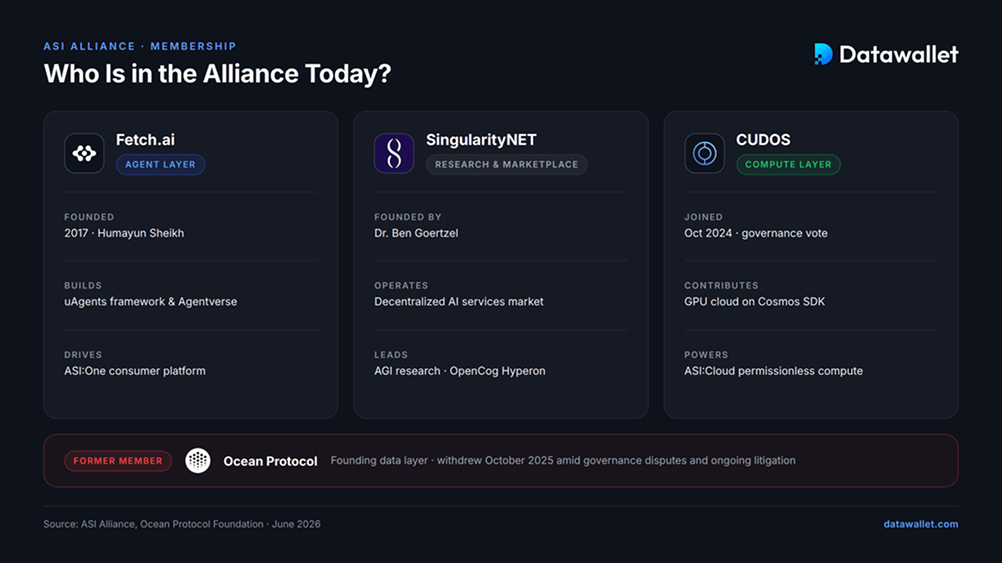
The alliance has three members, each owning a distinct layer of the stack.
Fetch.ai: The agent layer and origin of the FET token, founded in 2017 by Humayun Sheikh, an early DeepMind investor.
- Builds autonomous AI agents through the uAgents framework and the Agentverse marketplace.
- The most commercially mature member, driving most of the alliance's consumer products including ASI:One.
- For broader category context, see our guide to the best crypto AI agents and platforms.
SingularityNET: The research and marketplace layer, founded by Dr. Ben Goertzel, the AGI researcher behind Sophia the Robot.
- Operates a decentralized marketplace where developers publish and monetize AI services.
- Leads the alliance's long-horizon AGI research, including the OpenCog Hyperon framework.
- Goertzel serves as CEO of the alliance, with Fetch.ai's Humayun Sheikh as chairman.
CUDOS: The compute layer, joining in October 2024 after a community governance vote.
- Contributes a decentralized GPU cloud built on the Cosmos SDK.
- Powers ASI:Cloud, the alliance's permissionless compute product.
- Sits within the broader DePIN sector of crypto projects monetizing physical infrastructure.
Ocean Protocol, a founding member, is no longer part of the alliance. Its departure is covered below.
ASI Token Mergers Explained
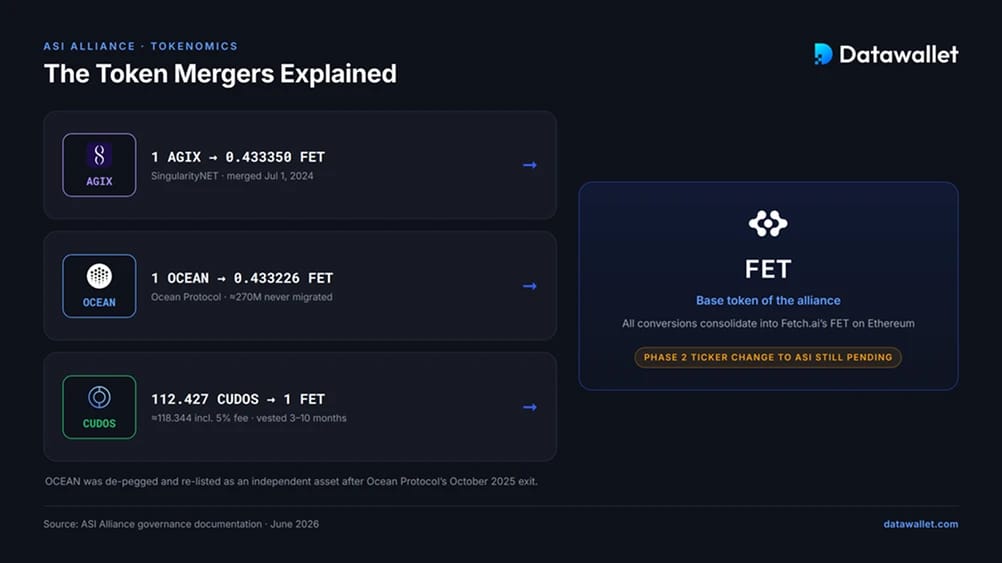
The merger consolidated multiple tokens into FET in stages. On July 1, 2024, Phase 1 went live: SingularityNET's AGIX converted at 1 AGIX to 0.433350 FET, and Ocean's OCEAN converted at 1 OCEAN to 0.433226 FET, with Fetch.ai's existing FET serving as the base asset.
CUDOS followed after its governance vote passed in September 2024. Per the official integration proposal, CUDOS converted at 112.427 per 1 FET, adjusted to roughly 118.344 after a 5% merger fee, with vesting spread over 3 to 10 months. The conversion added about 88.9 million FET to the supply.
Phase 2 of the original plan, a full rebrand of the FET ticker to ASI, has never been completed. As of mid-2026 the token still trades as FET on exchanges, even though data aggregators list it under the Artificial Superintelligence Alliance name. The pending ticker change remains a recurring source of speculation, with FET historically spiking whenever an official update touches the topic.
One note for long-time holders: AGIX migration continues to unwind through scheduled unlocks, and a portion of OCEAN was never converted. Roughly 270 million OCEAN across about 37,000 wallets remained unmigrated when Ocean withdrew, and OCEAN has since been de-pegged and re-listed as an independent asset.
Why Ocean Protocol Left the Alliance
In October 2025, the Ocean Protocol Foundation withdrew its directors and resigned its membership from the alliance, effective immediately. The split quickly turned hostile and is the most consequential event in the project's history.
Ocean's public statement accused SingularityNET and Fetch.ai of breaching the alliance's core commitment that each member retains control of its own assets. Specific allegations included large token sales that drained market liquidity, an attempt to force Ocean to convert its independently managed OceanDAO treasury into FET, and a unilateral move to shut down the OCEAN-to-FET token bridge in August 2025. Ocean said it had sought to withdraw as early as April 2024 and filed legal action over the bridge dispute.
The other side pushed back hard. Fetch.ai CEO and alliance chairman Humayun Sheikh announced he would personally fund a class action for FET holders who lost money during Ocean's exit, while the alliance maintained that Ocean's departure did not affect the core technology stack since data tooling had largely been built by the remaining teams.
The market consequences were severe either way. FET fell roughly 10% after the announcement and was already down more than 90% from its all-time high, a decline Ocean attributed to partner token sales and the underperformance of Fetch.ai's TRNR treasury trade. Litigation was unresolved as of mid-2026 and remains an overhang for the token.
The ASI Product Stack in 2026
The alliance's credibility now rests on shipped products, and the 2026 stack is its most concrete output to date.
ASI:One
ASI:One is the consumer-facing agentic platform, a web interface where users interact with AI agents for tasks like price comparison, scheduling, and email management. Recent releases include AI Roundtables, a feature where multiple users' personal agents hold a discussion that can be exported as audio, signalling a push toward everyday consumer use cases.
ASI-1 Mini
ASI-1 Mini, launched by Fetch.ai in February 2025, was the first Web3-native large language model built for agentic workflows. It emphasizes transparent multi-step reasoning to address the black-box problem in AI, runs on as few as two GPUs, and is paid for in FET through the ASI wallet.
ASI:Cloud
ASI:Cloud is the permissionless compute layer powered by CUDOS, offering GPU provisioning and model inference with wallet-based login and no KYC. By late 2025 it had processed billions of inference tokens and onboarded over 1,000 users running live inference, hosting open-source models like LLaMA, Qwen, and Gemma alongside ASI-1 Mini.
ASI:Create
ASI:Create entered closed alpha in February 2026 as a platform for building and deploying AI agents at scale, with an open beta planned next. It is the current focal point of the roadmap, and its adoption numbers will be an early signal of whether the alliance can convert infrastructure into active builders.
ASI:Chain
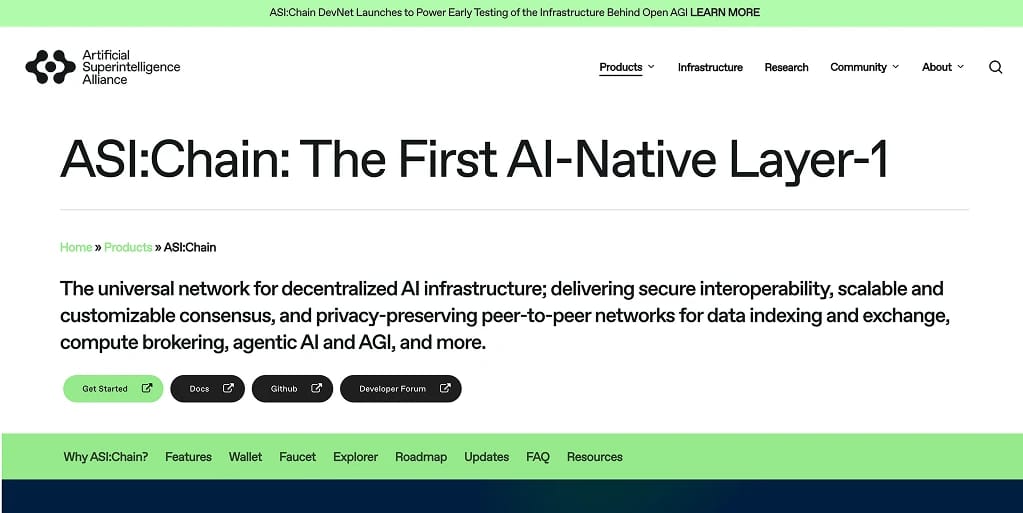
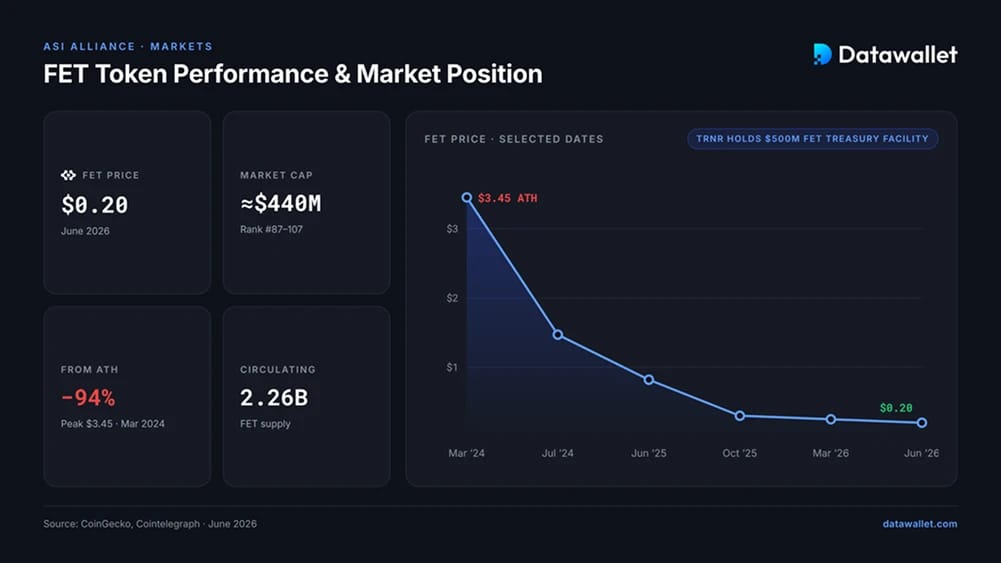
ASI:Chain is the centerpiece of the infrastructure roadmap: a blockDAG-based layer 1 designed for high-concurrency AI workloads. The DevNet beta is live, a public TestNet is scheduled for 2026, and mainnet is targeted for late 2026 or early 2027, with bridge support expanding to chains including Cardano. In April 2026 the alliance partnered with Matterhorn to bring an AI-native development environment to ASI:Chain, targeting 20,000 builders by year end.
FET (ASI) Tokenomics
The competitive field is crowded. Agent-economy rivals like Virtuals Protocol have built faster-moving tokenized agent marketplaces, while Bittensor dominates the decentralized model-training narrative, so ASI's differentiation rests on owning the full stack from model to compute to chain.
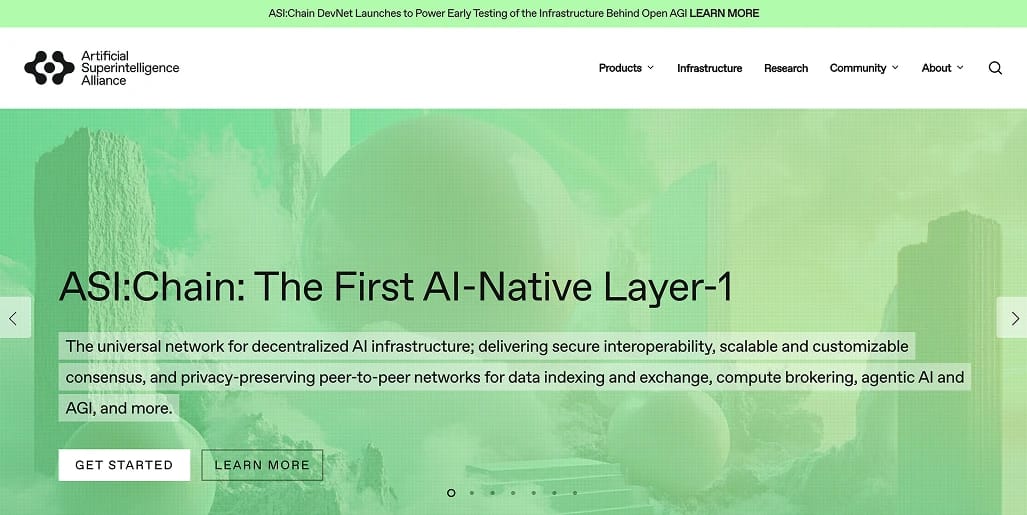
FET has a maximum supply of roughly 2.72 billion tokens, with about 2.26 billion circulating as of June 2026, around 83% of the total, per CoinGecko. The structure reflects the merger itself: one supply consolidating four token communities, with modest emissions left and utility spread across every layer of the stack.
- Supply composition: Fetch.ai's original FET base, AGIX and OCEAN converted at the Phase 1 ratios, and roughly 88.9 million FET minted for the CUDOS merger.
- Emissions: New supply enters mainly through residual AGIX migration unlocks, with recent tranches releasing about 2.59 million FET each, under 0.1% of total supply, so dilution pressure is limited compared with most AI tokens.
- Valuation: Fully diluted valuation sits near $520 million against a circulating market cap around $440 million, a narrow gap by sector standards.
- Utility: FET pays for ASI-1 model inference and ASI:Cloud compute, registers and discovers agents through the Almanac contract, secures the network through staking, and carries governance rights.
- Coming at mainnet: FET becomes the native gas asset of ASI:Chain, tying transaction demand directly to network activity.
FET Token Performance and Market Position
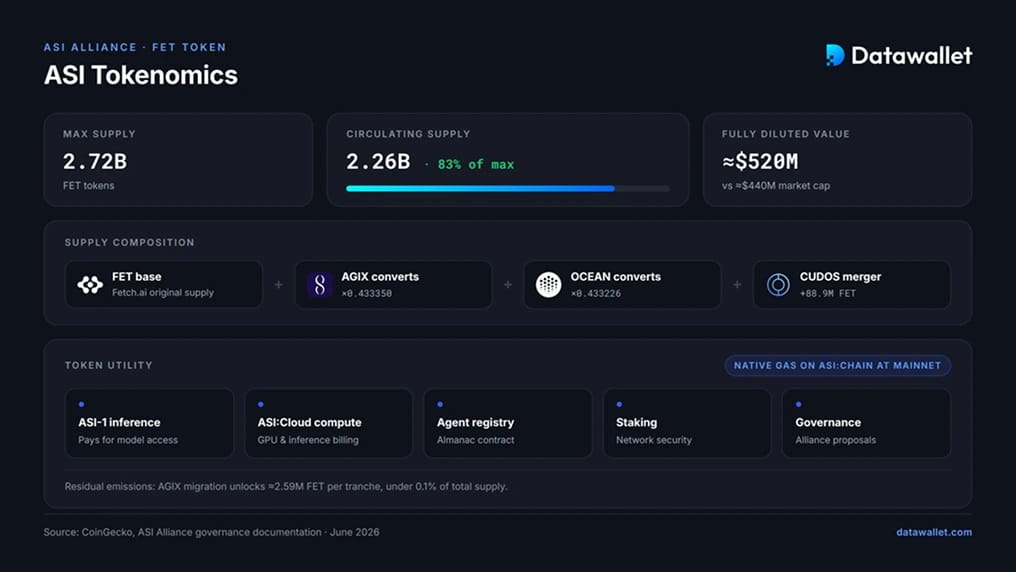
FET trades around $0.19 to $0.20 as of June 2026, with a market capitalization near $430 to $455 million and a circulating supply of roughly 2.26 billion tokens, according to CoinGecko. That places it around rank 90 to 107, well below the top-30 position the combined entity held at the 2024 merger. The token sits about 94% under its all-time high of $3.45, set in March 2024.
The token's largest institutional storyline is Interactive Strength (Nasdaq: TRNR), a fitness equipment maker that announced a $500 million facility in June 2025 to build the first corporate treasury centered on an AI token, with custody handled by BitGo. The strategy gave FET a Nasdaq-listed proxy, though the digital asset treasury model broadly struggled through the 2025-2026 drawdown.
FET's utility case is broader than in 2024. The token pays for ASI-1 model access, ASI:Cloud compute, agent registration and discovery, staking, and governance, and is slated to become the native gas asset of ASI:Chain at mainnet. Whether that utility translates into sustained demand depends on inference volume, active agents, and builder counts rather than narrative alone.
What to Watch Next
Four catalysts will define the next 12 months. First, the ASI:Chain mainnet launch in late 2026 or early 2027 is the largest milestone, since it activates the dedicated infrastructure the merger was meant to enable. Second, the long-delayed FET-to-ASI ticker change would reset the asset's identity on exchanges and is a known trading catalyst whenever updates surface.
Third, the legal disputes from Ocean's exit remain unresolved in multiple jurisdictions, and outcomes could move treasury assets and sentiment in either direction. Fourth, adoption numbers from ASI:Create's open beta and the Matterhorn builder program will show whether the developer push is converting into real usage.
Final Thoughts
The Artificial Superintelligence Alliance set out to prove that decentralized AI projects could pool resources and compete with centralized labs. The thesis survived its first major stress test, the acrimonious loss of a founding member, but the cost shows in a token down more than 90% from its peak.
What remains is a leaner three-member coalition with an unusually complete product stack for this sector: models, compute, agents, and soon a dedicated chain. FET in 2026 is a bet on execution, with ASI:Chain mainnet as the clearest milestone to track. Anyone weighing exposure should size positions with the litigation overhang and FET's volatility history in mind.