




Compare Top Tanzanian Crypto Exchanges
1. MEXC
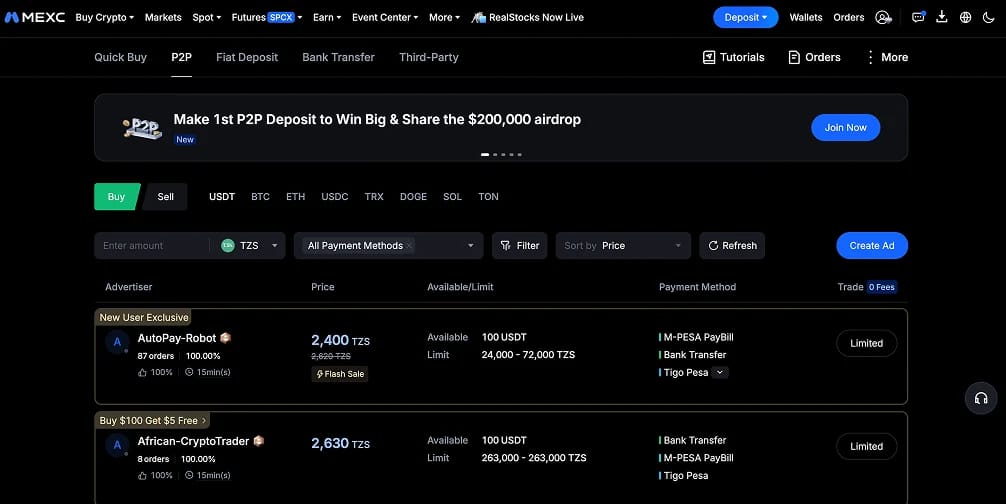
MEXC tops our Tanzania list because it runs a live TZS P2P desk and charges nothing on either side of the trade. The desk lists M-Pesa PayBill, Tigo Pesa (now Mixx by Yas), and bank transfer as payment methods, P2P trades carry zero fees, and spot trading runs 0% maker and 0.02% taker, the cheapest combination of any platform here.
When I funded a test order through M-Pesa PayBill, the merchant released escrow inside the 15-minute payment window with the spread under 2% of mid-market USDT. The desk is younger than Binance's, so merchant histories matter: filter for high completion rates and meaningful order counts rather than taking the promotional ads at the top of the book.
Past the on-ramp, MEXC lists 2,800+ assets with a pipeline that regularly beats larger venues to new tokens, plus a full futures suite. The trade-off is disclosure: proof-of-reserves cadence lags Bitget and OKX, so it works best as an on-ramp and trading venue rather than long-term custody for size.
Pros
- Live TZS P2P with M-Pesa PayBill, Tigo Pesa, and bank transfer at zero P2P fees.
- 0% maker and 0.02% taker spot fees, the lowest combination available.
- 2,800+ assets with one of the fastest listing pipelines anywhere.
Cons
- TZS merchant pool is younger and thinner than Binance's, so vet order histories.
- Proof-of-reserves disclosure lags top-tier competitors.
- Feature density takes adjusting for first-time buyers.
2. Binance
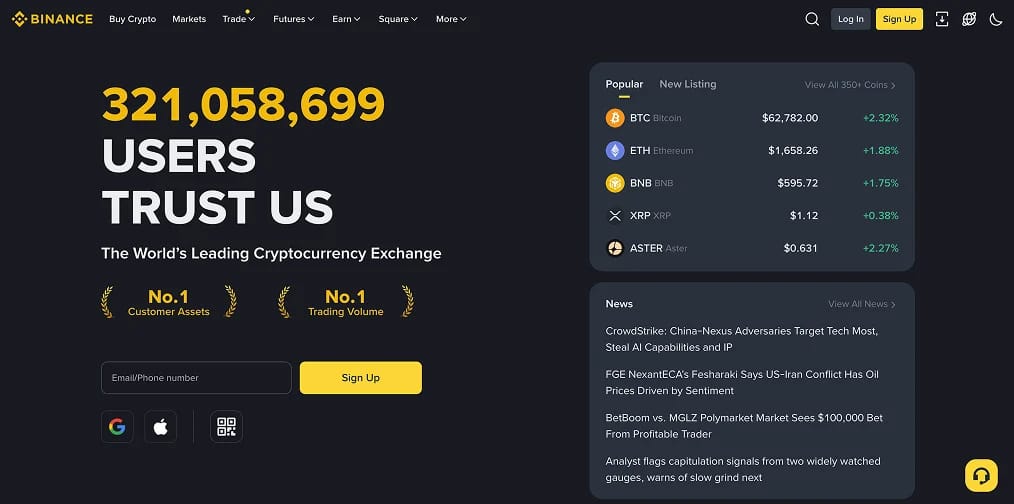
Binance runs the deepest TZS P2P book in the market, and that depth is the whole argument. East Africa learned P2P on Binance, and the Tanzanian merchant base reflects years of accumulated trust scores, completion histories, and payment coverage spanning M-Pesa, Mixx by Yas, Airtel Money, and direct transfers to CRDB and NMB accounts.
Depth shows up in pricing. On orders above roughly TZS 2 million, the Binance desk consistently produced the tightest quotes we found, because more merchants competing on the same pair compresses the spread. Smaller orders price similarly across MEXC and Binance, so the gap mostly matters when you move size.
The trade-offs are platform-level rather than Tanzania-specific. Binance's global record carries the 2023 US settlement, and the exchange has periodically tightened P2P advertising in African markets under regulator pressure, thinning listings in neighbouring countries without warning. Nothing of that kind has hit the TZS desk so far, but it shapes how much I would rely on a single venue.
Pros
- Largest TZS merchant pool, with the tightest quotes on orders above TZS 2 million.
- Payment coverage spans M-Pesa, Mixx by Yas, Airtel Money, CRDB, and NMB.
- SAFU insurance fund and the deepest global spot liquidity for conversions.
Cons
- History of suspending P2P ad categories in African markets under regulator pressure.
- Global compliance record is heavier baggage than most rivals carry.
- Interface buries the P2P desk behind several menus on first use.
3. Bybit
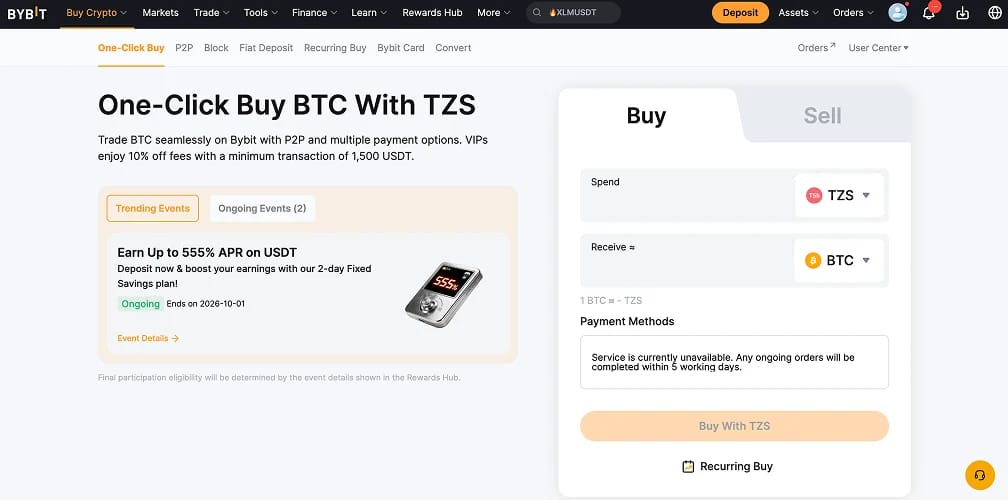
Bybit stays on the list for the product stack even though it no longer has a shilling on-ramp. The exchange has removed TZS from its P2P desk, so Tanzanian users now fund it with a TRC20 USDT transfer from a purchase made on MEXC or Binance. The transfer costs around a dollar and settles in minutes.
That extra step buys access to the deepest trading stack available here. Bybit covers spot across 2,000+ assets at 0.1%, perpetual futures, copy trading, Earn products on idle stablecoins, and the Bybit Card in supported regions, and the app holds together on mid-range Android over mobile data. For traders moving into derivatives, our crypto futures exchange guide covers how Bybit's perps compare.
The TZS removal is also a lesson in how fast P2P desks change in frontier markets. Treat any on-ramp as provisional, keep a second venue verified, and check the live book before assuming last month's path still works.
Pros
- Deepest trading stack on this list: futures, copy trading, Earn, and the Bybit Card.
- 0.1% spot fees across 2,000+ assets with strong derivatives liquidity.
- Light app performance on mid-range Android phones and mobile data.
Cons
- No TZS P2P desk after removing shilling support, so funding requires a USDT transfer.
- Two-platform setup adds friction for first-time buyers.
- Deep product menu can overwhelm someone who only wants to hold USDT.
4. OKX
OKX earns fourth on two things: the lowest spot fees among the large venues at 0.08% maker and 0.10% taker, and a Web3 wallet built into the app. For Tanzanian users who want to go past holding USDT into DeFi, DEX trading, or tokens that never reach centralised listings, it removes the need for a separate wallet app on a phone already short on storage.
The TZS P2P desk works through verified merchants on mobile money and bank transfer, but it is thinner than MEXC or Binance, and on sub-TZS 500,000 orders the spread widened outside East African business hours in our testing. Treat OKX as a trading and Web3 venue first and an on-ramp second, funding it with a TRC20 USDT transfer from a P2P purchase elsewhere.
OKX publishes monthly proof-of-reserves attestations and keeps one of the cleaner disclosure records among major exchanges, which counts in a market where no platform answers to a local regulator.
Pros
- 0.08% maker and 0.10% taker spot fees, the lowest of the major venues here.
- Built-in Web3 wallet for DeFi and DEX access without a second app.
- Monthly proof-of-reserves with a consistent disclosure history.
Cons
- TZS merchant depth trails MEXC and Binance, especially off-peak.
- Spreads widen on smaller orders outside East African hours.
- Web3 features add complexity a pure stablecoin saver will never touch.
.webp)
5. Bitget
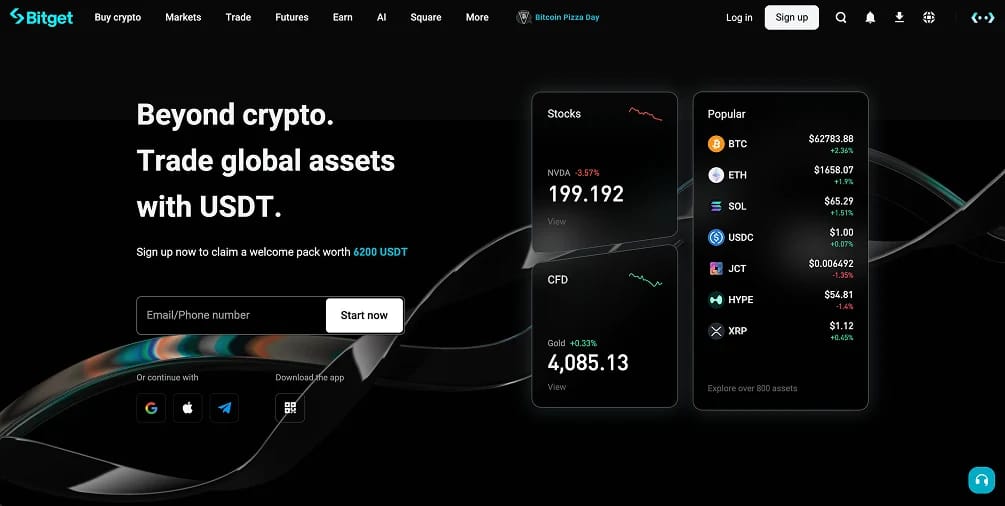
Bitget makes the list on reserve transparency and the most mature copy trading product of any exchange Tanzanians can reach. Its proof-of-reserves disclosures have shown total ratios well above 100%, and the protection fund sits above $400 million, a genuine buffer in a market where users have no local recourse if a platform fails.
TZS funding runs through P2P with mobile money and bank transfer, plus a card option that carries the usual processor markup and works only as a last resort. Merchant depth on the TZS pair lands mid-pack: workable during Dar business hours, thin late at night, so check the live book before a larger order.
Copy trading is the standout. Newer traders can mirror established strategies with position sizing controls rather than trading blind, and the elite trader pool is large enough to filter by drawdown history instead of headline returns.
Pros
- Reserve ratio consistently above 100% with a $400M+ protection fund.
- The deepest copy trading pool of any platform available in Tanzania.
- Zero-fee P2P with mobile money and bank transfer support.
Cons
- TZS merchant depth is mid-pack and thins outside business hours.
- Card funding carries a 2 to 5% processor markup.
- Lower brand recognition in Tanzania than Binance, so local P2P dispute volumes are less tested.
6. KuCoin
KuCoin closes the list as the altcoin specialist. It lists 700+ assets and consistently picks up smaller-cap tokens before they reach Bybit or Binance, which matters if you hunt early-stage names rather than holding majors. Trading bots with grid and DCA strategies, plus Earn products on idle stablecoins, round out a feature set for users who already know their way around.
Like Bybit, the TZS on-ramp is the weak point. P2P depth in shillings is shallow, and most Tanzanian KuCoin users fund through a TRC20 USDT transfer from a purchase made elsewhere. That extra step is acceptable for a secondary venue and disqualifying for a primary one.
One compliance note: KuCoin's operating entity pleaded guilty in January 2025 to running an unlicensed money transmitting business in the US, paying $297 million in penalties. The compliance program has been rebuilt since, but factor it into how much you leave on the platform.
Pros
- Early listings on smaller-cap tokens ahead of the larger venues.
- Mature trading bots and Earn products for yield on idle USDT.
- Reliable TRC20 deposits for users funding from another exchange.
Cons
- TZS P2P depth is shallow, ruling it out as a first on-ramp.
- January 2025 US guilty plea sits in recent memory.
- Feature density is unfriendly to complete beginners.
How to Choose a Crypto Exchange in Tanzania
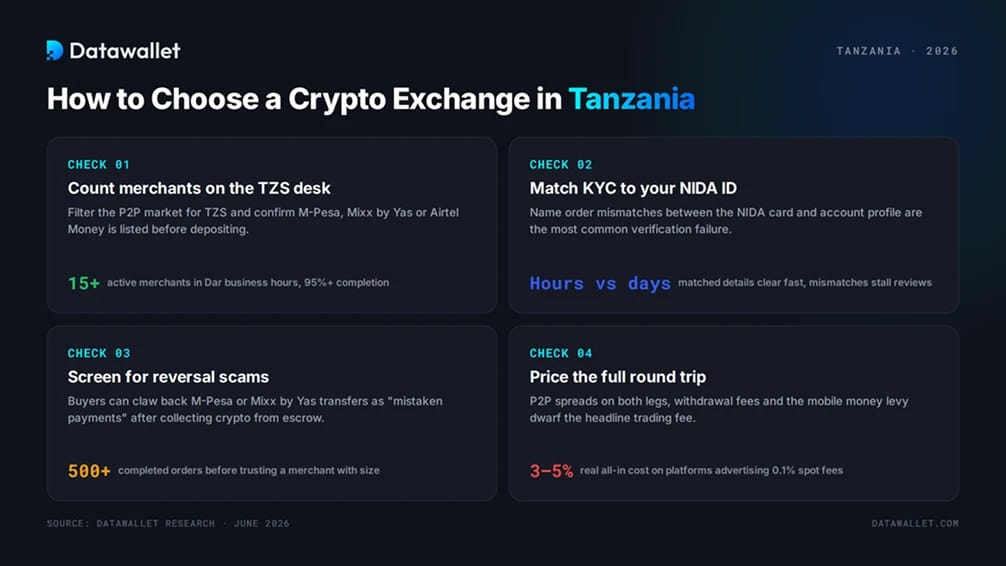
Feature lists matter less here than whether you can move shillings in and out without losing money to spreads or scams. Four checks I run before trusting a platform with a real order:
- Open the P2P desk and count merchants before depositing. Filter for TZS and confirm your payment method is listed: M-Pesa, Mixx by Yas, or Airtel Money. A functional desk shows at least 15 active merchants during Dar es Salaam business hours with completion rates above 95%. An empty book means the platform is not usable from Tanzania, whatever its marketing says. Desks also change without notice, as Bybit's TZS removal showed.
- Match your KYC documents exactly. Every platform requires a NIDA national ID, passport, or driving licence plus a selfie. The most common verification failure among Tanzanian users is a name order mismatch between the NIDA card and the account profile, so enter your names in the order they appear on the document.
- Screen merchants for reversal risk. The signature P2P scam in East Africa is the mobile money reversal: a buyer pays through M-Pesa or Mixx by Yas, collects the crypto from escrow, then reports the transfer to the telco as a mistaken payment to claw it back. Trade only with merchants showing 500+ completed orders and long histories, and never release crypto until the money is confirmed in your wallet, not just notified by SMS.
- Price the full round trip, not the trading fee. Run a small TZS to USDT to TZS loop and measure total slippage. Between the P2P spread on both legs, the withdrawal fee, and the government levy on mobile money transfers, a platform advertising low spot fees can cost 3 to 5% all-in. That round-trip number is the only fee figure worth comparing.
Crypto and Bitcoin Regulation in Tanzania
Tanzania has no crypto licensing framework, but the rules that touch crypto sit across several instruments, and the direction of each one matters:
- The Bank of Tanzania's 2019 public notice: On 12 November 2019, the BoT cautioned the public that trading, marketing, and using virtual currencies contravenes existing foreign exchange laws, reiterating that the Tanzanian shilling is the only legal tender. That notice remains the BoT's baseline position, and the government has since repeated that crypto activity is done at your own risk.
- The 2025 foreign currency regulations: The Foreign Currency Usage Regulations (GN No. 198 of 2025), effective 28 March 2025, made it an offence to quote, advertise, or accept payment in anything other than shillings for domestic transactions, as confirmed in the BoT's public notice of 2 May 2025. The regulations target dollarisation rather than crypto directly, but they make any attempt to price local goods in USDT clearly unlawful.
- The Yellow Card precedent: In December 2024, the High Court's Commercial Division decided Yellow Card Tanzania Ltd v. Nyamwero, enforcing a settlement deed involving a virtual currency business. Courts treating crypto-related contracts as enforceable rather than void for illegality signals the judiciary does not read the BoT notices as a blanket criminal prohibition on individuals.
- CBDC research and a possible framework: President Samia Suluhu Hassan directed the BoT in 2021 to prepare for digital currencies, and the central bank has completed a CBDC feasibility study now awaiting government direction. The same reporting confirmed the government still describes cryptocurrency use as illegal, citing money laundering and counterfeit asset concerns.
The practical position: no individual has a licensed venue to use, P2P trading sits in a grey zone the state has not prosecuted at retail level, and using crypto to pay for goods and services inside Tanzania is the one line clearly drawn. Holding USDT quietly and paying a supplier in it are very different legal propositions here.
How Does Tanzania Tax Crypto?
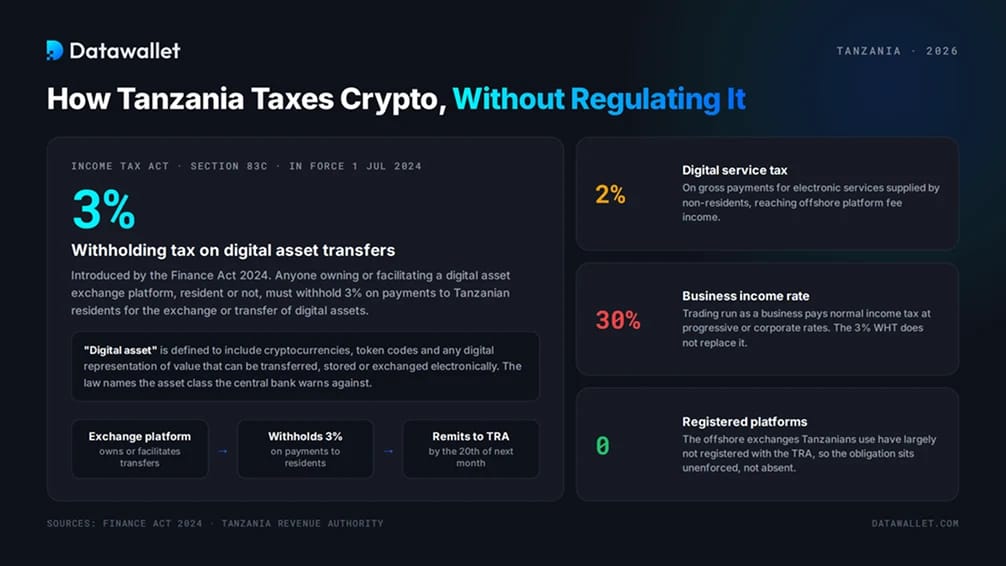
Tanzania is one of the few African countries that taxes digital assets explicitly while declining to regulate them. The framework arrived through the Finance Act 2024 and sits in the Income Tax Act:
- 3% withholding tax on digital asset transfers: Section 83C of the Income Tax Act, introduced by the Finance Act 2024, requires anyone who owns a digital asset exchange platform or facilitates digital asset transfers, resident or not, to withhold 3% on payments made to resident persons for the exchange or transfer of digital assets. It took effect on 1 July 2024.
- Platform registration with the TRA: The Tanzania Revenue Authority operates a simplified registration framework for non-resident platforms, with returns and payments due by the 20th of the following month. The offshore exchanges Tanzanians use have largely not registered, which leaves the withholding obligation unenforced rather than absent.
- Digital service tax: A separate 2% DST applies to gross payments for electronic services supplied by non-residents, which can reach the fee income of offshore platforms serving Tanzanian users.
- Business income: If your trading rises to the level of a business, normal income tax applies at progressive individual rates or the 30% corporate rate, and the 3% withholding does not replace that liability.
The contradiction is worth sitting with. The Finance Act's definition of digital assets covers cryptocurrencies by name, even though the BoT maintains they contravene foreign exchange law. Keep records of every disposal and its TZS value at the time, because when enforcement infrastructure catches up with the legislation, it will reach backwards.
Cryptocurrency Adoption in Tanzania
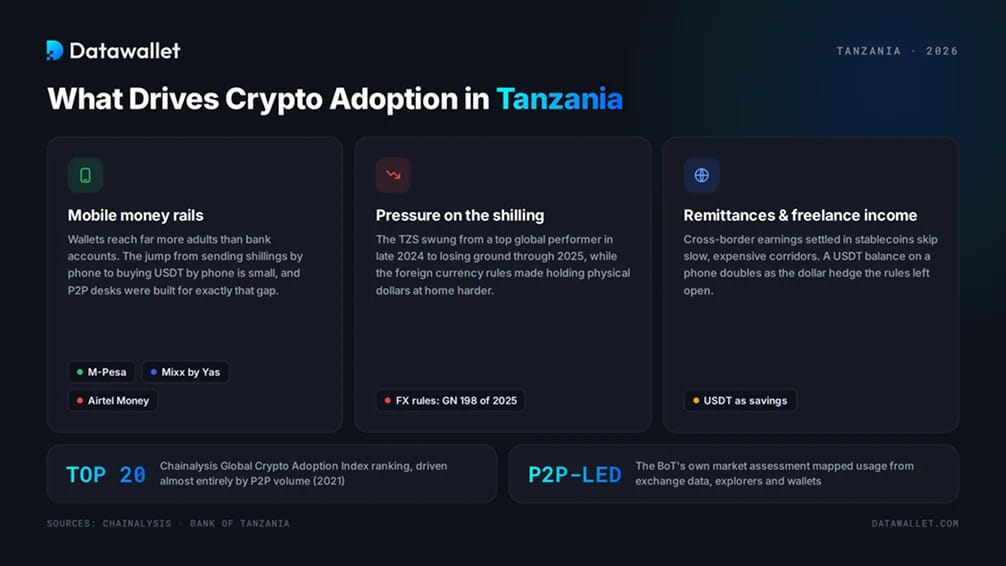
Tanzanian crypto activity grew out of the same infrastructure that made the country a mobile money leader. With M-Pesa, Mixx by Yas, and Airtel Money wallets reaching far more adults than bank accounts do, the jump from sending shillings by phone to buying USDT by phone is small, and P2P desks were built for exactly that gap. Chainalysis placed Tanzania in the top 20 of its Global Crypto Adoption Index as far back as 2021, driven almost entirely by P2P volume.
The Bank of Tanzania has itself studied the market it warns against. Its assessment of crypto usage drew on exchange data, blockchain explorers, and wallet activity to map how Tanzanians use digital assets in practice, feeding into the CBDC research now awaiting a government decision.
Currency pressure does the rest. The shilling swung from one of the world's best-performing currencies in late 2024 to losing ground against the dollar through 2025, and the foreign currency regulations made holding physical dollars domestically harder at the exact moment demand for a dollar hedge rose. A USDT balance on a phone fills the space those rules left open, alongside remittances and freelance income settled in stablecoins.
How to Buy Bitcoin in Tanzania
The reliable path runs through mobile money to USDT on a P2P desk, then a spot trade into BTC. The sequence I use:
- Pick a platform with a live TZS desk. Open MEXC or Binance, go to the P2P section, filter for TZS, and confirm active merchants accept M-Pesa, Mixx by Yas, or Airtel Money. Check the quoted rate against mid-market USDT before committing.
- Complete KYC with a NIDA ID or passport. Enter your names in the exact order printed on the document. Verification usually clears within hours when details match and can stall for days when they do not.
- Buy USDT through a verified merchant. Choose one with 500+ completed trades and a 98%+ completion rate, pay through your mobile money wallet, and only mark the order as paid after the transfer confirms. Escrow typically releases the USDT in 5 to 15 minutes.
- Swap USDT for BTC with a limit order. Skip the one-click convert screen and place a limit order on the BTC/USDT spot pair instead. The difference is usually 1 to 3% in your favour.
- Decide where the BTC lives. Active traders can leave it on the exchange. Anyone holding long term should withdraw to self-custody, double-checking the address and network first. Our best crypto wallets guide covers the options.
The same desks work in reverse when you need shillings back, selling USDT to a merchant who pays your M-Pesa or Mixx by Yas wallet directly.
Final Thoughts
For most Tanzanian users, MEXC is the platform to start with, backed by Binance when you need the deeper merchant pool for larger orders. Bybit keeps a place for its trading stack despite dropping TZS from P2P, while OKX and Bitget earn theirs for fees and transparency, and KuCoin works as a secondary altcoin venue funded by USDT transfer.
Watch the regulatory file more closely than the price chart. A completed CBDC study sitting with the government, an explicit tax on digital assets already in force, and a court precedent enforcing crypto-related contracts all point toward Tanzania eventually formalising this market the way Kenya has begun to with its VASP framework. Until then, the grey zone cuts both ways: nobody licenses the platforms you use, and nobody protects you if one fails.
Run a small round trip before committing real money. Buy TZS 100,000 of USDT, sell it back, and measure what the loop cost. Ten minutes of testing beats any review, including this one.
Our Methodology
We evaluated over 20 exchanges accessible from Tanzania by creating accounts, completing KYC with Tanzanian documents, funding TZS through P2P with mobile money, executing trades, and selling back to M-Pesa and Mixx by Yas wallets. Each platform was scored across six criteria:
- Trust Score: Our proprietary rating (out of 5) weighting security history, proof-of-reserves transparency, regulatory standing, platform longevity, and audit coverage.
- TZS Funding Methods: Confirmed M-Pesa, Mixx by Yas, Airtel Money, and bank transfer support through P2P, testing settlement speed, merchant depth, and spread against mid-market USDT.
- Merchant Quality: Reviewed completion rates, account histories, and dispute resolution speed on each TZS desk, with attention to reversal scam exposure.
- Security Track Record: Assessed breach history, custody arrangements, reserve disclosure cadence, and account protections including 2FA and withdrawal whitelists.
- Assets and Liquidity: Placed market and limit orders on BTC/USDT, ETH/USDT, and at least one mid-cap pair to measure spread, depth, and fill quality.
- Fee Structure: Compared maker and taker fees, withdrawal charges, P2P spreads, and the all-in cost of a TZS to USDT round trip.
We excluded platforms with no functional TZS path, persistently thin merchant books, or serious recent compliance failures without remediation. Testing ran from March to June 2026.