







Compare Top Panamanian Cryptocurrency Exchanges
1. Bybit
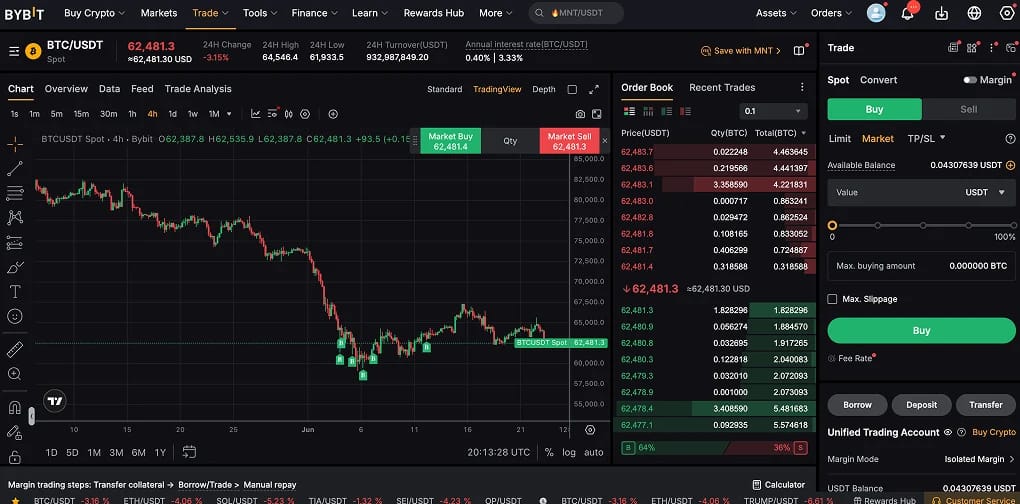
Bybit takes the top spot because it is the only platform here that fits both kinds of Panama user without a trade-off. A local buys dollars through the P2P desk using Yappy or a bank transfer. A tax resident moves USDC over from cold storage and holds it as a yield-bearing dollar balance, which is what most residents want once their gains sit outside the local tax base.
Bybit Earn pays on idle USDC and USDT, so dollar liquidity keeps working between trades instead of sitting flat. When I funded a USD P2P order, escrow released inside the payment window at close to the 1.5% spread the local market runs.
Past the on-ramp you get 2,000+ assets, perpetual futures, copy trading, the Bybit Card, and tokenized US stocks through xStocks and Bybit TradFi. Traders moving into derivatives can weigh the perp stack in our crypto futures exchange guide.
The access gap that matters in Panama is that Bybit does not serve US or UK persons, so a Panama-based American keeps their home-country accounts on a domestic venue.
Pros
- Works for both local P2P funding (Yappy, bank transfer) and dollar-balance holding in one account.
- USDC and USDT Earn products suit residents who want yield on idle dollar liquidity.
- Deep stack across 2,000+ assets, futures, copy trading, and the Bybit Card.
Cons
- February 2025 hack was the largest in exchange history, even though users were reimbursed in full.
- No US or UK access, so American and British residents need a secondary venue.
- Derivatives depth can overwhelm someone who only wants to hold spot.
2. Binance
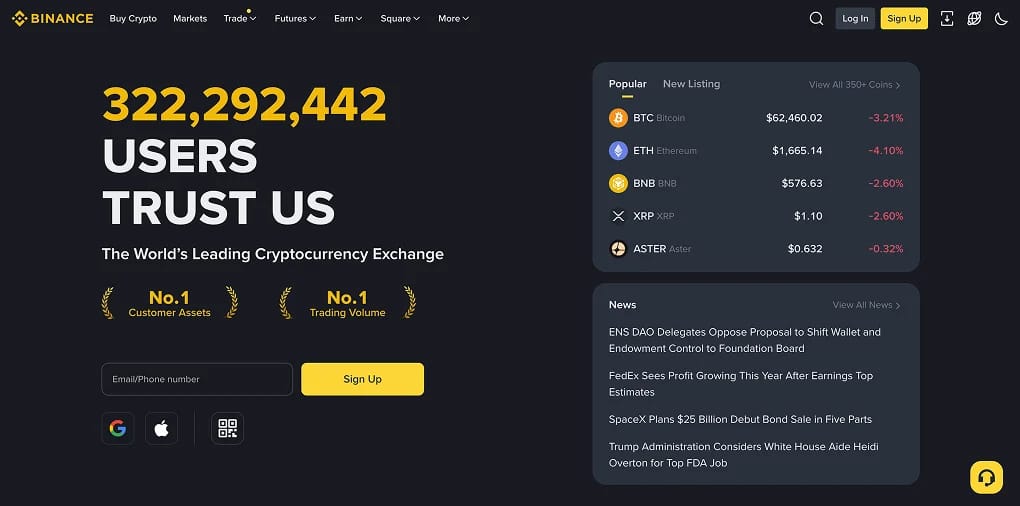
Binance holds the deepest P2P book in Panamanian rails, and for locals that depth is the whole point. The desk lists Yappy, Nequi, Transferencia ACH Panamá, and Zinli, which together cover how most Panamanians move money. Yappy alone, the QR system inside Banco General, is accepted where cards are not.
The USDT to USD spread on the desk sits near 0.985, roughly 1.5% all in, with escrow clearing in minutes on a merchant with real history. Binance also runs El Dorado, its lighter Latin American P2P layer, covering Panama alongside Colombia, Argentina, and the wider region.
From experience - banks here are relaxed about crypto income from a recognised exchange, but some query a P2P transfer from an unfamiliar individual. Stick to high-volume merchants and keep your screenshots.
Underneath the on-ramp sits the deepest liquidity in crypto, with 350+ spot assets, futures to 100x, and conversions that rarely stall. The trade-offs are the usual ones, a 2023 US settlement on its compliance record and a habit of trimming P2P ad categories in some Latin American markets under regulator pressure.
Pros
- Deepest P2P book in Panamanian rails, covering Yappy, Nequi, ACH Panamá, and Zinli.
- El Dorado provides a regional P2P fallback when the main desk thins out.
- Largest global liquidity pool, so conversions and withdrawals rarely lag.
Cons
- Some local banks scrutinise inbound P2P transfers from unknown individuals, so merchant choice matters.
- Global compliance history is heavier than most rivals carry.
- The P2P desk sits behind several menus and takes a minute to find on first use.
3. Kraken
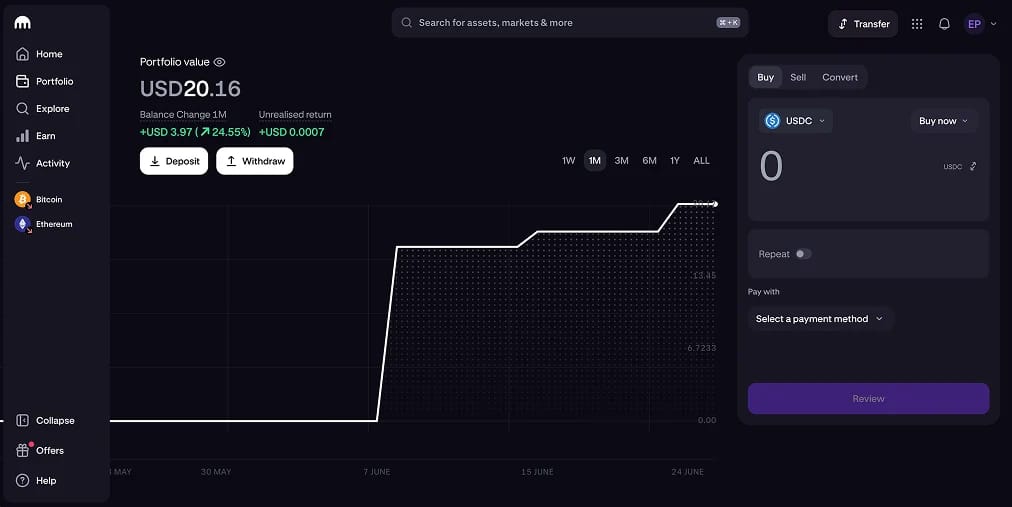
Kraken is the platform I'd hand any tax resident, because it solves the problem locals don't have, moving real dollars in from an offshore bank and holding them under proper custody. It takes USD by SWIFT and Fedwire, which is how anyone funding from an international account moves size, and the fixed wire fee turns trivial as a percentage past five figures.
On regulation it is the most credible venue here, which matters when actual wealth is involved rather than pocket money. Kraken holds FinCEN MSB registration in the US and MiCA CASP authorisation in the EU, with proof-of-reserves audits dating to 2014. It also leads on tokenized stocks, with a 100+ ticker xStocks lineup and the first tokenized-equity perpetual futures, both open to non-US persons.
For a resident parking gains in USD or USDC between trades, a clean wire path plus audited custody beats a few basis points on fees. For a long-term dollar stack, pair it with a hardware wallet from our best crypto wallets guide.
Where Kraken loses ground is the local on-ramp. There is no Yappy or ACH desk, so a Panamanian without an international USD account funds it less easily than Binance or Bybit. Pro fees start at 0.16% maker and 0.26% taker, above OKX, and the Pro interface is more than a first-timer needs.
Pros
- USD wire support (SWIFT and Fedwire) makes it the natural fit for offshore-funded residents.
- Most regulated venue here, with FinCEN, MiCA, and proof-of-reserves back to 2014.
- Clean for holding USD and USDC balances under audited custody between trades.
Cons
- No local Yappy or ACH P2P, so locals without an international account struggle to fund it.
- Spot fees run higher than OKX or the zero-maker venues.
- Kraken Pro is heavier than a casual buyer needs.
4. OKX
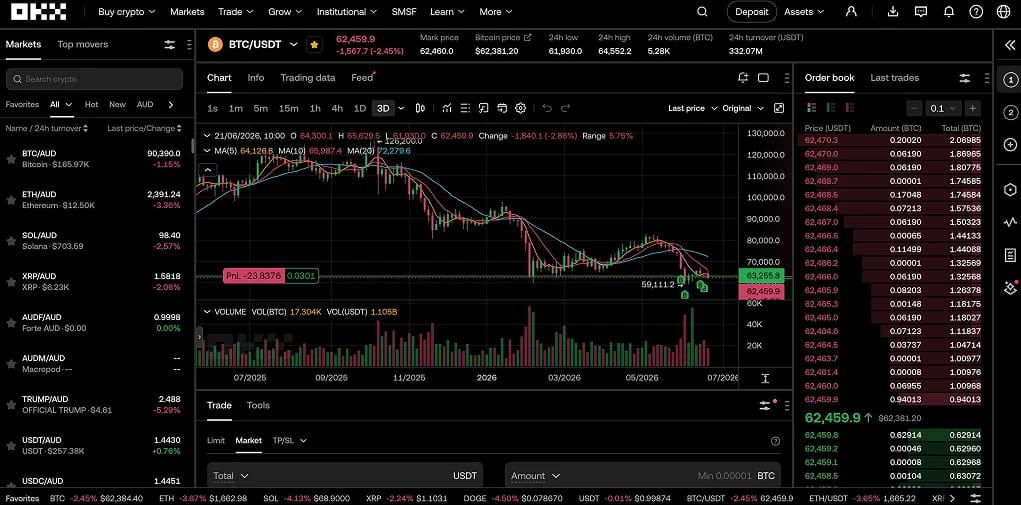
OKX is the pick for a resident who wants a full trading and on-chain stack, not a simple buy button. Spot fees are the lowest among the large venues at 0.08% maker and 0.10% taker, dropping to 0.02% and 0.05% on perpetual futures, and OKX runs the second-largest derivatives book behind Binance, with perps up to 125x.
The other draw is Web3. The non-custodial OKX Wallet spans 100+ chains with a built-in DEX aggregator, so a resident moves from spot into DeFi, swaps, and unlisted tokens without a second app.
Funding is the weaker side. The USD P2P desk runs verified merchants on bank transfer but is thinner than Binance off-peak, so most users fund USDT elsewhere and bridge in on TRC20 for about a dollar.
OKX publishes monthly proof-of-reserves with Merkle-tree self-verification and holds a MiCA licence, more regulatory cover than most venues here. Tokenized stocks are coming via its NYSE-parent ICE partnership, with Ondo tokens reachable from the wallet.
Pros
- Lowest spot fees of the major venues, with perps to 125x and the second-deepest derivatives book.
- Non-custodial OKX Wallet across 100+ chains with a built-in DEX aggregator.
- MiCA licence and monthly Merkle-tree proof-of-reserves.
Cons
- USD P2P depth trails Binance, especially outside business hours.
- Most users fund via USDT transfer rather than the local desk.
- Options, high leverage, and pre-market listings make it unforgiving for beginners.
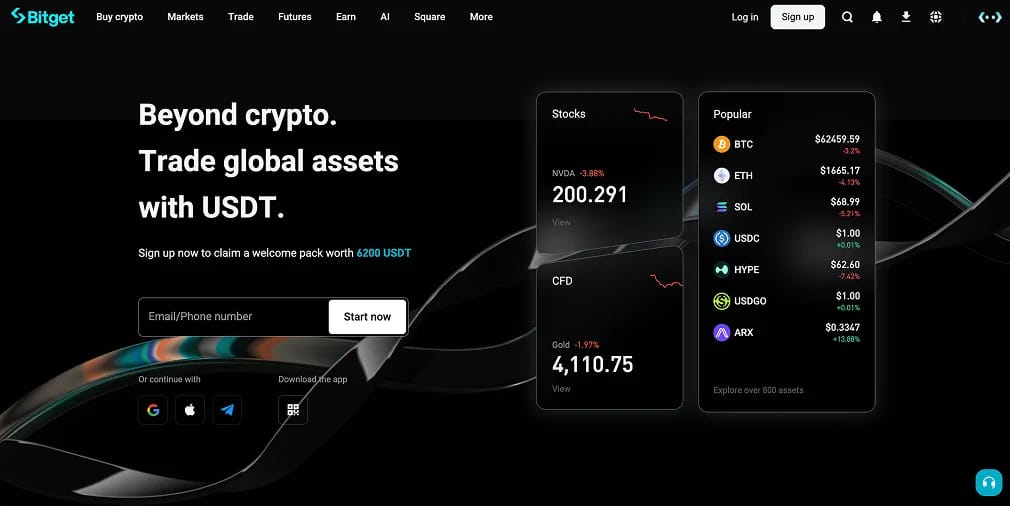
5. Bitget
Bitget is the copy-trading specialist here, and that is the reason to pick it. Its network runs 190,000+ lead traders, one of the largest in crypto, so a newer Panama user can mirror an established strategy with allocation caps and stop-losses, filtering the pool by drawdown history instead of trading blind.
On safety it is one of the stronger venues here, with a 169% proof-of-reserves ratio and a protection fund above $400 million, real cover where a failed platform leaves no local recourse. Past copy trading it carries a full perps book, the non-custodial Bitget Wallet across 100+ chains, and tokenized stocks and commodities via its UEX layer.
Funding runs through USD P2P bank transfer plus a card option with the usual processor markup, and merchant depth is mid-pack, fine in Panama City hours and thinner late at night. Brand recognition here trails Binance, so local dispute volumes are less tested, and the product spread can overwhelm a pure spot buyer.
Pros
- One of crypto's largest copy-trading networks at 190,000+ lead traders.
- 169% proof-of-reserves with a $400M+ protection fund for platform-side cover.
- Full perps book, Bitget Wallet across 100+ chains, and tokenized assets via UEX.
Cons
- Panama P2P merchant depth is mid-pack and thins outside business hours.
- Card funding carries a 2 to 5% processor markup.
- Lower local brand recognition than Binance, so dispute volumes are less battle-tested.
6. MEXC
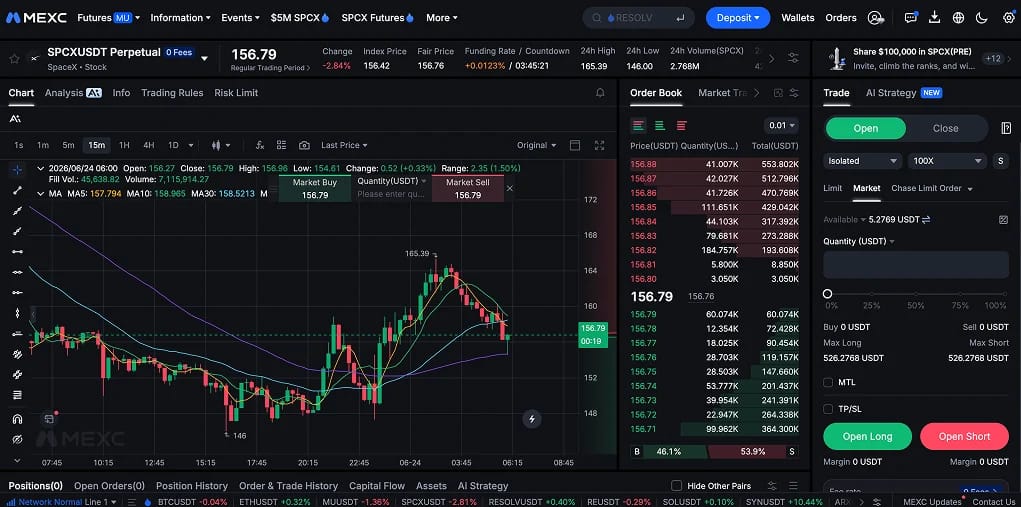
MEXC is the venue for coverage and cost. It runs 0% maker and 0.02% taker on most spot pairs, the cheapest combination here, which adds up when dollar cost averaging into BTC or ETH. Its 2,800+ asset catalogue is the widest on the list, with a listing pipeline that beats larger venues to new tokens and early perps on emerging names.
For derivatives, MEXC offers up to 200x leverage on BTC and ETH futures, double the usual ceiling and more marketing than strategy, since a 0.5% move against a 200x position wipes it out.
It also lists tokenized stocks through Ondo and ran one of the SpaceX IPO campaigns that later refunded. The fee structure suits altcoin hunting and DCA, not size you mean to hold.
Funding is the weak point. P2P is thin, so most local users buy USDT on Binance or Bybit first and bridge it in on TRC20, while card payment carries the standard surcharge. MEXC is also less rigorous on proof-of-reserves than Bitget or OKX, so treat it as a trading venue, not custody for size.
Pros
- 0% maker and 0.02% taker spot fees, the lowest combination on this list.
- 2,800+ assets with the fastest listings and early perps on emerging tokens.
- Up to 200x futures leverage for traders who want it, funded by USDT transfer.
Cons
- Thin Panama P2P, so most users fund via USDT transfer from another exchange.
- Less transparent on proof-of-reserves than Bitget or OKX.
- 200x leverage is a liquidation trap for anyone treating it as a strategy.
Tokenized Stocks and Perps in Panama
Tokenized stocks are now a core line on these venues, and Panama is well placed to use them. xStocks, the 1:1 backed tokens from Backed Finance, give non-US residents 24/7 exposure to US equities and ETFs like AAPL, NVDA, the S&P 500, and a gold ETF, all priced in USD with no US brokerage required. For a dollarised, expat-heavy market, that fills a real gap.
Kraken and Bybit lead here. Kraken lists 100+ xStocks and runs the first tokenized-equity perpetual futures at up to 20x, open to non-US clients in 110+ countries. Bybit lists xStocks on spot and adds TradFi perps on gold, forex, indices, and stocks. Binance, Bitget, and MEXC also offer tokenized-stock products, and every exchange here runs crypto perpetual futures as a core line.
Two caveats matter in Panama. xStocks are blocked for US persons, so a Panama-based American is excluded even while a Colombian or European resident qualifies.
The tokens also carry issuer risk. In June 2026, Binance, Bybit, Bitget, and MEXC cancelled tokenized SpaceX IPO campaigns and refunded over $1 billion after the shared issuer could not secure shares. They track price, not ownership, and confer no voting rights.
How to Choose a Crypto Exchange in Panama
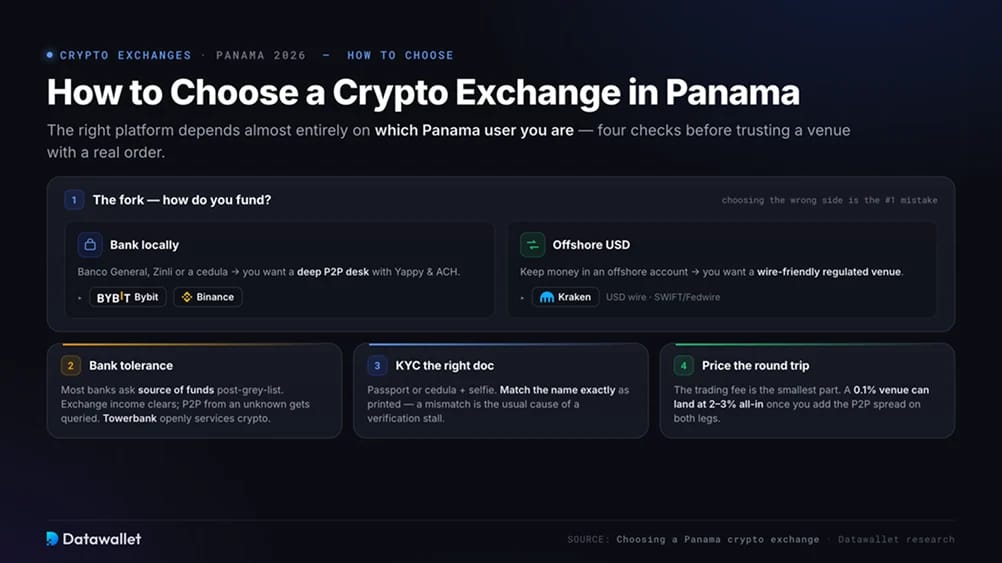
The right platform depends almost entirely on which Panama user you are. Four checks before trusting a venue with a real order:
- Decide whether you fund in local rails or by wire: This is the fork. Bank locally with Banco General, Zinli, or a cedula, and you want a deep P2P desk listing Yappy and ACH, which points to Binance or Bybit. Keep your money in an offshore USD account, and you want a wire-friendly regulated venue, which points to Kraken. Choosing the wrong side is the most common reason a Panama setup feels harder than it should.
- Check whether your bank tolerates the flow: Most Panamanian banks stay cautious and ask about source of funds since the grey-list exit. Income from a recognised exchange usually clears. A P2P deposit from an unknown individual draws questions. Keep records, use established merchants, and for serious size, Towerbank openly services crypto clients.
- Complete KYC against the document you bank with: Every major venue wants a passport or cedula plus a selfie. Match the name exactly as printed, since a mismatch between your exchange profile and your cedula or passport is the usual cause of a verification stall.
- Price the full round trip, not the headline fee: Run a small USD to USDT to USD loop and measure slippage. The trading fee is the smallest part; the real cost is the P2P spread on both legs plus any withdrawal fee, and a platform advertising 0.1% spot fees can land at 2 to 3% all in. That round-trip figure is the only fee worth comparing.
Crypto and Bitcoin Regulation in Panama
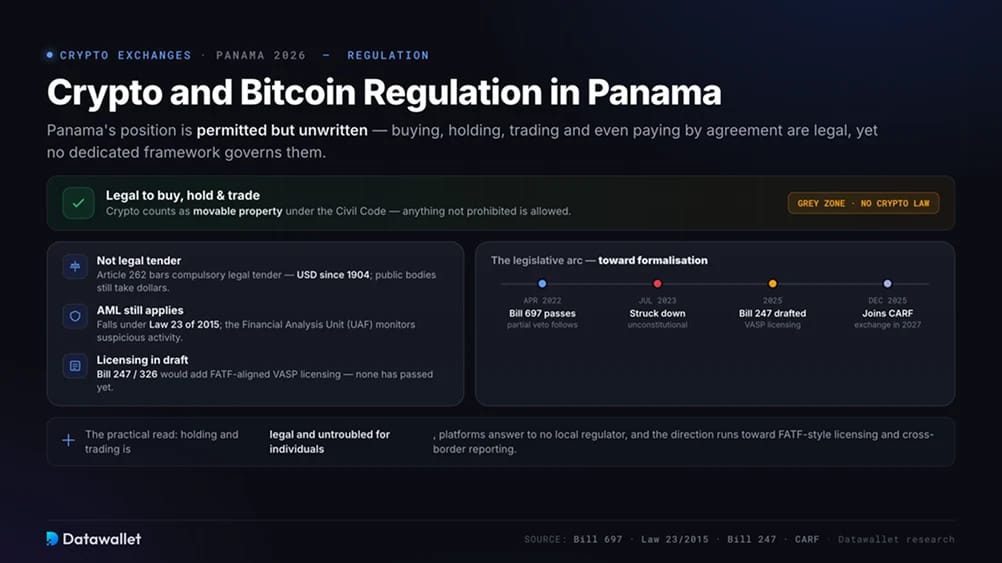
Panama's crypto position is permitted but unwritten. Buying, holding, trading, and even paying with crypto by mutual agreement are legal, yet no dedicated framework governs them. A few moving parts decide what that means:
- No crypto-specific law: Bill 697 of 2021 passed the National Assembly in April 2022, drew a partial veto from President Cortizo over anti-money-laundering gaps, and was struck down by the Supreme Court in July 2023 as unconstitutional. That left crypto in a grey zone, where it sits today. Under the constitutional principle that anything not prohibited is allowed, crypto counts as movable property under the Civil Code.
- Monetary freedom, not legal tender: Article 262 of the Constitution bars compulsory legal tender, which is why the US dollar has circulated alongside the balboa since 1904. Crypto works in transactions when both parties agree, but it is not legal tender, and public institutions must still receive dollars.
- AML obligations still apply: Virtual asset activity falls under Law 23 of 2015 on anti-money-laundering and counter-terrorist financing. The Superintendency of Banks and the securities regulator place crypto outside their direct scope, while the Financial Analysis Unit (UAF) monitors suspicious activity.
- A new framework is in draft: Bill 247, introduced in 2025, would add FATF-aligned VASP licensing, mandatory registration, and a national digital-asset council, with Bill 326 and a 2026 draft also in play. None has passed, so offshore exchanges still operate without a Panama licence.
- Reporting is tightening: Panama joined the OECD's Crypto-Asset Reporting Framework (CARF) in December 2025, with automatic data exchange starting in 2027. The window for unreported activity is narrowing even while licensing stays in draft.
The practical read - holding and trading crypto is legal and untroubled for individuals, the platforms answer to no local regulator, and the direction of travel runs toward FATF-style licensing and cross-border reporting.
How Does Panama Tax Crypto?
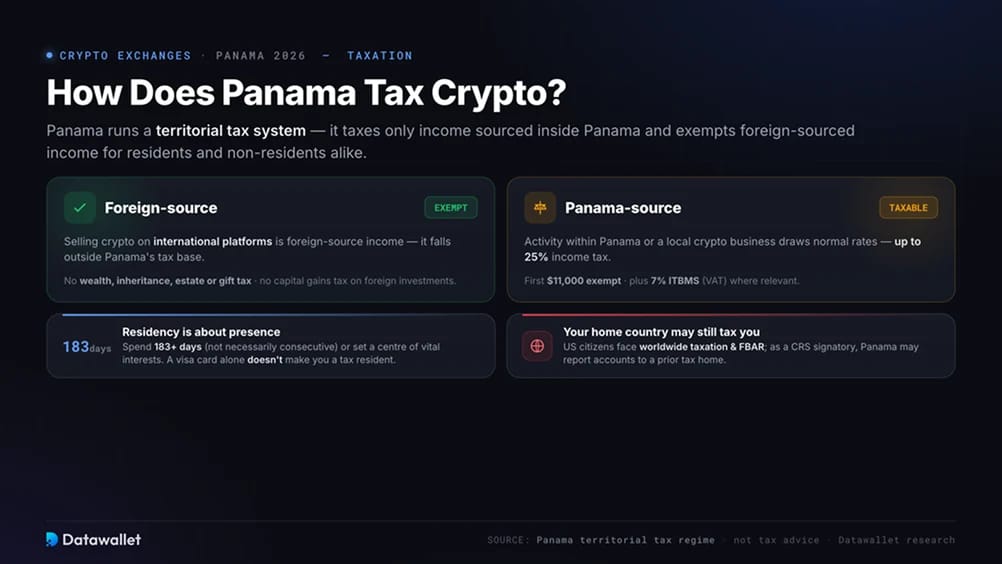
This is where Panama gets attractive for the residency crowd. It runs a territorial tax system that taxes only income sourced inside Panama and exempts foreign-sourced income for residents and non-residents alike. No crypto-specific regime exists, so general principles apply by how and where activity happens.
- Foreign-sourced crypto gains are exempt: Selling crypto on international platforms counts as foreign-source income and falls outside Panama's tax base. Panama also levies no wealth, inheritance, estate, or gift tax, and no capital gains tax on foreign investments.
- Tax residency is about presence, not a card: You become a tax resident by spending more than 183 days in a calendar year in Panama, or by establishing a centre of vital interests there. An immigration permit alone, such as a Friendly Nations or Qualified Investor visa, does not make you one. The 183 days need not be consecutive.
- Panama-source income is taxable: Activity conducted within Panama, or a local crypto business, draws normal rates: individual income tax up to 25% with the first $11,000 exempt, plus 7% ITBMS (VAT) where relevant. The line between foreign-source trading and Panama-source activity is where a Contador Público Autorizado earns their fee.
- Your home country may still tax you: US citizens face worldwide taxation and FBAR reporting regardless of Panama residency, and as a CRS signatory, Panama may report your accounts to a prior tax home that still considers you resident. Exemption in Panama is not the same as tax-free everywhere.
Keep dollar records of every disposal and its date, because once CARF data exchange begins in 2027, reporting will reach activity that feels invisible today. None of this is tax advice. For most residency cases, a licensed Panamanian accountant plus an adviser at home is money well spent.
Cryptocurrency Adoption in Panama
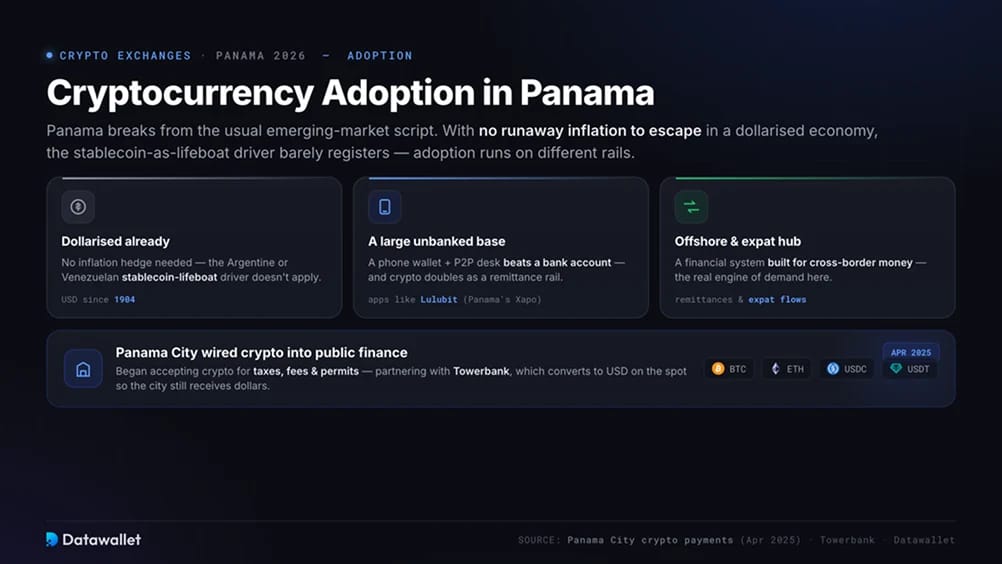
Panama's adoption story breaks from the usual emerging-market script. With no runaway inflation to escape in a dollarised economy, the Argentine or Venezuelan stablecoin-as-lifeboat driver barely registers. Adoption runs instead on the country's role as an offshore and expat hub, a large unbanked population, and a financial system built for cross-border money.
Many Panamanians sit outside the banking system, kept out by cost, paperwork, and a thin branch network beyond the cities. For them a phone wallet and a P2P desk beat a bank account, and crypto doubles as a remittance rail that skips intermediaries. Local apps like Lulubit, Panama's answer to Xapo, were built for exactly that demand.
The clearest signal came in April 2025, when Panama City began accepting BTC, ETH, USDC, and USDT for taxes, fees, and permits. The city sidestepped the stalled national law by partnering with Towerbank, which converts incoming crypto to dollars on the spot so the municipality still receives USD.
A capital wiring crypto into public finance through a local bank, before any legislation passed, tells you how Panama tends to move on this.
How to Buy Bitcoin in Panama
The path depends on which user you are, though the spot trade at the end is the same. For a local funding in dollars:
- Pick a venue with a live Panama P2P desk: Open Binance or Bybit, filter P2P for USD, and confirm merchants accept Yappy, ACH Panamá, or bank transfer. Check the quote against the roughly 0.985 USDT to USD the local market runs.
- Complete KYC with your cedula or passport: Enter your name exactly as printed. Verification clears within hours when details match and stalls for days when they do not.
- Buy USDT through a verified merchant: Pick one with a long history and high completion rate, pay through Yappy or your bank app, and mark the order paid only once the transfer has left. Escrow usually releases in minutes.
- Swap USDT for BTC with a limit order: Skip the one-click convert and place a limit order on BTC/USDT. That usually saves 1 to 3% versus instant buy.
- Decide where the BTC lives: Active traders can leave it on the exchange. Long-term holders withdraw to self-custody, checking the address and network first. Our best crypto wallets guide covers the options.
Funding from an offshore account is shorter. Wire USD into Kraken, buy BTC or hold USDC on the spot market, then move long-term balances to a hardware wallet. No P2P step and no local bank touchpoint, which is often the entire appeal.
Final Thoughts
For most users, start with Bybit, which handles local P2P and dollar-balance holding in one app. Binance is the call for the deepest Yappy and ACH liquidity, and Kraken is the one for a tax resident wiring dollars from abroad. OKX, Bitget, and MEXC round out the list on fees, copy trading, and asset coverage.
Watch the legislative file, not the price chart. A FATF-aligned licensing bill in draft, CARF reporting due in 2027, and a capital already routing crypto through a local bank all point toward formalisation.
Panama keeps the friendliest tax setup in the region for foreign-sourced crypto gains, but the reporting and banking layer around it is tightening. Use the open window to get your structure clean rather than betting the grey zone lasts.
Before committing real money, run a small round trip. Buy a hundred dollars of USDT, sell it back, and measure what the loop cost on your bank. Ten minutes of testing beats any review, this one included.
Our Methodology
We evaluated the exchanges accessible from Panama by opening accounts, completing KYC with regional documents, funding USD through local P2P (Yappy, ACH, bank transfer) and international wire, trading, and withdrawing. Each platform scored across six criteria:
- Trust Score: Our proprietary rating (out of 5) weighting regulatory standing, proof-of-reserves transparency, security history, platform longevity, and audit coverage. Venues with major-jurisdiction licensing and audited reserves scored highest.
- USD Funding Methods: Confirmed Yappy, Nequi, ACH Panamá, bank transfer, card, and wire support, testing settlement speed, merchant depth, and spread against mid-market USDT.
- Banking Compatibility: Assessed how cleanly deposits and withdrawals interact with Panamanian banks given the post-grey-list compliance environment.
- Security Track Record: Reviewed breach history, custody setup, reserve disclosure cadence, and protections like 2FA and withdrawal whitelists.
- Assets and Liquidity: Placed market and limit orders on BTC/USDT, ETH/USDT, and at least one mid-cap pair to measure spread, depth, and fill quality.
- Fee Structure: Compared maker and taker fees, withdrawal charges, P2P spreads, and the all-in cost of a USD to USDT round trip.
We excluded platforms with no functional Panama funding path, persistently thin order books, or serious recent compliance failures without remediation. Testing ran from April to June 2026.
.webp)