




Can I Bridge to X Layer?
Yes, and since X Layer is now a standard EVM-equivalent OP Stack chain, it behaves like any other rollup. Any wallet that handles Base, Optimism, or Arbitrum works once you point it at chain ID 196. Several cross-chain bridges reach the network, alongside the OKX exchange and the canonical OKX bridge.
The common snag is gas. X Layer charges fees in OKB, not ETH, so arriving with only stablecoins leaves you stuck until you hold some OKB. I seed a wallet with a little OKB first, then bridge the assets I actually want. If you have not added the network, our guide on adding X Layer to MetaMask covers the RPC settings.
How to Bridge to X Layer
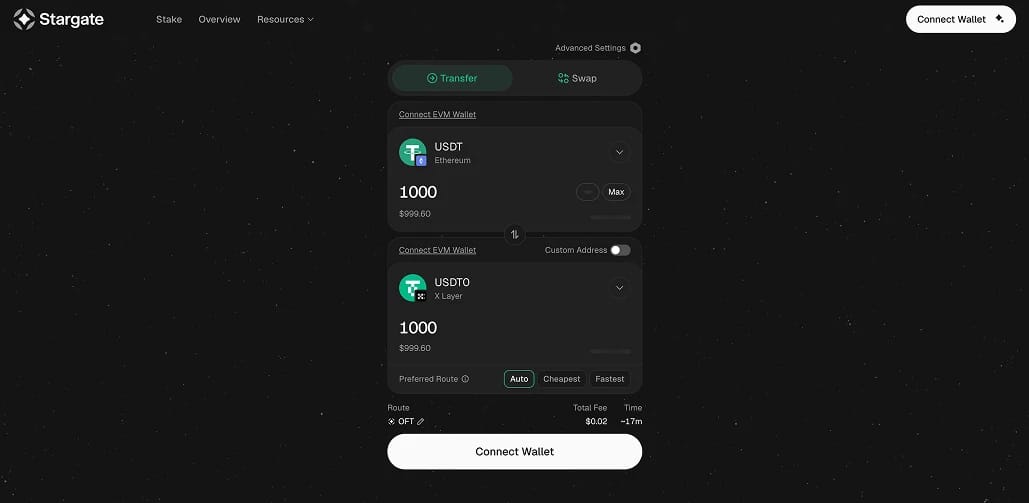
The most practical multi-chain route is Stargate, a LayerZero liquidity bridge that delivers USDT0 and other supported tokens to X Layer as native assets, with no wrapped copies. It is what I use for stablecoins coming from another chain.
Here is how to bridge with Stargate:
- Connect your wallet. Open Stargate and link MetaMask, Rabby, or OKX Wallet. Check the URL reads stargate.finance before signing, since bridge clones drain wallets.
- Open the Transfer tab. Set your source chain in the From field.
- Set X Layer as the destination. Search "x layer" if it is not already listed, then select it.
- Choose your asset and amount. USDT0 is the main stablecoin route, while ENA, frxETH, and other supported tokens also land here. Enter the amount and test small first.
- Pick your speed. Take the "taxi" for an instant fill, or "ride the bus" to batch the transfer for a lower fee with a short wait.
- Review and confirm. Check the quote and arrival time, confirm in your wallet, and keep a little OKB on X Layer for gas.
The Simplest Route for OKB and USDC: OKX Exchange
If you hold an OKX account, the exchange is often the easiest on-ramp, and for OKB it is effectively canonical. Since the Ethereum version of OKB was retired in the 2025 overhaul, OKX's "Withdraw to X Layer" feature is now the clean way to get gas onto the network.
The flow matches any withdrawal: buy or deposit the asset, open the withdrawal screen, choose X Layer, and send to your self-custody address. OKX supports OKB and native USDC over this route, gasless on the exchange side. It is the lowest-friction option for anyone avoiding smart contracts, with the trade-off that funds sit on the exchange until the withdrawal clears.
X Layer Bridging Fees
Cost splits three ways: source-chain gas, the bridge or withdrawal fee, and gas on X Layer. The last is trivial, sitting at a fraction of a cent after the throughput upgrade.
Budget roughly this across routes:
- Stargate from an L2 (Arbitrum, Base, Optimism): A roughly 0.06% pool fee plus the LayerZero messaging fee, usually a dollar or two all in. Bus mode is the cheaper of the two speeds.
- Stargate from Ethereum mainnet: The protocol fee stays small, but mainnet gas is the variable, from a few dollars to low double digits.
- OKX exchange withdrawal: A flat network fee, generally cheap for OKB and USDC, with no gas on your side.
- Official X Layer bridge: Gas only, no protocol fee. The catch is the timeline, not the cost.
That timeline is the biggest change for anyone who used X Layer in 2024. As an optimistic rollup, the canonical bridge enforces a roughly 7-day challenge window on withdrawals to Ethereum. Deposits are fast; exits are not. For a quick exit, a third-party bridge with pre-funded liquidity removes the delay for a small premium.
Best X Layer Bridges Compared
The table covers routes I have used or verified directly. Fees shift with network conditions, so treat them as indicative.
For stablecoins, know what lands in your wallet. X Layer follows Circle's Bridged USDC Standard, so the USDC OKX issues can later upgrade to native in place. An older wrapped form, USDC.e, also exists. Confirm you are landing on the standard USDC contract, not the wrapped one, since apps do not always treat them as interchangeable.
Bridging Risks to Watch
Even audited bridges carry tail risk. These are the failure modes I guard against:
- No gas on arrival. The X Layer trap: bridge stablecoins with no OKB and you cannot transact until you fund gas separately. Seed OKB first.
- Fake bridge interfaces. Cloned sites empty wallets. Bookmark official URLs and never reach a bridge through a search ad or a DM.
- Wrong stablecoin version. USDC and USDC.e are separate contracts. Confirm which one your bridge delivers before relying on it.
- The 7-day exit. Canonical withdrawals to Ethereum enforce the full challenge window. Plan for it, or use a liquidity bridge for faster exits.
- Smart contract exposure. Bridge code can fail. Favor protocols with independent audits and an active bug bounty, and cap each transfer.
- Wrong network. OP Stack chains share address formats, so confirm chain ID 196 is selected before signing.
About X Layer
X Layer is OKX's Ethereum Layer 2, and its design has changed completely since launch. It went live in April 2024 as a zkEVM validium on Polygon's CDK, but after an August 2025 "PP upgrade" lifted throughput to around 5,000 transactions per second, OKX migrated it to the OP Stack, the framework behind Base and Optimism. The result is a hybrid: OP Stack execution with full EVM equivalence, settling cross-chain through Polygon's AggLayer via pessimistic proofs.
OKB anchors the network as its only gas token. In the same overhaul, OKX burned roughly 65 million OKB and fixed supply at 21 million, disabling the mint function for a Bitcoin-style hard cap. That is why sourcing OKB matters before you bridge anything else.
The ecosystem is early but building. Aave deployed v3.6 markets in March 2026, USDT0 (the LayerZero-based omnichain Tether) has been live since late 2025, and OKX added Exchange OS in May 2026. Still, total value locked sits near $25 million, modest against the headline upgrades and an investment from the NYSE's parent company. That gap is the open question for anyone weighing X Layer against larger Layer 2 networks.
Final Thoughts
Bridging to X Layer is simple once you know its quirks. For USDT0 and supported tokens from another chain, Stargate is the fast default. For OKB and native USDC, the OKX exchange withdrawal is cleanest, and the canonical bridge covers maximum security if you can accept the 7-day exit.
Whichever you pick, the discipline holds: keep a little OKB for gas, confirm chain ID 196, verify the stablecoin contract, and send a small test first. For the wider landscape, see our guide to the best crypto bridges.