



.svg)
Can I Bridge to Sepolia?
Yes. Sepolia sits at the center of a web of mirrored test networks, and several crypto bridges run dedicated testnet deployments connecting them. Almost every major layer 2 maintains a Sepolia instance, including Base Sepolia, Arbitrum Sepolia, OP Sepolia, and Unichain Sepolia, so the cross-chain plumbing you would use on mainnet has a free rehearsal version.
People mean two different things when they search for a Sepolia bridge, and each needs its own tool. The first is moving testnet assets between Sepolia chains, for example pushing testnet USDC from Ethereum Sepolia to Base Sepolia to validate a deposit contract. The second is acquiring Sepolia ETH in the first place, which got harder as faucets added mainnet balance checks and identity gates.
Before either, add Sepolia to MetaMask or your preferred wallet, and confirm chain ID 11155111 before signing anything.
How to Bridge Between Sepolia Testnets
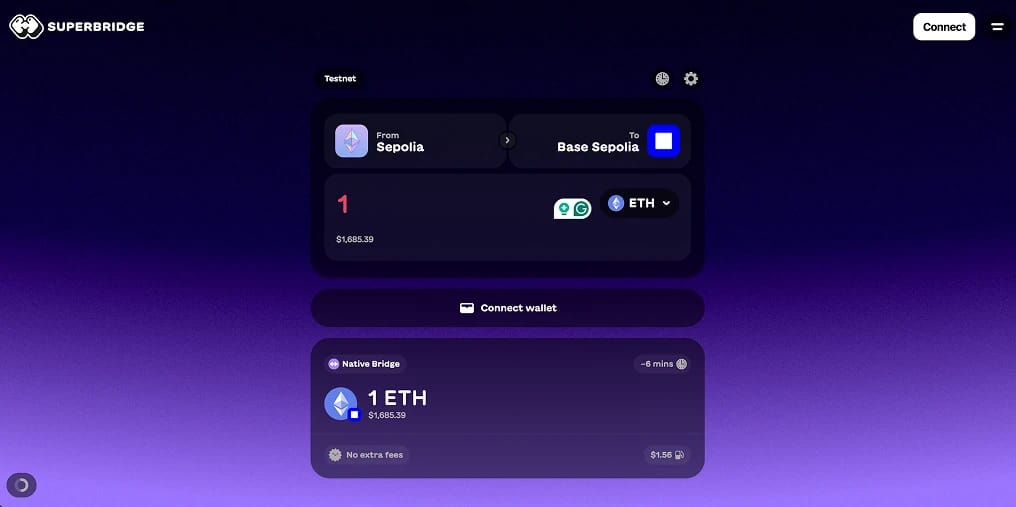
Superbridge runs a dedicated testnet interface on top of the canonical OP Stack bridge contracts, connecting Ethereum Sepolia with Superchain rollup testnets like Base Sepolia, OP Sepolia, and Unichain Sepolia. Because it uses the same contracts the production networks run, it doubles as a rehearsal for real canonical bridging, deposits and withdrawals behave exactly as they will on mainnet.
Steps to bridge between Sepolia chains with Superbridge:
- Connect your wallet: Open superbridge.app and connect MetaMask, Rabby, or another EVM wallet. Double-check the URL, since phishing clones target bridge interfaces even on testnets.
- Pick source and destination: Select Ethereum Sepolia as the source and your target rollup testnet, say Base Sepolia. Each network is labeled with its testnet name to avoid mainnet mix-ups.
- Choose the asset and amount: Testnet ETH and supported ERC-20s are available. Enter the amount, leaving enough on the source chain for gas.
- Confirm the deposit: Approve the transaction in your wallet. Canonical deposits settle on the destination in a few minutes once the L1 transaction finalizes.
- Verify arrival: Check the destination balance in your wallet or on the relevant explorer, such as sepolia.etherscan.io for Ethereum Sepolia.
One mechanic to plan around - withdrawals back to Ethereum Sepolia follow the OP Stack prove-and-finalize process, the same multi-step exit the production Superchain enforces. That is a feature if you are testing withdrawal handling, and a drag if you just need funds back quickly, in which case deposit fresh from a faucet instead.
How to Convert Mainnet ETH to Sepolia ETH
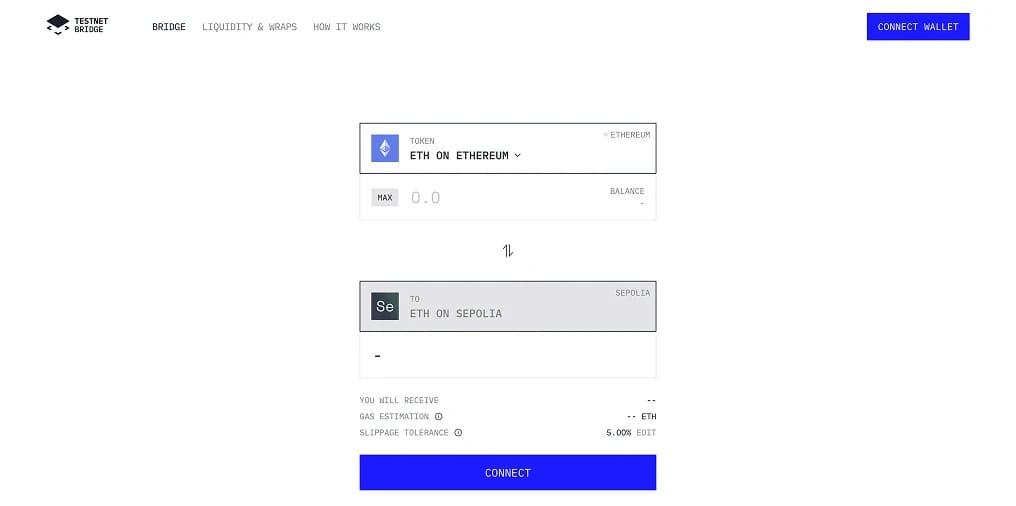
When faucets rate-limit you and a deadline will not move, the Testnet Bridge by LayerZero lets you swap real mainnet ETH for native Sepolia ETH. It pairs a Uniswap pool with LayerZero's OFT messaging, giving Sepolia ETH an open market price instead of a faucet queue.
Connect a wallet on Ethereum mainnet, enter the ETH amount, and the interface quotes how much Sepolia ETH you will receive. Two caveats apply. You pay real mainnet gas fees on the swap, so small conversions carry proportionally high overhead, and pool liquidity is thin, meaning larger orders move the price. For a developer who needs 1 to 5 Sepolia ETH today, it remains the most dependable shortcut.
The reverse direction also works, though selling Sepolia ETH back for mainnet ETH is rarely worth the gas unless you accumulated a large test balance.
What Does Bridging to Sepolia Cost?
Costs depend entirely on which of the two jobs you are doing:
- Between Sepolia testnets via Superbridge: Zero protocol fee. Gas is paid in testnet ETH, a fraction of a cent in notional terms on Ethereum Sepolia and effectively nothing on the L2 instances. Deposits take a few minutes; withdrawals follow the canonical exit process.
- Mainnet ETH to Sepolia ETH via Testnet Bridge: Real money. You spend mainnet ETH at the prevailing pool rate plus an Ethereum gas fee, which ranges from under a dollar to several dollars depending on congestion.
- Relay's testnet deployment: Also free of protocol fees, with relayer fills landing in seconds, useful when iteration speed matters more than canonical mechanics.
Since Ethereum Sepolia mirrors mainnet's fee market, gas fluctuates with testnet activity. Spikes around major fork rehearsals are common, and blockspace got genuinely busy during the Fusaka activation window in October 2025.
Best Sepolia Bridges Compared
Superbridge leads because canonical contracts carry no extra trust assumptions and mirror production behavior, which is the whole point of a testnet. Relay is the pick when you need rapid L2-to-L2 hops or chains outside the Superchain, though its own docs note testnet swaps routinely fail for lack of DEX liquidity, so keep it to same-asset transfers. For raw Sepolia ETH acquisition, the LayerZero market is the only liquid venue.
When a Faucet Beats a Bridge
Often you do not need a bridge at all. If the goal is simply gas on a specific testnet, claiming directly from a faucet on that chain skips a transaction entirely. The trade-off is that faucet access tightened over the past year as airdrop farmers drained public taps.
The Alchemy faucet now requires a minimum mainnet balance of 0.001 ETH plus real mainnet activity before it dispenses anything. QuickNode applies a similar balance check, Google's Cloud faucet wants a signed-in Google account, and drip amounts across providers have been cut repeatedly. Our guide on getting Sepolia testnet tokens covers the current faucet lineup and limits.
Sepolia's Role in Ethereum's 2026 Testnet Lineup
The testnet map was redrawn over the last year. Holesky, once Ethereum's largest test network, was retired after the Fusaka upgrade wrapped its testing duties in late 2025. The lineup now splits cleanly: Sepolia for applications and smart contracts, Hoodi for validator and staking infrastructure, and Ephemery for short-lived validator cycles that reset every 28 days.
That consolidation made Sepolia the front line for protocol rehearsals. Fusaka activated on Sepolia on October 14, 2025, ahead of its December 3 mainnet launch, bringing PeerDAS data sampling. The blob parameter forks that followed, BPO1 and BPO2, also ran through Sepolia first, with the Ethereum Foundation confirming the second went live in early January 2026 without issues.
The next milestone is Glamsterdam, pairing enshrined proposer-builder separation with block-level access lists. Multi-client devnets stabilized in May 2026, and Sepolia activation is the step the market watches next, since a clean testnet fork is what unlocks a mainnet date. A funded Sepolia wallet ready before that activation lets you test client and contract behavior under the new rules early.
About Sepolia
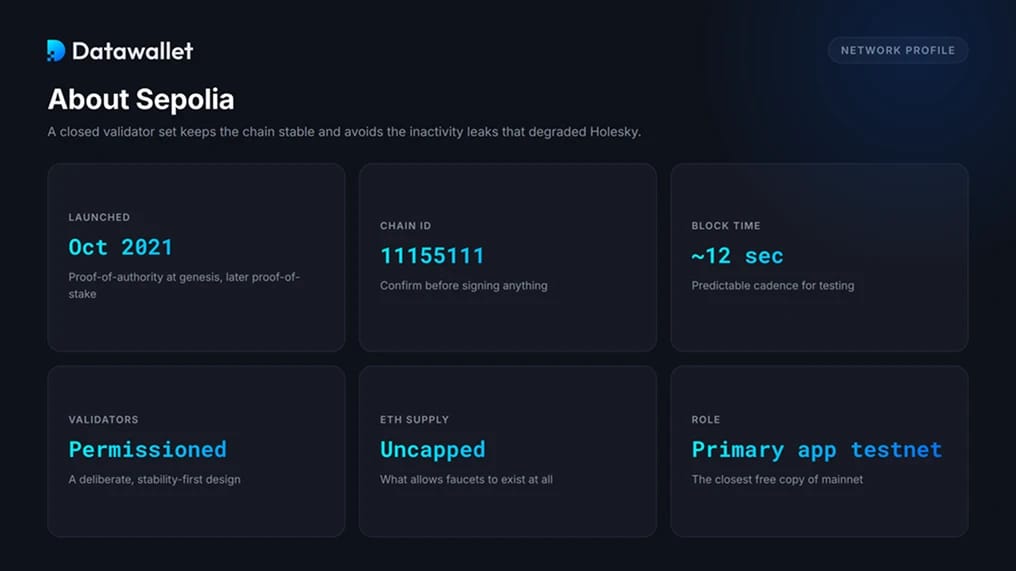
Sepolia launched in October 2021 as a proof-of-authority network and transitioned to proof-of-stake alongside the Merge era, mirroring mainnet's consensus while keeping a permissioned validator set. That closed design is deliberate. It keeps the chain stable, prevents the inactivity-leak problems that degraded Holesky, and gives developers predictable 12-second blocks.
The supply of Sepolia ETH is uncapped, which is what allows faucets to exist, though distribution friction means the token trades at a small nonzero price on the LayerZero market anyway. For contract deployment, dApp testing, and cross-chain integration work, it is the closest free approximation of Ethereum mainnet available.
Final Thoughts
Bridging to Sepolia splits into two distinct jobs, and picking the right tool for each saves real time. For moving testnet assets between Ethereum Sepolia and its OP Stack instances, Superbridge runs the canonical contracts with zero protocol fees, the closest match to how your bridging will behave in production. For acquiring Sepolia ETH when faucets fall short, the LayerZero Testnet Bridge converts mainnet ETH at a market rate in minutes.
Start with the free path: configure your wallet, claim from a faucet, and bridge across instances with Superbridge as needed. Spend real ETH only when limits block you. With Glamsterdam queued for its Sepolia rehearsal, a working Sepolia setup is worth maintaining year-round rather than rebuilding each time a fork approaches.
For the broader cross-chain landscape beyond testnets, see our ranking of the best crypto bridges.