



What Is the SpaceX IPO?
The SpaceX IPO refers to the expected public listing of SpaceX, the private aerospace company founded by Elon Musk in 2002. An initial public offering would allow investors to buy shares on a public stock exchange, instead of only accessing exposure through private markets or secondary share sales.
SpaceX is best known for Falcon rockets, Dragon spacecraft, Starlink satellites, and its long-term Starship program. The company’s broader mission is to reduce launch costs, expand space access, and eventually support human settlement beyond Earth. That mix of commercial revenue and ambitious technology is what makes the IPO so closely watched.
The company is led by Elon Musk, its founder and CEO, while President and COO Gwynne Shotwell is widely credited with driving execution, customer relationships, and daily operations. Together, they have helped SpaceX become a key launch provider for NASA, commercial satellite operators, and global broadband users through Starlink.
For investors, the SpaceX IPO matters because it could create one of the most anticipated technology listings in years. Until shares officially trade, however, access remains limited and speculative. That is why some traders look at pre-IPO markets, private funds, or crypto-based perpetual contracts for synthetic SpaceX exposure.
Can You Buy SpaceX Stock Before the IPO?
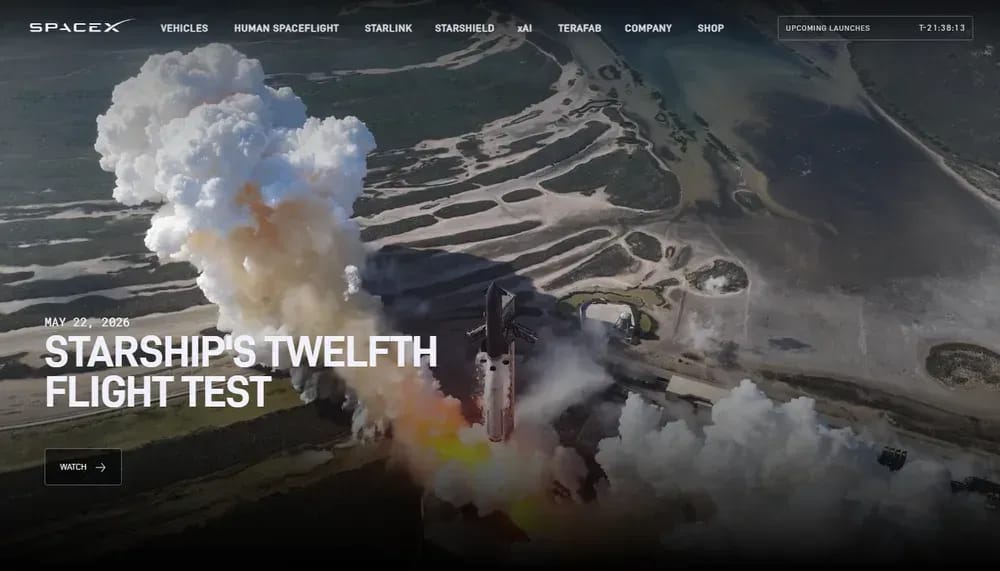
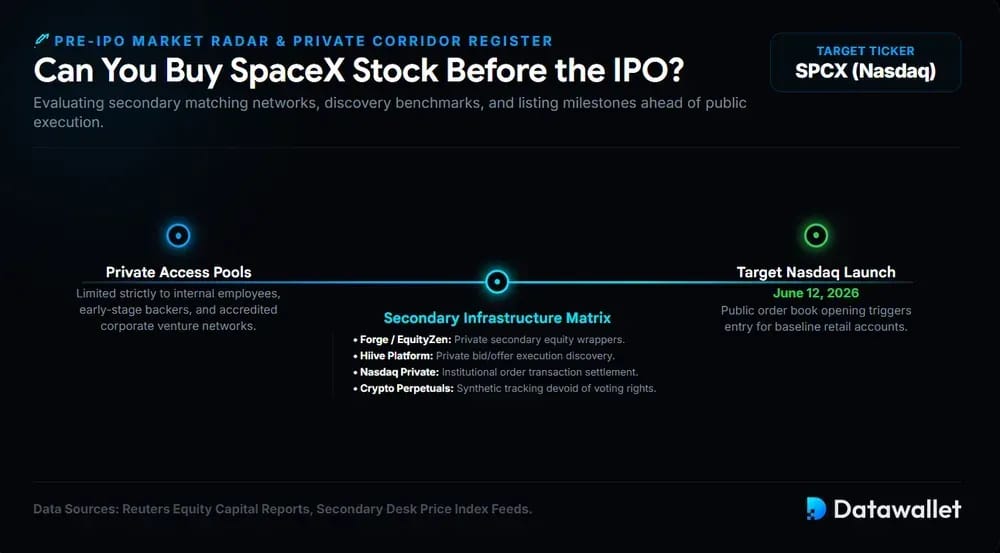
Retail investors cannot buy SpaceX stock on a public exchange before the IPO because the company is still private until its listing. According to Reuters, SpaceX is targeting a Nasdaq debut on June 12, 2026, under the ticker SPCX, subject to final pricing and market conditions.
Before that, access is usually limited to employees, early investors, venture funds, and accredited investors who qualify for private secondary transactions. These deals are not the same as buying public shares: they may involve high minimums, transfer restrictions, limited liquidity, and platform-specific fees.
Most investors will need to wait until public trading begins. Even after the IPO, the first tradable price may differ from the IPO allocation price, especially if demand is high and the free float is limited. That makes pre-IPO exposure more complex than simply “buying SpaceX early.”
What Are SpaceX Pre-IPO Markets?
SpaceX pre-IPO markets are platforms that offer exposure before the stock trades publicly. They range from private secondary platforms to synthetic crypto products, but access, rights, liquidity, and risk differ significantly across each route.
The main routes include:
- Forge and EquityZen for private secondary shares.
- Hiive for bids, offers, and private-market price discovery.
- Nasdaq Private Market for institutional secondary transaction infrastructure.
- Crypto perps like Bybit Futures for synthetic price exposure without shareholder rights.
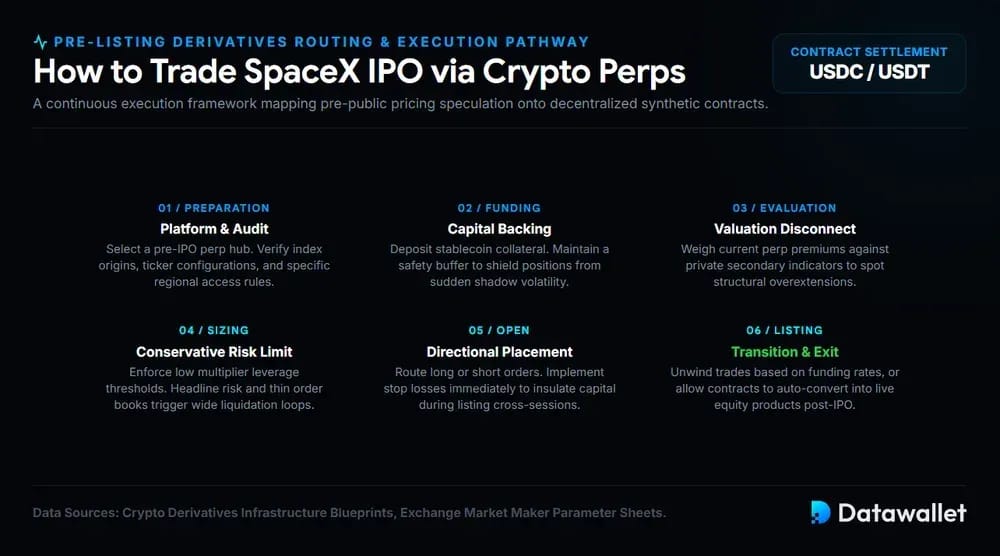
How to Trade SpaceX IPO via Crypto Perps
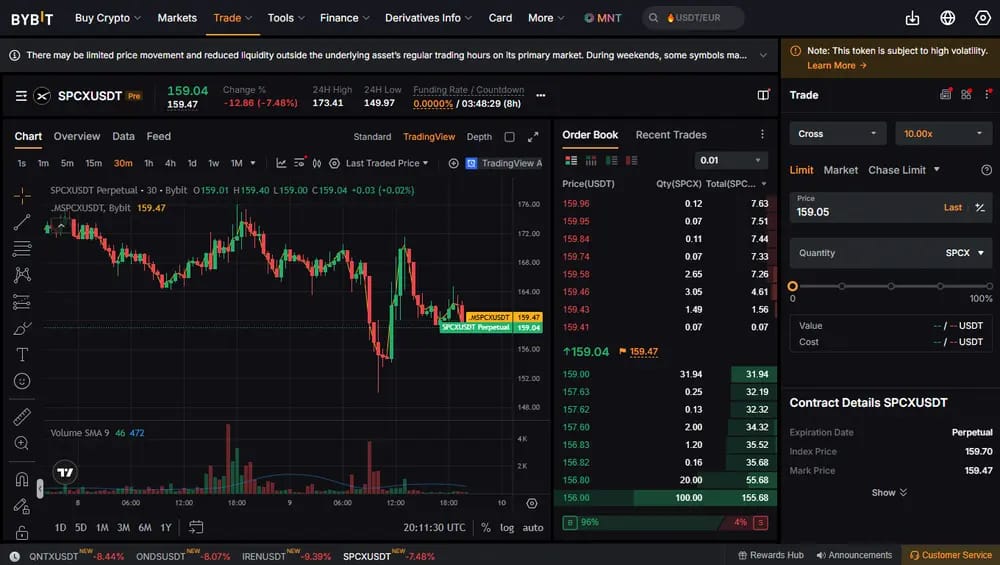
Crypto perps let traders speculate on SpaceX’s IPO price before shares trade publicly, using leveraged contracts instead of direct ownership or shareholder rights.
A typical trading process looks like this:
- Choose platform: Select a platform offering SpaceX pre-IPO perps, and compare it against other crypto futures exchanges for fees, liquidity, leverage, collateral, and regional access.
- Check contract: Review the exact ticker, index source, collateral asset, settlement rules, leverage cap, and what happens when SpaceX begins public trading.
- Fund account: Deposit supported collateral, usually USDC or USDT, and keep extra margin available so normal volatility does not immediately trigger liquidation.
- Review price: Compare the perp price with reported IPO pricing, private-market valuations, and wider demand before deciding whether the contract looks overextended or discounted.
- Set leverage: Use conservative leverage because SpaceX IPO perps can move sharply around headlines, order book gaps, funding changes, and Nasdaq listing updates.
- Place order: Open a long position if you expect upside, or a short position if you believe the pre-IPO premium is too aggressive.
- Manage risk: Add stop losses, monitor liquidation levels, track funding payments, and avoid oversized positions during the IPO pricing and first trading sessions.
- Exit position: Close the trade before, during, or after the IPO based on liquidity, funding costs, volatility, and whether the perp transitions into a regular stock-linked contract.
Best Platforms for Trading Pre-IPO Crypto Perps
We reviewed the leading platforms by checking live product announcements, contract structures, collateral requirements, leverage limits, liquidity, and regional availability. We also prioritized platforms with direct SpaceX exposure, transparent contract specifications, and broader derivatives infrastructure rather than thin, one-off markets.
Because pre-IPO crypto perps are still new, the best choice depends on whether you want synthetic perpetual exposure, tokenized IPO access, or decentralized perpetual access. Traders should also compare fees, margin rules, funding mechanics, and supported countries before using any of the following exchanges.
Here is a quick comparison of the main options:
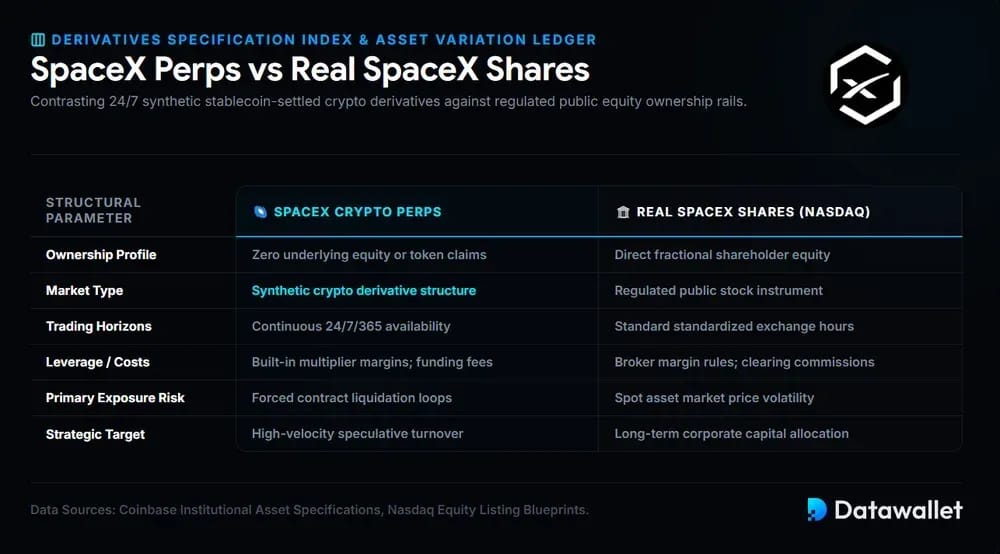
SpaceX Perps vs Real SpaceX Shares: What’s the Difference?
SpaceX perps are derivatives that track the company’s expected or public-market value without giving traders ownership in SpaceX. Coinbase describes its SpaceX pre-IPO perp as USDC-settled, 24/7, and non-expiring, meaning traders get synthetic exposure rather than voting rights, dividends, or shareholder protections.
Real SpaceX shares, once listed on Nasdaq, would represent equity ownership in the company itself. That means shareholders participate directly in stock performance, corporate actions, and regulated equity-market trading, while perp traders mainly face margin, liquidation, funding-rate, and platform-specific contract risk.
Key Risks of Trading SpaceX Perpetual Futures
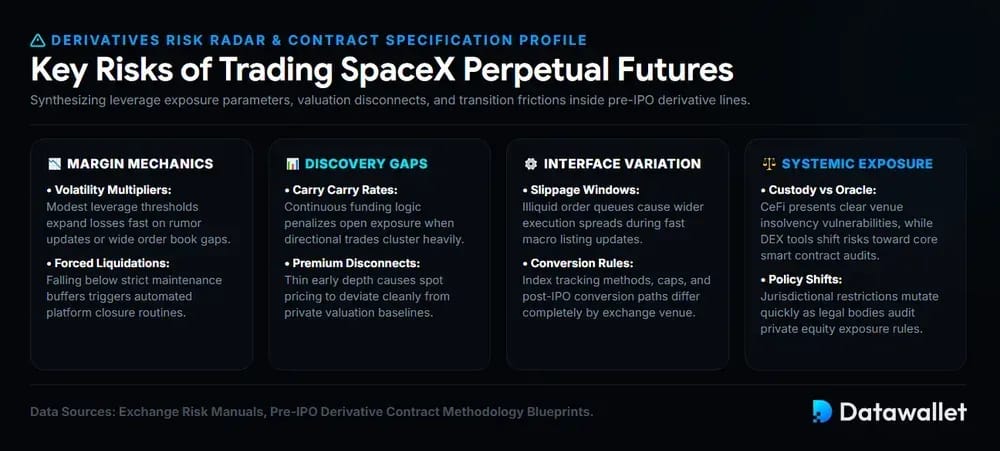
SpaceX perps can offer early price exposure, but they also carry higher risk than spot assets because leverage, margin, and contract design amplify mistakes.
The main risks to understand are:
- Leverage: Even modest leverage can magnify losses quickly when SpaceX-related headlines, IPO rumors, or order book gaps move the contract against your position.
- Liquidation: If your margin falls below maintenance requirements, the platform can automatically close your position, as Coinbase explains in its liquidation guide.
- Funding: Perps use funding payments to keep prices aligned, so holding a position can become expensive when one side of the market is crowded.
- Pricing: Pre-IPO perps may trade far above or below private-market valuations because they reflect speculation, thin liquidity, and changing expectations about the IPO.
- Liquidity: New SpaceX perp markets may have shallow depth, wider spreads, and slippage during fast moves, making entries and exits worse than expected.
- Contract: Read the product rules carefully because settlement, index sources, IPO transition mechanics, and leverage limits can differ across Coinbase, Bybit, Binance, and DEX markets.
- Platform: Centralized platforms add custody and account risk, while decentralized platforms add wallet, oracle, and smart contract audit risk.
- Regulation: Pre-IPO derivatives may be restricted in certain countries, and rules can change quickly as regulators review crypto-linked exposure to private companies.
What Happens to SpaceX Perps After the IPO?
After the IPO, SpaceX pre-IPO perps generally shift from tracking implied private-market value to referencing public share-price data. Coinbase says its contract has an automatic post-IPO transition, meaning open positions become standard SpaceX Perps with no rollover once the stock lists.
Binance uses a structured pre-IPO perpetual conversion framework: if the listing succeeds, the contract can become a TradFi perp; if the IPO fails, Binance can issue a failure notice and remove it. Bybit’s SPCXUSDT market is USDT-settled and listed as a perpetual with up to 10x leverage.
Kraken also added SpaceX pre-IPO perp exposure, while Hyperliquid access comes through Trade.xyz’s SPCX-USDC pre-IPO market. Trade.xyz documents that IPOPs can reference, convert into, or settle against a post-listing market, while Aster treats pre-IPO perpetual futures as synthetic markets tied to future public value.
SpaceX IPO Trading Strategy: Long, Short, or Wait?
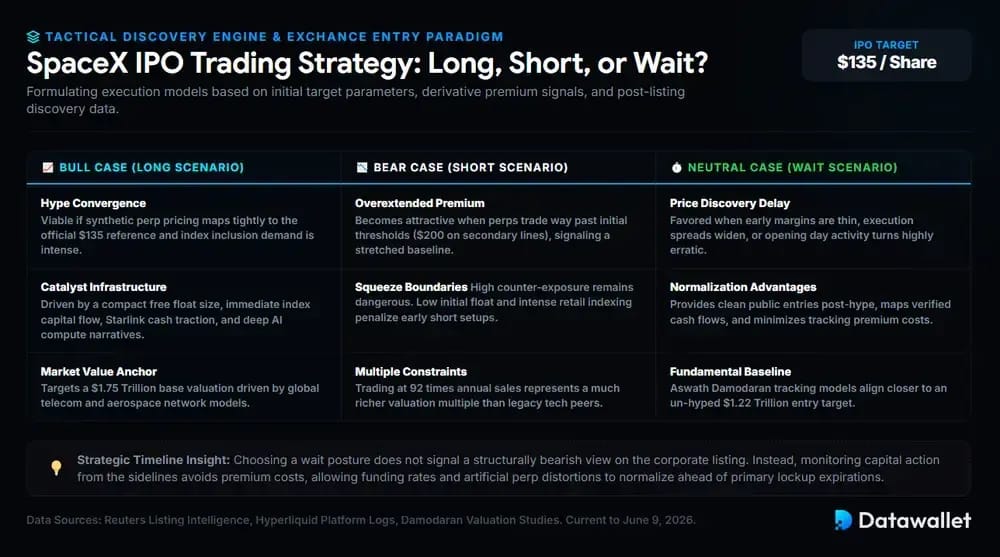
The SpaceX trading strategy depends on whether traders trust the IPO premium, expect a retail-driven squeeze, or prefer waiting for public-market price discovery after the first volatile sessions.
Long Scenario
A long trade makes sense if the perp price stays close to the reported $135 IPO price and demand remains extreme. Reuters reported a planned $75 billion raise at a $1.75 trillion valuation, while SPCXUSDT pre-IPO perpetual futures have recently traded above the proposed offer price.
The bullish case is strongest over the next six months if SpaceX benefits from small free float, index inclusion, Starlink growth, and AI compute narratives. Axios notes the bull case for SpaceX depends heavily on Starlink scaling, Starship execution, and future compute revenue.
Short Scenario
A short trade becomes more attractive when synthetic markets price SpaceX far above the IPO valuation. Pantera noted that SpaceX was trading around $200 per share on Hyperliquid as of June 1, a major premium to the expected $135 IPO price.
That premium may look stretched, but shorting early is dangerous. Reuters reported that short sellers are cautious because of SpaceX’s low float, expected index demand, retail interest, and the risk of shorting SpaceX during its public debut.
Wait Scenario
Waiting may be the cleanest strategy if perps remain expensive, spreads widen, or first-day volatility looks detached from fundamentals. Aswath Damodaran’s post-prospectus SpaceX valuation lands closer to $1.25 trillion to $1.3 trillion, below the roughly $1.75 trillion IPO valuation.
- Better entry: Public trading may reveal a cleaner price after initial hype.
- Lower noise: Funding rates and perp premiums can normalize post-listing.
- More data: First filings, revenue updates, and guidance improve valuation work.
- Less squeeze: Float pressure may ease after index and lockup events.
Over the next six months, the better setup may come after the first trading sessions, ETF flows, and early shareholder releases. The wait case is not bearish on SpaceX; it simply avoids paying a heavy premium before public price discovery stabilizes.
SpaceX Bitcoin Treasury: Does Starlink Hold BTC?
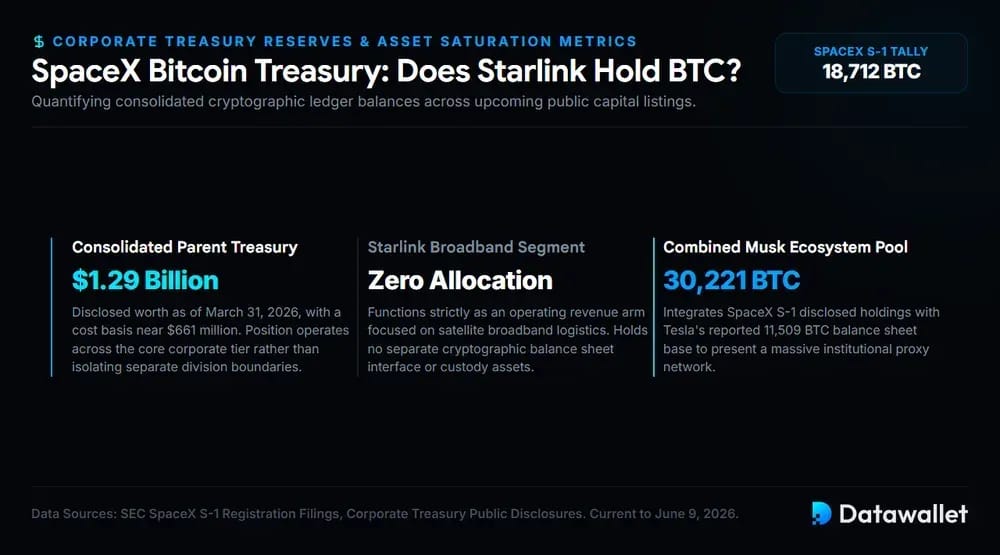
SpaceX’s IPO filing reportedly disclosed 18,712 BTC on the company’s balance sheet, worth about $1.29 billion as of March 31, 2026, with a reported cost basis near $661 million. That makes Bitcoin a visible treasury asset for SpaceX, not just a background crypto-related talking point.
Starlink does not appear to have a separately disclosed Bitcoin treasury. The key distinction is that Starlink is part of SpaceX’s operating business, focused on satellite broadband revenue, while the BTC position is reported at the SpaceX corporate level. Unless SpaceX later separates Starlink financially, investors should treat the Bitcoin as SpaceX-wide treasury exposure.
Combined with Tesla’s reported 11,509 BTC, Elon Musk-led companies would hold about 30,221 BTC across SpaceX and Tesla. For IPO investors, this means SpaceX offers indirect Bitcoin exposure alongside rockets, Starlink broadband, Starship, AI infrastructure, and satellite growth, but it is not a pure BTC treasury company like Michael Saylor’s Strategy.
Final Thoughts
SpaceX’s IPO gives investors a rare chance to access one of the world’s most important private technology companies, but pre-IPO perps are not the same as owning shares.
Perpetual futures can be useful for traders who understand leverage, funding rates, liquidation, and synthetic pricing. However, they can also exaggerate hype, especially when IPO demand is already extreme.
For most readers, the safest approach is to compare the IPO price, synthetic perp premium, and expert valuation estimates before deciding whether to go long, short, or wait.