


Login to Track Your Live Crypto Portfolio
Sign Up and Track Your Live Crypto Portfolio for Free
Forgot your password?
Tether and Georgia Build GELT Stablecoin Rail

This article has been reviewed and verified for accuracy by our editorial team. All claims, data points and platform details are cross-referenced against primary sources.
Some links on this page are affiliate links. Datawallet may earn a commission when you sign up through them, at no extra cost to you. This never influences our editorial ratings, rankings or recommendations.
Some links on this page are affiliate links. Datawallet may earn a commission when you sign up through them, at no extra cost to you. Ratings and rankings reflect our own testing and assessment criteria.
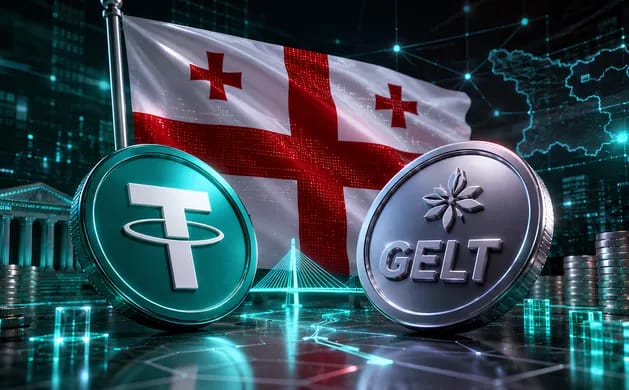
GM. Tether is partnering with the Georgian government to launch GELT, a lari-pegged stablecoin, as the issuer expands its strategy of building sovereign-backed digital rails.
Meanwhile, Vitalik Buterin announced the Ethereum Foundation will adopt a leaner, decentralized structure focused on censorship resistance and security. Additionally, Indonesia blocked Polymarket over local gambling laws, and a Satoshi-era whale moved $203 million in Bitcoin.
Here are the details on sovereign stablecoins, the future of the Ethereum Foundation, and legacy wallet movements. 👇
Tether and Georgia Build GELT Stablecoin Rail
Tether plans to launch GELT, a Georgian lari stablecoin backed by support from the Georgian government, as the issuer expands its country-specific digital currency strategy. The token is meant to lower payment costs, speed settlement, and enable programmable transfers under a regulated domestic framework.
Tether said Georgia has built a digital asset regime designed for substantive compatibility with emerging US stablecoin rules, including the GENIUS Act. Prime Minister Irakli Kobakhidze framed the effort as infrastructure for a more connected financial system, while Paolo Ardoino said stablecoins are becoming foundational rails.
The issuer has not yet disclosed GELT’s structure, rollout schedule, or exact regulatory mechanics, but it cast the token as a tool for cross-border commerce, payments, and regional financial access. That positioning extends Tether’s broader playbook after peso-linked MXNT stayed active and euro token EURT was wound down.
GELT also reveals how Tether is adapting to a more fragmented regulatory world by pairing local fiat tokens with jurisdiction-specific policy alignment. USDT, with a market cap around $189 billion, remains its flagship product, but GELT suggests future growth may come from narrower, government-backed corridors rather than one universal stablecoin.
Vitalik Maps Ethereum Foundation’s Leaner Future
Vitalik Buterin said the Ethereum Foundation is shrinking into what he called a smaller ship, narrowing its mission as senior departures and governance criticism unsettle the community. He said the nonprofit will focus on CROPS, a framework centered on censorship resistance, openness, privacy, and security.
Buterin also said the foundation will reduce ether sales while operating under mild austerity, even as it still controls about $408 million in ETH. He disclosed that roughly 90% of his own net worth remains tied to Ethereum and welcomed having less direct influence.
Indonesia Blocks Polymarket in Gambling Clampdown
Indonesia blocked access to Polymarket after regulators concluded the platform’s event contracts amount to betting on uncertain outcomes, which violates national law where gambling remains illegal. Officials said they are also tracing affiliated social media accounts and preparing restrictions against similar prediction market services.
The new restriction adds Indonesia to a widening list of jurisdictions targeting Polymarket and rival firms, following actions in Brazil, Argentina, Nevada, and Washington. Authorities said the restrictions are meant to protect the public, especially younger users, from financial harm, regulatory breaches, and unlicensed speculation.
Satoshi Era Whale Liquidates $203 Million In Digital Tokens
A Satoshi-era bitcoin whale transferred about 2,650 BTC worth roughly $203 million to FalconX and Cumberland through three transactions, according to Onchain Lens citing Arkham data. The wallet still holds around 6,000 BTC worth approximately $462 million, leaving traders watching closely for possible follow-on sales.
The timing lands amid several other dormant-whale moves, reinforcing market sensitivity to large legacy holders as bitcoin trades near $77,000. It remains unclear whether the transfers were meant for liquidation, collateral, or custody changes, but similar movements often raise expectations of incoming exchange-side selling pressure.
Data of the Day
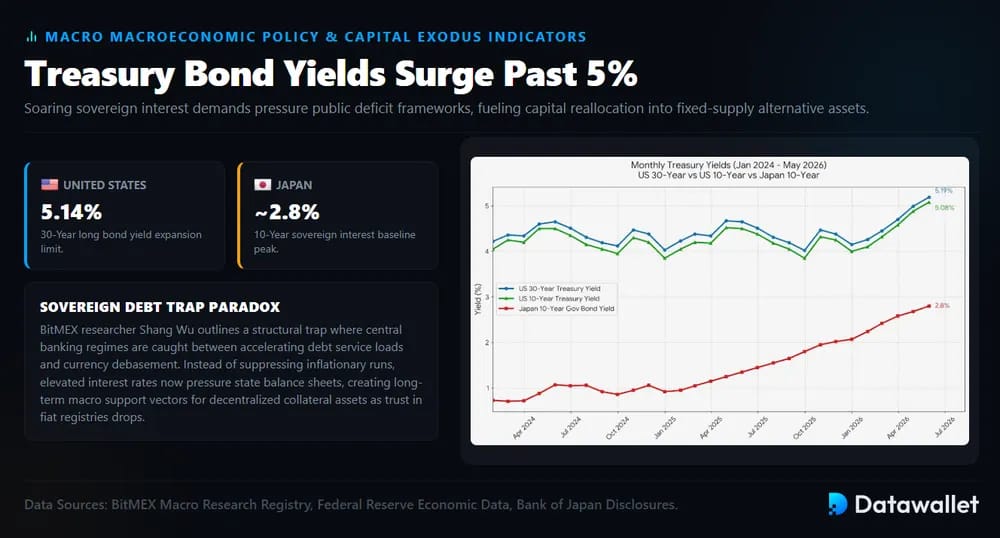
BitMEX researcher Shang Wu argued that soaring sovereign bond yields and debt burdens are creating a structural setup that could push capital away from fiat assets and toward bitcoin. He pointed to the US 30-year yield above 5.14% and Japan’s 10-year yield near 2.8%.
Wu said governments are cornered between debt stress and currency debasement, because higher rates now threaten to overwhelm public finances instead of simply containing inflation. In that view, short-term volatility may stay violent, but bitcoin gains a powerful long-run tailwind as trust in sovereign paper erodes.
More Breaking News
- MoonPay launched a ChatGPT app that generates crypto checkout links for assets like Bitcoin, XRP, Solana, and USDC, turning OpenAI’s chatbot into a conversational on-ramp.
- Coinbase said Wall Street’s growing crypto push does not worry the exchange, arguing its 3.7 million-strong Stand With Crypto base gives it political energy incumbents cannot copy.
- Facet co-founder Tom Lehman urged Ethereum developers to include EIP-8182 in Hegota, proposing a single protocol-level shielded pool for private ETH and ERC-20 transfers.
- Investors pulled more than $1 billion from Bitcoin ETFs and $215 million from ether funds while rotating into HYPE, XRP, and Solana products.
- Ledger added support for ADI, the gas token tied to UAE-linked ADI Chain, as institutional stablecoin and tokenized asset infrastructure continues spreading beyond dollar markets.
- Pope Leo XIV issued the first papal encyclical devoted entirely to AI, declaring data and algorithms common goods and rejecting the claim that technology is morally neutral.
For the latest updates on digital asset markets, follow us on X @Datawalletcom.
For the latest updates on digital asset markets, follow us on X @Datawalletcom.
Get tomorrow’s issue in your inbox