






Compare Top DRC Crypto Exchanges
1. Bybit
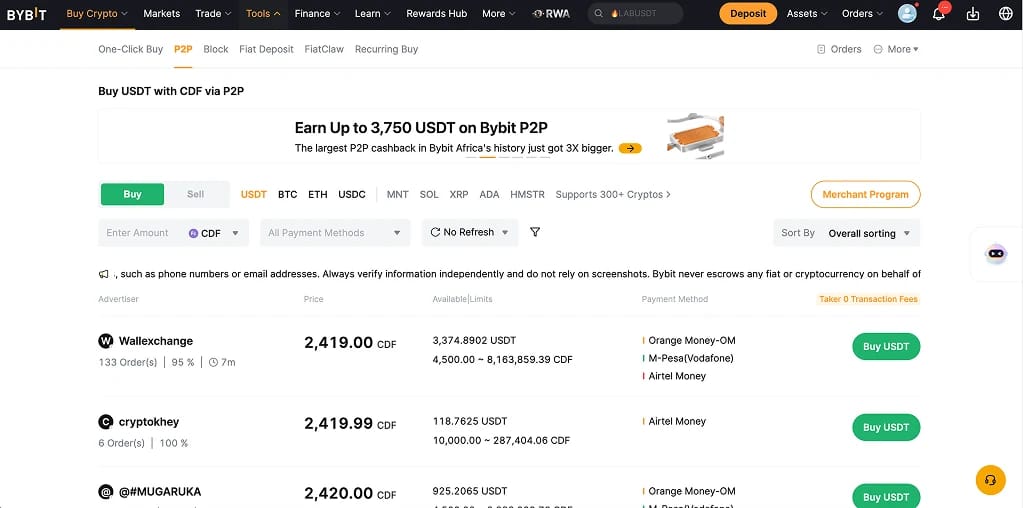
Bybit takes the top spot as the only major exchange that has built for Congolese users specifically rather than serving them by accident. The platform opened a dedicated CDF market on its P2P desk in February 2026 and began recruiting local merchants, so franc orders settle against M-Pesa, Airtel Money, Orange Money and bank transfer without a foreign currency leg.
The merchant pool is young but growing, and the escrow mechanics are the same ones protecting Bybit's far deeper markets elsewhere. A test order we ran through M-Pesa during Kinshasa business hours cleared escrow in about eight minutes at a spread under 2% against mid-market USDT. The fully translated French interface removes a barrier that trips up first-time users on smaller platforms.
Beyond the on-ramp, Bybit pairs 0.1% spot fees with one of the largest derivatives books in the market, copy trading, and regular proof-of-reserves disclosures. It absorbed a $1.4 billion hack in February 2025 without customer losses, replenishing reserves within days, a stress test few exchanges have passed at that scale. The DRC does not appear on its excluded jurisdictions list, which we track in our Bybit restricted countries guide, and our Bybit review covers the wider platform.
Pros
- Dedicated CDF P2P market with M-Pesa, Airtel Money, Orange Money and bank transfer at zero P2P fees.
- Fully translated French interface and 24/7 support.
- 0.1% spot fees, deep derivatives liquidity, copy trading and proof-of-reserves disclosures.
Cons
- The CDF merchant pool is newer and thinner than Binance's, so large orders can move the price.
- No BCC licence, though no foreign exchange serving the DRC holds one.
- Mandatory KYC requires a passport or national ID with a clean name match.
2. Binance
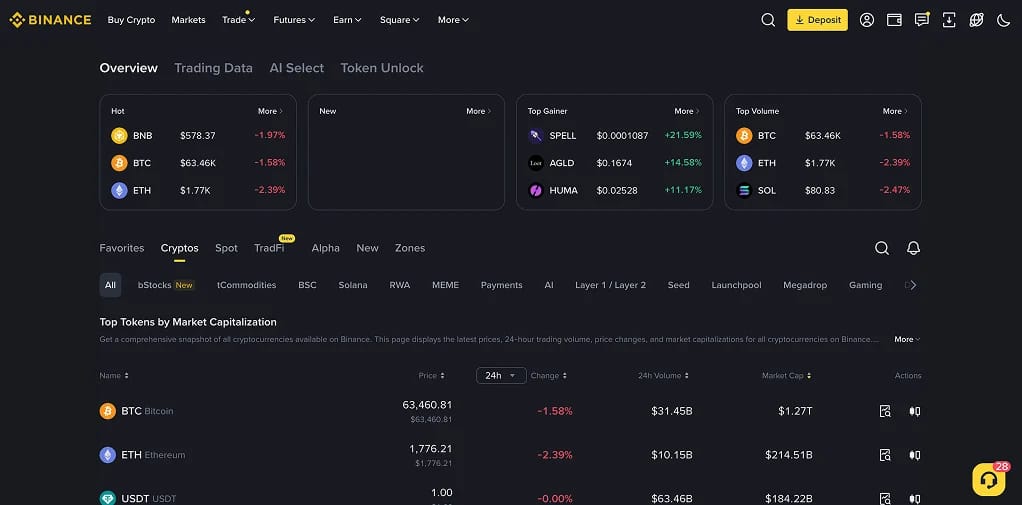
Binance held the Congolese market to itself for years and still owns the deepest CDF order book. Its P2P desk has the largest merchant count in francs, and in October 2024 it switched on direct mobile money purchases for DRC users through local partners, so a first-time buyer can fund from an Airtel Money or Orange Money wallet on the Buy Crypto screen without touching P2P.
That direct on-ramp only supports buying, and the processor margin makes it dearer than a P2P order, so we treat it as a training-wheels feature. The P2P desk is where the value sits. CDF merchant depth held up in our testing at all hours, most sellers accepted dollar-wallet transfers, and disputes we sampled resolved inside the advertised windows.
The global caveats travel with the brand. Binance settled with the US Department of Justice for $4.3 billion in 2023, and its P2P desks in other African markets have suspended local-currency ads under regulator pressure, a risk to price into any single-exchange strategy. Spot fees sit at 0.1%, dropping with BNB, and the asset list covers 400+ coins. Our Binance review has the full picture.
Pros
- Largest CDF P2P merchant base with M-Pesa, Airtel Money, Orange Money and bank transfer.
- Direct mobile money buy option for beginners through local payment partners.
- Deepest global liquidity, so conversions and withdrawals rarely stall.
Cons
- The direct mobile money buy carries a processor margin well above P2P pricing.
- History of suspending local-currency P2P ads in other African markets under pressure.
- The 2023 US settlement still weighs on the global compliance record.
3. OKX
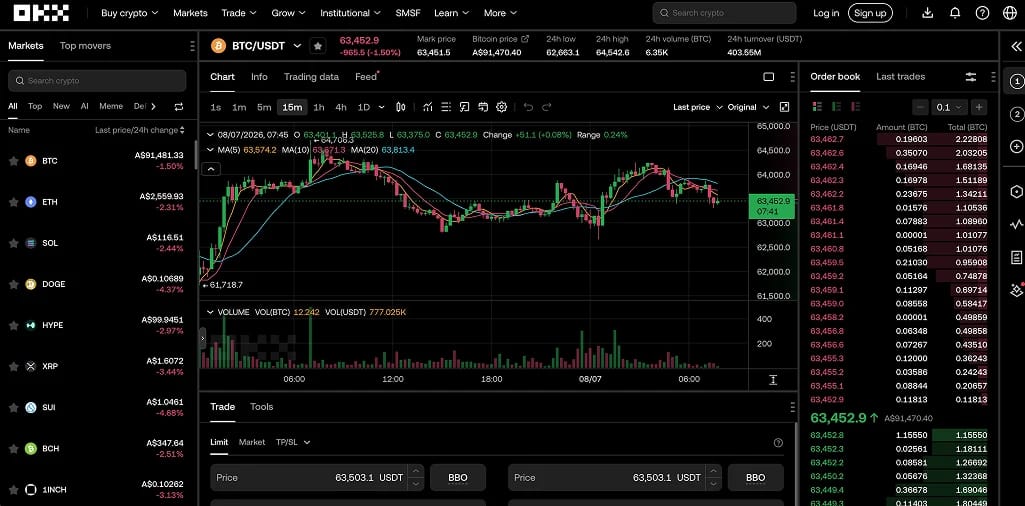
OKX earns third place on trading economics and its Web3 wallet rather than local rails. It runs no CDF market, so Congolese users buy USDT on Bybit or Binance and move it across as a TRC20 transfer, which costs cents and lands in minutes. Once funded, spot fees from 0.08% undercut everything else on this list.
The built-in wallet justifies that extra step. It bridges the exchange account into DeFi protocols, DEX trading and tokens that never reach centralised listings, all inside one app. On a bandwidth-constrained Congolese connection, collapsing two apps into one has practical value, and the French interface is complete.
OKX publishes monthly proof-of-reserves attestations and keeps one of the cleaner disclosure records among the majors. For a DRC user it cannot be the first stop. It is where money goes after the franc leg is done. Our OKX review covers the platform in depth.
Pros
- Spot fees from 0.08%, the lowest of any major exchange serving the DRC.
- Web3 wallet with DEX and DeFi access built into the main app.
- Monthly proof-of-reserves disclosures and a full French interface.
Cons
- No CDF market, so funding requires a USDT transfer from another exchange.
- Card purchases carry the usual processor markup of 2 to 5%.
- The product surface can overwhelm someone who only wants to hold stablecoins.
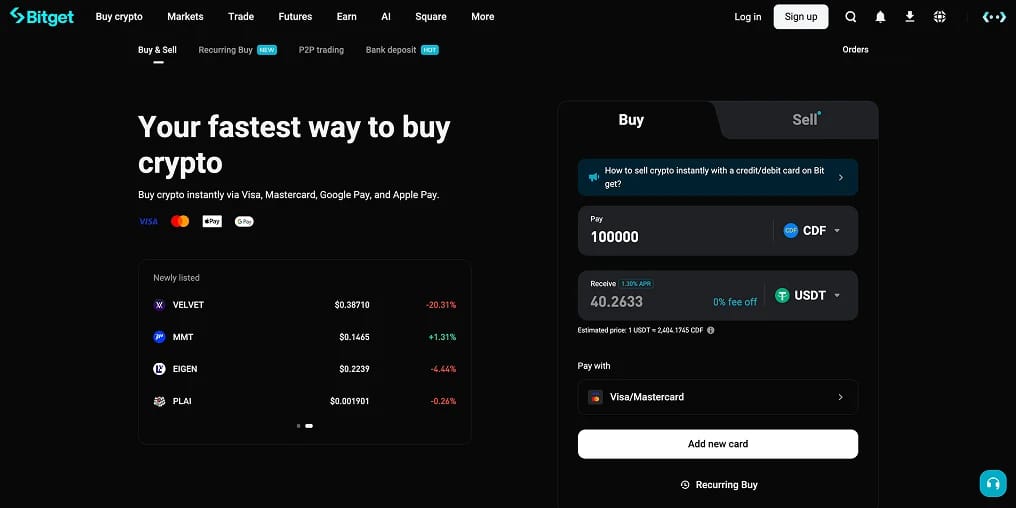
4. Bitget
Bitget is the copy trading venue on this list. Its flagship product lets newer traders mirror vetted lead traders position by position, with a real audience among younger Congolese users who learned markets through Telegram groups. The protection fund sits above $400 million, with regular proof-of-reserves reports at ratios above 100%.
Funding takes the same shape as OKX. Bitget lists no CDF market, and its USD bank transfer channel excludes the DRC, so the practical way in is a TRC20 USDT transfer from a funded Bybit or Binance account, or a card purchase with the standard markup. Once inside, spot fees run 0.1% with BGB discounts.
Around 800 listed assets place it between the majors and the listing factories, with futures to 125x. We rate it a strong second venue for the copy trading and derivatives stack, behind the platforms that solve the franc problem first. Our Bitget review goes deeper.
Pros
- Mature copy trading with a large pool of vetted lead traders.
- $400M+ protection fund and proof-of-reserves ratios above 100%.
- 800+ assets with competitive futures fees and leverage to 125x.
Cons
- No CDF P2P market and no USD bank transfer support for the DRC.
- Copy trading normalises leverage for beginners who may underprice the risk.
- French localisation is partial in places compared with Bybit or Binance.
5. MEXC
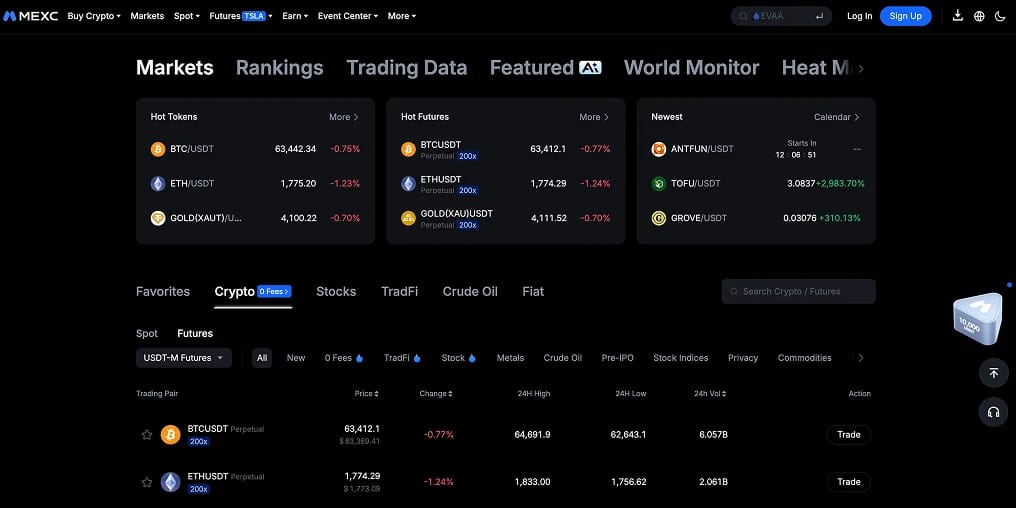
MEXC is the pick when fees decide everything. Spot makers pay nothing and takers 0.05%, which compounds for anyone averaging into BTC or USDT on a schedule. The listing machine outruns every rival, with 2,800+ assets and new tokens appearing weeks before the larger venues.
Congolese users fund it as they do OKX and Bitget, sending USDT across from a P2P purchase elsewhere. Card buys exist for emergencies at the usual 2 to 5% processor cost, a trade-off we break down in our guide to buying crypto with a credit card. The price of the fee structure is disclosure. MEXC publishes proof-of-reserves less rigorously and less often than Bybit, OKX or Bitget.
We treat MEXC as a venue for cost-sensitive traders and early token hunters, with balances kept lean and profits cycled back to a platform with a stronger disclosure record. Our MEXC fees breakdown prices out the full schedule.
Pros
- 0% maker fees on spot and among the lowest taker rates anywhere.
- 2,800+ listed assets with the fastest new-token pipeline of the majors.
- Lean, fast app that works well on constrained mobile data.
Cons
- No CDF funding, so it depends entirely on transfers from another exchange.
- Proof-of-reserves disclosure lags the top of this list.
- Support responses are slower in French than in English.
6. KuCoin
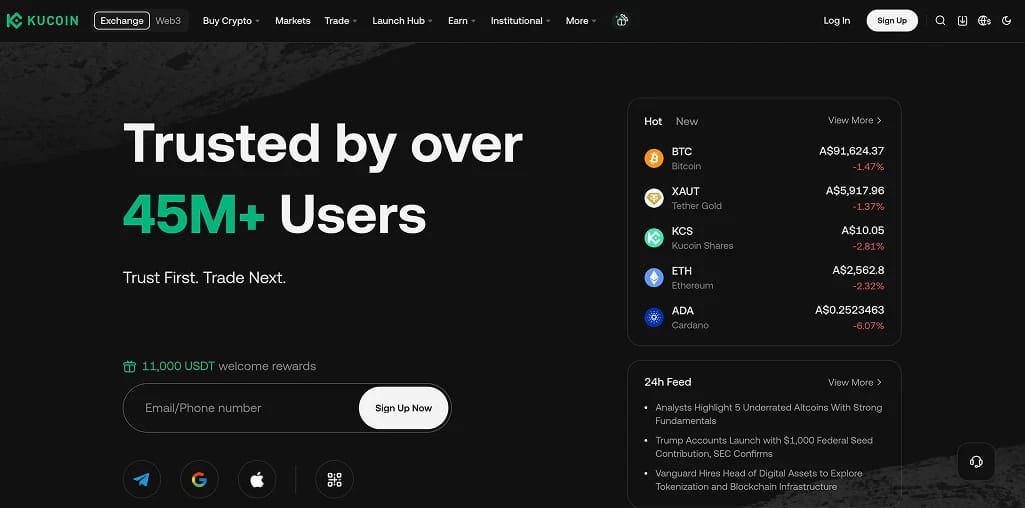
KuCoin rounds out the list as a secondary altcoin venue. Its 700+ listings, grid and DCA trading bots, and Earn products for idle USDT give it a defined role alongside a funded primary exchange. Smaller-cap tokens frequently list here before Bybit or Binance pick them up.
There is no franc on-ramp, so the TRC20 transfer pattern applies again. The bots are the standout feature. A grid bot on a major pair suits the long sideways stretches that frustrate manual traders, and setup takes minutes on the mobile app.
The compliance history deserves a clear-eyed read. KuCoin's operator pleaded guilty in January 2025 to running an unlicensed money transmitting business in the US, paying $297 million in penalties. The compliance program has been rebuilt and customer funds were never touched, but it belongs in the sizing decision for any balance left on the platform. Our KuCoin review weighs the record in full.
Pros
- 700+ assets with early listings on smaller-cap tokens.
- Grid, DCA and rebalancing bots that run unattended.
- Earn products generate yield on idle USDT between trades.
Cons
- No CDF market, so it cannot serve as a primary on-ramp.
- The January 2025 US guilty plea remains a trust consideration.
- Interface density makes it a poor first exchange for beginners.
How to Choose a Crypto Exchange in DR Congo
Choosing a crypto exchange in the DRC means confirming a working franc or mobile money on-ramp, testing merchant depth before committing real size, matching your ID to the KYC screen, and measuring the full cost of a round trip.
- Check for a live CDF desk before anything else: Open the P2P section, filter for CDF, and count active merchants during Kinshasa business hours. Bybit and Binance maintain franc markets. Everywhere else, plan to fund by USDT transfer from one of those two.
- Match the payment method to your wallet: M-Pesa, Airtel Money and Orange Money all appear as P2P payment options, and many merchants also accept transfers between the USD-denominated mobile wallets Congolese operators support with per-transaction caps around $1,000 to $1,500. Pick merchants advertising your operator to avoid failed payment windows.
- Prepare KYC documents carefully: Exchanges accept a passport or the national biometric ID, and name mismatches are the most common cause of stalled verification. The voter card that serves as everyday ID in much of the country is inconsistently accepted, so upload a passport where you have one.
- Measure the real round-trip cost: Headline fees of 0.1% say little. The P2P spread on both legs plus mobile money cash-out fees decide what you keep, and a platform can cost 3 to 5% all-in despite cheap trading. Run a small CDF to USDT to CDF loop and treat that figure as the true price.
- Factor in remittance use: If family abroad sends money home, a stablecoin leg can undercut the 8 to 12% charged on traditional corridors into the DRC. Compare it against services in our guide to buying crypto with Western Union before defaulting to the old rails.
Crypto and Bitcoin Regulation in DR Congo
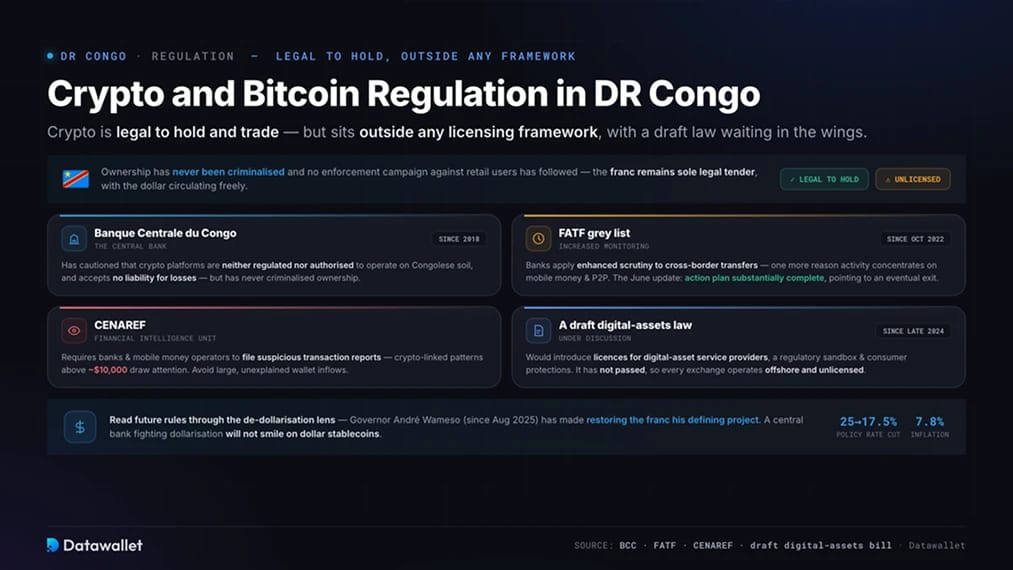
Crypto in the DRC is legal to hold and trade but sits outside any licensing framework, with a central bank that has warned against it, a financial intelligence unit monitoring transactions, and a draft law that would formalise the sector.
- Banque Centrale du Congo (BCC): The central bank has cautioned since 2018 that crypto platforms are neither regulated nor authorised to operate on Congolese soil, and it accepts no liability for losses. It has never criminalised individual ownership, and no enforcement campaign against retail users has followed. The franc remains sole legal tender, with the dollar circulating freely.
- FATF grey list: The DRC has sat on the FATF's list of jurisdictions under increased monitoring since October 2022. The June update this year noted the action plan is substantially complete, pointing towards an eventual exit, but while the listing lasts, banks apply enhanced scrutiny to cross-border transfers, one more reason activity concentrates on mobile money and P2P.
- CENAREF reporting obligations: The national financial intelligence unit requires banks and mobile money operators to file suspicious transaction reports, and crypto-linked patterns above roughly $10,000 draw attention. Avoid large, unexplained wallet inflows.
- A draft digital assets law: A bill circulating since late 2024 would introduce licences for digital asset service providers, a regulatory sandbox and consumer protections. It has not passed, so every exchange on this list operates offshore and unlicensed.
- De-dollarisation pressure: Governor André Wameso, in office since August 2025, has made restoring the franc his defining project, backed by interbank dollar sales and a rate cut from 25% to 17.5% as inflation fell to 7.8%. A central bank fighting dollarisation will not smile on dollar stablecoins, and future rules should be read through that lens.
Nothing here prohibits buying or holding. The practical risks are a bank questioning crypto-linked transfers and a coming law that arrives with teeth.
How Does DR Congo Tax Crypto?
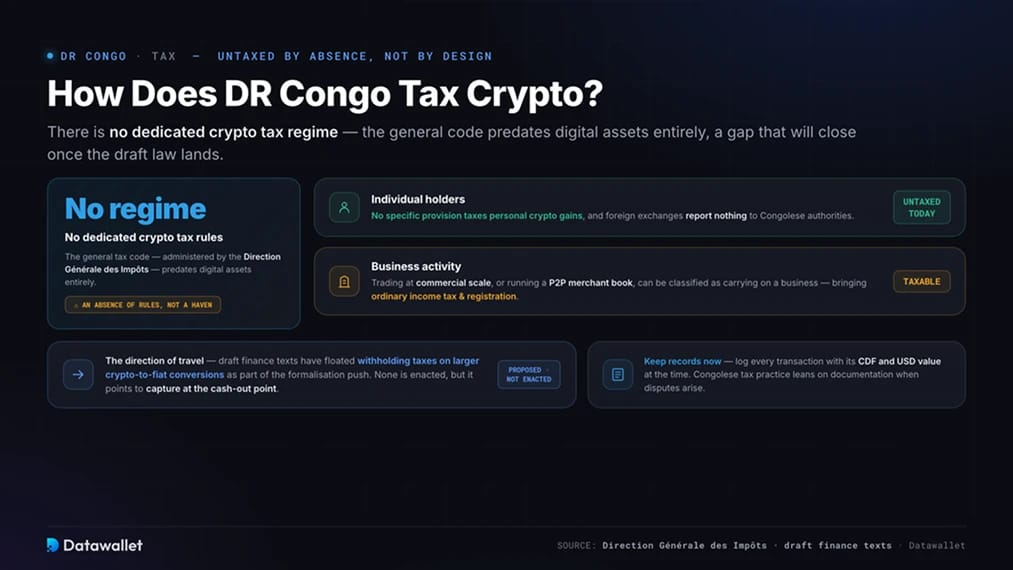
The DRC has no dedicated crypto tax regime, and the general tax code administered by the Direction Générale des Impôts predates digital assets entirely.
- Individual holders: No specific provision taxes personal crypto gains, and foreign exchanges report nothing to Congolese authorities. This is an absence of rules, a gap that will close once the draft digital assets law lands.
- Business activity: Anyone trading at commercial scale, or running a P2P merchant book, can be classified as carrying on a business, which brings ordinary income tax and registration obligations.
- Proposed measures: Draft finance texts have floated withholding taxes on larger crypto-to-fiat conversions as part of the wider formalisation push. None has been enacted, but the direction of travel points to capture at the cash-out point.
- Record keeping: Log every transaction with its CDF and USD value at the time. Congolese tax practice leans on documentation when disputes arise, and reconstructed records convince nobody.
None of this is tax advice. Anyone moving serious size should sit down with a Kinshasa-based fiscal adviser before the framework changes underneath them.
Cryptocurrency Adoption in DR Congo
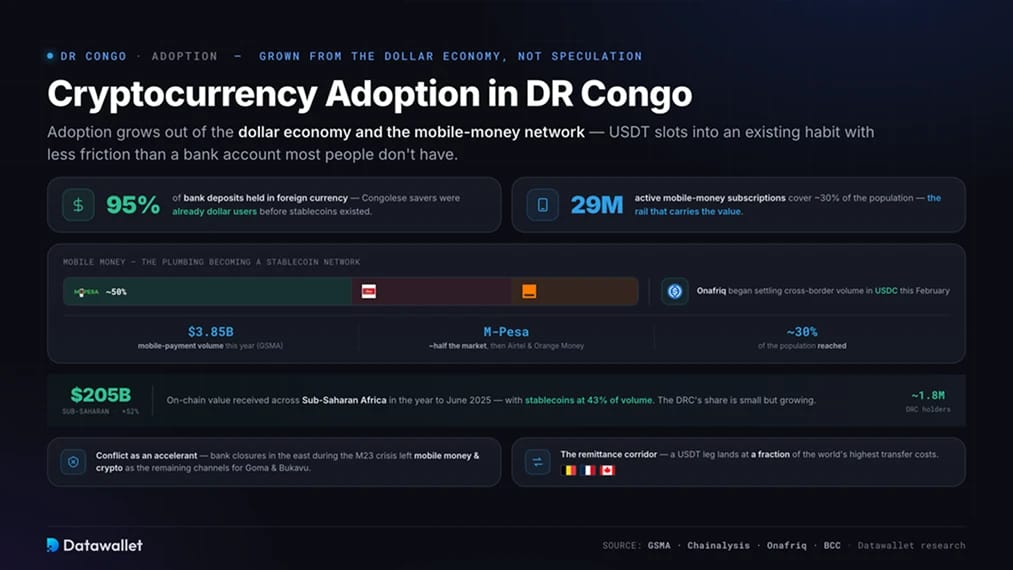
Crypto adoption in the DRC grows out of the dollar economy and the mobile money network more than out of speculation.
- A dollarised base layer: With around 95% of bank deposits held in foreign currency, Congolese savers were already dollar users before stablecoins existed. USDT slots into an existing habit with less friction than a bank account most people do not have.
- Mobile money as the rail: Roughly 29 million active mobile money subscriptions cover about 30% of the population, with Vodacom's M-Pesa holding around half the market ahead of Airtel Money and Orange Money. GSMA projections put Congolese mobile payment volumes near $3.85 billion this year, and Onafriq, the network connecting the country's wallets, began settling cross-border volume in USDC this February. The plumbing under Congolese mobile money is becoming a stablecoin network.
- Regional stablecoin momentum: Chainalysis measured over $205 billion in on-chain value received across Sub-Saharan Africa in the year to June 2025, up 52%, with stablecoins at 43% of volume. The DRC's share is small but growing from an estimated 1.8 million holders. Market comparisons sit on our crypto adoption statistics page.
- Conflict as an accelerant: Bank closures in the east during the M23 crisis cut whole cities off from cash, leaving mobile money and crypto as the remaining channels for moving value in and out of Goma and Bukavu. Adoption born of necessity tends to outlast the emergency.
- The remittance corridor: The diaspora in Belgium, France and Canada pays among the world's highest transfer costs into the DRC. A USDT leg cashing out through P2P lands at a fraction of the traditional price.
How to Buy Bitcoin in DR Congo
The cheapest path to Bitcoin in the DRC is a P2P purchase of USDT with mobile money followed by a spot swap into BTC.
- Open an account on a platform with a live CDF desk: Bybit and Binance are the two with franc markets. Confirm merchant depth in the P2P section before depositing anything.
- Complete verification: Upload a passport or national biometric ID with a selfie, keeping the account name identical to the document. Approvals usually land within hours.
- Buy USDT through P2P: Filter for CDF, pick a merchant with a completion rate above 95% who lists your mobile money operator, pay from your M-Pesa, Airtel Money or Orange Money wallet, and wait for escrow to release. Ten minutes is typical.
- Swap USDT for BTC with a limit order: Skip the one-click convert screen. A limit order on the BTC/USDT pair saves 1 to 3% against instant-buy pricing.
- Move long-term holdings to self-custody: Balances you will not trade belong in your own wallet, with the address triple-checked and the right network selected. Our best crypto wallets guide compares the options.
Selling reverses the steps, with the P2P cash-out landing in your mobile wallet in francs or dollars.
Final Thoughts
Bybit leads the DRC market because it built the missing piece, a real CDF desk with the mobile money methods Congolese people use daily, on a platform that proved its solvency under a $1.4 billion stress test. Binance remains the liquidity benchmark and the best second account, while OKX, Bitget, MEXC and KuCoin each earn a role once the franc leg is handled elsewhere.
The market itself is at a turning point. A central bank governor is fighting to pull the country back towards its own currency just as its payment networks start settling in digital dollars, and a draft law that would license the sector sits unfinished. The window in which everything runs on offshore P2P will not stay open in its current form.
Whichever platform you pick, put a small amount through the full loop first. Buy USDT with your mobile wallet, swap it, sell it, and withdraw back to the same wallet. The spread and the time in transit will tell you more than any ranking, ours included.
Our Methodology
We opened accounts on each exchange, completed KYC, funded through CDF P2P orders paid with M-Pesa and Airtel Money where markets existed, transferred USDT to the platforms without franc desks, traded live pairs, and cashed back out to mobile wallets. Each platform was scored on six criteria.
- Trust Score: Our proprietary rating out of 5, weighting security history, proof-of-reserves transparency, regulatory standing, longevity and audit coverage.
- CDF Funding Methods: Confirmed which platforms run live franc P2P markets, which mobile money operators merchants accept, settlement speed, and spread against mid-market USDT.
- Local Usability: Assessed French localisation, app performance on constrained mobile data, and support responsiveness in French.
- Security Track Record: Reviewed breach history, custody arrangements, proof-of-reserves cadence, and protections such as 2FA and withdrawal whitelists.
- Assets and Liquidity: Placed market and limit orders on BTC/USDT, ETH/USDT and one mid-cap pair per venue, measuring spread, depth and fill quality.
- Fee Structure: Compared maker and taker schedules, P2P spreads on CDF, withdrawal charges, and the all-in cost of a franc-to-USDT round trip.
We excluded platforms with no practical funding path for Congolese users, unresolved compliance failures, or persistent access problems. Testing ran from May to July, with regulatory statuses rechecked against the FATF's June update.
.webp)