


Ethereum's release schedule has tightened. Fusaka landed in December 2025, Glamsterdam reached final devnet testing in mid-2026, and core developers have already named the fork that follows it, Hegota.
That speed is deliberate. After years of bundling changes into one large yearly release, the Ethereum Foundation has shifted to a twice-a-year cadence of smaller, tightly scoped forks. Hegota is the second 2026 slot.
The difference from its predecessor is the target. Glamsterdam scales how Ethereum builds and prices blocks. Hegota turns to a quieter problem that touches the network's core promise of permissionless access. Here is what is settled, what is still contested, and what it means for ETH. 👇
What is the Ethereum Hegota Upgrade?
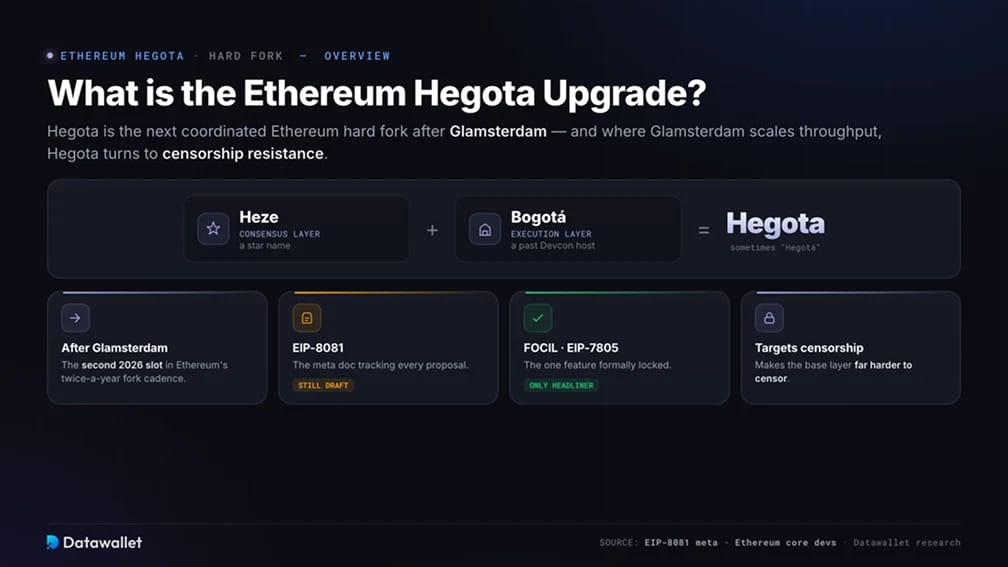
Hegota is the next coordinated Ethereum hard fork after Glamsterdam, bundling changes to both halves of the protocol into one release. Following Ethereum's naming pattern, the consensus-layer star Heze pairs with Bogotá, a past Devcon host, on the execution side to form the blended title, sometimes written Hegotá.
Its scope is governed by EIP-8081, the meta document tracking every proposal under consideration. That document is still in Draft as of mid-2026, and that matters. Only one feature is formally locked as a headliner, and the rest remain candidates.
That headliner is FOCIL, or Fork-Choice Enforced Inclusion Lists, defined in EIP-7805. It was floated for Glamsterdam, then deferred to avoid stacking too many untested interactions into one fork, and now leads Hegota's consensus-layer work.
Why Hegota Matters: Censorship Resistance Becomes a Protocol Rule
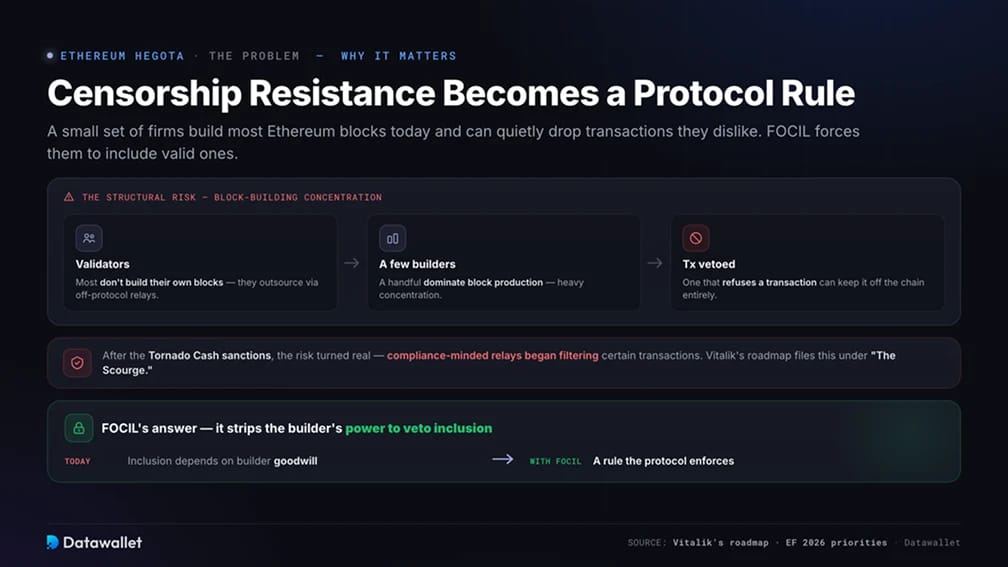
To see the point of Hegota, look at who builds Ethereum's blocks today. Most validators do not assemble their own. They outsource the job to a small set of specialised builders through off-protocol relays, a structure built to keep MEV handling efficient.
The side effect is concentration. A handful of builders dominate block production, and one that refuses a given transaction can keep it off the chain. After the Tornado Cash sanctions, that risk turned real, as compliance-minded relays began filtering certain transactions.
Vitalik Buterin's roadmap files this under "The Scourge," the part of Ethereum's long-term plan aimed at neutralising MEV-driven centralisation and protecting credible neutrality. The Foundation's 2026 protocol priorities lean the same way, treating block-production censorship as a structural threat rather than a fringe concern.
FOCIL is the first hard answer. It does not break up the builder market or touch transaction ordering. It strips the builder's power to veto inclusion, turning a guarantee that now depends on goodwill into a rule the protocol enforces.
Hegota's Headliner: FOCIL (EIP-7805)
FOCIL is the load-bearing feature of the upgrade and its only confirmed headliner, the single proposal marked Scheduled for Inclusion on the Hegota meta document. Thomas Thiery (@soispoke) is its lead author, and FOCIL reached that status in early 2026 after years of inclusion-list research.
How FOCIL Works
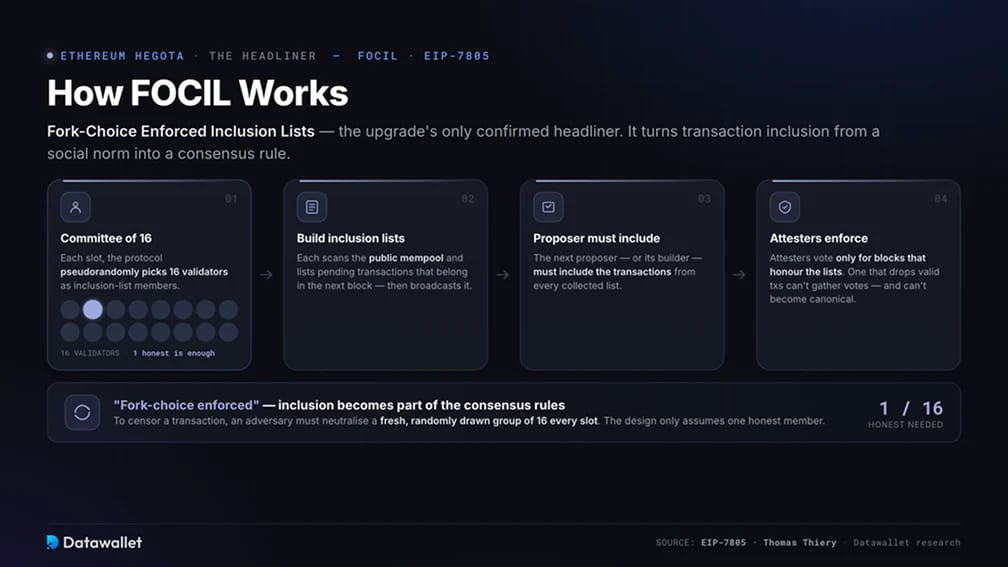
For each slot, the protocol pseudorandomly picks a committee of 16 validators as inclusion-list members. Each scans the public mempool and builds a short list of pending transactions it believes belong in the next block, then broadcasts it across the network.
The next slot's proposer, or the builder constructing its block, must include the transactions from every collected list. Attesters vote only for a block that honours those lists. One that drops valid inclusion-list transactions it could have fit will not gather enough votes and cannot become canonical.
The phrase "fork-choice enforced" captures the teeth of it. Inclusion stops being a social norm and becomes part of the consensus rules. To censor a transaction, an adversary would need to neutralise a fresh, randomly drawn group of 16 validators every slot, or hope none of them lists it. The design only assumes one honest committee member out of the sixteen to work.
Why FOCIL Matters Now
Glamsterdam already moves block building into the protocol through enshrined proposer-builder separation, which trims relay trust but does not, by itself, stop a determined builder from excluding transactions. FOCIL closes that gap, which is why the two ship in back-to-back forks rather than together.
It also pairs naturally with account abstraction. Buterin has pointed to a synergy between FOCIL and the Frame Transaction proposal, where smart-account and privacy-protocol transactions sent through the public mempool could be force-included even if a proposer tried to ignore them. Together they would give users a protocol-level path to inclusion that no single intermediary controls.
Account Abstraction and Verkle Trees in Hegota
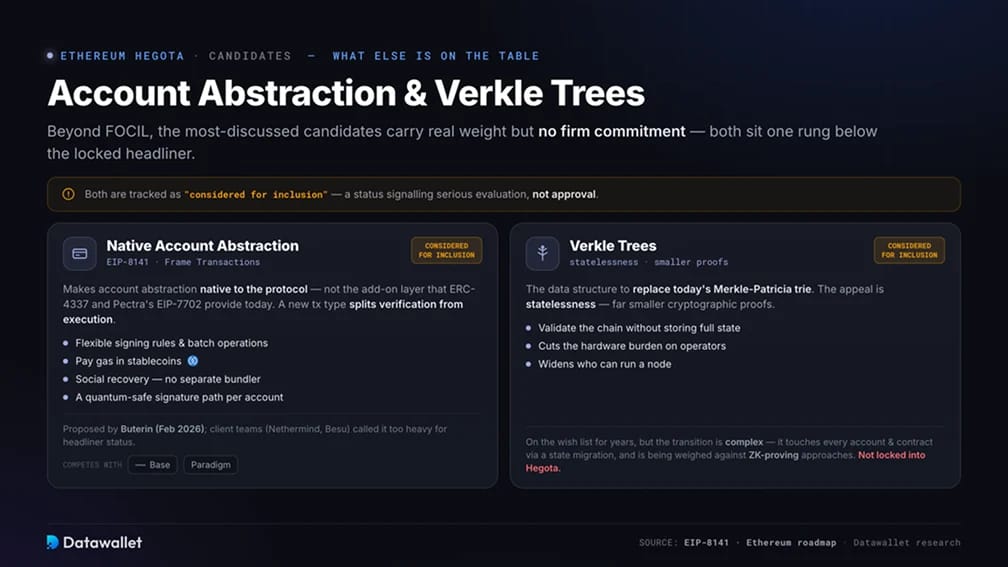
Beyond FOCIL, the most-discussed Hegota candidates carry real weight but no firm commitment. Both are tracked as "considered for inclusion," a status signalling serious evaluation rather than approval.
Native Account Abstraction (EIP-8141)
EIP-8141, known as Frame Transactions, would make account abstraction native to the protocol rather than the add-on layer that ERC-4337 and Pectra's EIP-7702 provide today. It introduces a transaction type that splits verification from execution, so any account could use flexible signing rules, batch operations, pay gas in stablecoins, or adopt social recovery without a separate bundler.
Buterin proposed it in February 2026 and backed it at the March All Core Devs call, partly for its quantum-resistance angle. Letting accounts switch to quantum-safe signatures ahead of any network-wide migration matters more since Google Quantum AI research cut the estimated qubit count needed to break Ethereum's elliptic-curve signatures.
Client teams pushed back. Nethermind and Besu argued it was too heavy for headliner status, which would have meant Hegota could not ship without it, dragging in its timeline risk. The compromise was Considered for Inclusion status, which keeps it alive without blocking the fork. It now competes with rival account-abstraction designs from Coinbase's Base team and Paradigm for an eventual slot.
Verkle Trees and Statelessness
Verkle trees have sat on Ethereum's wish list for years as the data structure to replace today's Merkle-Patricia trie. The appeal is statelessness. Far smaller cryptographic proofs could let nodes validate the chain without storing the full state, cutting the hardware burden on operators and widening who can run a node.
Ethereum's roadmap lists Verkle trees as considered for Hegota, not confirmed. The transition is complex, since it touches every account and contract through a state migration, and developers have weighed it against approaches better suited to zero-knowledge proving. Treat any claim that they are locked into Hegota with caution, because the record does not support it yet.
How Hegota's Scope Gets Decided
Hegota is a useful window into how Ethereum now plans forks, explaining why so much remains open. Under the headliner process, major features are chosen first through a structured timeline rather than assembled all at once.
Headliner proposals opened in January 2026 on the Ethereum Magicians forum, with a February deadline and several All Core Devs calls to deliberate between them. Each needs a named champion to shepherd it. Only once a headliner is chosen does a 30-day window open for smaller, non-headliner additions.
The discipline is intentional. By naming one anchor feature and making everything else justify its place, developers avoid the bloated, delay-prone releases of earlier years. The public picture also shifts as calls progress, so the live status on Forkcast and the meta thread is the only reliable scope, not any single snapshot.
Ethereum Hegota Release Date
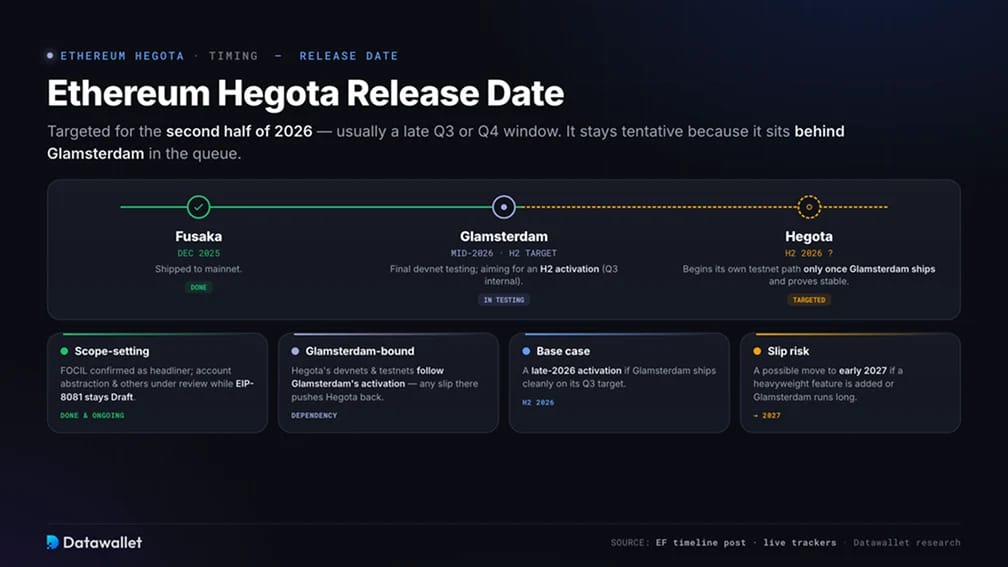
Hegota is targeted for the second half of 2026, usually a late Q3 or Q4 window. That timing stays tentative for one reason. It sits behind Glamsterdam in the queue, and Glamsterdam has its own moving date.
Glamsterdam reached final devnet testing in mid-2026 and is aiming for an H2 activation, with internal targets clustering around Q3 after the timeline slipped from an earlier first-half goal. Hegota begins its own testnet path only once Glamsterdam ships and proves stable.
The realistic read for Hegota:
- Scope-setting (done and ongoing): FOCIL confirmed as headliner, with account abstraction and other candidates under review while EIP-8081 stays in Draft.
- Dependent on Glamsterdam: Hegota's devnets and testnets follow Glamsterdam's mainnet activation, so any slip there pushes Hegota back.
- Base case (H2 2026): a late-2026 activation if Glamsterdam ships cleanly on its Q3 target.
- Slip risk (2027): several analysts flag a possible move into early 2027, especially if a heavyweight feature like account abstraction is added or Glamsterdam runs long.
The Ethereum Foundation's timeline post and the live trackers remain the authoritative sources as dates firm up.
What Hegota Means for ETH Holders and Investors
Major Ethereum upgrades often trade on a "buy the rumour, sell the news" rhythm, with ETH building into a fork and fading after activation. That held through Pectra and Fusaka, though recent cycles have been noisier than the clean historical cases.
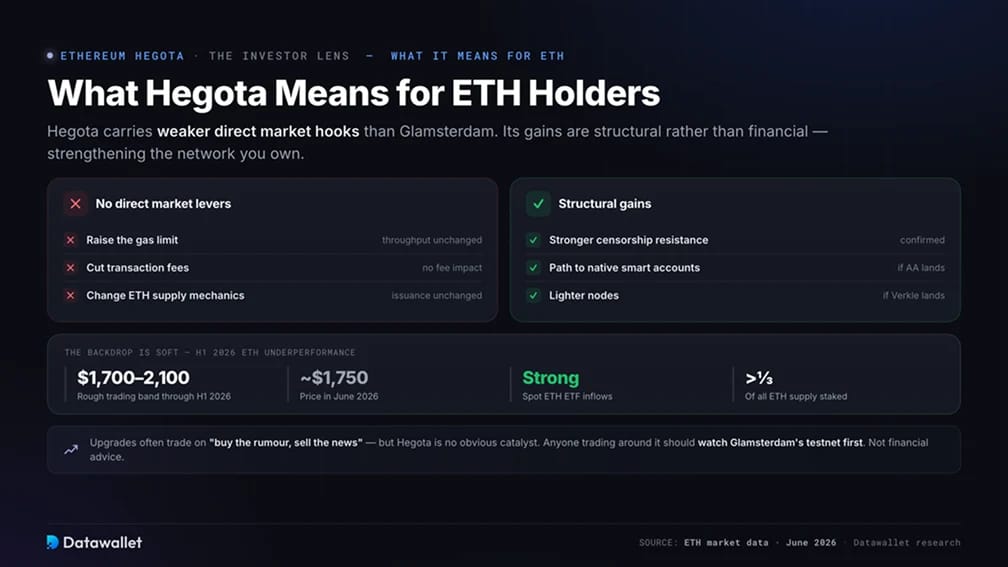
Hegota carries weaker direct market hooks than Glamsterdam. It does not raise the gas limit, cut fees, or change ETH's supply mechanics. Its gains are structural rather than financial, strengthening censorship resistance and, if the candidates land, opening a path to native smart accounts and lighter nodes. Those qualities matter for the network's long-run credibility more than for a near-term price move.
The backdrop is soft. ETH spent the first half of 2026 underperforming, trading in a rough $1,700 to $2,100 band and near $1,750 in June, even as spot ETH ETFs drew strong inflows and over a third of all ETH supply sat in staking. That gap between healthy product demand and a weak price is the value-accrual debate hanging over the asset, and Hegota does little to settle it.
For holders, the upgrade improves the quality of the network they own rather than offering an obvious catalyst. Anyone trading around it should watch Glamsterdam's testnet progress first, since Hegota's calendar hangs on it. None of this is financial advice, and timelines and markets both shift quickly, so do your own research before allocating.
Key Risks of the Hegota Upgrade
Hegota's risks split between the feature itself and the wider process around it.
- Timeline dependency: Hegota cannot start its testnet cycle until Glamsterdam ships, so any delay to the larger fork delays Hegota.
- Scope uncertainty: with EIP-8081 in Draft and headline candidates unsettled, the final feature set could look very different from today's, complicating planning for builders and validators.
- FOCIL coordination: inclusion lists add networking and timing duties for validators, and builders must stay well-connected to committee members to receive lists in time. Edge cases like equivocation and invalidation need careful handling.
- Bandwidth and resources: running an extra committee process each slot adds load, which is why list sizes are capped and the design avoids a separate incentive system.
- Account-abstraction complexity: if EIP-8141 is promoted, it touches core transaction processing across every execution client, widening the testing surface and the chance of smart-contract assumptions breaking.
- Overscoping: Ethereum's recent restraint has been a strength. Loading Hegota with too much would invite the delays the new cadence is meant to prevent.
Final Thoughts
Hegota is where Ethereum's roadmap turns from scaling the base layer to defending it. Glamsterdam answers how much the network can process. Hegota answers a different question, whether anyone can be quietly shut out of it.
FOCIL is the clearest expression of that. Wiring inclusion into the fork-choice rule turns censorship resistance from a property the community trusts builders to respect into one the protocol guarantees. The candidates around it, native account abstraction and statelessness, would push the same theme toward a more usable, more decentralised network, if and when they clear the bar.
For now, Hegota is half-defined and timeline-bound to the fork in front of it. The direction is set and broadly supported. The details, and the date, are still being written.