



%203.svg)
Phantom is the largest revenue earner in Hyperliquid's builder program, generating over $20.6 million in cumulative fees from roughly $39 billion in perp volume and more than 137,000 traders. A wallet, rather than an exchange, now ranks among crypto's most successful derivatives frontends.
The appeal is convenience: deposit SOL, get auto-converted to USDC, and open a leveraged position in a few taps without touching a bridge or exchange account. The trade-off is cost, since every fill pays Phantom a premium over the same order on Hyperliquid's native interface.
This Phantom Perpetuals review covers markets, leverage, the fee stack, risk controls, country restrictions, and whether the wallet experience justifies the extra basis points. 👇
What Is Phantom Perps?
Phantom Perps is the perpetual futures product built into the Phantom wallet, launched on July 8, 2025 with an initial rollout to EU users. Rather than building its own exchange, Phantom plugs into Hyperliquid, the largest decentralized perpetuals platform, through a permissionless API integration.
The connection runs on Hyperliquid's builder codes, a protocol feature that lets third-party apps submit orders on behalf of users and collect an onchain fee per fill. Users approve a maximum builder fee once, the protocol caps it at 0.1% for perps, and the approval can be revoked at any time.
Adoption was immediate. Phantom processed $1.8 billion in volume within the first 16 days from around 17,000 traders, and by mid-2026 it leads all Hyperliquid builders by revenue with 31.8% of fees earned by the top ten frontends.
The product remains fully non-custodial. Your perps balance lives on Hyperliquid under the Ethereum address tied to your Phantom account, and positions previously opened on Hyperliquid with the same wallet appear automatically in the app.
How to Trade Perps in Phantom
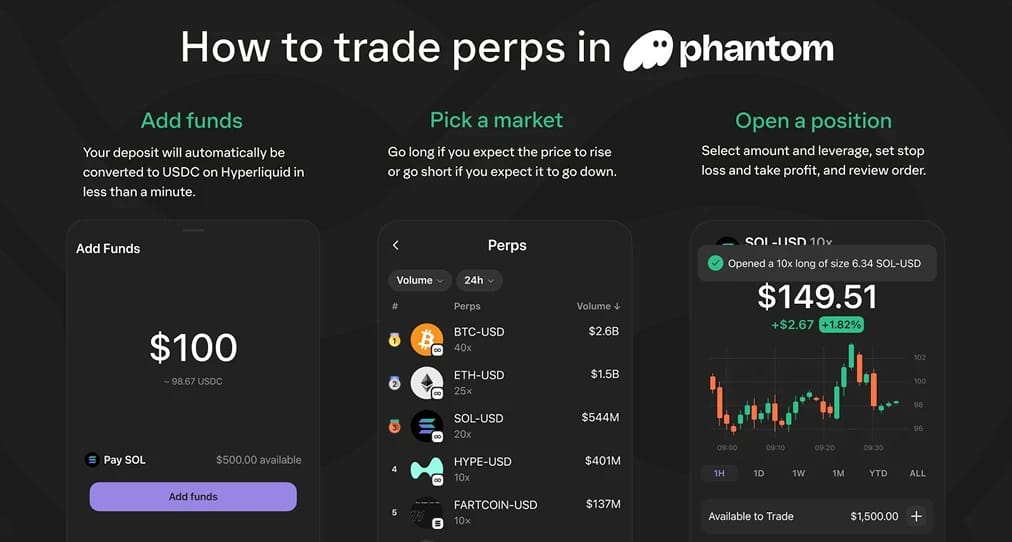
Opening a position takes minutes from a funded wallet, with no registration or identity checks. Here are the main steps:
- Open the Perps Tab: Launch the Phantom mobile app, go to the Home tab, and tap Perps to load the markets list and your perps balance.
- Fund Your Perps Balance: Deposit SOL, USDC, or another supported token, and Phantom converts it to USDC on Hyperliquid behind the scenes.
- Pick a Market: Choose from 200+ markets spanning BTC, ETH, SOL, meme coins, and HIP-3 equity perps tracking stocks and indices.
- Set Direction and Leverage: Select long or short, then dial in leverage up to 40x for crypto majors or 10x for equity perps.
- Choose an Order Type: Place a market order for instant execution, or set a limit order at your target price on mobile.
- Attach Risk Triggers: Add take-profit and stop-loss levels at entry so the position closes automatically at either price.
- Monitor the Position: Track PnL, margin, funding payments, and your liquidation price in real time from the positions screen.
- Close and Withdraw: Exit the trade, then withdraw USDC to your wallet, Cash account, or swap into SOL. The minimum withdrawal is $5 and Hyperliquid charges a flat 1 USDC fee on your first withdrawal.
Desktop traders can use Phantom Terminal at trade.phantom.com, a browser platform launched in December 2025 with TradingView charts, a live order book, and position syncing across mobile and extension. Terminal supports market orders only, so limit entries stay in the app.
Markets and Leverage on Phantom Perps
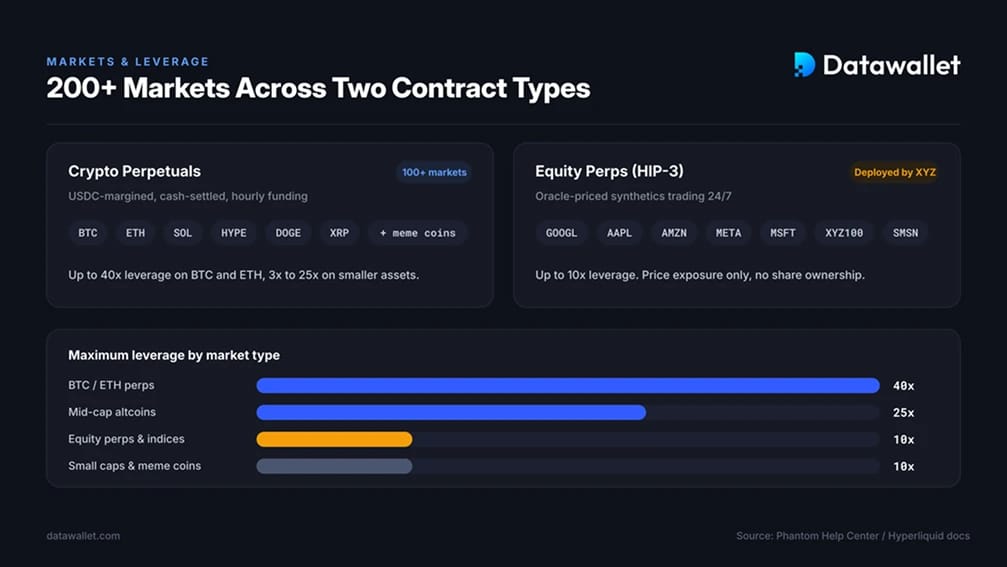
Phantom mirrors Hyperliquid's full listing set, so the catalog grows whenever new markets go live on the exchange. Coverage splits into two categories with different leverage ceilings and pricing behavior.
Crypto Perpetuals
The core offering spans 100+ crypto perpetual contracts, from BTC-USD and ETH-USD down to mid-caps and meme coins. Maximum leverage reaches 40x on Bitcoin and Ethereum, with smaller assets capped between 3x and 25x depending on liquidity and volatility.
All contracts are USDC-margined and cash-settled, with funding payments exchanged hourly between longs and shorts to keep perp prices anchored to spot. Check live rates on Datawallet's crypto funding rates tracker before entering a crowded trade.
Equity Perps and HIP-3 Markets
Equity perps are perpetual futures tracking US stocks, indices, commodities, and foreign exchange, deployed by third-party builder XYZ under Hyperliquid's HIP-3 framework. Available markets include GOOGL, AMZN, AAPL, META, MSFT, and the XYZ100 broad-market index, with leverage capped at 10x.
These synthetic contracts are priced from oracle feeds, giving exposure to a stock's movement without share ownership or shareholder rights. Pricing tracks real-time data during US market hours, while after-hours quotes reflect expected movement and can drift from traditional exchange prices.
The lineup has expanded through 2026, including international listings such as Samsung, SK Hynix, and Hyundai added in February. Phantom does not issue or control these contracts; the deployer manages the oracle, margin parameters, and market maintenance.
Phantom Perps Fees and Funding Rates
The fee stack has two layers: Hyperliquid's protocol fees and Phantom's builder fee on every fill. Understanding both separates an informed cost estimate from an unpleasant surprise on high-frequency strategies.
Here are the main components of Phantom Perps fees:
- Builder Fee: Phantom charges a 0.05% builder fee on both sides of every perp trade, collected onchain in USDC and displayed before you confirm.
- Hyperliquid Base Fees: The protocol adds its standard 0.015% maker and 0.045% taker rates at the entry tier, which scale down with 14-day rolling volume as covered in our Hyperliquid fees guide.
- Effective Cost: Combined, a retail taker pays roughly 0.095% per fill through Phantom, about double the cost of the same order placed directly on Hyperliquid.
- Equity Perp Rates: HIP-3 markets carry double the standard protocol base rate under Hyperliquid's deployer economics, so stock and index perps cost more per fill than crypto majors.
- Funding Rates: Hourly payments pass between longs and shorts depending on whether the perp trades above or below spot, reflected in your PnL rather than as separate transactions.
- Deposits and Conversion: Funding the perps balance is free apart from Solana network gas and any swap spread when converting SOL or other tokens into USDC.
- Withdrawals: Hyperliquid charges a flat 1 USDC fee on your first withdrawal, with a $5 minimum, plus standard bridging and swap costs when converting back to SOL.
Risk Management and Liquidations
Phantom strips the derivatives experience down to essentials, which shapes both the safeguards and their limits. Risk is handled through a few core mechanisms rather than the deep toolkits found on centralized venues.
Here are the key risk controls on Phantom Perps:
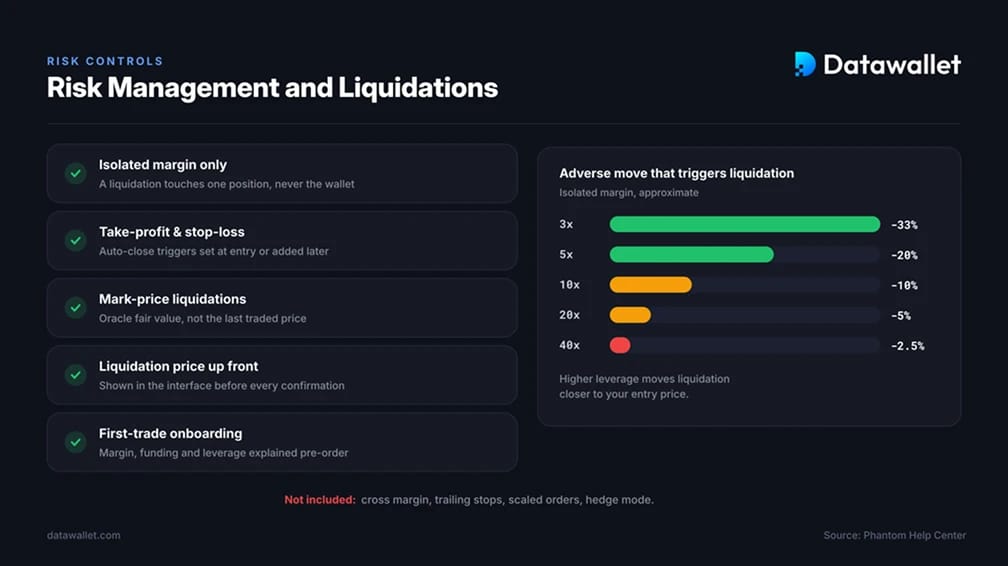
- Isolated Margin Only: Every position is collateralized separately, so a liquidation wipes out only the margin assigned to that trade, never your wider wallet balance.
- Take-Profit and Stop-Loss: Both triggers can be set at entry or added to open positions, closing automatically when the market touches your level.
- Mark Price Liquidations: Liquidations reference Hyperliquid's oracle-based mark price rather than the last traded price, reducing forced closures from brief wicks or thin order books.
- Leverage Warnings: The interface surfaces your liquidation price before confirmation, making clear that a 20x position liquidates on roughly a 5% adverse move.
- In-App Education: First-time traders pass through an onboarding sequence covering margin mechanics, funding, and leverage before placing an order.
You give up breadth versus a full exchange. With no cross margin, trailing stops, scaled orders, or hedge mode, traders running complex multi-leg strategies will outgrow the interface quickly.
Security, Custody and Country Restrictions
Phantom Perps inherits its security model from the wallet's local key management and Hyperliquid's onchain settlement. Private keys stay encrypted on your device, Phantom never takes custody, and every trade, margin change, and liquidation settles transparently on the Hyperliquid L1.
That structure removes exchange custody risk but adds self-custody responsibility. Lose your recovery phrase and you lose your perps balance, with no support desk to restore it.
There is no KYC requirement, though access is geofenced. Perps are unavailable in the United States and United Kingdom due to regulatory restrictions, and additional jurisdictions can display an unavailability notice in line with Hyperliquid's own access rules. Our guide to Hyperliquid's supported and restricted countries covers the underlying restrictions in detail.
One structural point: Phantom is a venture-backed company monetizing order routing, so incentives lean toward trading activity. In a widely shared episode from late 2025, Phantom's top perps user lost around 99% of a $2 million portfolio while paying roughly $191,000 in builder fees, a reminder of what frictionless leverage can do.
Pros and Cons of Phantom Perps
Phantom's perps product makes onchain leverage accessible, but the simplicity driving adoption also defines its ceiling.
Benefits of Trading on Phantom Perps
- Zero-Friction Onboarding: Deposit SOL and trade within minutes, with no exchange account, KYC process, bridging steps, or manual USDC conversion required.
- Hyperliquid Liquidity: Orders fill against the deepest onchain perp book in crypto, with sub-second execution and over $300 billion in monthly volume.
- Equity Perps Access: Stocks, indices, commodities, and FX trade 24/7 through HIP-3 markets, a product centralized giants like Binance still lack.
- Non-Custodial Positions: Funds and positions remain tied to your own keys, verifiable onchain at any time through explorers like Hypurrscan.
- Cross-Device Syncing: Positions follow your account across the mobile app, browser extension, and Phantom Terminal without separate logins.
Drawbacks of Using Phantom Perps
- Fee Premium: The 0.05% builder fee roughly doubles entry-tier costs versus trading Hyperliquid directly, which compounds painfully for active traders.
- US and UK Exclusion: Two of the largest trading populations are locked out entirely, with no licensed pathway announced.
- Limited Order Toolkit: No cross margin, trailing stops, hedge mode, or conditional order chains, and Terminal supports market orders only.
- Third-Party Dependency: Execution, listings, and uptime all depend on Hyperliquid, while equity perp integrity rests on an external deployer's oracles.
- Leverage Accessibility Risk: Putting 40x leverage two taps from a retail wallet home screen invites position sizing mistakes from inexperienced users.
Phantom Perps vs Competitors
Phantom competes less with exchanges and more with other doors into the same liquidity. Nearly 40% of Hyperliquid's daily active users trade through third-party frontends, so the real comparison is what each access point charges and adds.
Against Hyperliquid's native interface, Phantom wins on convenience and loses on everything measurable: fees, order types, and analytics. Against centralized exchanges, the trade is custody and access versus depth.
Bybit and Binance offer triple the leverage, richer tooling, and tighter spreads, but both require full KYC and hold your collateral. Datawallet's roundup of the best decentralized perpetuals exchanges covers the wider onchain field if self-custody is non-negotiable.
Final Thoughts
Phantom Perps is the strongest proof yet that distribution beats infrastructure in crypto derivatives. By bolting Hyperliquid's engine onto a wallet millions open daily, Phantom built a $20 million revenue stream and onboarded over 137,000 traders without running a matching engine.
For casual traders wanting occasional leveraged exposure with self-custody intact, it delivers exactly what it promises. Anyone trading meaningful size or frequency should graduate to Hyperliquid directly, where the same liquidity costs half as much with the full professional toolkit.