



Which Countries Does WEEX Restrict?
WEEX names its blocked markets in the Excluded Jurisdictions clause of its Terms of Use. Sanctioned states make up part of the list. The rest are heavily regulated markets WEEX has opted out of, and that is where its marketing and its legal terms diverge.
As of mid-2026, residents of the following jurisdictions are barred from using WEEX, grouped by region.
WEEX also reserves the right to pull service from any region at its discretion and to close accounts and liquidate positions held by users it finds in an excluded market. A missing IP block at sign-up does not make access compliant.
Why WEEX Blocks These Markets
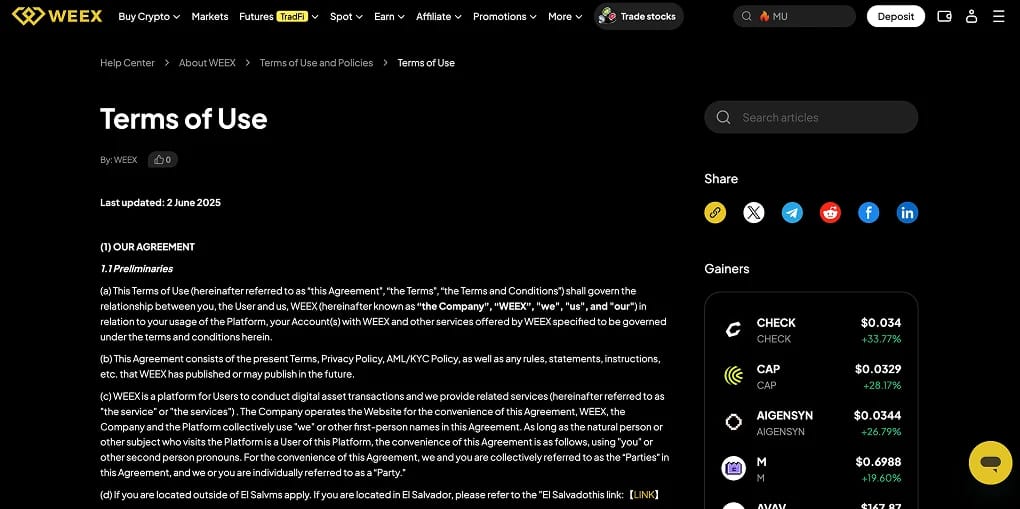
Sanctions account for one half of WEEX's restricted list, and missing licenses account for the other. That split explains why a privacy-focused exchange still walls off wealthy, crypto-friendly economies like South Korea and the UAE.
1. Sanctions and AML Compliance
The sanctioned markets track the frameworks that bind compliant exchanges everywhere. WEEX says it screens customers and transactions against major sanctions databases and refuses business tied to designated parties.
- OFAC exposure: Serving users in embargoed states such as Cuba, Iran, Syria and North Korea risks breaching OFAC rules, which can reach individuals, entities and entire jurisdictions.
- AML obligations: FATF guidance expects exchanges to identify money-laundering and terrorist-financing risk, then license and supervise accordingly, which is hard to satisfy in high-risk regions.
- UN and EU lists: WEEX screens against the United Nations Security Council Consolidated List and the EU sanctions list, so jurisdictions tied to those measures are excluded outright.
- Enforcement powers: The terms let WEEX freeze, restrict or close accounts and reverse transactions where service would conflict with applicable law.
2. Licensing Gaps and the Offshore Model
The regulated economies come down to authorization. WEEX does not hold the licenses these markets demand, so it excludes them rather than risk the enforcement it has already faced in the United States.
- United States: Federal and state money-transmission rules apply to crypto platforms, and a US state regulator issued WEEX a cease-and-desist order in 2025 for operating without a money transmitter license.
- Canada: Securities regulators require registration and binding undertakings from crypto trading platforms, which WEEX has not completed.
- Singapore, Hong Kong and the UAE: Each runs a strict licensing regime for digital-asset platforms (MAS, the SFC and VARA), and WEEX chose exclusion over local authorization, with a VARA application reported as still pending.
- South Korea: Real-name banking and VASP rules create onboarding requirements WEEX does not meet.
- Mainland China: Sweeping domestic restrictions on crypto trading keep the market closed to exchanges like WEEX.
WEEX Supported Countries
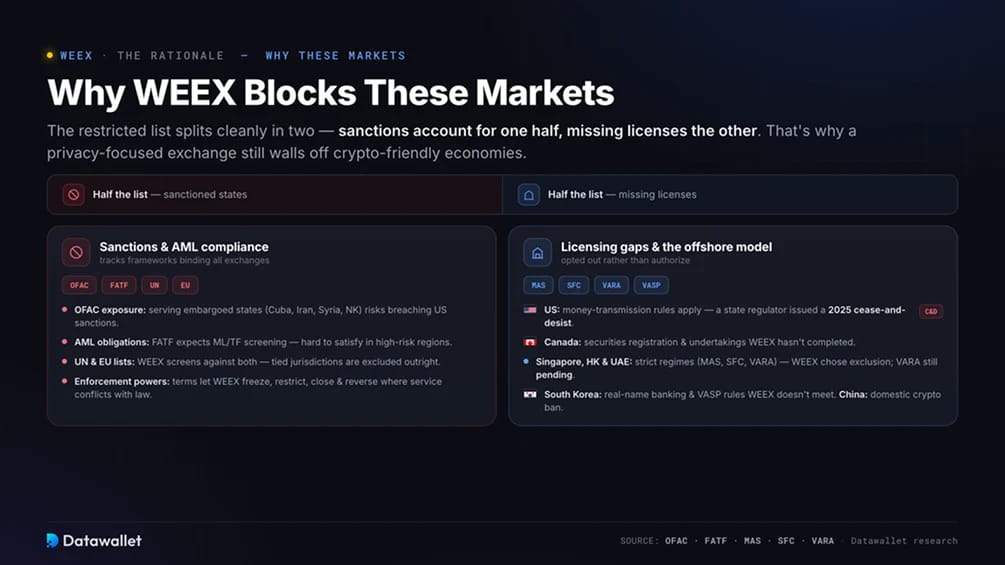
Outside its excluded list, WEEX is open across much of the world. The company says it reaches 130-plus countries and reports more than 10 million registered users, though self-reported figures are best read as directional rather than audited. Its strongest presence sits where active derivatives traders cluster, across much of Europe, Latin America, Africa, and South and Southeast Asia.
Eligible users get spot markets, USDT-margined perpetual futures, copy trading, demo trading, OTC and WE-Launch listings. Because onboarding leans on crypto rather than deep fiat banking, WEEX suits traders who already hold digital assets and want altcoin access plus leverage, not newcomers seeking a simple cash on-ramp.
If your region appears on the excluded list, our best crypto futures exchanges guide compares regulated options, and the top decentralized perpetuals exchanges cover non-custodial venues.
Can You Use WEEX in the United States?
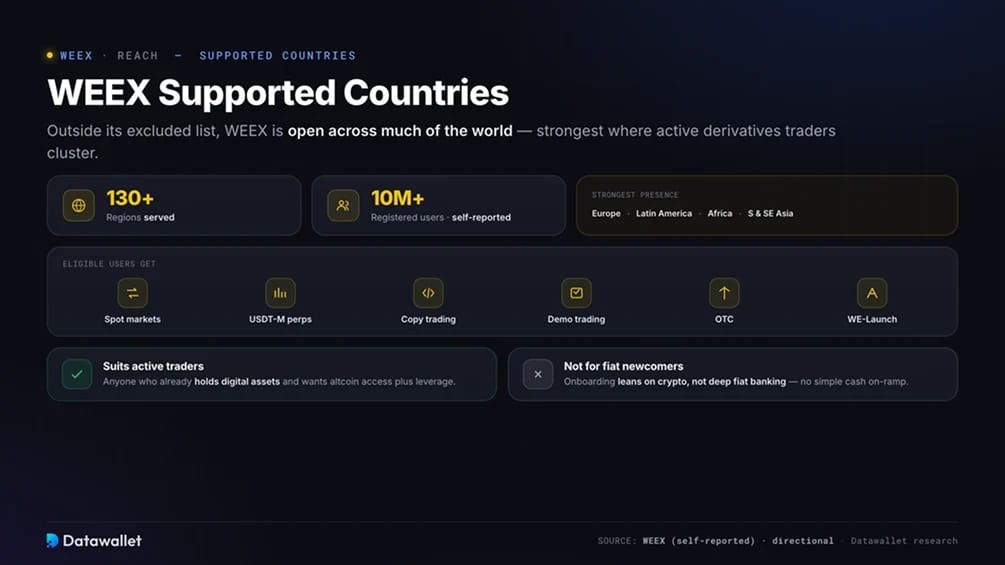
No. WEEX's Terms of Use list the United States, along with its territories and commonwealths, as an Excluded Jurisdiction, so US residents cannot open or operate accounts.
WEEX is sometimes called US-friendly because of its Money Services Business registration with FinCEN. That registration is an anti-money-laundering filing, not authorization to serve customers, and it does not override the licensing money transmission requires. The gap turned concrete on March 27, 2025, when the Georgia Department of Banking and Finance issued a final cease-and-desist order against WEEX for transmitting money without a state license.
A no-KYC sign-up can make WEEX feel reachable from the US, but access is not approval. Trading there breaches the platform's terms, sits outside any US consumer safeguard, and carries the regulatory risk that prompted the Georgia action. US traders are better served by licensed venues like Kraken.
Does WEEX Require KYC?
WEEX uses optional identity verification rather than mandatory KYC for crypto trading. You can register with an email or phone number and trade spot and futures without uploading documents, which drives much of its appeal to privacy-conscious users.
Verification still unlocks the rest of the platform.
- Unverified accounts: Users can deposit, trade and withdraw crypto, but daily withdrawals are capped (commonly cited near 10,000 USDT) and some functions stay locked.
- Verified accounts: Identity checks raise withdrawal limits sharply and are generally required for fiat services.
- Fiat access: WEEX's fiat rails have been intermittent, with card and bank channels paused during 2025, so crypto funding remains the most reliable method.
- Compliance reality: Optional KYC does not waive the geographic terms. Signing up from an excluded jurisdiction still breaches the agreement, and WEEX can verify residency later and restrict or close the account.
In sanctioned states, the risk runs past account closure, since accessing financial services covered by sanctions can conflict with local and international law whether or not an exchange checks ID.
WEEX Licenses and Regulation
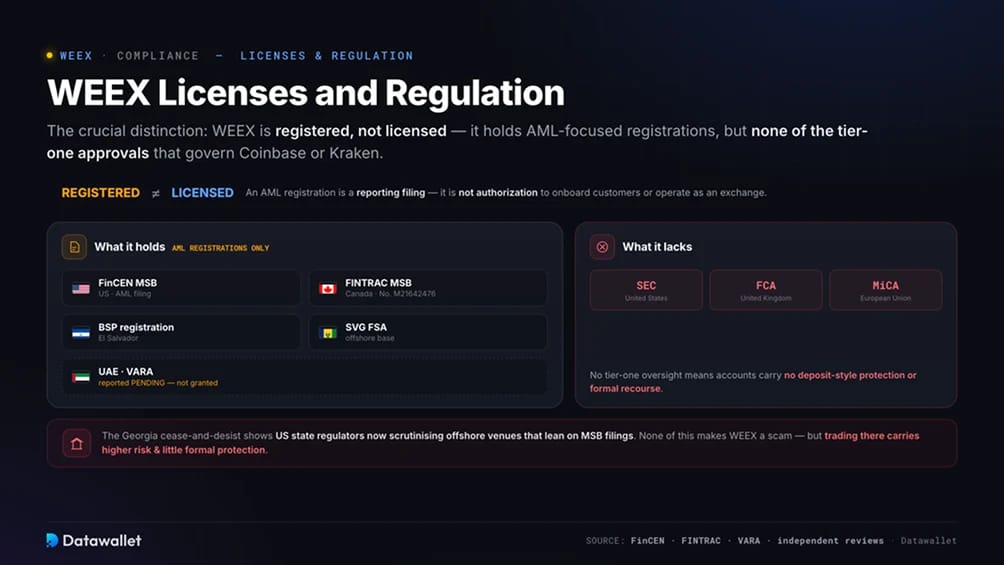
WEEX is registered, not licensed. It holds compliance registrations focused on anti-money-laundering reporting, but none of the tier-one approvals that govern platforms like Coinbase or Kraken.
- United States: Registered as a Money Services Business with FinCEN, an AML filing rather than an operating license.
- Canada: Registered as an MSB with FINTRAC (Registration Number M21642476), again AML registration, not authorization to onboard Canadians.
- El Salvador: Holds a Bitcoin Services Provider registration under the country's digital-asset framework.
- St Vincent and the Grenadines: Operates under an SVG FSA registration, a common offshore base for derivatives platforms.
- United Arab Emirates: A VARA license has been reported as pending rather than granted.
Independent reviewers consistently note that WEEX lacks oversight from the SEC, the UK FCA or the EU's MiCA regime, so accounts carry no deposit-style protection or formal recourse. The Georgia cease-and-desist shows US state regulators now scrutinizing offshore venues that lean on MSB filings, and similar action elsewhere could narrow access further. None of this makes WEEX a scam, but trading there carries higher risk and little formal protection.
About WEEX
WEEX launched in 2018 as a centralized, derivatives-first exchange closer to Bybit and OKX than a beginner platform. It is run by WEEX International Exchange LTD, an offshore company with a low public profile, variously tied to Singapore, Dubai, the Seychelles and Taiwan. The Georgia order listed a Taipei address, and public records name only a founder known as "Peter."
The core offering is USDT-margined perpetual futures with up to 400x leverage on select pairs, plus spot trading across 1,000-plus cryptocurrencies and 1,700-plus pairs. It also runs copy trading, demo accounts, OTC and the WXT token, integrates TradingView charts, and uses former footballer Michael Owen as a brand ambassador.
On security, WEEX publishes Merkle-tree Proof of Reserves, runs a stated 1,000 BTC protection fund, and offers 2FA plus a tool to flag clone sites. It reports no major external hack.
Its main incident, a March 2025 ETH/USDT order-matching delay, was resolved in roughly 30 minutes, after which WEEX said it compensated 5,022 users with about 6.12 million USDT. Trustpilot feedback stays mixed, citing account freezes and slow dispute handling.
Final Thoughts
WEEX is a capable high-leverage venue with deep altcoin coverage and real transparency features, but it is not the broadly available, US-and-Canada-friendly exchange that older summaries implied.
Its Terms of Use exclude the US, Canada, South Korea, China, Hong Kong, Singapore and the UAE on top of sanctioned states, and its compliance rests on registrations rather than licenses.
If you live in a supported region and understand the risks of leverage and thin regulatory protection, WEEX can suit active futures and copy trading. Verify your eligibility against the current terms before depositing, enable every security control, and keep long-term holdings in self-custody.
If your jurisdiction is excluded, a regulated alternative like Bybit or Kraken gives you comparable tools with clearer legal footing.