Who is Raoul Pal?
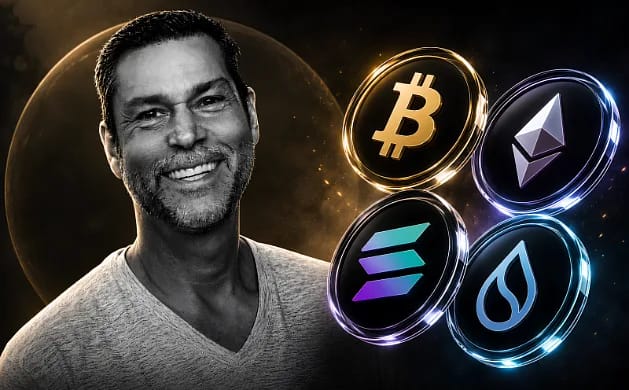
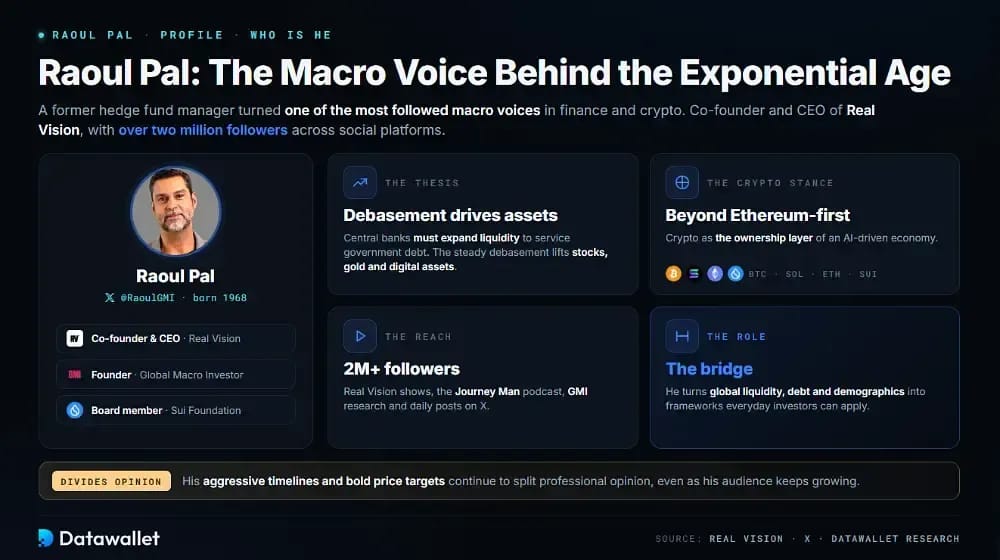
Raoul Pal (@RaoulGMI on X) is a former hedge fund manager who became one of the most followed macro voices in finance and crypto. He co-founded and leads Real Vision, publishes Global Macro Investor research, and reaches more than two million followers across social platforms.
He is best known for turning global liquidity, debt, and demographic trends into frameworks everyday investors can apply. At the center of his work is the claim that central banks must expand liquidity to service government debt. He argues that the resulting steady debasement drives stocks, gold, and digital assets.
Within crypto, Pal has moved beyond an Ethereum-first stance toward a broader adoption thesis. He sits on the board of the Sui Foundation, backs Solana and Bitcoin alongside ETH, and describes the asset class as the ownership layer of an AI-driven economy.
His audience extends across Real Vision shows, the Journey Man podcast, GMI research, and daily posts on X. That reach has made him a bridge between institutional macro thinking and retail portfolios, although his aggressive timelines and bold price targets continue to divide professional opinion.
Raoul Pal's Background
Pal's career moved from London trading floors into hedge fund management and early retirement before shifting toward the research and media ventures that made him a household name in crypto. Each stage contributed to the framework he publishes today.
Early Life and Education
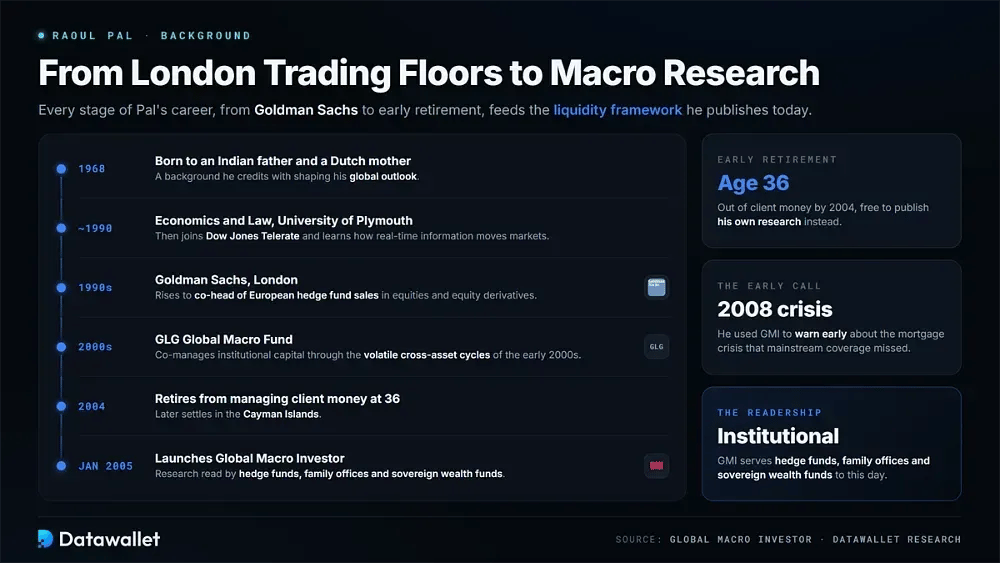
Born in 1968 to an Indian father and a Dutch mother, Pal credits that background with shaping his global outlook. He studied Economics and Law at the University of Plymouth, graduating around 1990. He then joined Dow Jones Telerate, where he learned how real-time information moves markets.
Goldman Sachs and GLG Partners
At Goldman Sachs in London, Pal rose to co-head of European hedge fund sales in equities and equity derivatives, serving some of the industry's largest managers. He later co-managed the GLG Global Macro Fund, running institutional capital through the volatile cross-asset cycles of the early 2000s.
Retirement and Global Macro Investor
Pal retired from managing client money in 2004 at age 36 and later settled in the Cayman Islands. He launched Global Macro Investor in January 2005. The research service is read by hedge funds, family offices, and sovereign wealth funds, and he used it to warn early about the 2008 mortgage crisis.
How Did Raoul Pal Build Real Vision?
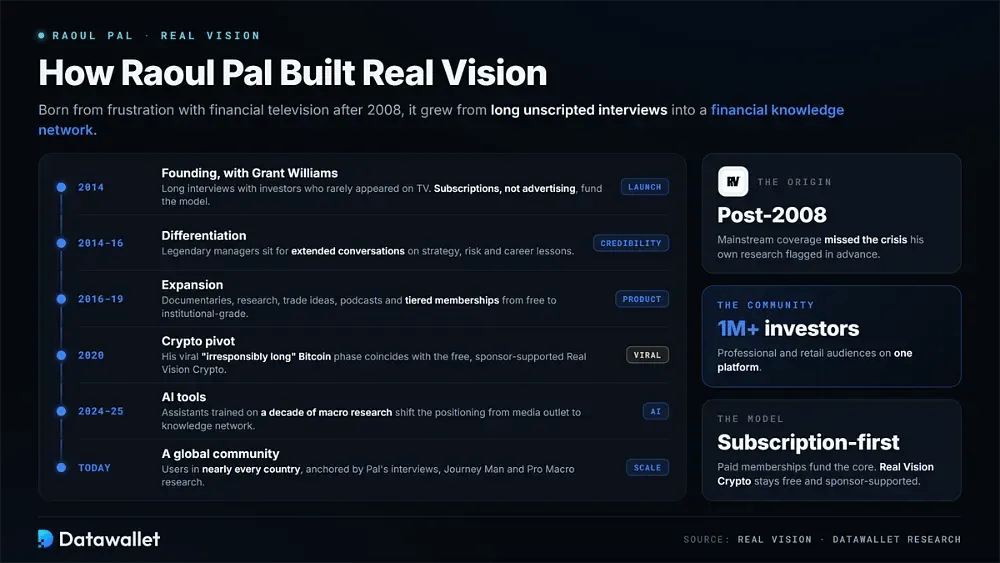
Real Vision emerged from Pal's frustration with financial television after 2008. Mainstream coverage had missed the crisis that his own research flagged in advance.
The platform developed over the following decade:
- Founding (2014): Pal and Grant Williams launched Real Vision around long, unscripted interviews with investors who rarely appeared on television. Subscriptions, rather than advertising, funded the model.
- Differentiation (2014-2016): Legendary managers largely absent from mainstream television sat for extended conversations about strategy and risk as well as career lessons. Those interviews helped establish credibility with both professional and retail audiences.
- Expansion (2016-2019): Documentaries, written research, trade ideas, and podcasts broadened the offering. Real Vision also built tiered memberships that separated free educational material from advanced institutional-grade macro services for paying members.
- Crypto pivot (2020): Pal's viral "irresponsibly long" Bitcoin phase coincided with Real Vision Crypto, a free, sponsor-supported vertical that brought a younger global audience into digital assets.
- AI tools (2024-2025): Real Vision added AI assistants trained on a decade of macro research to its library, shifting its positioning from a media outlet toward a financial knowledge network.
- Today: The platform reports users in nearly every country. Pal's interviews, the Journey Man podcast, and Pro Macro research anchor a community of over one million investors.
Raoul Pal's Net Worth
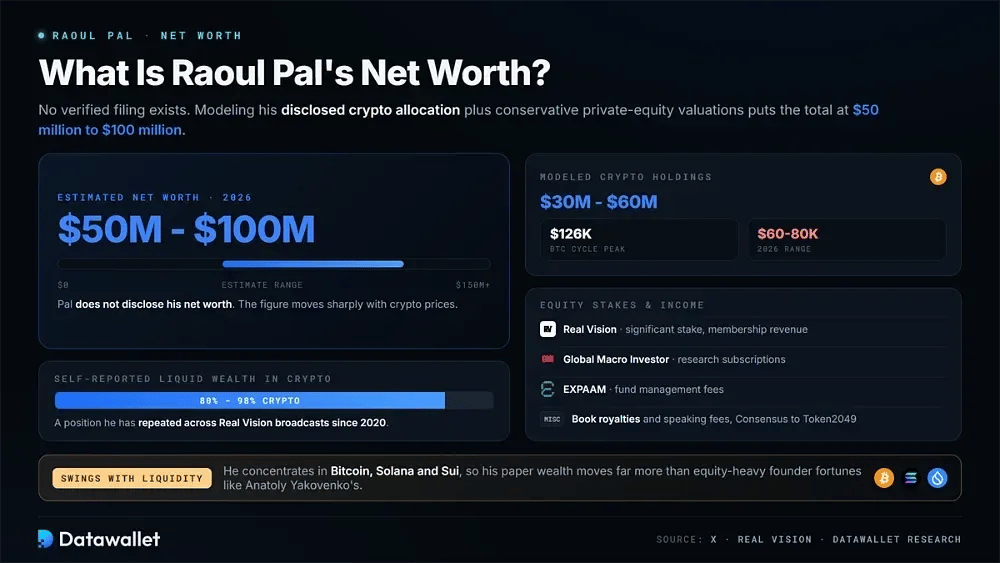
Pal does not disclose his net worth, and no verified filing confirms a figure. He has, however, publicly stated that between 80% and 98% of his liquid wealth sits in cryptocurrency, a position he has repeated across Real Vision broadcasts since 2020.
His equity interests are better documented. Significant stakes in Real Vision, Global Macro Investor, and Exponential Age Asset Management sit alongside income from memberships and research subscriptions. He also earns fund management fees, book royalties, and speaking fees from events such as Consensus and Token2049.
Modeling his disclosed crypto allocation against a market that fell from a $126,000 Bitcoin peak to the $60,000 to $80,000 range in 2026 places his holdings near $30 million to $60 million. Conservative valuations for his private equity stakes take the estimated total to between $50 million and $100 million.
That estimate moves with liquidity. Pal concentrates in Bitcoin, Solana, and Sui rather than diversified assets, so his paper wealth swings more sharply than that of founders with equity-heavy fortunes. The contrast is visible in our profile of Anatoly Yakovenko's net worth.
Inside Raoul Pal's Business Empire
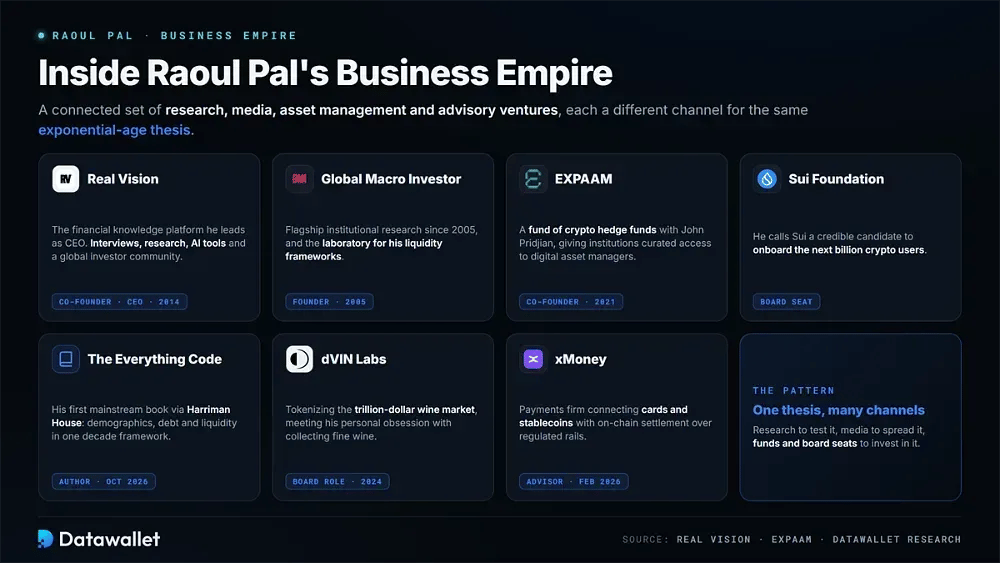
Today, Pal operates across a connected set of research, media, asset management, and advisory ventures. Each gives him a different channel for expressing the same exponential-age thesis.
These are the core ventures he runs or advises today:
- Real Vision: The financial knowledge platform he co-founded in 2014 and leads as CEO. Its offering spans interviews, research, AI tools, and a global community of professional and retail investors.
- Global Macro Investor: His flagship institutional research service since 2005 is read by hedge funds, pension funds, and sovereign wealth funds. It also serves as the laboratory where his liquidity frameworks are first developed.
- EXPAAM: Exponential Age Asset Management, co-founded with John Pridjian in 2021, operates a fund of crypto hedge funds that gives family offices and institutions curated access to digital asset managers.
- Sui Foundation: Pal holds a board seat at the foundation supporting the Sui blockchain and has called the network a credible candidate to onboard the next billion crypto users.
- The Everything Code: His first mainstream book, published by Harriman House on October 13 this year, brings demographics, debt, and liquidity together in one framework for the coming decade.
- dVIN Labs: Pal has a board role at the protocol tokenizing the trillion-dollar wine market, connecting his investing background with his personal obsession for collecting fine wine.
- xMoney: He took a strategic advisory seat in February at the payments firm connecting cards and stablecoins with on-chain settlement across regulated global payment rails.
Key Concepts Raoul Pal Popularized
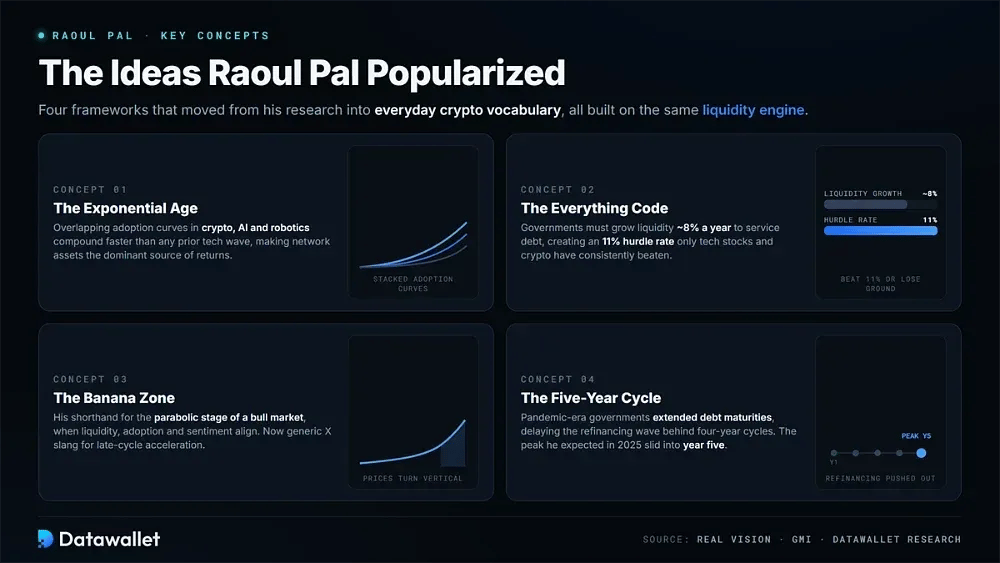
The "Exponential Age" describes overlapping adoption curves in crypto, AI, and robotics that Pal believes are compounding faster than any previous technology wave. In his framework, these forces are deflationary and reshape labor and capital while making network-based assets the dominant source of returns over the next decade.
His "Everything Code" connects debt, demographics, and liquidity in a single macro model. The thesis holds that governments must grow liquidity by roughly 8% a year to service their debt, creating an 11% hurdle rate that only technology stocks and cryptocurrencies have consistently beaten.
"Banana Zone" is Pal's shorthand for the parabolic stage of a crypto bull market. It describes the point when liquidity and adoption align with sentiment and prices turn vertical. The phrase is now used across X as a generic label for late-cycle acceleration, including by traders who do not follow his work.
More recently, he introduced the five-year cycle. Pal argues that pandemic-era governments extended debt maturities, postponing the refinancing wave that historically drove four-year crypto cycles. That delay pushed the market peak he once expected in 2025 into the cycle's fifth year.
The Exponentialist and the Economic Singularity
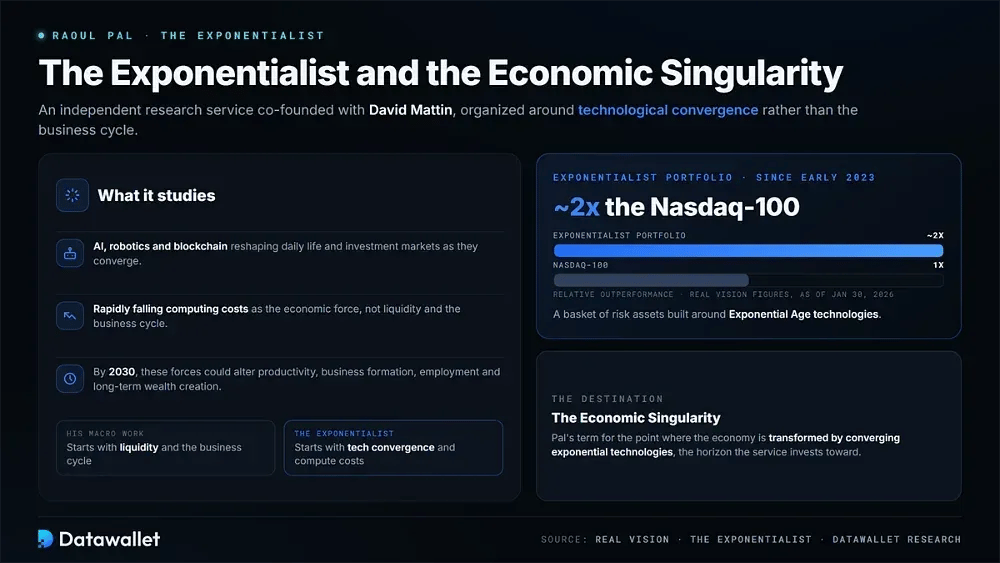
Another part of Pal's current work is The Exponentialist, an independent research service he co-founded with David Mattin. It examines how AI, robotics, blockchain, and other fast-moving technologies could reshape daily life and investment markets as the economy approaches what Pal calls the Economic Singularity.
Unlike his macro work, which starts with liquidity and the business cycle, The Exponentialist is organized around technological convergence and the economic effects of rapidly falling computing costs. Pal argues that by 2030 these forces could alter productivity, business formation, employment, and how investors think about long-term wealth creation.
The service also translates that thesis into an investable portfolio. Real Vision says its Exponentialist Portfolio is a basket of risk assets built around Exponential Age technologies and reported that, as of January 30, 2026, it had outperformed the Nasdaq-100 by nearly two times since early 2023.
Raoul Pal's Latest Market Views
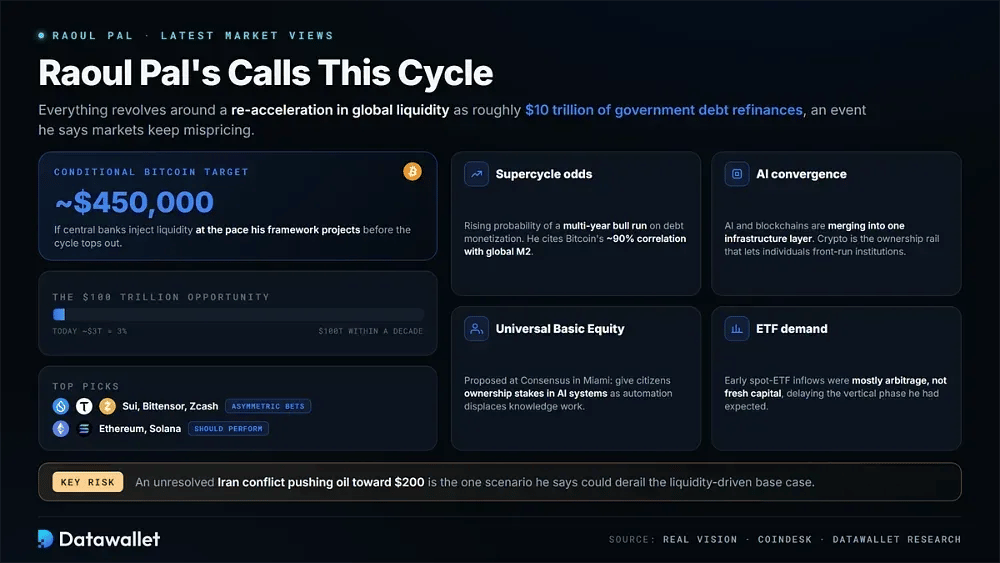
Pal's public calls this cycle revolve around a re-acceleration in global liquidity as roughly $10 trillion of government debt refinances. He believes markets have persistently mispriced the impact of that event.
His most discussed positions and predictions right now include:
- Supercycle odds: Pal sees a rising probability of a sustained multi-year bull run driven by debt monetization. He cites Bitcoin's roughly 90% correlation with global M2 money supply.
- Bitcoin target: His conditional forecast puts Bitcoin near $450,000 if central banks inject liquidity at the pace his framework projects before the cycle tops out.
- $100 trillion: Pal describes today's roughly $3 trillion crypto market as 3% of a $100 trillion opportunity that he expects the asset class to reach within a decade.
- Top picks: He identifies Sui, Bittensor, and Zcash as asymmetric bets. Ethereum and Solana, in his view, should also perform well through the rest of the cycle.
- AI convergence: Pal argues AI and blockchains are merging into a single infrastructure layer. Crypto, in that model, becomes the ownership rail that allows individuals to front-run institutional capital.
- Universal Basic Equity: At Consensus in Miami, he proposed giving citizens ownership stakes in AI systems as a structural response to large-scale automation displacing traditional knowledge-work employment.
- Key risks: An unresolved Iran conflict that pushes oil toward $200 is the scenario Pal identifies as most capable of derailing his otherwise bullish, liquidity-driven base case.
- ETF demand: He tracks spot Bitcoin ETF buying as confirmation. Pal has noted that most early inflows were arbitrage rather than fresh capital, delaying the vertical phase he had expected.
Criticisms and Controversies Around Raoul Pal
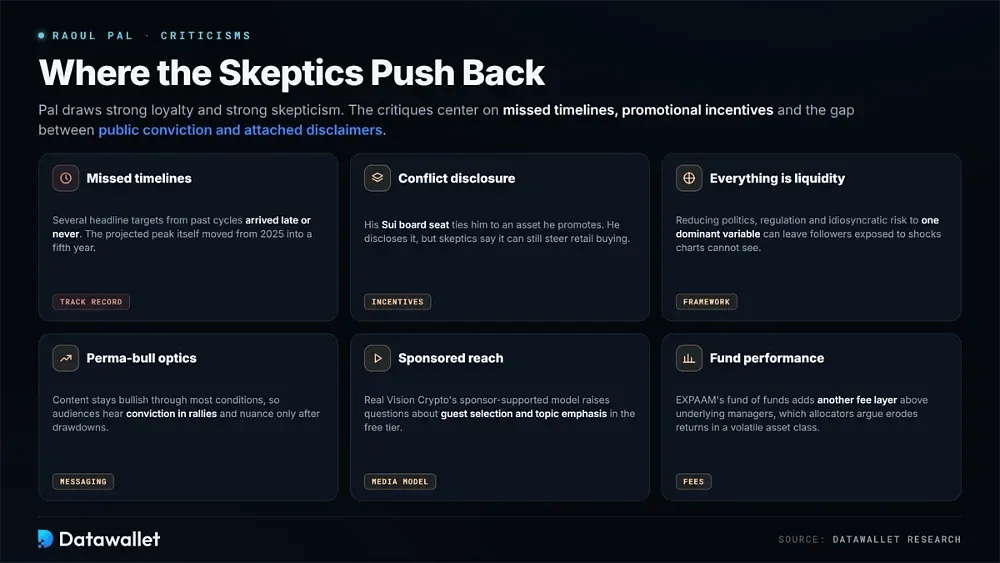
Pal draws both strong loyalty and skepticism. The most persistent criticism centers on missed timelines, promotional incentives, and the distance between his public conviction and the disclaimers attached to his forecasts.
Recurring criticisms include:
- Missed timelines: Several headline targets from previous cycles arrived late or never. Critics also point to his projected cycle peak moving from 2025 into a fifth year.
- Conflict disclosure: His Sui Foundation board seat gives him a formal connection to an asset he promotes. Pal discloses the relationship, but skeptics argue it can still influence retail buying.
- Everything is liquidity: Opponents say his framework reduces politics, regulation, and idiosyncratic risk to one dominant variable. In their view, that can leave followers exposed to shocks that liquidity charts cannot anticipate.
- Perma-bull optics: Because Pal's crypto content remains bullish through most conditions, critics argue that audiences hear conviction during rallies while the nuance becomes more prominent only after drawdowns have occurred.
- Sponsored reach: Real Vision Crypto's sponsor-supported model continues to raise questions about whether partnerships affect guest selection or topic emphasis across the platform's large free tier.
- Fund performance: EXPAAM's fund of funds structure places another fee layer above the underlying managers, which some allocators argue can erode returns in an asset class that is already highly volatile.
Final Thoughts
Raoul Pal has evolved from commentator into infrastructure. Real Vision and Global Macro Investor distribute his research, while EXPAAM puts capital behind it. His Sui Foundation board seat and mainstream book deal extend the same liquidity thesis into blockchain governance and a wider investing audience.
His framework now faces an observable test. If the refinancing wave he describes lifts global liquidity and crypto recovers its highs during the cycle's fifth year, the five-year model becomes the new default. Failure would push the criticism of his missed timelines closer to consensus.
Readers who want to follow the signals Pal watches can track ETF demand alongside market breadth and sentiment through our altcoin season index and crypto fear and greed index. Those indicators provide live data against which to judge his liquidity thesis.