


Login to Track Your Live Crypto Portfolio
Sign Up and Track Your Live Crypto Portfolio for Free
Forgot your password?
Polymarket Scrambles After $700K Polygon Wallet Drain

This article has been reviewed and verified for accuracy by our editorial team. All claims, data points and platform details are cross-referenced against primary sources.
Some links on this page are affiliate links. Datawallet may earn a commission when you sign up through them, at no extra cost to you. This never influences our editorial ratings, rankings or recommendations.
Some links on this page are affiliate links. Datawallet may earn a commission when you sign up through them, at no extra cost to you. Ratings and rankings reflect our own testing and assessment criteria.

GM. Polymarket is investigating a $700,000 wallet drain on its Polygon infrastructure, while the SEC paused its tokenized stock exemption proposal following pushback regarding corporate oversight.
Meanwhile, FTX's former outside partners agreed to pay $66 million to settle claims, and Binance is formally disputing a report alleging it facilitated $850 million in Iran-linked payments.
Here are the details on infrastructure vulnerabilities, regulatory delays, and exchange disputes. 👇
Polymarket Scrambles After $700K Polygon Wallet Drain
Polymarket opened an internal investigation after suspicious outflows hit wallet infrastructure tied to its UMA CTF Adapter on Polygon, following alerts from onchain investigator ZachXBT. The company said early findings point to a compromised private key in an internal top-up wallet, not a contract breach.
Polymarket executives told users that market resolution and customer balances were safe, stressing that core contracts and platform funds were unaffected. ZachXBT identified two drained addresses, while Lookonchain and PeckShield estimated losses above $500,000, later refined to $700,000, with part of the funds routed toward ChangeNOW.
Engineering vice president Josh Stevens later said ZachXBT, Bitcoin Vietnam, and ChangeNOW coordinated fast enough to freeze $164,000, illustrating how ad hoc cooperation remains one of crypto’s most effective emergency tools. The incident struck as Polymarket was still riding fundraising momentum from a $15 billion valuation discussion.
The breach revives old questions around Polymarket’s supporting architecture, which has already faced scrutiny over UMA governance and a third-party authentication flaw. In 2025, a single actor allegedly forced a $7 million market to resolve incorrectly, reminding traders that peripheral infrastructure can shake confidence even when user funds survive.
SEC Pauses Tokenized Stock Exemption After Pushback
The SEC has delayed a planned innovation exemption that would have opened a clearer path for trading tokenized stocks and similar assets in the United States. Staff had been expected to release the framework this week. Instead, officials are absorbing feedback from exchanges and market participants.
A central concern is whether third parties could issue tokenized versions of company shares without corporate approval, complicating dividends, voting rights, and recordkeeping. Commissioner Hester Peirce defended the proposal’s limited scope. She said it would cover digital representations of existing equities, not synthetic substitutes alone.
FTX Outside Partners Pay $66 Million Settling Claims
Fenwick & West agreed to pay $54 million and auditor Prager Metis $11.75 million to settle claims linked to FTX customer losses, in a second wave of Miami class-action deals. Former player Udonis Haslem will add $420,000. Plaintiffs say the cases cover millions of potential account holders.
Fenwick denied wrongdoing and still faces a separate $525 million suit in Washington that Friday’s settlement does not resolve. The new filing follows an earlier round covering 15 defendants. Judge K. Michael Moore must still grant preliminary approval before any payments can proceed to claimants.
Binance Rejects $850 Million Iran Flow Report
Binance is disputing a Wall Street Journal report that alleged Iranian financier Babak Zanjani ran an $850 million payment network through the exchange. The newspaper said internal compliance findings linked multiple accounts to the same devices. CEO Richard Teng called the story fundamentally inaccurate publicly.
Binance said the transactions occurred before sanctions, that it had already investigated the activity, and that the article overstated the platform’s direct role. The dispute lands while Binance’s defamation suit against the Journal remains active. US authorities are still examining possible Iran-linked sanctions evasion claims.
Data of the Day
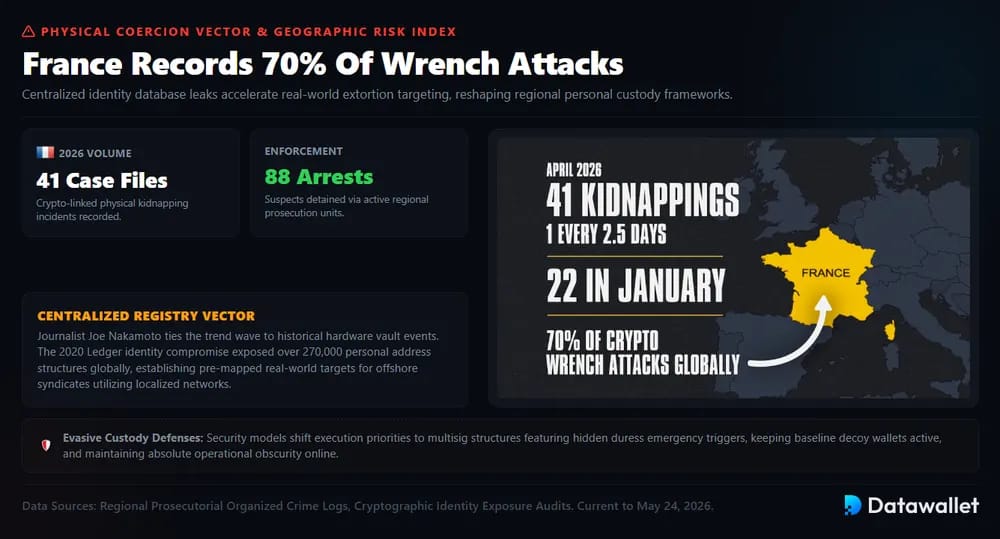
Bitcoin journalist Joe Nakamoto said roughly 70% of global wrench attacks now occur in France, where authorities have recorded 41 crypto-linked kidnappings in 2026. He tied the surge partly to centralized KYC databases. The 2020 Ledger leak alone exposed more than 270,000 customer identities worldwide.
Security advice from Bitcoiners focused less on software and more on personal defense: use custody services with duress phrases, keep a decoy wallet, and stay quiet online. Nakamoto said attackers often recruit local youths while operating from abroad. French prosecutors have arrested at least 88 people.
More Breaking News
- OKX and Intercontinental Exchange partner for perpetual oil futures using traditional benchmarks to serve 120 million retail traders amid massive trading volume growth.
- StablR’s EURR and USDR depegged after an attacker used a compromised multisig signer to mint $13.5 million in tokens, then dump about $10.4 million onchain.
- F2Pool cryptocurrency co-founder Chun Wang will serve as the mission commander for an upcoming SpaceX commercial flight to Mars to collect critical deep space data.
- The European Central Bank formally rejected a proposal to loosen strict liquidity guidelines for euro stablecoin issuers during an informal council meeting in Cyprus.
- Trump Media transferred $205 million in Bitcoin to a centralized digital exchange as part of an active trading strategy despite suffering massive quarterly financial losses.
- Prediction market platforms Kalshi and Polymarket lost their judicial bids to halt state gambling enforcement actions across Nevada and Washington after a federal ruling.
- Mozilla unveiled a comprehensive browser redesign for Firefox that features a prominent privacy control switch allowing users to deactivate all AI software entirely.
For the latest updates on digital asset markets, follow us on X @Datawalletcom.
For the latest updates on digital asset markets, follow us on X @Datawalletcom.
Get tomorrow’s issue in your inbox