


Login to Track Your Live Crypto Portfolio
Sign Up and Track Your Live Crypto Portfolio for Free
Forgot your password?
Solana (SOL) Cuts Slot Time to 350 Milliseconds

This article has been reviewed and verified for accuracy by our editorial team. All claims, data points and platform details are cross-referenced against primary sources.
Some links on this page are affiliate links. Datawallet may earn a commission when you sign up through them, at no extra cost to you. This never influences our editorial ratings, rankings or recommendations.
Some links on this page are affiliate links. Datawallet may earn a commission when you sign up through them, at no extra cost to you. Ratings and rankings reflect our own testing and assessment criteria.
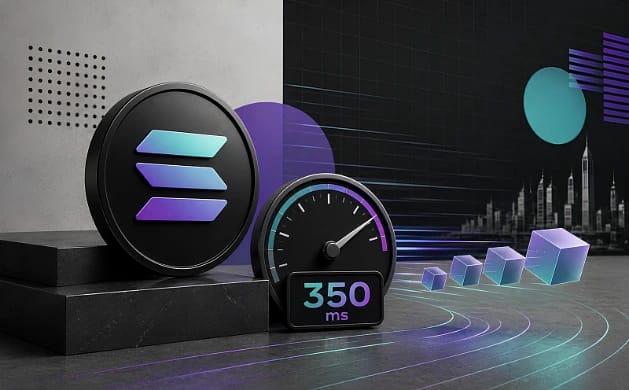
GM. Solana cut its mainnet slot time to 350 milliseconds in the first of four planned steps toward a 200 millisecond target, shortening confirmation latency across the network.
Elsewhere, Strategy swung from a $13 billion paper loss to $1.4 billion in gains, Grayscale edged closer to the first US Zcash ETF, and Kraken's parent weighed becoming a full bank abroad.
Read the full issue below. 👇
Solana Cuts Slot Time to 350 Milliseconds in First Step
Solana completed a mainnet upgrade trimming its target slot time to 350 milliseconds, down 50 from the longstanding 400. A slot is the window in which a designated validator produces a block of transactions.
The change marks the first stage of SIMD-0525, a proposal merged in May charting a path toward 200 milliseconds. Shorter slots cut confirmation and finalization latency, with epochs now spanning roughly 42 hours instead of 48 and validator turns rotating every 1.4 seconds.
Throughput does not automatically rise, since validators handle slots more often while each carries less work. Shorter windows also limit how long any single validator can delay or reorder transactions before the next takes over, according to the proposal's authors.
Developers plan three further 50 millisecond cuts, each activated separately and pausable should too many validators miss assigned slots. Full finality on Solana still takes about 12.8 seconds, with the Alpenglow overhaul targeting roughly 150 milliseconds.
Strategy Swings to $1.4 Billion Bitcoin Profit on Rally
Strategy returned to unrealized gains of roughly $1.4 billion after a five-day rally lifted bitcoin above its average acquisition price of $75,385. The firm holds 840,447 coins worth about $64.97 billion, with shares climbing 10% to two-month highs.
The reversal is stark against July, when the token near $58,000 left the position some $13 billion underwater. Michael Saylor's company has sold 6,948 BTC since May, abandoning its never-sell stance to fund preferred dividends and buybacks.
Grayscale Moves Closer to First US Zcash ETF
Grayscale filed its fifth amendment with the SEC, moving its existing trust nearer to a spot structure that would be the first US fund directly tracking Zcash. The vehicle would list on NYSE Arca under ticker ZCH with a 2.5% sponsor fee.
Bank of New York Mellon would act as transfer agent and Coinbase Custody as custodian, while an earlier amendment disclosed DCG talks to contribute 200,000 tokens. The trust has run since 2017 and holds over $260 million, with ZEC ranking 12th by market capitalization.
Kraken Parent Payward Explores Becoming a Full Bank
Payward is examining ways to offer banking services outside the United States, co-CEO Dave Ripley said, describing trading, banking, and asset management as the three areas the firm is honing. He declined to name target jurisdictions or licences.
The company already runs Kraken Financial, a Wyoming-chartered institution that cannot lend customer fiat and lacks FDIC insurance, though it secured a limited Federal Reserve master account this year. Kraken executives floated mortgages as a possible future offering.
Data of the Day
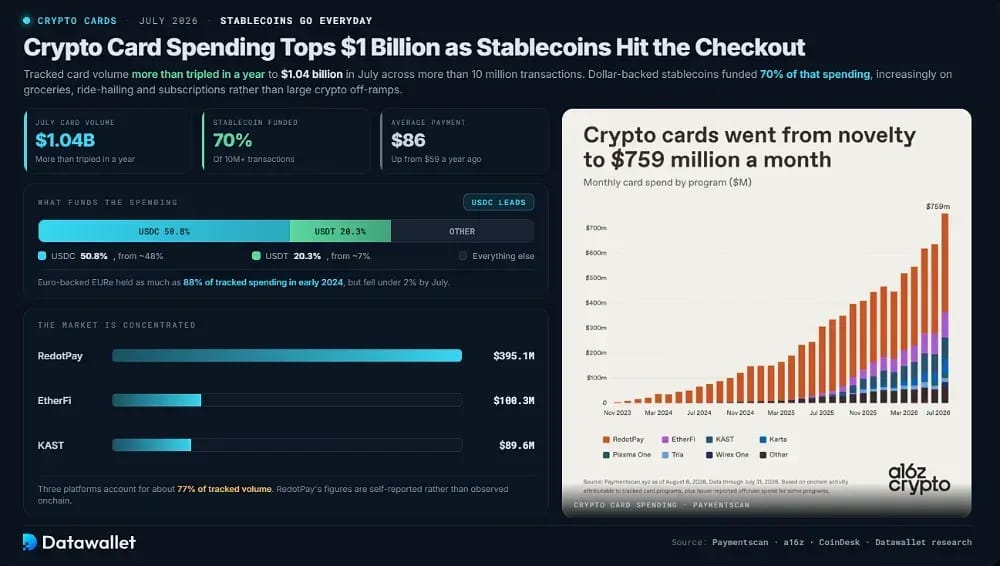
Crypto card spending more than tripled over the year to $1.04 billion in July, with dollar-backed stablecoins funding 70% of over 10 million transactions. USDC accounted for 50.8% of volume and USDT another 20.3%.
Average payments climbed to about $86 from $59, signaling frequent everyday purchases rather than large off-ramps. Groceries made up 35% of Oobit's Brazilian activity, while StraitsX logged 600% growth in lower-GDP markets as crypto cards spread.
More Breaking News
- MANTRA halted its chain and froze all transactions after an incident isolated to its Cosmos EVM module, with the tokenization network saying no user funds were exploited.
- XRP surged 51% for its best week since November 2024, as Treasury buyback expansion sparked yield curve control hopes, clearing nearly $2 billion in shorts as XRP reclaimed $1.50.
- Coldcard added new security measures after the $130 million exploit, now requiring 65 key presses or 128 coin flips when generating seeds on affected hardware wallets.
- Crypto's next billion users might be AI agents paying with stablecoins, with Coinbase estimating 99% of payments through its x402 protocol settle in USDC.
- Nomura-backed Laser Digital won Japan's first exchange licence in four years, arriving as parliament reclassifies digital assets under the country's financial instruments law.
- Upbit trading volume spiked 273% to $1.84 billion as South Korean investors returned to crypto, with XRP the most-traded asset on both major domestic venues.
- Ray Dalio urged investors to buy gold and a bit of bitcoin, recommending 10% to 15% allocations over bonds as he forecast a US debt crisis within roughly three years.
- A Reuters poll found 63% of Americans consider Trump's crypto profits inappropriate, with 69% saying his private business interests shape decisions made in office.
For the latest updates on digital asset markets, follow us on X @Datawalletcom.
Get tomorrow’s issue in your inbox