




What is DATA Network?
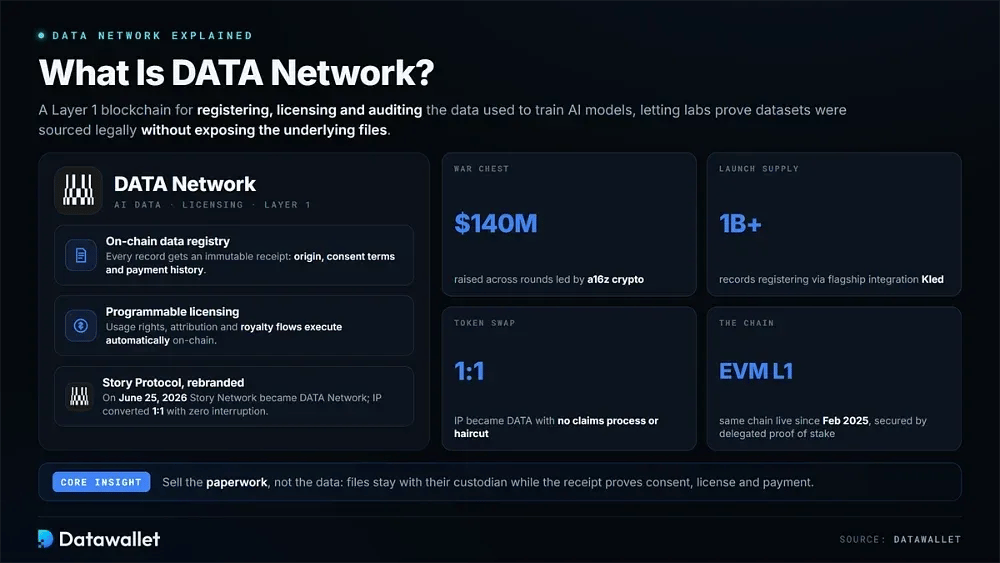
DATA Network is a Layer 1 blockchain for registering, licensing and auditing data used to train artificial intelligence models. Each record added to the network gets an onchain receipt covering its origin, consent terms and payment history. This allows AI labs to prove datasets were sourced legally without exposing the underlying files.
This is a rebrand rather than a new chain. On June 25, 2026, Story Protocol announced its transition into The DATA Foundation, renamed Story Network to DATA Network and converted the IP token into DATA at a 1:1 ratio, according to CoinDesk. Validators, staking positions and existing integrations continued without interruption.
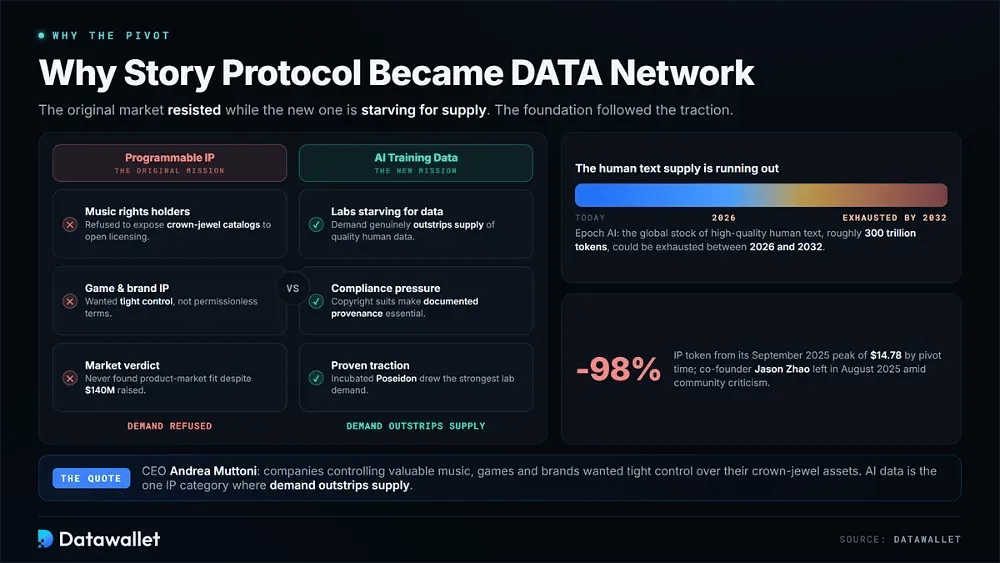
The pivot narrows an ambitious mission that never found its market. Story raised $140 million, led by a16z crypto, with the goal of making all intellectual property programmable. Large rights holders, however, resisted exposing music, game and brand assets to permissionless licensing. AI training data emerged as the one IP category where demand genuinely outstripped supply.
At launch, DATA Network began registering more than one billion records through its flagship integration with Kled, an opt-in human data marketplace. Kled founder Avi Patel joined the foundation as chief data officer. Former chief product officer Andrea Muttoni became CEO, while co-founder SY Lee moved to the a16z-backed data startup Poseidon as chairman.
How Does DATA Network Work?
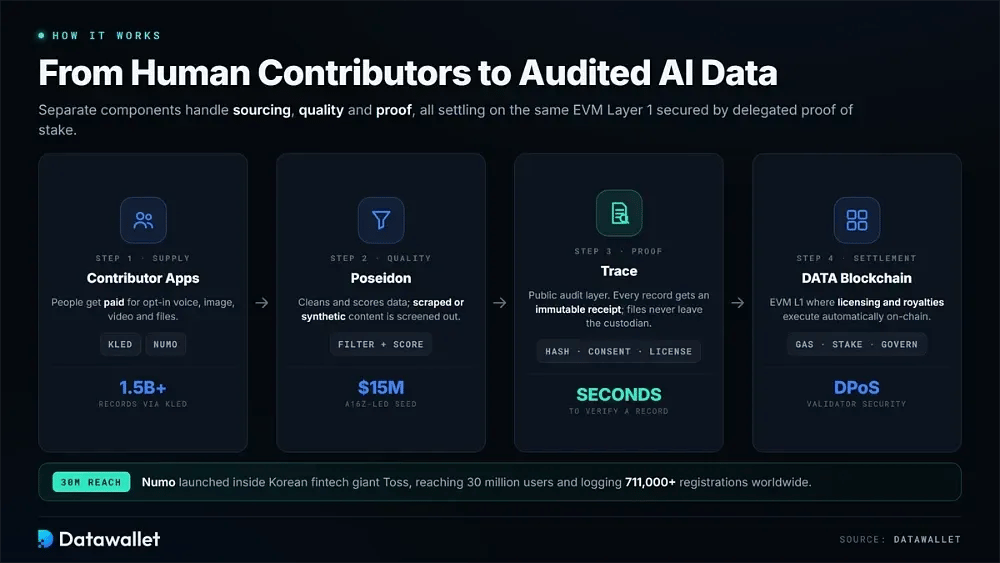
DATA Network addresses three parts of the AI data problem: sourcing data at scale, proving its origin and guaranteeing quality. Separate components handle those functions while settling on the same chain.
Consumer-facing contributor apps feed records into the network. Data from Kled and Numo is processed by Poseidon, then made verifiable through Trace.
1. The DATA Network Blockchain
The base layer is the same purpose-built Layer 1 that launched as Story Network in February 2025. It remains EVM-compatible and secured by a delegated proof-of-stake validator set. DATA is used for gas, staking and governance, while developers can deploy standard Solidity contracts alongside native data-registration modules.
Its licensing framework separates the network from general-purpose EVM chains. Registered records carry programmable terms onchain, allowing usage rights, attribution and royalty flows to execute automatically instead of relying on off-chain contracts. Confidential Data Rails, designed to verify sensitive datasets without exposing them publicly, were slated for mainnet in Q3 2026.
2. Trace: The Onchain Audit Layer
Trace, launched alongside the rebrand, is the network's public audit and search platform. According to The Defiant, every record registered on DATA Network generates an immutable receipt containing a content hash, consent terms, licensing details, payment status and timestamps. Anyone can search for a record and confirm its history in seconds.
The underlying data is never stored by Trace. Labs can verify provenance and chain of custody while the files remain with their custodian, preserving privacy and competitive secrecy. The receipt model targets AI developers facing copyright litigation who increasingly need documented proof that training data was collected with consent.
3. Contributor Apps: Kled and Numo
Supply comes through opt-in applications that pay people for contributing data. Each contribution is registered on DATA Network, creating the provenance trail buyers require.
The two flagship contributor channels work as follows:
- Kled: A human data marketplace billed as the world's largest opt-in platform, which began registering over 1.5 billion user-contributed images, videos and files onto the network at launch.
- Numo: Poseidon's contributor app paying users in stablecoins in real time, which recorded over 711,000 data registrations and launched inside Korean fintech giant Toss, reaching 30 million users.
4. Poseidon: Data Processing and Quality
Poseidon acts as the refinement layer between contributors and buyers because raw human data is often messy. Incubated by the Story team and backed by a $15 million a16z-led seed round, it cleans and normalizes data, then scores it for authenticity. Scraped, synthetic or altered content is screened out before datasets reach AI labs.
The platform runs entirely on DATA Network and provides payment rails for both stablecoins and fiat. It concentrates on first-person, real-world voice, image and video data, which robotics and physical AI systems need most and cannot scrape from the open internet.
Why Did Story Protocol Pivot to AI Data?
The official explanation is that the original market resisted while the new one is starving. President Andrea Muttoni told crypto.news that companies controlling valuable music, games and brands rejected permissionless licensing because they wanted tight control over their crown-jewel assets.
At the same time, the supply of quality training data is running out. Research from Epoch AI suggests the global stock of high-quality human text, roughly 300 trillion tokens, could be exhausted between 2026 and 2032. Copyright lawsuits against frontier labs are also mounting, making documented provenance increasingly important for compliance.
The market was sending another signal. IP had fallen about 98% from its September 2025 peak of $14.78. Co-founder Jason Zhao left in August 2025 amid community criticism, while Poseidon, the one project incubated by Story, was attracting the strongest demand from labs. The foundation followed that traction.
The IP to DATA Token Migration
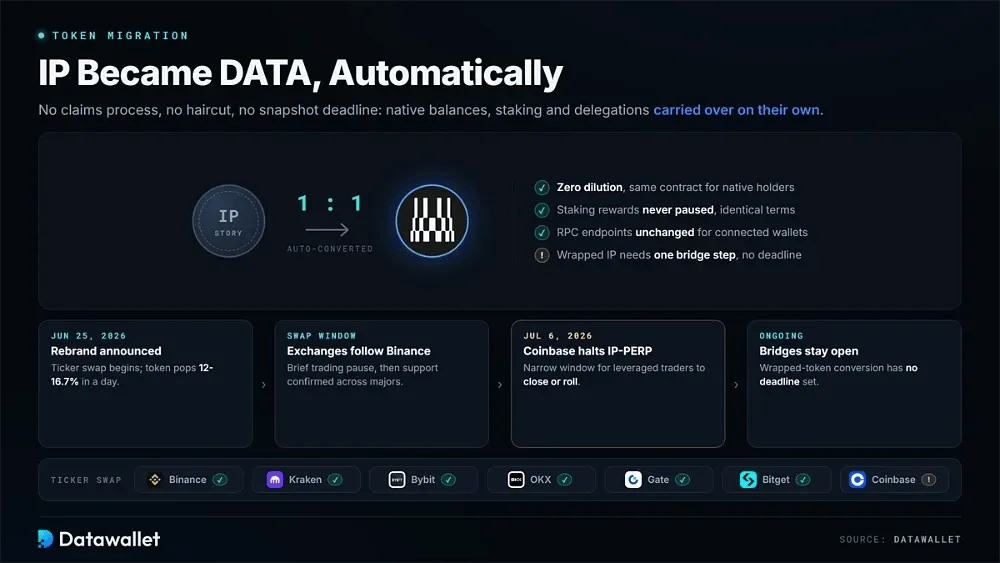
For holders, the token transition was designed to require minimal effort. Unlike rebrands that force users through claims processes or conversion haircuts, native balances, staking positions and delegations carried over automatically when the June 25 rebrand announcement was made.
Here is what changed and what holders needed to do:
- Ratio: Every IP token became one DATA token, with no dilution, no new contract migration for native holders and no snapshot deadline to worry about.
- Staking: Existing staking and delegation positions continued uninterrupted under identical terms, so validators and delegators kept earning rewards throughout the entire transition window.
- Wrapped tokens: Holders of wrapped IP on external chains face one extra conversion step through official bridges, though the foundation set no deadline for completing it.
- Exchanges: Binance led the ticker swap with a brief trading pause, while Kraken, Bybit, OKX, Gate and Bitget confirmed support shortly afterward.
- Derivatives: Coinbase suspended its IP-PERP perpetual futures market on July 6, giving leveraged traders a narrow window to close or roll their open positions.
- Explorer: Network activity moved to a rebranded block explorer, and the chain's RPC endpoints continued operating without any changes for connected wallets.
DATA Tokenomics & Supply
DATA inherited the IP token's economic structure wholesale. Genesis supply was one billion tokens, with ongoing emissions funding validator rewards. As a result, the token is inflationary rather than capped like fixed-supply assets such as Bitcoin.
Key supply and allocation facts as of early September 2026:
- Genesis supply: One billion DATA at network launch, with total supply now around 1.03 billion as staking emissions gradually add new tokens each year.
- Circulating supply: Roughly 358 million tokens, about 35% of total supply, according to CoinGecko, leaving most of the supply still locked or unvested.
- Insider lockups: Team and lead investor unlocks, delayed from February to August 2026, were extended another 18 months to February 13, 2028.
- Emissions reform: Governance proposals SIP-9 and SIP-10 cut annual emissions, reduced locked-token staking rewards and lowered the staking minimum from 1,024 to 32 DATA.
- Utility: DATA pays gas on the network, secures the chain through staking and delegation, and grants voting power over protocol-level governance decisions.
- Enforcement: The February lockup change introduced a neutral automated smart-contract mechanism, keeping affected insiders legally bound even where technical authorization was incomplete.
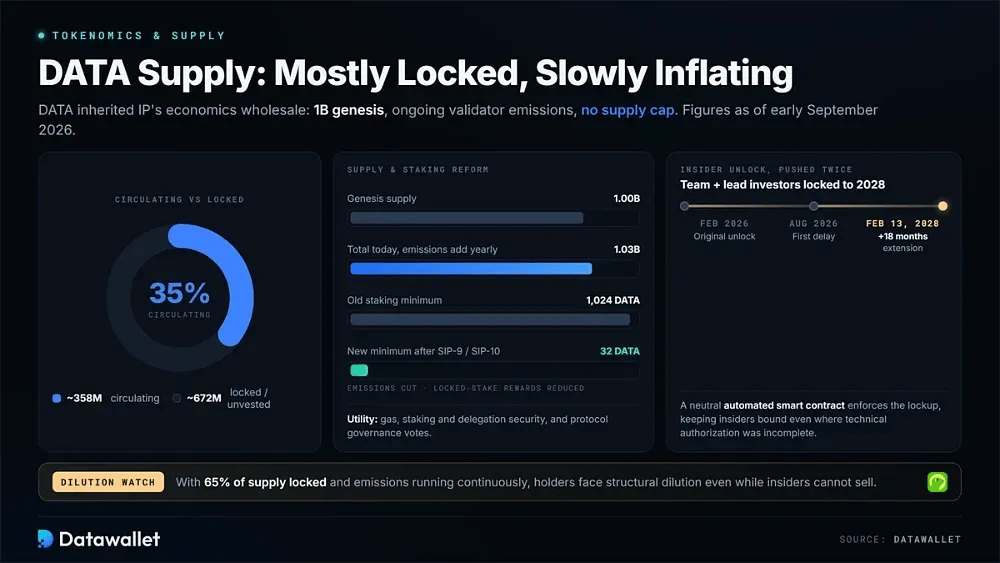
DATA Network Statistics and Trends
Two months after the rebrand, the onchain registry is growing quickly even as the token continues to struggle. The figures below are drawn from CoinGecko, CoinMarketCap, CryptoSlate and foundation announcements.
Key metrics as of early September 2026:
- Token price: DATA traded near $0.20 in late August with a market capitalization of roughly $67-73 million, ranking around #223-356 across major trackers.
- Drawdown: The token sits about 98.7% below its all-time high of $14.78-14.89, set in September 2025 while still trading as IP.
- New low: DATA printed a fresh all-time low of roughly $0.17 on August 18, 2026, before recovering around 10% into month-end.
- Rebrand pop: The announcement itself lifted the token 12-16.7% in a single day, briefly outperforming a market absorbing $1.5 billion in liquidations.
- Registered records: Kled began onboarding over 1.5 billion user-contributed records at launch, a company-reported figure not yet independently verified by third parties.
- Contributor reach: Numo surpassed 711,000 worldwide data registrations and gained distribution to 30 million users through its integration inside Korea's Toss app.
- Funding base: The foundation carries $140 million in total venture funding led by a16z crypto, plus Poseidon's separate $15 million seed round.
- Treasury adoption: IP Strategy Holdings runs a DATA-centered treasury reserve policy and operates validator infrastructure on the network.
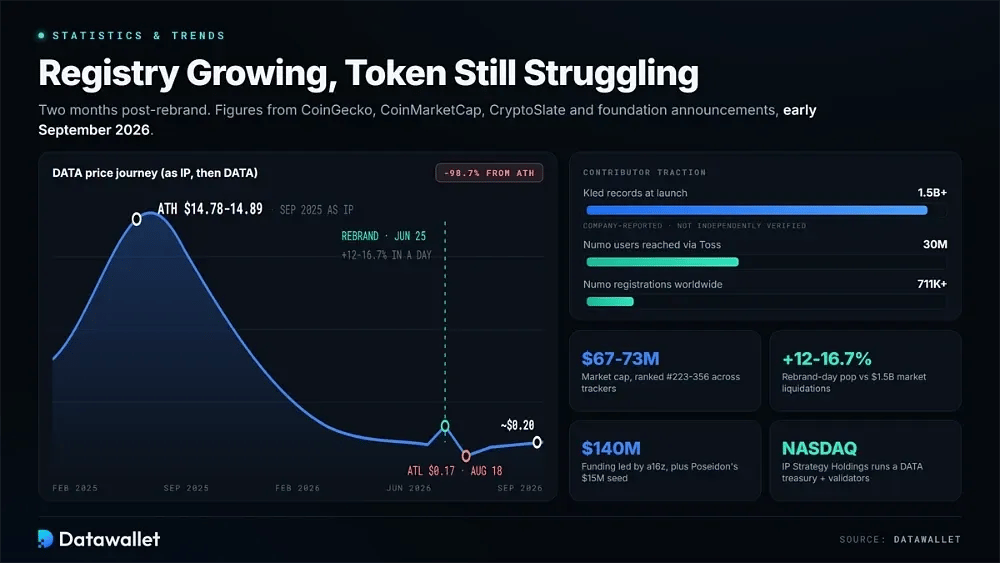
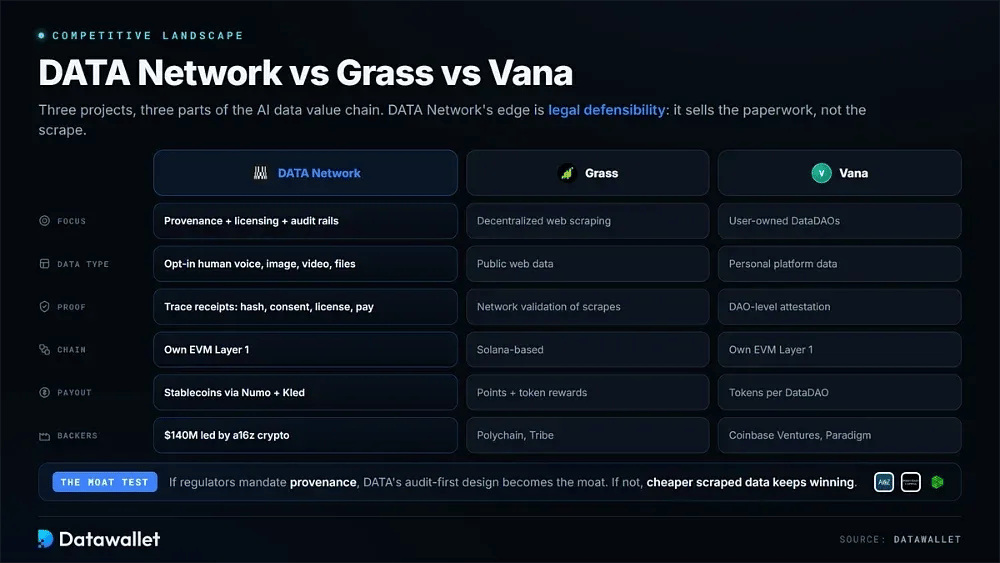
DATA Network vs Other AI Data Projects
DATA Network competes in a crowded field of crypto projects monetizing data for AI, but the projects focus on different parts of the value chain. Grass crowdsources web scraping through user bandwidth. Bittensor rewards model intelligence itself, while Vana pools user data into collectively owned DAOs.
Legal defensibility is the main point of differentiation. Grass supplies scraped public data at scale, the same category targeted by copyright litigation. DATA Network instead sells the paperwork showing that data was consented, licensed and paid for. If courts or regulators impose provenance requirements on AI labs, DATA's audit-first design becomes the moat. If they do not, cheaper scraped data keeps winning.
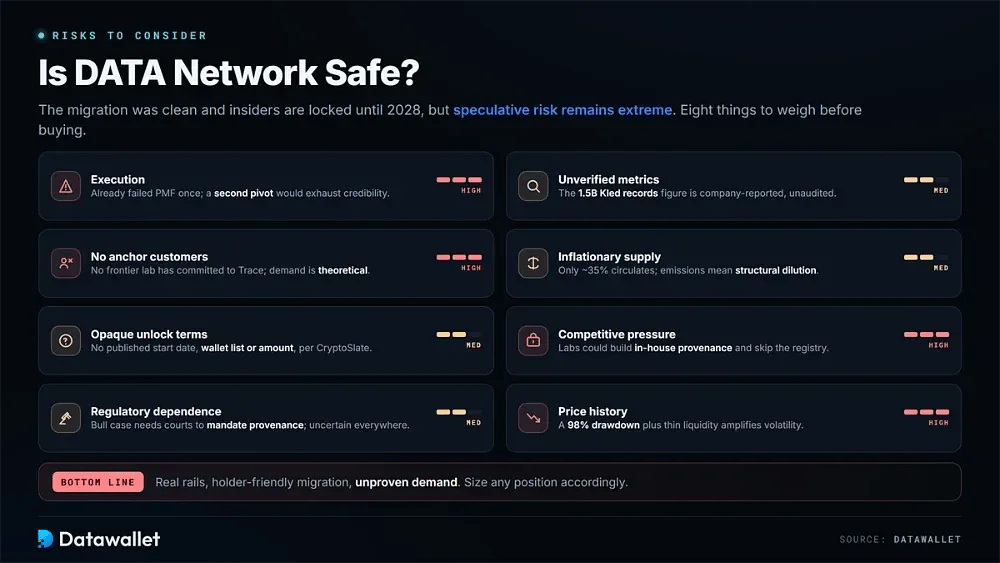
Is DATA Network Safe? Risks to Consider
The migration itself was clean. Native holders faced no haircuts, forced claims or contract swaps, while the extended insider lockup removes a source of sell pressure that has crushed comparable tokens. Speculative risk remains extreme.
The main risks to weigh before buying DATA:
- Execution risk: The project already failed to find product-market fit once, and a second pivot would likely exhaust remaining credibility with both users and investors.
- Unverified metrics: The 1.5 billion Kled records and market-leading claims are company-provided figures that no independent third party has audited or confirmed to date.
- No anchor customers: No frontier AI lab has publicly committed to using Trace receipts, leaving demand for the network's core product still theoretical.
- Inflationary supply: Only around 35% of tokens circulate, and staking emissions continually add supply, so holders face structural dilution even with insiders locked.
- Opaque unlock terms: The 18-month extension came without a published start date, affected wallet list or token amount, according to CryptoSlate.
- Competitive pressure: Big AI labs could build in-house provenance systems or license directly from data vendors, bypassing a public blockchain registry entirely.
- Regulatory dependence: The bull case leans heavily on courts and regulators mandating provenance, an outcome that remains uncertain across every major jurisdiction.
- Price history: A 98% drawdown signals deeply damaged market confidence, and thin liquidity amplifies volatility in both directions for a small-cap token.
DATA Network Team & Backers
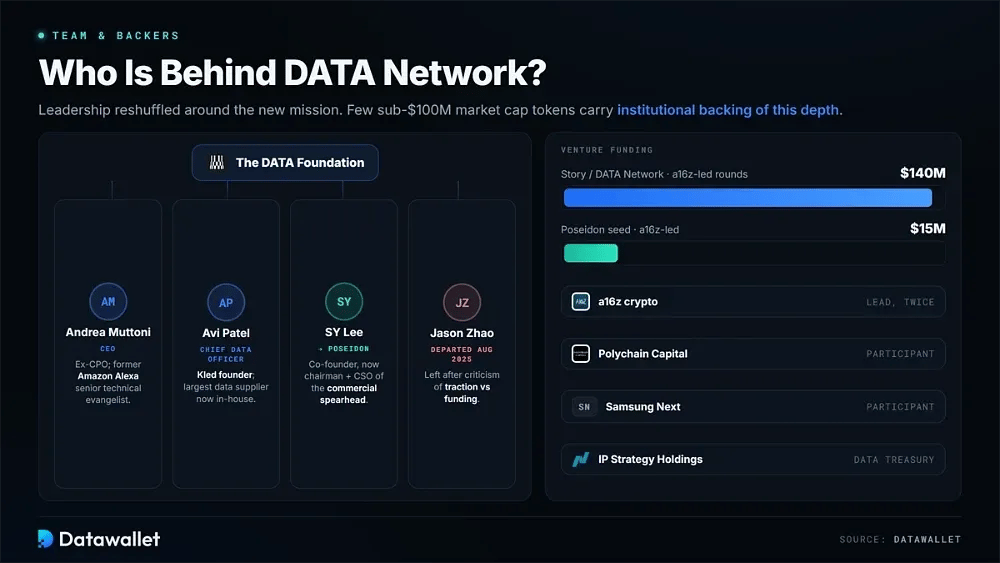
Leadership was reshuffled around the network's new mission. Andrea Muttoni, previously chief product officer and a former senior technical evangelist at Amazon Alexa, became CEO of The DATA Foundation. Kled founder Avi Patel joined as chief data officer, bringing the network's largest data supplier in-house.
Co-founder SY Lee moved to Poseidon as chairman and chief strategy officer, leaving the ecosystem's commercial spearhead under founding leadership. Jason Zhao, the other co-founder, had already departed in August 2025 after community criticism of the project's traction relative to its funding.
Funding remains one of the project's strongest cards. Story raised $140 million across rounds led by a16z crypto, with participation from Polychain Capital and Samsung Next. A16z later doubled down by leading Poseidon's $15 million seed round. Few tokens with a sub-$100 million market cap have institutional backing of this depth.
Final Thoughts
DATA Network represents one of crypto's most consequential pivots of 2026. A heavily funded Layer 1 has abandoned a failed thesis for an adjacent one with genuine urgency behind it. The data wall is real and copyright litigation is accelerating, while no incumbent owns the provenance layer the foundation aims to build.
The open question is whether blockchain is the right tool. For the model to succeed, AI labs that are famously secretive about training data must voluntarily adopt public audit rails. So far, current record counts come from ecosystem insiders rather than external customers.
Treat DATA as a venture-style bet on AI compliance infrastructure rather than a functioning revenue business. Before assuming the turnaround is working, watch for named lab partnerships, independently verified dataset sales and the Confidential Data Rails launch. Size positions accordingly.