







Which Countries Does WhiteBIT Restrict?
WhiteBIT blocks around 30 jurisdictions and territories, listed in its User Agreement and enforced through its identity verification policy, which refuses documents from residents of restricted regions. The list mixes sanctioned countries with disputed and occupied territories that fall outside any recognized regulator.
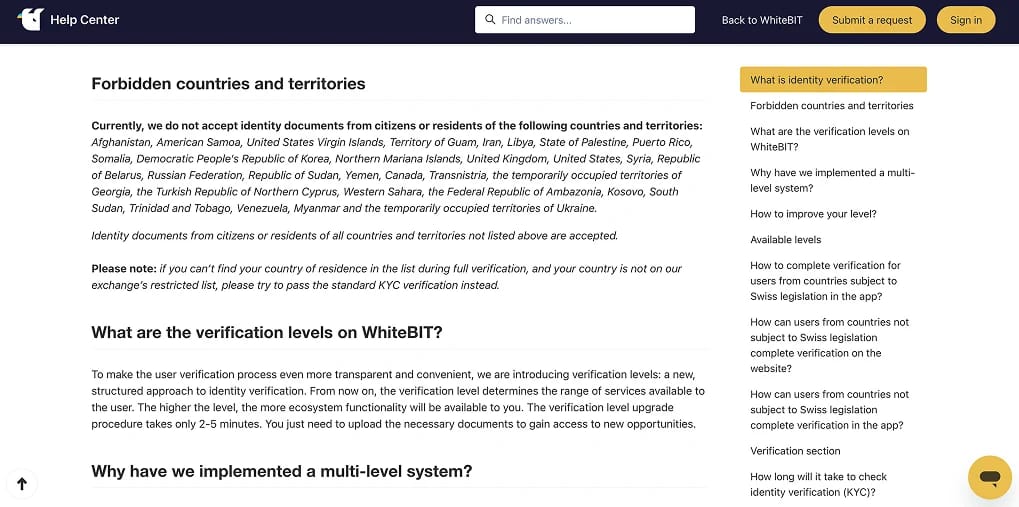
WhiteBIT Restricted Countries List in 2026
The table groups the restricted set by region. Some entries are sovereign nations under sanctions, while others are territories or conflict zones outside any standard licensing framework.
Why Does WhiteBIT Restrict These Countries?
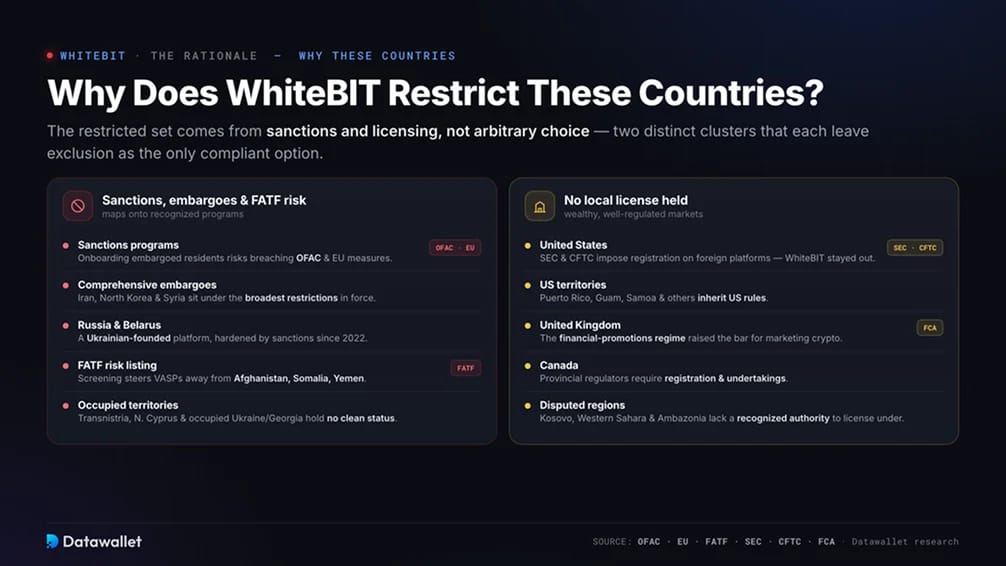
The restricted set comes from sanctions and licensing, not arbitrary choice. Some markets carry sanctions exposure that would put WhiteBIT in breach of OFAC, UN, or EU measures. Others demand a local license it never obtained, so it blocks the market rather than operate unlicensed.
1. Sanctions, Embargoes, and FATF Risk
Most of the list maps onto recognized sanctions programs and high-risk jurisdiction lists rather than any call WhiteBIT makes alone.
- Sanctions programs: Onboarding residents of embargoed regions risks breaching OFAC and EU measures that bar financial services to designated countries and parties.
- Comprehensive embargoes: Iran, North Korea, and Syria sit under the broadest restrictions in force, which is why most compliant exchanges block them outright.
- Russia and Belarus: A Ukrainian-founded platform has legal and reputational reasons to exclude both, hardened by sanctions packages since 2022.
- FATF risk listing: FATF guidance pushes virtual asset providers to screen against money-laundering risk, steering them away from Afghanistan, Somalia, and Yemen.
- Occupied territories: Transnistria, Northern Cyprus, and the occupied parts of Ukraine and Georgia hold no clean regulatory status, so WhiteBIT treats them as off-limits.
2. Markets Where WhiteBIT Holds No Local License
A second cluster reflects missing authorization. These are wealthy, well-regulated markets that demand a license WhiteBIT has chosen not to pursue.
- United States: The SEC and CFTC impose registration on foreign platforms, and WhiteBIT has stayed out rather than meet it.
- US territories: Puerto Rico, Guam, American Samoa, the U.S. Virgin Islands, and the Northern Mariana Islands inherit US rules, so they fall with the mainland.
- United Kingdom: The FCA financial promotions regime raised the bar for marketing crypto to UK consumers, prompting many offshore exchanges to close registrations.
- Canada: Provincial securities regulators require trading platforms to register and file undertakings, which WhiteBIT has not done.
- Disputed regions: Kosovo, Western Sahara, and the Federal Republic of Ambazonia lack a recognized authority to license under, leaving exclusion as the default.
WhiteBIT Supported Countries
WhiteBIT operates in more than 190 countries and ranks as Europe's largest crypto exchange by web traffic. Its parent, W Group, reports over 35 million customers, while the exchange counts more than 8 million registered users.
Demand concentrates in the European Economic Area, led by Germany, Spain, and Italy, with further reach into parts of Asia, Latin America, and the CIS outside the sanctioned markets. Eligible users get spot, margin, and futures trading, lending and Earn products, a Launchpad, and the Whitechain ecosystem, funded over SEPA, cards, and P2P.
The supported picture shifted in mid-2026. WhiteBIT is building whitebit.eu, a dedicated European platform for the MiCA framework, so EEA traders will increasingly transact through the regulated entity instead of the global site. Our guide to the best crypto exchanges in Europe maps which platforms now hold full EU authorization.
The WhiteBIT MiCA License Explained
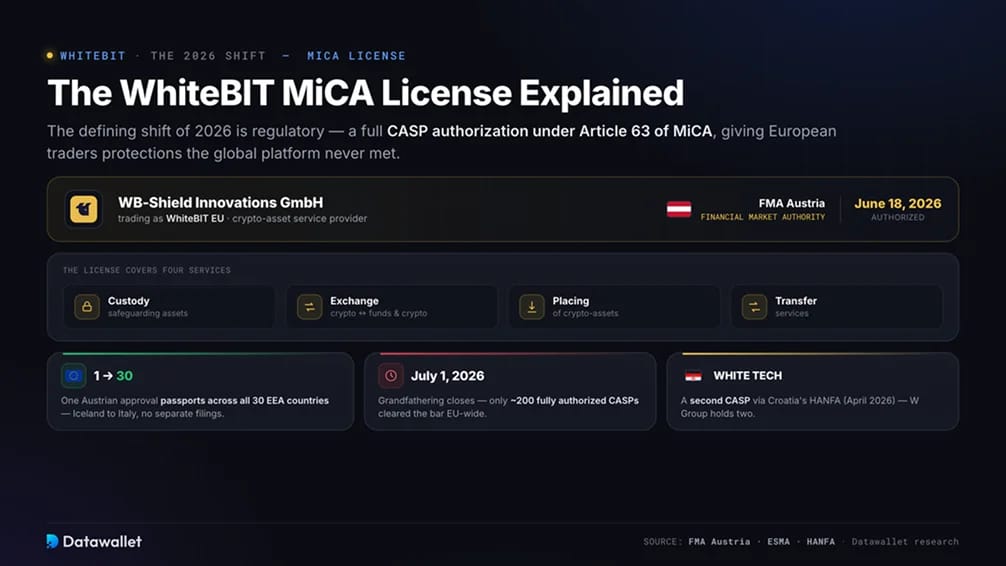
The defining shift of 2026 is regulatory. On June 18, Austria's Financial Market Authority authorized WB-Shield Innovations GmbH, trading as WhiteBIT EU, as a crypto-asset service provider under Article 63 of the Markets in Crypto-Assets Regulation, with the exchange confirming approval the next day.
The license covers custody, the exchange of crypto for funds and other crypto-assets, the placing of assets, and transfer services. Under MiCA, one member state's authorization passports across all 30 EEA countries, so a single Austrian approval lets WhiteBIT EU serve eligible users from Iceland to Italy without separate national filings.
Timing matters. MiCA's grandfathering period closes on July 1, 2026, after which providers on legacy national registrations must stop serving EU clients. Industry counts put fully authorized CASPs near 200 firms, a sliver of the thousands operating under older regimes, so WhiteBIT cleared the bar with little room to spare. W Group holds a second CASP authorization through WHITE TECH, granted by Croatia's HANFA in April 2026.
For users, the approval changes the substance of the relationship. European traders gain client-asset safeguarding, governance standards, and disclosure rules the global platform never met, and WhiteBIT joins the small group of MiCA-authorized venues competing on regulatory standing over fees. Our list of the best MiCA-licensed crypto exchanges shows where it sits against Kraken, Bybit EU, and the rest.
Can I Use WhiteBIT in the USA?
No. The United States sits on WhiteBIT's restricted list, so US residents cannot open an account, verify, deposit, or trade. The block extends to US territories, including Puerto Rico, Guam, American Samoa, the U.S. Virgin Islands, and the Northern Mariana Islands.
Registration is the reason. Serving Americans spot and derivatives products would draw oversight from the SEC, the CFTC, and FinCEN, and WhiteBIT has not pursued the licensing to do it. Talk of a US waitlist surfaces periodically, but no live service exists, and the exchange's 2026 focus points at regulated Europe. A VPN does not make access compliant, since verification still runs from a supported region and mismatched data can trigger reviews or failed withdrawals.
Does WhiteBIT Require KYC?
Yes. WhiteBIT runs mandatory identity verification, and unverified accounts cannot trade, deposit fiat, or withdraw beyond minimal limits. Verification is tiered, with higher levels unlocking larger limits and fiat providers, and a financial questionnaire is needed before card and SEPA rails open. As of mid-2026, verification runs mainly through the mobile app, and starting on the web redirects you there.
Verification takes a few steps:
- Open verification: Sign in to the app and open the identity verification section.
- Enter your details: Add your full name, date of birth, address, and nationality.
- Upload an ID: Submit a passport, national ID, or driver's license with a clear image that matches your details.
- Complete a face check: Pass the facial recognition step that links your identity to the documents.
- Add the financial questionnaire: Fill it in if you plan to use fiat deposit and withdrawal providers.
- Enable 2FA: Turn on two-factor authentication, then wait for WhiteBIT to approve or request more documents.
About WhiteBIT
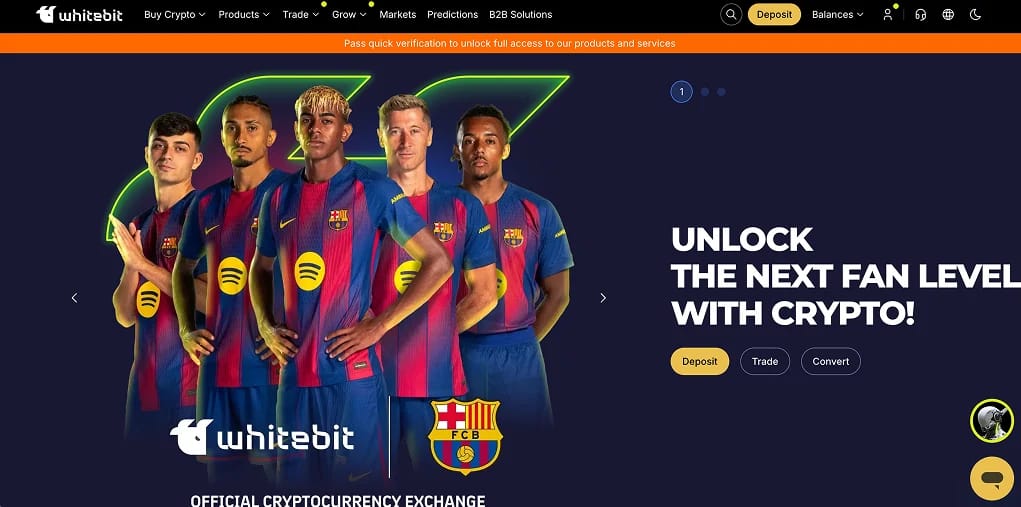
WhiteBIT launched in November 2018, founded in Ukraine by Volodymyr Nosov, who still leads it as CEO, and now runs from Vilnius, Lithuania. It sits inside W Group, which reports more than 35 million customers, and has built reach through partnerships with FC Barcelona, Juventus, Visa, FACEIT, and the Ukrainian national football team. WhiteBIT also appears among trusted UAH-friendly platforms in our guide to the best crypto exchanges in Ukraine.
The exchange supports 360+ assets across 750+ trading pairs at a flat 0.1% spot fee, with margin and perpetual futures for eligible users, per CoinMarketCap. Security rests on roughly 96% cold storage, regular Hacken audits, and no major breach since launch.
Its native token, WBT, has grown from a fee-discount coin into the gas asset for Whitechain, WhiteBIT's EVM-compatible Layer 1, powering tiered benefits across fees, withdrawals, and Launchpad access. The Nova Card, a Visa product in about 30 European markets, extends the ecosystem from trading into payments.
Final Thoughts
The clearest way to read WhiteBIT in 2026 is as two platforms under one brand. The global service keeps its wall of sanctioned and unlicensed markets, while the new MiCA-authorized European arm gives EEA users a regulated venue with protections the older site lacked.
What you do next depends on where you live. Inside the EEA, plan to trade through whitebit.eu once it opens to you, and confirm your assets are listed before funding. Anywhere else, check your country against the restricted table first, since verification fails from a blocked region, and treat any VPN workaround as a compliance and withdrawal risk.
.webp)