






Which Countries Does Bitfinex Restrict?
Bitfinex draws its borders from two separate rulebooks, and reading them as one is where most summaries slip up. The main exchange, governed by its Terms of Service, blocks a short list of sanctioned territories plus the regulated markets it chose to leave. Bitfinex Securities, the venue for tokenized bonds and equities, adds its own prohibited persons and jurisdictions on top.
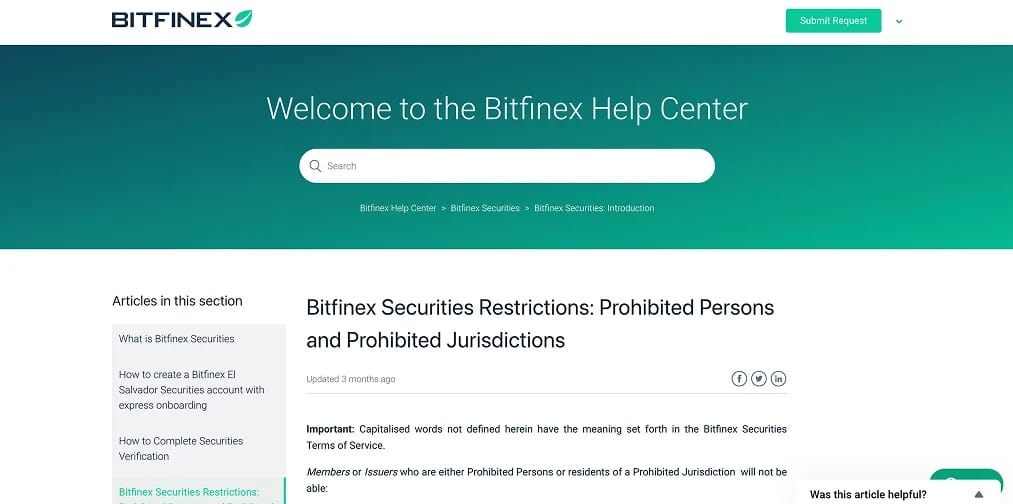
The table below groups restrictions by cause rather than by continent, since a Cuban and a British resident are turned away for different reasons.
Bitfinex's verification process enforces these lines, and the company can suspend or close an account if it later finds the holder in a barred region. An account opened from a restricted country is still in breach, whatever the sign-up screen allowed.
Why Bitfinex Restricts These Regions
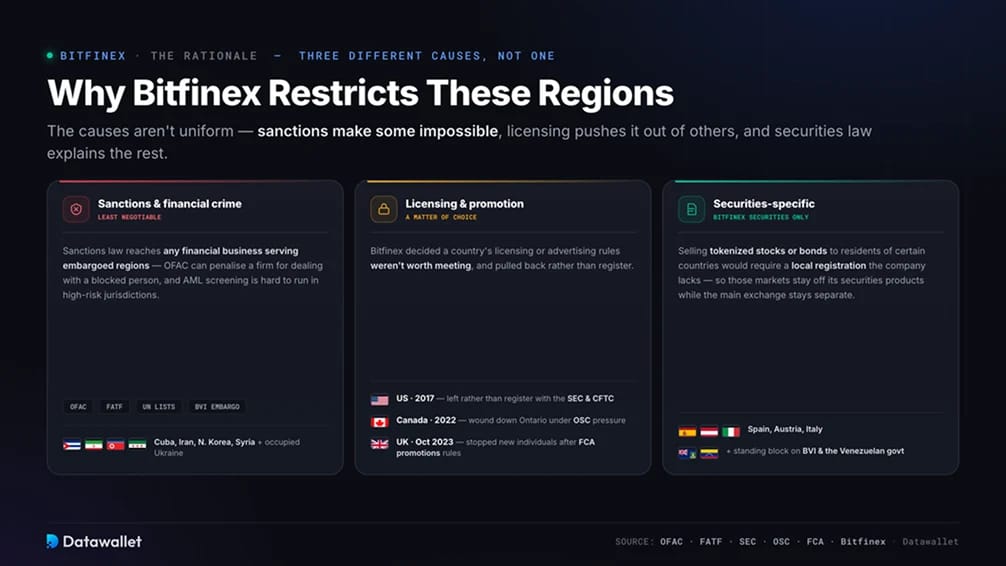
The causes are not uniform. Sanctions make some regions impossible to touch, licensing gaps push Bitfinex out of others, and securities law explains a final set affecting only its tokenized products.
Sanctions and financial-crime rules
The embargoed territories are the least negotiable, because sanctions law reaches any financial business serving them. The US Office of Foreign Assets Control can penalize a firm for dealing with a blocked person or embargoed region, so exchanges wall those places off. Anti-money-laundering standards from the Financial Action Task Force add another layer, since their screening is hard to run in high-risk jurisdictions. Territories on FATF, United Nations, or British Virgin Islands embargo lists are excluded.
Licensing and promotion regimes
The withdrawn markets are a matter of choice. In each case Bitfinex decided a country's licensing or advertising rules were not worth meeting, and pulled back.
- United States: The exchange left in 2017 rather than register with federal regulators such as the SEC and CFTC, and it still blocks anyone flagged as a US Person.
- Canada: Bitfinex wound down its Ontario customers in 2022 under pressure from the Ontario Securities Commission, which has forced several offshore platforms out of the province.
- United Kingdom: After the Financial Conduct Authority extended its financial-promotions regime to crypto in October 2023, Bitfinex stopped verifying new individual UK customers and restricted existing ones.
Securities-specific limits
The last group sits entirely inside Bitfinex Securities. Selling tokenized stocks or bonds to residents of certain countries would require local registration, so the company keeps those markets off its securities products while the main exchange stays separate. Spain, Austria, and Italy fall into this bracket, alongside a standing block on the British Virgin Islands and the Venezuelan government.
Bitfinex Supported Countries
Beyond those markets, Bitfinex is available almost everywhere else, and the company has long put its reach at more than 180 countries. Usage concentrates in Asia and Europe, with South Korea historically its single largest market by traffic, followed by a long tail across Latin America and Oceania.
Eligible users can trade spot, margin, and derivatives, lend or borrow through the peer-to-peer funding market, and reach OTC desks and tokenized securities depending on verification level and location. It settles fiat in USD, EUR, GBP, and JPY, though its rails favor larger accounts, with manual bank wires starting at 10,000 USD, EUR, or GBP and a third-party provider covering smaller sums.
Bitfinex leans toward experienced traders rather than first-time buyers, so newcomers wanting a simple cash on-ramp will find the funding minimums and interface steeper than a mainstream retail app.
Is Bitfinex Available in the United States?
No. Bitfinex has not served US residents since 2017, when it announced a 90-day wind-down of American accounts. The company cited banking friction and the cost of US compliance, choosing to exit rather than register with federal regulators. Anyone flagged as a US Person today is blocked from opening or funding an account. Traffic estimates still show a notable share of US visitors, reflecting VPN use rather than any open door.
A VPN can make the platform look reachable from inside the US, but loading the site is not the same as being allowed to trade on it. No US consumer protection stands behind such an account, the activity breaks Bitfinex's own agreement, and the exchange can act on the breach the moment a user's real location becomes clear. Anyone trading from the US is better off on a platform built to operate there.
Our guide to the best crypto exchanges in the USA compares regulated options, and for an advanced-trading substitute, Kraken offers spot, margin, and futures with full US authorization.
Using Bitfinex in the UK and Canada
Both limits stem from regulation rather than sanctions. In the UK, after the FCA extended its crypto financial-promotions rules in October 2023, Bitfinex stopped onboarding new individual customers and restricted existing UK users from adding funds, though qualifying corporate accounts kept access. UK residents can compare the best crypto exchanges in the UK for FCA-registered options.
In Canada, only Ontario is affected. Bitfinex had those customers close their accounts in early 2022 during the Ontario Securities Commission's crackdown on unregistered platforms. Since most exchanges must register province by province, our best crypto exchanges in Canada list is the safer place to start elsewhere.
Does Bitfinex Require KYC?
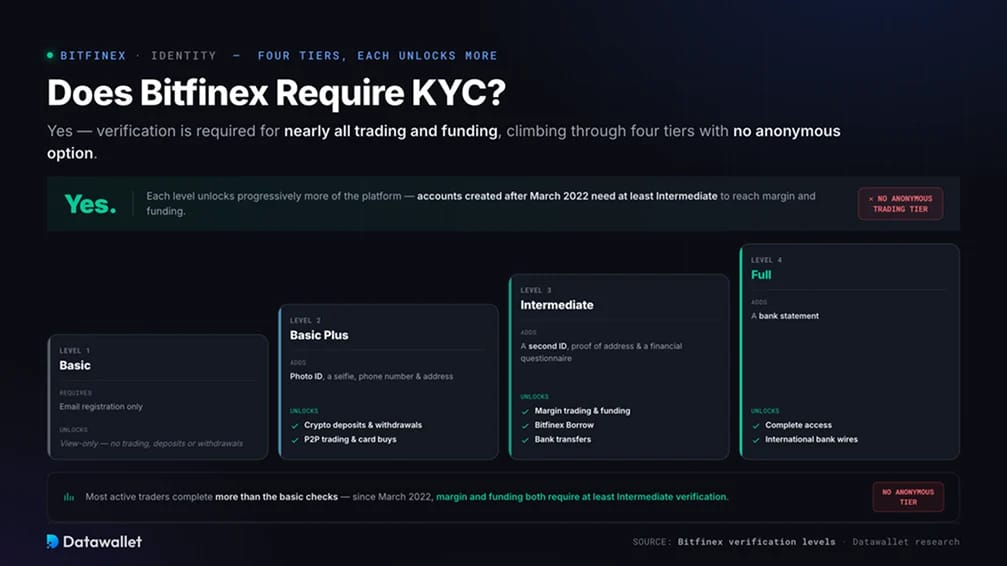
Yes. Bitfinex requires identity verification for nearly all trading and funding, using tiered verification levels that unlock progressively more of the platform.
- Basic: A view-only tier with no trading, deposits, or withdrawals.
- Basic Plus: Adds photo ID, a selfie, a phone number, and an address, and enables crypto deposits, withdrawals, peer-to-peer trading, and card purchases.
- Intermediate: Requires a second ID, proof of address, and a financial questionnaire, and is needed for margin trading, funding, Bitfinex Borrow, and bank transfers.
- Full: Adds a bank statement and grants complete access, including international bank wires.
Accounts created after March 2022 need at least Intermediate verification to reach margin and funding, so most active traders complete more than the basic checks. The platform has no anonymous trading tier.
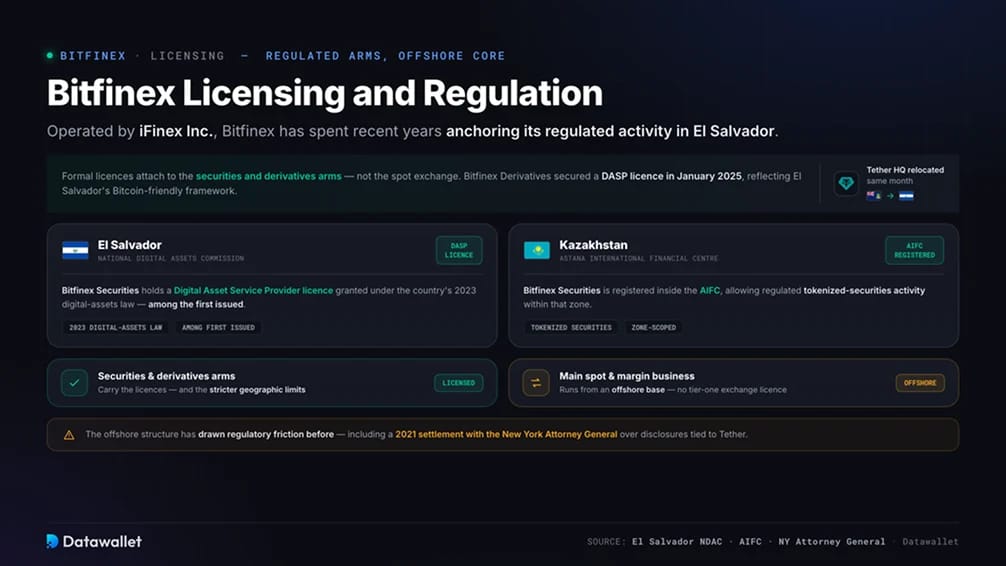
Bitfinex Licensing and Regulation
Bitfinex is operated by iFinex Inc. and has spent recent years anchoring its regulated activity in El Salvador. Bitfinex Derivatives secured a Digital Asset Service Provider license there in January 2025, and affiliate Tether relocated its headquarters from the British Virgin Islands to the country the same month, a move that reflects El Salvador's Bitcoin-friendly framework.
Its formal licenses attach to the securities and derivatives arms rather than the spot exchange.
- El Salvador: Bitfinex Securities holds a Digital Asset Service Provider license from the National Digital Assets Commission, granted under the country's 2023 digital-assets law and among the first issued.
- Kazakhstan: Bitfinex Securities is registered inside the Astana International Financial Centre, allowing regulated tokenized-securities activity within that zone.
These approvals underpin the tokenized bonds and equities that Bitfinex Securities issues, and explain why the securities platform carries stricter geographic limits than the exchange itself. The main spot and margin business runs from an offshore base without a tier-one exchange license, a structure that has drawn regulatory friction before, including a 2021 settlement with the New York Attorney General over disclosures tied to Tether.
About Bitfinex
Bitfinex launched in 2012 and built its standing among professional and institutional traders through deep order books, margin funding, and an early derivatives offering. Parent company iFinex also issues the UNUS SED LEO (LEO) token, which trims trading fees, and shares ownership ties with Tether, the largest stablecoin issuer in the market. Standard fees run to 0.1% for makers and 0.2% for takers, dropping with volume and LEO holdings.
The exchange's defining episode remains the August 2016 breach, when roughly 120,000 BTC were stolen. US authorities seized much of the haul in 2022 and later convicted Ilya Lichtenstein and Heather Morgan of laundering the funds. In January 2025, a federal court directed the recovered coins, by then worth billions, back to Bitfinex, which has committed to using them to redeem the Recovery Right Tokens issued to affected users after the hack.
Final Thoughts
"Restricted" means two different things on Bitfinex depending on the product. For the core exchange, the closed doors are sanctioned states plus the regulated markets it walked away from, chiefly the US, Ontario, and individual UK accounts. For Bitfinex Securities, the list runs longer, because tokenized stocks and bonds answer to securities law in every country they touch.
Traders in eligible regions get a deep, professional-grade platform, provided they clear the verification tier their activity requires and accept regulatory protections thinner than a domestically licensed exchange offers.
.webp)