







Which Countries Does BYDFi Restrict?
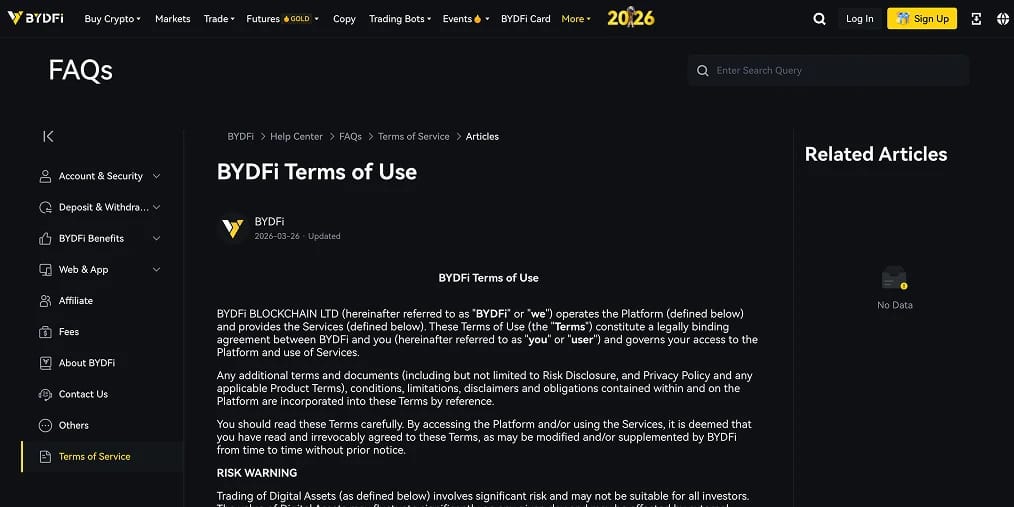
More than 40 countries and territories appear in the Prohibited Countries clause of BYDFi's Terms of Use, last revised in March 2026. The clause dwarfs the six-market list in BYDFi's legacy support notices and captures several of the world's largest economies.
Here is the full list from the current terms, grouped by region.
BYDFi can add locations at its discretion, and a separate Restricted Person clause bans anyone on UN, OFAC, EU, UK or Canadian sanctions lists regardless of residence. Travelling into a prohibited jurisdiction can block access mid-trip, and the agreement expressly forbids VPN use to mask an IP address.
One caution. A legacy support notice still names the United Kingdom, Pakistan and Kazakhstan as unsupported, yet none appears in the current terms, so users there should confirm their standing before funding an account.
Why BYDFi Excludes These Jurisdictions
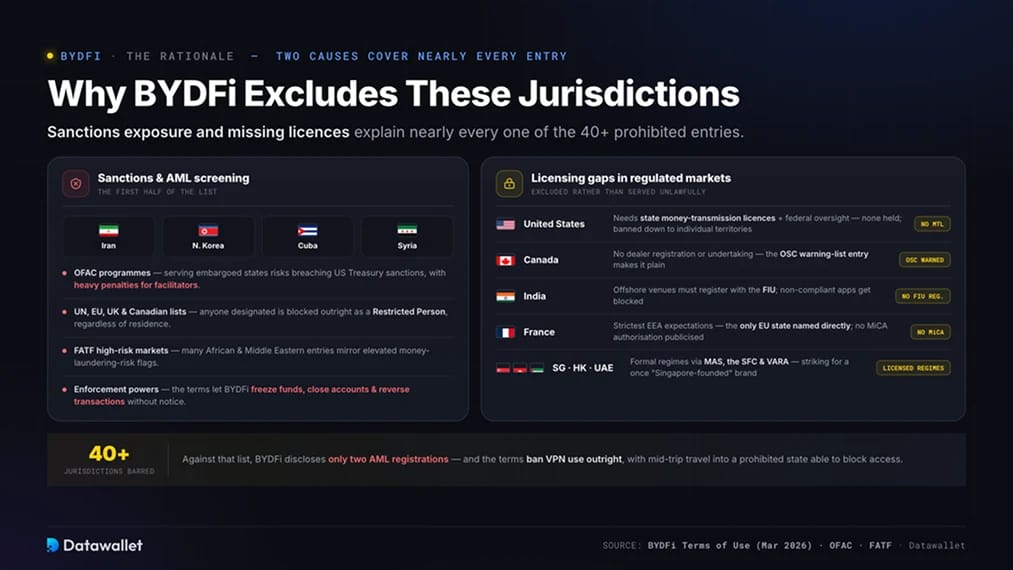
Sanctions exposure and missing licences explain nearly every entry on the prohibited list. Sanctioned states shield BYDFi from financial-crime enforcement, while the regulated economies are markets where it has never obtained local authorisation.
1. Sanctions and AML Screening
Embargoed and high-risk states make up the first half of the list, driven by screening obligations that bind every exchange needing global banking and payment partners.
- OFAC programmes: Serving users in Cuba, Iran, North Korea or Syria risks breaching US Treasury sanctions, which cover jurisdictions and individuals and carry heavy penalties for facilitators.
- UN and allied lists: BYDFi's Restricted Person definition references the UN Security Council Consolidated List along with EU, UK and Canadian designations, so anyone on those registers is blocked outright.
- High-risk markets: Many African and Middle Eastern entries mirror jurisdictions flagged for elevated money-laundering risk under FATF monitoring, where compliant onboarding is hard to sustain.
- Enforcement powers: The terms authorise BYDFi to freeze funds, close accounts and reverse transactions wherever continued service would conflict with applicable law, without notice or liability.
2. Licensing Gaps in Regulated Markets
Major economies appear because BYDFi lacks the approvals they require. It discloses only two North American AML registrations, so markets demanding a genuine operating licence are excluded rather than served unlawfully.
- United States: Crypto platforms need state money-transmission licences and federal oversight on top of any FinCEN filing, none of which BYDFi holds, so the terms exclude the US down to individual territories.
- Canada: Securities regulators require crypto trading platforms to register as dealers or sign binding undertakings, and BYDFi has done neither, as its Ontario warning-list entry makes plain.
- India: Offshore exchanges must register with India's Financial Intelligence Unit before serving local users, and non-compliant platforms have had their apps blocked, a fight BYDFi avoids by excluding the market.
- France: France enforces some of the strictest crypto registration expectations in the EEA, and BYDFi publicises no MiCA authorisation, making it the one EU member state named directly. EEA residents can compare MiCA-licensed crypto exchanges holding the approval BYDFi lacks.
- Singapore, Hong Kong and the UAE: Each runs a formal licensing regime through MAS, the SFC and VARA. The Singapore exclusion stands out, since BYDFi spent years describing itself as Singapore-founded.
BYDFi Supported Countries
Most of Europe, Latin America, Africa, Southeast Asia and Oceania can still trade on BYDFi. The company promotes 190-plus countries and more than 1,000,000 registered users, though the terms remove over 40 jurisdictions from that headline, putting practical reach closer to 150 markets.
Traders there can access more than 1,000 spot pairs, over 500 perpetual contracts with up to 200x leverage, copy trading, automated bots, demo accounts and the BYDFi Card. Under the terms, fiat purchases run entirely through third-party providers, so the platform works best for people who already hold crypto. Anyone weighing BYDFi against licensed venues can compare the best crypto futures exchanges for regulated derivatives options.
Can You Use BYDFi in the United States?
No. The Terms of Use name the United States as a Prohibited Country with unusual precision, extending the ban to Puerto Rico, Guam, the US Virgin Islands, American Samoa, the Northern Mariana Islands and every minor outlying island. BYDFi also runs a dedicated assessment process to catch corporate customers with indirect US ties.
Some reviews treat BYDFi's Money Services Business registration with FinCEN as evidence of US approval. The filing exists for anti-money-laundering reporting and confers no right to onboard American customers. The same terms are governed by Colorado law, with disputes arbitrated in Denver, even though no US resident can lawfully hold an account.
Americans wanting comparable tools should stick to licensed venues such as Kraken, and our guide to the best crypto exchanges in the USA covers the compliant field.
Is BYDFi Available in Canada?
No. Canada sits on the prohibited list even though BYDFi holds a Foreign Money Services Business registration with FINTRAC under number M22636235. That registration covers AML reporting only and falls well short of the dealer registration Canadian securities regulators demand from trading platforms.
The Ontario Securities Commission placed both BYDFi and its former BitYard brand on its investor warning list in February 2025, noting the platform is not registered to trade securities in the province. Canadians can find compliant alternatives in our roundup of the best crypto exchanges in Canada.
Does BYDFi Require KYC?
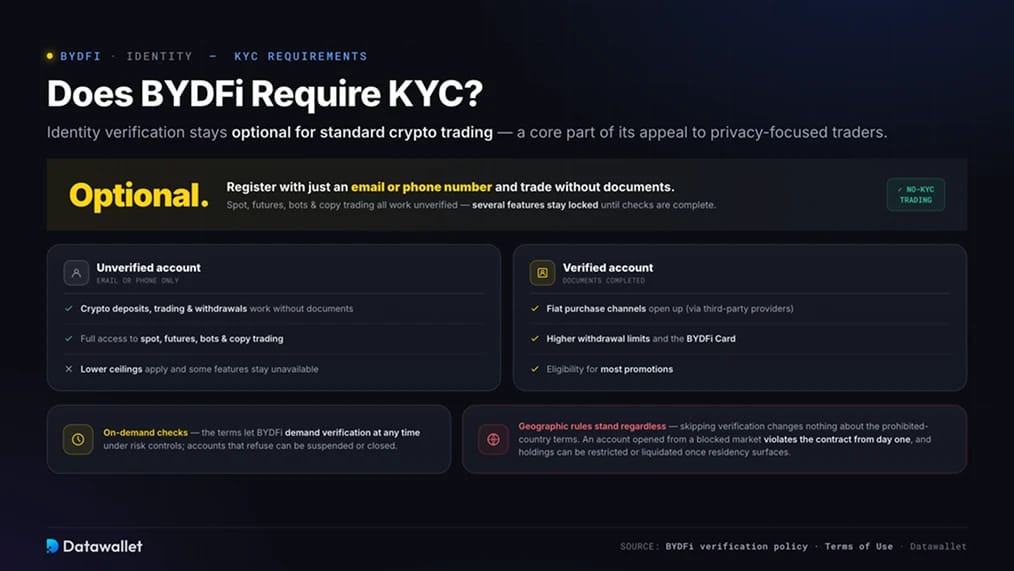
BYDFi keeps identity verification optional for standard crypto trading. New users can register with an email address or phone number and access spot, futures, bots and copy trading without uploading documents, a core part of its appeal to privacy-focused traders. Our guide to the best no-KYC crypto exchanges compares how BYDFi stacks up against rivals.
Several features stay locked until identity checks are complete.
- Unverified accounts: Crypto deposits, trading and withdrawals work without documents, though ceilings are lower and some features stay unavailable.
- Verified accounts: Completing KYC opens fiat purchase channels, higher withdrawal limits, the BYDFi Card and eligibility for most promotions.
- On-demand checks: The terms let BYDFi demand verification at any time under risk controls, and accounts that refuse can be suspended or closed.
- Geographic rules stand regardless: Skipping verification changes nothing about the prohibited-country terms. Opening an account from a blocked market violates the contract from day one, and BYDFi can restrict or liquidate holdings once residency surfaces.
BYDFi Licences and Regulation
Two AML registrations make up BYDFi's entire disclosed compliance stack. The FinCEN MSB registration (No. 31000215482431) and the FINTRAC registration above are financial-crime reporting filings rather than permissions to operate an exchange. BYDFi publicises no MiCA authorisation, no FCA registration and no approvals from MAS, the SFC or VARA, and the OSC entry remains the most direct regulatory statement on the platform.
Security disclosures offset part of that gap. The exchange publishes proof of reserves, added an 800 BTC user-protection fund in September 2025, partnered with Ledger on a co-branded hardware wallet, and has no major breach on public record since its 2020 launch. None of it replaces deposit protection or formal recourse, so accounts carry a standard offshore risk profile.
About BYDFi
BYDFi launched in 2020 as BitYard and rebranded in January 2023, named for its slogan "BUIDL Your Dream Finance". The operating entity is BYDFi BLOCKCHAIN LTD, announcements are issued from Victoria in the Seychelles, and co-founder Michael Hung fronts the company as CEO.
MoonX debuted in April 2025 as an on-chain trading engine covering meme coins across Solana, BNB Chain and Base with built-in token risk scanning, copy trading launched the same year alongside a Visa-backed virtual card, and a December 2025 integration added BYDFi to the open-source CCXT trading library. Perpetual futures charge 0.02% maker and 0.06% taker fees, competitive with far larger rivals.
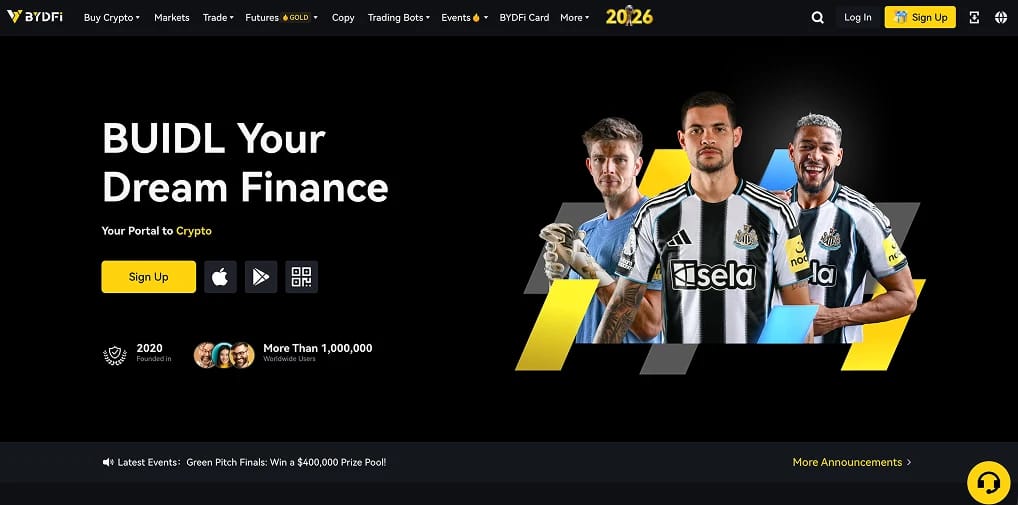
The highest-profile move came in August 2025, when Newcastle United signed BYDFi as the club's Official Cryptocurrency Exchange Partner on a multi-year deal.
Final Thoughts
BYDFi's prohibited list covers a much larger share of the world than the 190-country headline lets on. The current terms exclude the US, Canada, India, France, Singapore, Hong Kong and the UAE along with dozens of sanctioned and high-risk states, and the compliance record rests on two AML registrations plus an active Canadian regulator warning.
Traders who clear the eligibility test and accept offshore custody risk will find genuine depth across futures, copy trading and on-chain markets. Before moving funds, read the live terms yourself, harden the account with every security option, and treat the exchange as a trading venue rather than a vault.
Anyone in an excluded jurisdiction should skip workarounds, since VPN access breaches the terms and risks a freeze, and choose a platform licensed where they live instead.
.webp)