


Top 8 NEAR Protocol Statistics and Trends
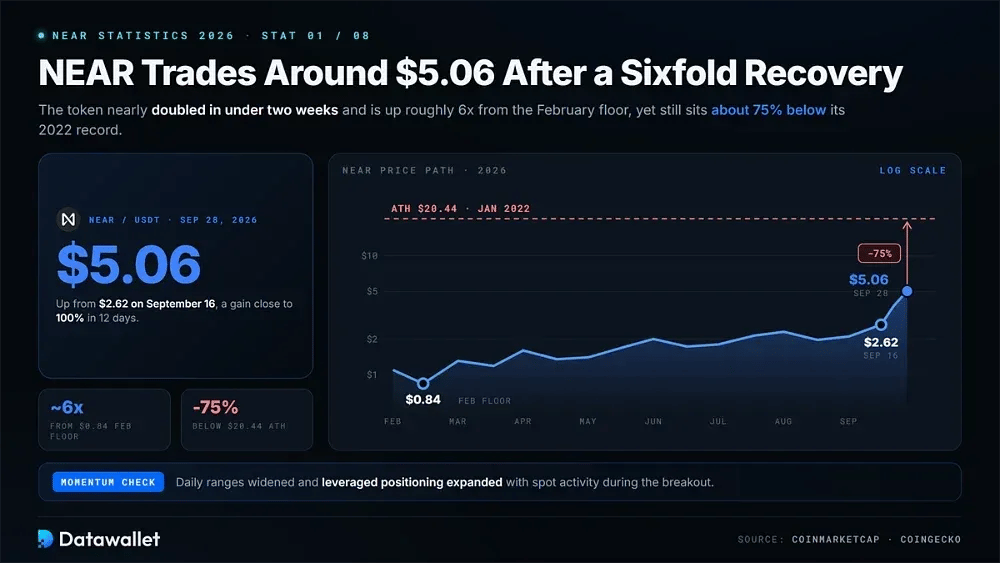
1. NEAR Trades Around $5.06 After a Roughly Sixfold Recovery
NEAR traded around $5.06 on September 28, according to CoinMarketCap's NEAR/USDT price history. That compares with $2.62 on September 16, putting the token close to a 100% gain in less than two weeks.
The recovery is larger when measured from the February cycle floor near $0.84. Even after that rebound, the distance to NEAR's former peak remains substantial. CoinGecko's historical NEAR data places the token's January 2022 all-time high at $20.44, leaving the late-September price roughly 75% below its record.
Momentum remains elevated after such a rapid move. Daily price ranges widened substantially during the breakout, and leveraged positioning expanded with spot activity. Traders can monitor where those positions concentrate through our NEAR liquidation heatmap rather than relying on a static article price.
2. NEAR Intents Has Processed More Than $30 Billion in Volume
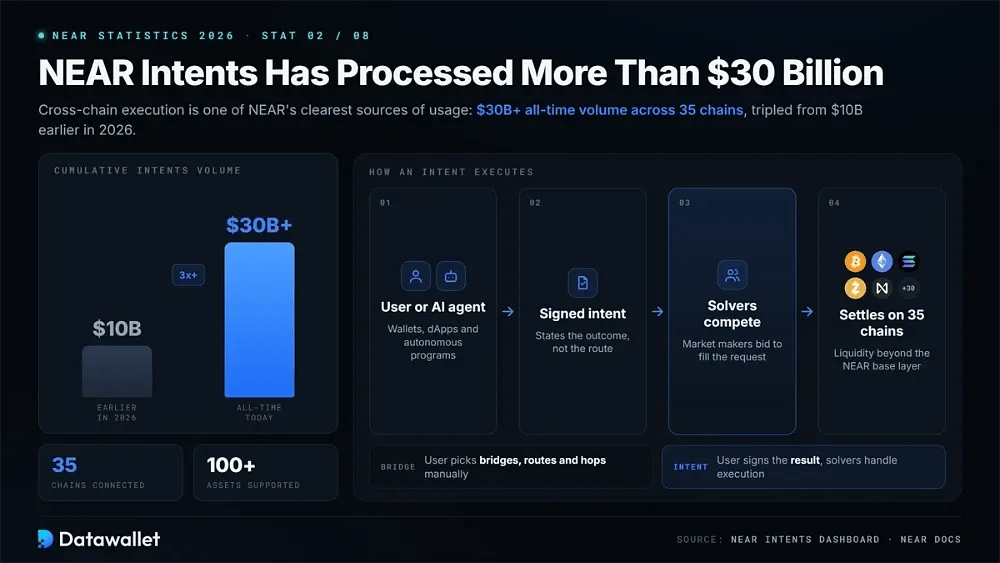
Cross-chain execution has become one of NEAR's clearest sources of measurable usage. The official NEAR Intents dashboard now reports more than $30 billion in all-time volume across 35 chains, reflecting rapid expansion from the $10 billion level reached earlier in 2026.
The main metrics defining NEAR Intents' current scale:
- Total Volume: Official protocol data now places cumulative Intents activity above $30 billion, up several multiples from its late-2025 level.
- Chain Reach: NEAR Intents currently connects 35 chains, giving applications access to liquidity beyond the NEAR base layer.
- Asset Coverage: The broader Intents and near.com stack supports more than 100 assets spanning native cryptocurrencies and other onchain markets.
- Execution Model: Users specify the outcome they want rather than manually choosing bridges, routes and intermediary transactions.
- Solver Competition: Market makers compete to satisfy each request, with the protocol selecting execution that meets the signed intent.
- Agent Access: The same architecture can serve wallets, dApps and autonomous programs rather than requiring separate settlement systems.
This differs from a conventional bridge. As the NEAR Intents documentation explains, users or AI agents express a desired outcome and competing market makers attempt to fulfill it. Our guide to adding NEAR to MetaMask covers the account side of NEAR's broader chain-abstraction model.
3. Confidential Intents TVL Reached $171.36 Million
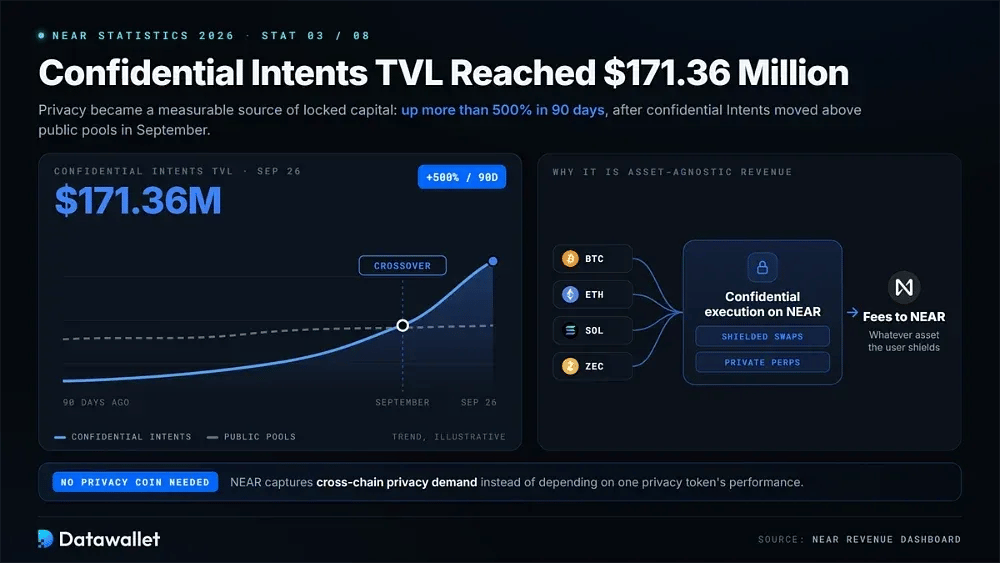
Privacy has shifted from an additional product feature into a measurable source of locked capital. The NEAR Revenue dashboard reported $171.36 million in confidential Intents TVL in its September 26 update, representing growth of more than 500% over 90 days.
That follows September's earlier crossover, when confidential Intents first moved above public pools. The shift coincided with confidential execution becoming more prominent across near.com, including swaps and perpetual-market activity. Instead of creating a separate privacy-focused token, NEAR applies confidentiality to transactions involving assets that may originate on other networks.
The distinction matters economically. Confidential execution can generate activity regardless of which asset a user wants to shield, allowing NEAR to capture fees from cross-chain privacy demand rather than depending on the performance of one privacy coin. Broader sentiment around the category can be tracked separately through our crypto fear and greed index.
4. NEAR Network TVL Reached About $244 Million
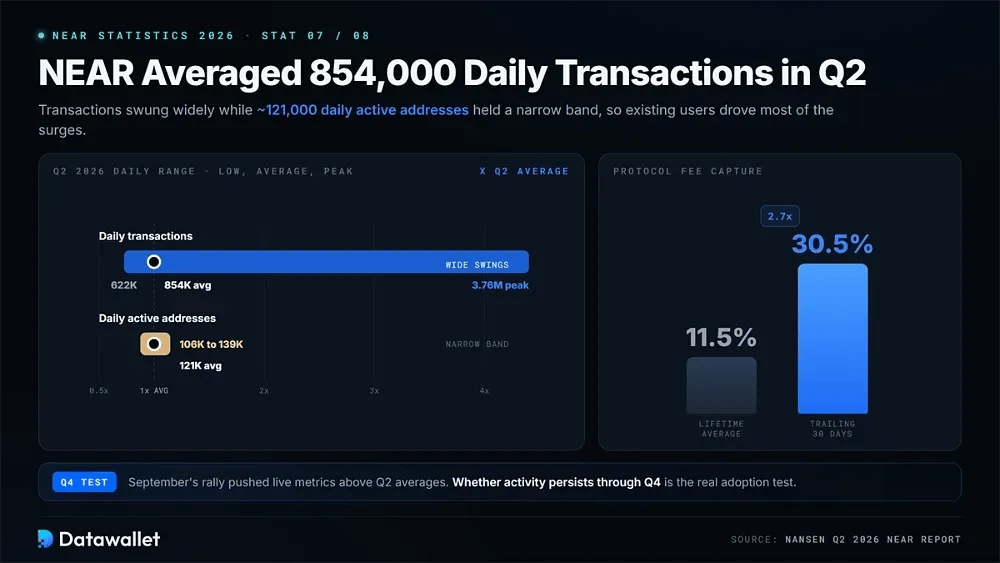
Capital deployed directly into NEAR DeFi has increased sharply during September. DefiLlama's NEAR chain dashboard currently puts total value locked at roughly $244 million, with stablecoin market capitalization near $85.8 million.
The same dashboard shows more than one million transactions during stronger 24-hour periods, alongside tens of millions of dollars in decentralized-exchange volume. These figures measure activity on the NEAR chain itself and should not be confused with Intents TVL, which includes assets held across verifier contracts on multiple networks.
Real-world assets have added another distribution channel. Ondo Finance brought tokenized securities into the NEAR ecosystem in September, allowing near.com and Intents users to access tokenized stocks and related products through the same cross-chain infrastructure.
NEAR remains smaller than Ethereum or Solana by DeFi capital, but its September expansion is material relative to its own recent base. Our total value locked tracker provides the broader comparison across major blockchain networks.
5. NEAR Halved Inflation to 2.5% While Roughly 571 Million Tokens Remain Staked
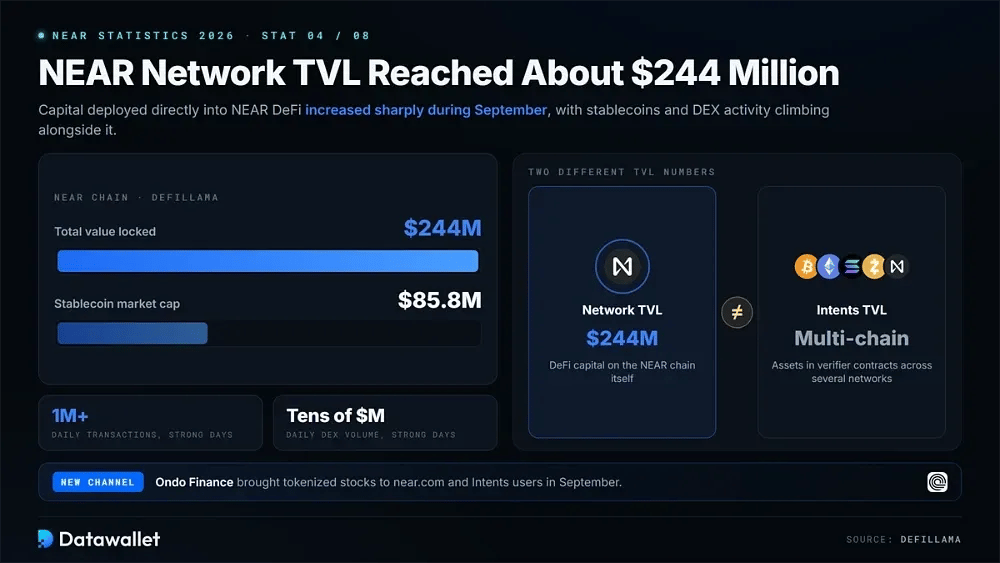
NEAR's token economics changed substantially over the past year. The most important supply-side adjustment was a 50% reduction in maximum annual inflation, while protocol revenue has increasingly been directed toward token buybacks.
The tokenomics changes shaping NEAR's current supply model:
- Inflation Halving: Near One's v2.9.0 announcement reduced maximum annual inflation from 5% to 2.5%, cutting the rate of new token issuance in half.
- Lower Rewards: Because validator rewards are funded partly through issuance, the inflation reduction also lowered the baseline staking yield available across the network.
- Staking Base: The NearBlocks validator explorer currently shows about 571 million NEAR staked against roughly 1.306 billion in total supply, or close to 44%.
- Validator Set: NearBlocks tracks more than 400 active validators, providing an onchain view of stake distribution rather than relying on exchange estimates.
- Revenue Buybacks: NEAR's official tokenomics positioning states that protocol revenue flows toward NEAR buybacks, connecting network usage with market purchases of the token.
- Governance Role: House of Stake increasingly formalizes decisions around economic parameters that were previously debated through less structured governance processes.
The buyback mechanism should not be confused with transaction-fee burning. They are separate forms of value capture: fee burns reduce supply directly, while buybacks use protocol revenue to acquire existing NEAR in the market.
6. The v2.13 Upgrade Delivered Dynamic Resharding and Quantum-Safe Keys
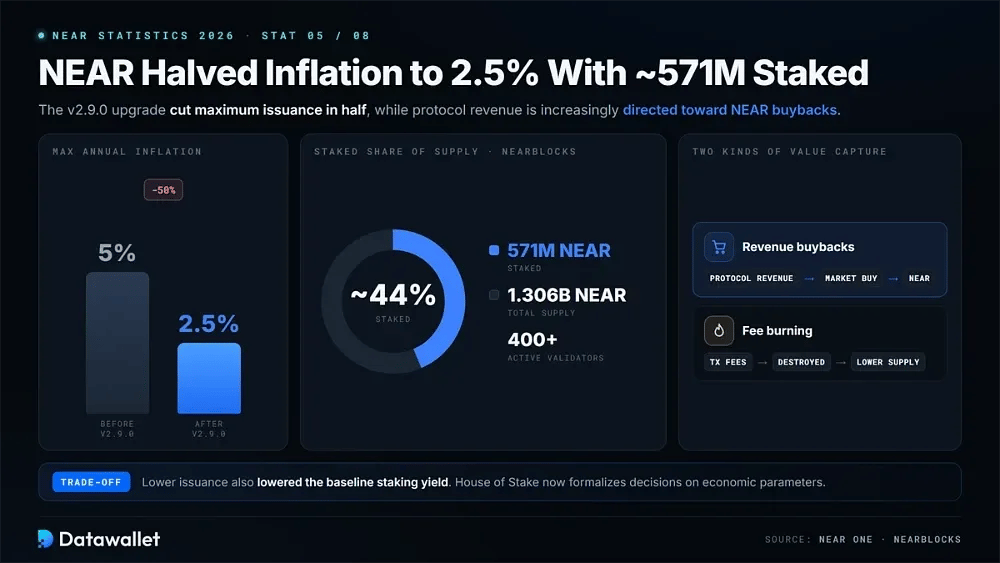
NEAR's v2.13 release moved two long-running technical goals into production. Capacity can now respond automatically to shard growth, while accounts gained access to a standardized post-quantum signature scheme.
The key technical changes delivered through nearcore v2.13:
- Dynamic Resharding: The nearcore v2.13 release notes state that shards can split automatically at epoch boundaries according to runtime state size.
- No Hard-Coded Layout: New shard layouts no longer need to be manually packaged into a protocol upgrade each time additional capacity is required.
- ML-DSA-65: v2.13 stabilized the FIPS 204 ML-DSA-65 post-quantum signature scheme as a third transaction-signature and access-key option.
- Compact Storage: ML-DSA-65 public keys are represented on-trie through 32-byte SHA3-256 hashes rather than storing the full 1,952-byte public key.
- Gas Keys: The release also stabilized gas keys, which carry a prefunded NEAR balance and multiple independent nonce sequences.
- State Sync: Centralized external-storage state sync was removed, leaving peer-to-peer state synchronization as the supported path.
Dynamic resharding matters because workloads are rarely distributed evenly. Cross-chain activity, trading and autonomous-agent transactions can create sudden state growth in particular parts of the network, making elastic capacity more useful than a fixed shard configuration.
7. NEAR Averaged 854,000 Daily Transactions and 121,000 Active Addresses
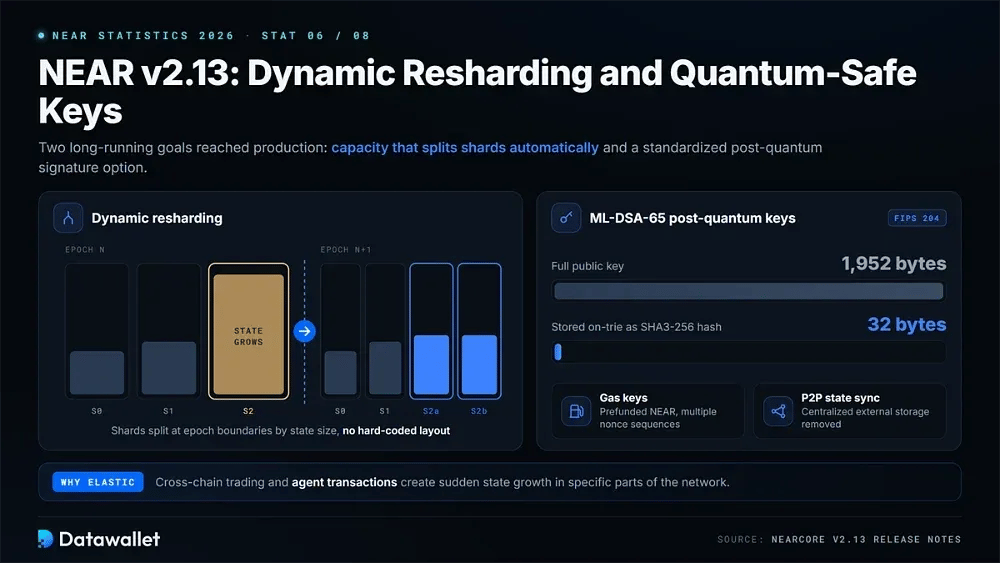
Usage was already substantial before September's price breakout. Nansen's Q2 2026 NEAR report recorded an average of approximately 854,000 daily transactions, ranging from roughly 622,000 to a peak of 3.76 million.
Daily active addresses averaged about 121,000, with most readings staying between 106,000 and 139,000. That narrower user range contrasts with the much larger swings in transaction count, suggesting that existing users sometimes generated substantially more activity rather than every transaction surge requiring a comparable jump in unique addresses.
Monetization also improved. Nansen calculated that protocol fee capture rose from an 11.5% lifetime average to 30.5% over the trailing 30 days measured in the report. In other words, a larger share of the economic activity occurring through NEAR's infrastructure was being retained by the protocol.
September's rally pushed several live network metrics above their Q2 averages, but those readings should not be substituted for the quarterly figures. Whether higher activity persists through Q4 will provide a clearer test of sustained adoption.
8. Bitwise's NEAR ETF Cleared Its Main SEC and NYSE Arca Listing Steps
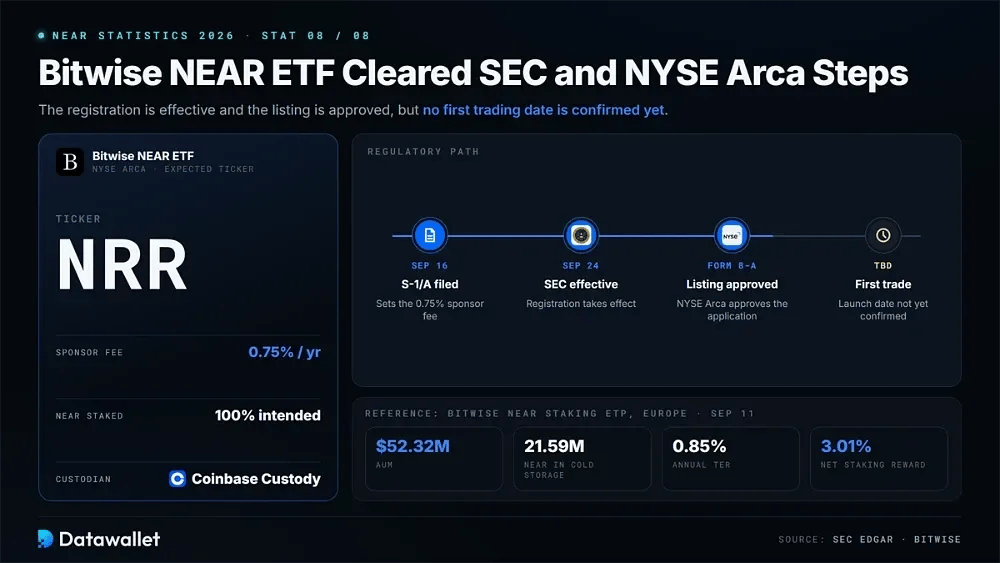
Bitwise's US NEAR product has moved beyond the filing-only stage. The registration is effective and NYSE Arca has approved the listing application, although those milestones should not be confused with a confirmed first trading date.
The main terms and regulatory milestones behind the Bitwise NEAR ETF:
- Effective Registration: The SEC's effectiveness notice gives the Bitwise NEAR ETF an effectiveness date of September 24, 2026.
- Listing Approval: Bitwise's Form 8-A states that the application to list the trust's shares was filed with and approved by NYSE Arca.
- Ticker: The fund is expected to trade under NRR, according to Bitwise's amended registration statement.
- Sponsor Fee: The September 16 S-1/A specifies a 0.75% annual sponsor fee.
- Staking: Bitwise states that the trust currently intends to stake 100% of its NEAR, subject to liquidity and operational requirements.
- Custody: Coinbase Custody is identified as the custodian for the trust's underlying NEAR holdings.
Europe already provides a reference product. The Bitwise NEAR Staking ETP reported $52.32 million in AUM and 21.59 million NEAR held in cold storage as of September 11, with a 0.85% annual TER and a 3.01% net staking reward.
How NEAR Repositioned for the Agentic Economy
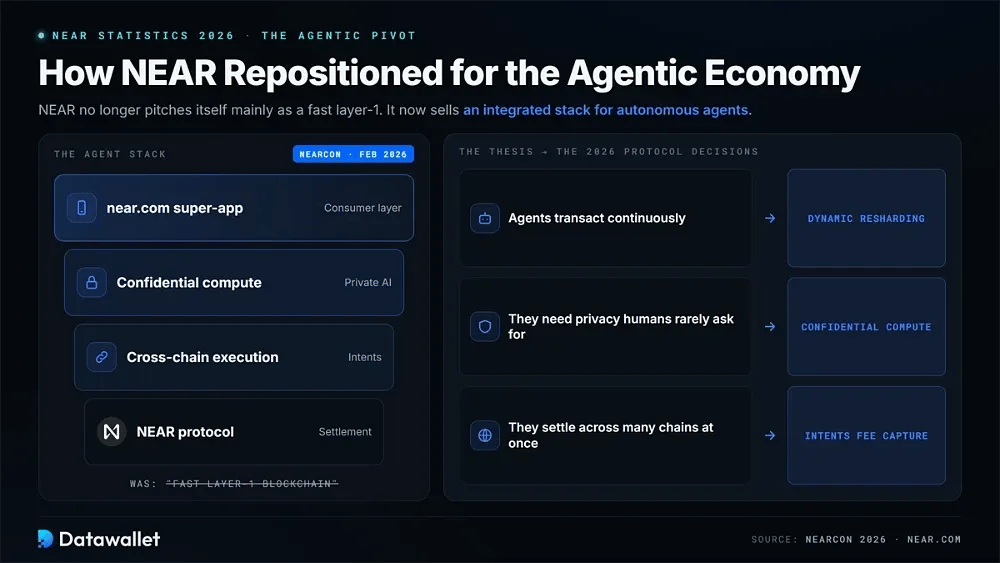
NEAR no longer presents itself primarily as a fast layer-1 blockchain. At NEARCON in February 2026, the project introduced an integrated stack for autonomous agents built around cross-chain execution, confidential compute and a consumer super-app operating under the near.com brand.
Its thesis is that AI agents will transact continuously, require privacy guarantees that human users rarely demand and settle across multiple chains at once. The protocol decisions made throughout 2026, including resharding and changes to fee capture, trace back to that premise.
NEAR AI Cloud Turns Verifiable Privacy Into a Product
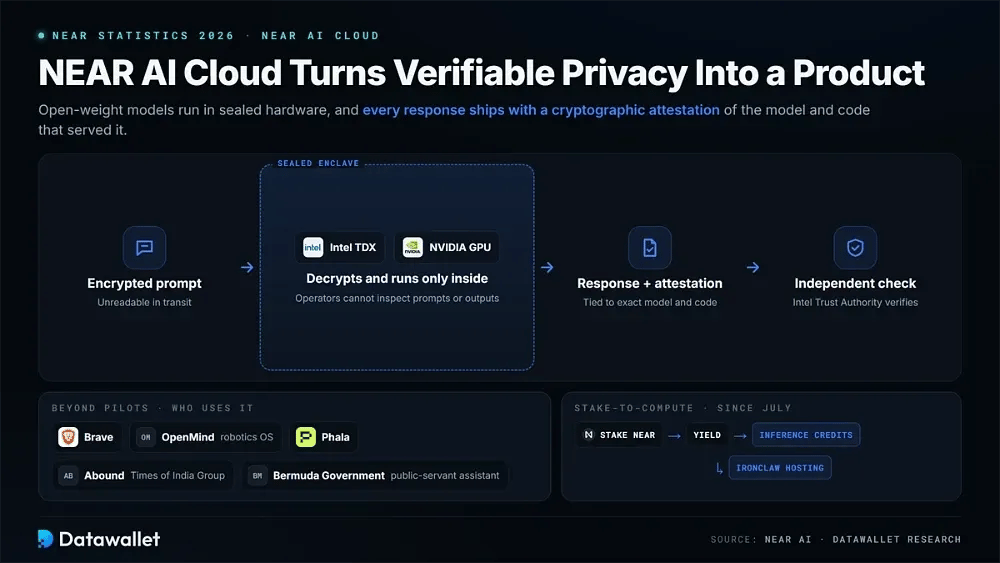
NEAR AI Cloud runs open-weight models in Intel TDX enclaves paired with NVIDIA GPUs operating in confidential-computing mode. Prompts decrypt only inside sealed hardware that operators cannot inspect. Each request produces a cryptographic attestation tying the response to the exact model and code that served it, with Intel Trust Authority independently verifying those proofs.
The product has progressed beyond pilot deployments. Its design partners include the Brave browser, robotics OS provider OpenMind and confidential cloud Phala. A separate partnership with Abound, the financial app from The Times of India Group, uses AI agents for cross-border payments. Bermuda's government has also adopted the infrastructure for a public-servant assistant.
Token utility extends into this compute layer. Since July, NEAR holders have been able to stake tokens and redirect the resulting yield toward AI inference credits or IronClaw hosting. IronClaw is the open-source agent runtime that operates inside encrypted enclaves. The mechanism turns staking yield into a metered claim on confidential computing, something few competing AI networks currently provide.
The Building Blocks Powering NEAR's Agent Stack
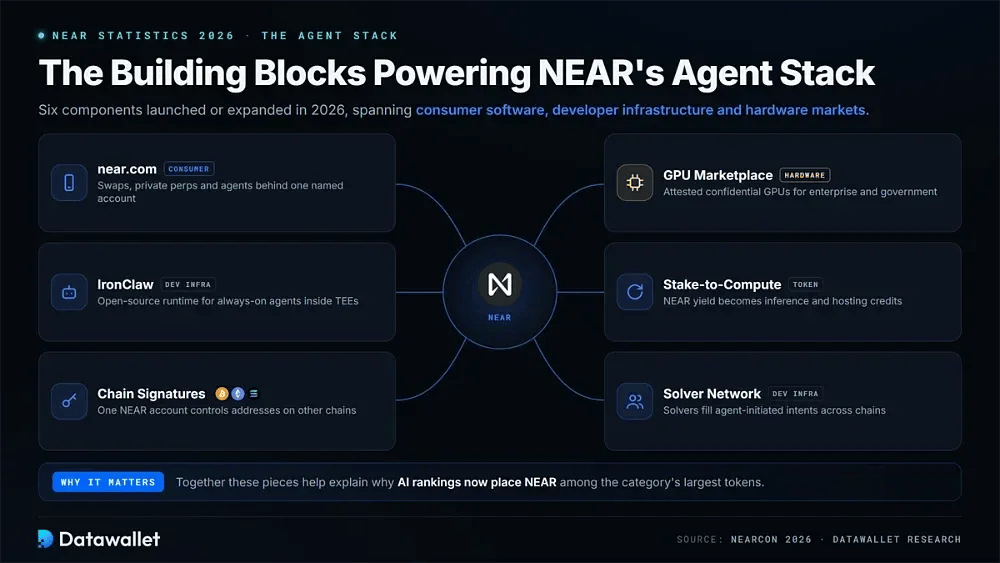
The agentic strategy is spread across consumer software and developer infrastructure, with hardware markets forming another layer. These components either launched or expanded during 2026. Taken together, they help explain why AI rankings now place NEAR among the category's largest tokens.
Six components that define NEAR's AI and chain abstraction push:
- near.com: The consumer super-app combines Intents swaps, confidential perpetuals and agent access behind one named account. It is retiring older interfaces and has become the network's primary retail distribution channel.
- IronClaw: This open-source runtime places always-on agents inside trusted execution environments, allowing them to hold credentials and make payments without revealing keys or logic to infrastructure operators.
- Chain Signatures: Multi-party computation allows one NEAR account to derive and control addresses on Bitcoin, Ethereum and Solana. Agents can therefore operate across ecosystems without relying on conventional bridge risk.
- GPU Marketplace: Introduced at NEARCON, the confidential GPU marketplace matches enterprise and government workloads with attested hardware, extending inference privacy guarantees into general-purpose accelerated computing.
- Stake-to-Compute: Staking-based payments turn NEAR yield into inference and hosting credits. Token demand can therefore be tied to AI usage rather than depending only on speculative positioning or emissions.
- Solver Network: Competing solvers execute agent-initiated intents across chains. As a result, autonomous programs already generate a portion of the record volume moving through NEAR's execution layer.
What the Privacy Rotation Means for NEAR Investors
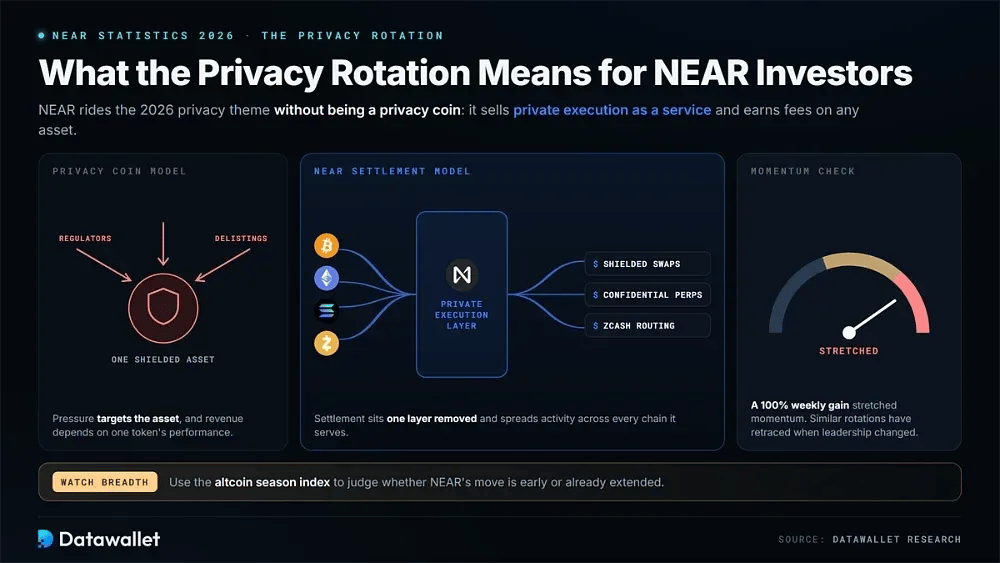
Assets outside the majors have attracted capital in 2026, and privacy infrastructure has been one of the stronger themes. NEAR participates in that rotation without functioning as a privacy coin. It instead sells private execution as a service and earns fees from shielded swaps, confidential perpetuals and Zcash routing regardless of the asset users choose to protect.
The distinction changes the risk profile. Historically, regulatory pressure on privacy coins targets the asset being shielded. Settlement infrastructure operates one layer removed and spreads activity across every chain it serves. NEAR's revenue can therefore rise with broader privacy demand rather than depending on one token's performance or exchange-listing status.
Positioning still warrants caution after such a steep move. A 100% weekly gain left momentum indicators stretched, and comparable rotations have historically retraced when market leadership changes. Our altcoin season index helps show whether breadth is widening or narrowing as traders assess whether NEAR's move is early or already extended.
What to Watch Through the End of 2026
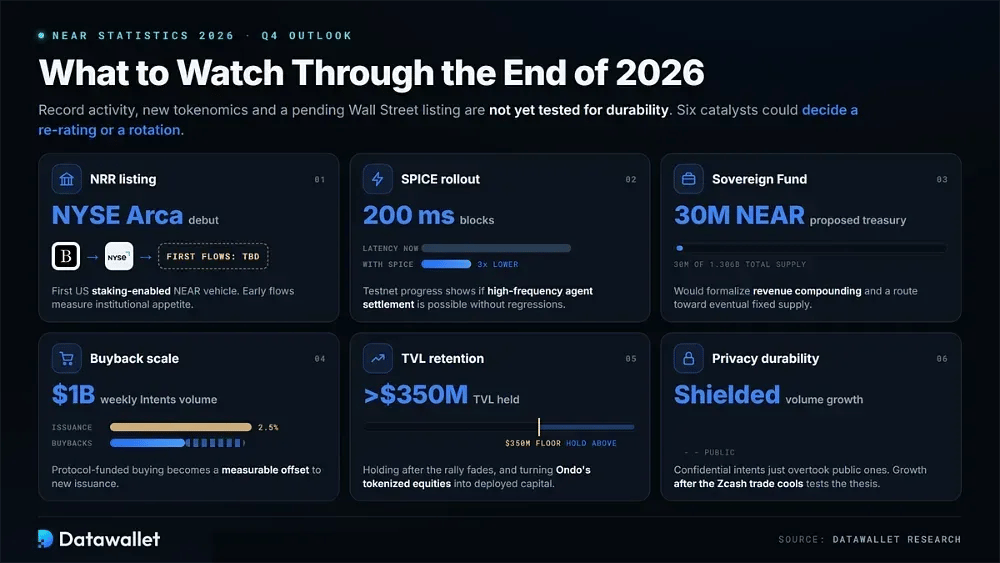
NEAR enters the end of September with record activity, redesigned tokenomics and a pending Wall Street listing. None has yet been tested for durability. Several specific catalysts during the coming quarter will help determine whether 2026 becomes a lasting re-rating or a sharp rotation.
Six catalysts most likely to move NEAR into 2027:
- NRR Listing: An NYSE Arca debut for the Bitwise NEAR ETF would create the first US staking-enabled NEAR vehicle. Initial flow data would provide a direct measure of institutional appetite.
- SPICE Rollout: Testnet progress toward 200-millisecond blocks will indicate whether NEAR can reduce latency threefold without stability regressions, a prerequisite for high-frequency agent settlement.
- Sovereign Fund: Governance action on the proposed 30 million NEAR treasury would formalize revenue compounding and could establish a credible route toward eventual fixed supply.
- Buyback Scale: Fee-switch purchases increase with Intents revenue. Sustained weekly volume of $1 billion would turn protocol-funded demand into a measurable offset against the remaining 2.5% issuance.
- TVL Retention: Keeping TVL above $350 million after rally-driven enthusiasm fades, while turning Ondo's tokenized equities into deployed capital, would validate the ecosystem story.
- Privacy Durability: Confidential intents have only recently overtaken public ones. Continued growth in shielded volume after the Zcash trade cools would test the privacy-revenue thesis.
Final Thoughts
What distinguishes NEAR's 2026 is that its fundamentals began moving before its price did. Intents volume increased from $5 billion to $31 billion while the token remained near multi-year lows. Inflation was cut in half, buybacks started and the network shipped upgrades that competitors still have on their roadmaps. September's rally repriced months of accumulated work.
The network's strategic identity is clearer as well. Rather than positioning itself as another general-purpose smart-contract chain, NEAR now competes as confidential infrastructure for cross-chain settlement and AI agents. The move by confidential intents above public ones indicates that users are paying for that functionality, while revenue capture near 30% shows a model that monetizes activity rather than merely scaling it.
The risks have risen alongside the gains. Price moved vertically, DeFi depth remains thin compared with larger ecosystems, and the ETF, SPICE and sovereign-fund catalysts are still pending. Their progress through the fourth quarter will determine whether NEAR consolidates its position among the assets defining this cycle's rotation.
Our Methodology
This article evaluates NEAR Protocol's market performance, network activity and adoption trajectory as of September 22, 2026. The analysis draws on live market dashboards and on-chain analytics, together with quarterly research reports, regulatory filings and primary protocol documentation.
How the data was compiled:
- Price Data: Spot prices, market capitalization, supply figures and drawdown context were sourced from CoinGecko and CoinDesk tracking, then cross-referenced against TradingView charts for cycle highs and lows.
- Intents Metrics: Cumulative volume, daily records, fee totals and confidential-versus-public TVL splits were compiled from Dune Analytics dashboards as reported by Crypto Briefing and Token Terminal.
- Network Activity: Daily transactions, active addresses and fee capture rates came from Nansen's Q2 2026 quarterly report, alongside NearBlocks explorer data and DefiLlama chain metrics.
- Tokenomics Records: Inflation, buyback and governance details come from nearcore release documentation, NEAR governance forum proposals and coverage of the House of Stake voting process.
- Institutional Products: ETF and ETP figures reference Bitwise's amended SEC Form S-1 filings and the issuer's published European product page, including assets, fees and staking terms.
- AI Infrastructure: Claims concerning confidential compute, IronClaw and enterprise partnerships were verified against NEAR AI's official blog, NEARCON press releases and partner announcements.
- Snapshot Caveat: Several figures come from live dashboards or fast-moving estimates. Exact values will change as prices fluctuate, volumes settle and further protocol or regulatory disclosures become available.