





KuCoin vs OKX: Overview
KuCoin launched in 2017 and passed 45 million users in July 2026. Led by CEO BC Wong, the platform reaches more than 200 countries and regions. OKX traces its roots to OKCoin, founded by Star Xu in 2013, and adopted its current name in 2022. It now serves over 120 million users worldwide.
OKX accounted for 13.88% of all centralized exchange volume in TokenInsight's exchange report for Q2 2026, compared with KuCoin's 2.96%. Derivatives accounted for 86% of OKX’s trading volume. KuCoin depended much more on spot activity, though its share of open interest climbed from 2.23% to 6.20%. That was the largest gain in TokenInsight's sample.
Here’s how the two exchanges stack up against each other:
KuCoin vs OKX: Products
Spot and margin trading, perpetual futures, bots, copy trading, savings products, and a payment card are available on both exchanges. KuCoin keeps expanding its listings to give traders early access to new assets. OKX focuses on regulated products and connections with traditional finance.
KuCoin Products
KuCoin caters to traders looking for assets that larger exchanges have yet to list.
- Spot Market: More than 1,500 assets are available. Check each pair's fee class before trading, as Class B and Class C pairs cost more.
- Perpetual Futures: Traders can use USDT or the underlying coin as collateral. Recent listing notices show new contracts opening with leverage limits between 3x and 20x.
- Stock and Index Perpetuals: Launched on March 13, 2026, this category reached 121 contracts by July 29. Coverage includes US tech giants and leveraged ETFs, Korean equities such as Samsung and SK Hynix, and a pre-IPO contract linked to OpenAI.
- Trading Bots: In-app grid and DCA (dollar-cost averaging) bots repeat orders according to rules set by the user.
- Copy Trading: Followers mirror lead traders' positions, though the smaller pool leaves fewer long track records to assess than on the largest exchanges.
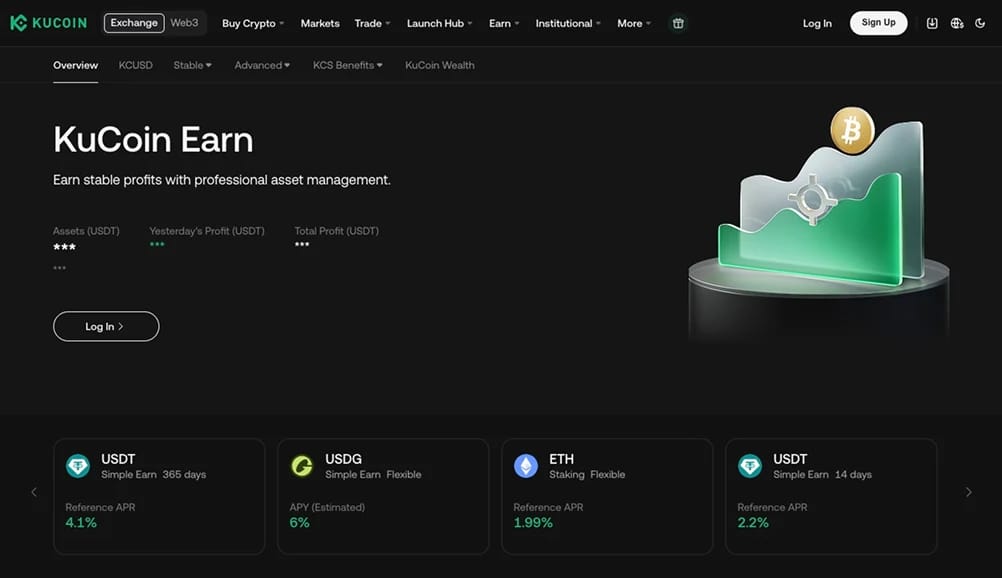
- KuCoin Earn: Alongside flexible savings and staking, KuCoin offers structured products with payouts tied to future prices. Those products can return less than holding the coin.
- KuCoin Pay and KuCard: Merchants accept QR payments, and off-chain payment volume more than tripled in H1 2026. The Mastercard-based KuCard also reached Australia.
- KIA AI Assistant: Daily KIA users grew 300%, according to KuCoin. Outside AI agents can also connect to KuCoin functions through its newer Skills Hub.
OKX Products
With most products in one trading account, OKX lets traders use the same collateral for spot, futures, and options.
- Unified Trading Account: A BTC balance can back a futures position through multi-currency margin without a transfer. OKX's equity perpetuals use the same collateral pool.
- Perpetuals, Expiry Futures, and Options: USDT, USDC, or the underlying coin can be used for margin and settlement. On September 1, 2026, OKX ended new Simple Options positions and plans to introduce a simpler replacement.
- X-Perps in Europe: EU traders can access a perpetual-style product under EU law through these MiFID-regulated contracts. They have a five-year expiry and allow up to 10x leverage.
- Stock Perpetuals and Tokenized Stocks: Nine US stock and ETF perpetuals opened on March 4, 2026, including NVDA, AAPL, SPY, and QQQ, according to OKX's listing notice. The exchange has since added index and energy contracts, including US500, US100, and XOM.
- ICE Oil Perpetuals: Priced on licensed ICE Brent and WTI benchmarks, these contracts went live on July 2, 2026. EEA traders access them through X-Perps. They also trade in the UAE, Asia, Latin America, the CIS region, and Türkiye.
- Bots, Copy Trading, and AI Agents: OKX combines grid, DCA, and arbitrage bots with a copy trading marketplace. Developers can use the Agent Trade Kit to build AI agents that place orders.
- OKX Wallet and X Layer: The self-custody wallet supports many chains, including OKX's Ethereum layer 2 network, X Layer. Setup is covered in our OKX Wallet review, with a separate guide explaining how to add X Layer to MetaMask.
- Earn, Loans, and Payments: The Earn section includes savings, Dual Investment, BTC Yield+, and crypto-backed loans. OKX Card and OKX Pay also let European users spend their funds.
.webp)
KuCoin vs OKX: Fees
Entry-level rates on major coins are nearly identical. Smaller tokens cost more to trade on KuCoin, while OKX has the lower fee for futures market orders. In Europe, OKX raises spot fees for users without a derivatives account.
Spot Trading Fees
- KuCoin: Makers and takers both pay 0.10% on Class A pairs such as BTC and ETH under the official VIP fee table. Class B pairs cost 0.20% per side, rising to 0.30% for Class C. Paying in KCS reduces every spot rate by 20%.
- OKX (global): The Regular tier charges 0.08% for maker orders and 0.10% for taker orders. Account assets or 30-day volume determine fee tiers. Although many older guides still claim an OKB discount, OKX's current help pages say holding OKB no longer affects fee tiers or offsets fees.
- OKX (Europe): Under the two tables in the EEA fee schedule, Regular accounts pay 0.08% and 0.10% after opening an X-Perps derivatives account. Without one, the rates are 0.20% and 0.35%.
Fee example: At entry level, a $1,000 BTC market buy costs $1.00 on either exchange. Paying with KCS lowers KuCoin's fee to $0.80. On OKX, a resting $1,000 limit order also costs $0.80. A KuCoin Class C market buy costs $3.00, falling to $2.40 with KCS, while an OKX Europe user without X-Perps pays $3.50.
Futures and Other Costs
- KuCoin: Perpetual fees start at 0.02% for makers and 0.06% for takers. Futures traders need VIP volume to reduce those rates because the KCS discount applies only to spot.
- OKX: Perpetual and expiry futures start at 0.02% for makers and 0.05% for takers. The current taker rate also applies to forced liquidations, while expiry contracts carry an additional 0.01% settlement fee.
- Taker comparison: A $10,000 futures market order costs $6 on KuCoin and $5 on OKX. Across 100 such orders in a month, the difference reaches $100 before any VIP discount.
- Funding payments: Longs and shorts exchange funding to keep perpetual prices near spot. Settlement on OKX occurs every 8, 4, 2, or 1 hours, depending on the contract. On a crowded trade, funding can exceed the trading fee.
- Withdrawals: Both exchanges set a flat network fee for each coin and chain. Check the network before confirming a transfer. Moving USDT on a low-cost network costs far less than using Ethereum mainnet.
.webp)
KuCoin vs OKX: Futures and Liquidity
Most OKX volume comes from futures. KuCoin has a smaller book but offers more new and unusual contracts. Our OKX futures review tests the platform in detail, with alternatives covered in our crypto futures exchange rankings.
Available Markets
- KuCoin: Its USDT and coin-margined perpetuals cover major coins and many small tokens, plus 121 stock and index contracts. Stocks or indices accounted for 61.1% of the 198 perpetuals added from January to July 2026.
- OKX: Crypto, US stocks and ETFs, and ICE oil benchmarks are covered by perpetuals, expiry futures, and options. EU customers use X-Perps in place of global perpetuals, with leverage capped at 10x.
Depth and Execution
- KuCoin: Perpetual volume averaged $3.07 billion a day in H1 2026, according to CoinGecko. Among its top 18 contracts, BTC, ETH, SOL, and XRP accounted for 52% of volume. Order-book depth thins quickly beyond those four.
- OKX: With 16.42% of global derivatives volume, OKX ranked second behind Binance in TokenInsight's Q2 2026 report. Its scale usually means tighter spreads and less slippage, limiting the effect of a large order on the fill price.
Risk Controls
- KuCoin: Isolated and cross margin are available. New contracts have low leverage caps to reduce the chance of fast liquidations in thin markets.
- OKX: Both isolated and cross margin accept multi-currency collateral. If the available balance cannot cover funding, OKX takes it from position margin, bringing the liquidation price closer.
Both exchanges maintain insurance funds, with auto-deleveraging as a fallback when those funds run short. Exchanges closed many winning positions without warning during the October 10, 2025 crash. OKX handles large orders better; KuCoin offers contracts that OKX has yet to list.
.webp)
KuCoin vs OKX: Stocks, Oil, and Pre-IPO Contracts
Traditional-asset contracts were the fastest-growing exchange product in 2026. TokenInsight measured $52 billion in TradFi perpetual volume in January and $268 billion in June. Stock contracts overtook commodities as the largest source of growth. On several peak days, these products exceeded 15% of all derivatives volume.
OKX gained more ground in this category than KuCoin. A 10.8-percentage-point increase in its share of equity perpetual volume in Q2 put it second behind Binance. TradFi contracts contributed 3.52% of OKX's derivatives volume, compared with 1.13% at KuCoin.
KuCoin built a wide selection of synthetic stock perpetuals in about three months. OKX has focused on licensed data and regulated entities, using ICE oil benchmarks and its MiFID-regulated European arm for X-Perps.
The difference is greatest in Europe. On September 10, 2026, OKX opened OpenAI and Anthropic pre-IPO contracts to eligible traders with up to 10x leverage, alongside 100 tokenized stocks. KuCoin cannot onboard new EU customers until Austria clears its entity. Our tokenized stock exchange guide covers other venues offering stock exposure.
.webp)
KuCoin vs OKX: Security
Both platforms offer monthly reserve reports and strong account controls. KuCoin rebuilt around audits and certifications after a large theft. OKX's record includes account takeovers, a withdrawal freeze, and incidents involving its DEX tools.
KuCoin Security Measures and History
- 2020 hack: Attackers breached KuCoin's hot wallets in September 2020 and took about $281 million. Most funds were recovered through freezes and on-chain tracing. The insurance fund covered the remainder.
- Proof of Reserves: By mid-2026, KuCoin had published reserve reports for 44 consecutive months, including 14 audits by security firm Hacken. CoinGecko recorded end-of-June holdings of 9,289 BTC and 129,069 ETH. KuCoin's token reserves fell 21.8% in H1 2026, below the 24.7% average decline across the top eight exchanges.
- Certifications: SOC 2 Type II, CCSS, and the ISO/IEC 27001:2022 and 27701 standards appear in KuCoin's H1 2026 review. It also describes a $2 billion Trust Project for security, compliance, and user protection.
- Delisting risk: KuCoin removed 25 tokens from trading on September 7, 2026. Withdrawals for those assets close on October 7. Frequent delistings accompany its large small-cap catalog.
OKX Security Measures and History
- Proof of Reserves: OKX began monthly reserve reporting in late 2022, then added zk-STARK proofs in April 2023 so users could privately confirm their inclusion. Its 45th report showed $23.1 billion in on-chain assets and reserve ratios above 100% for every reported asset.
- Outside checks: Hacken verifies OKX reserves too. Its case study records SOC 1 Type 2 and SOC 2 Type 2 reports held by the exchange.
- 2020 withdrawal freeze: While a private key holder cooperated with police, OKEx halted withdrawals on October 16, 2020. Withdrawals remained closed until late November, although no funds were lost.
- 2024 account thefts: Forged legal documents allowed an attacker to obtain customer data and drain some accounts. OKX said it compensated the affected users.
- 2025 DEX pause: In March 2025, OKX paused its DEX aggregator after North Korea-linked hackers used it to move stolen funds.
OKX has more advanced reserve checks, while KuCoin holds a broader set of formal certifications. A reserve report captures only one moment and does not audit the company's full finances. Keep only trading funds on either exchange and store savings in a self-custody wallet.
.webp)
KuCoin vs OKX: Regulation and Country Access
Licensing separates these exchanges most sharply. Full licenses require minimum capital, segregation of customer assets, and conduct supervision. Registration usually means only reporting suspicious activity to an anti-money-laundering agency. KuCoin relies mostly on registrations, whereas OKX holds several full licenses.
KuCoin's Licenses
- European Union: Austria's Financial Market Authority (FMA) granted KuCoin EU Exchange GmbH a MiCA license on November 27, 2025. The FMA banned new business on February 19, 2026, after key compliance officers left, then lifted that ban on May 18. A separate order still prohibits the company from starting operations.
- United States: In January 2025, KuCoin's operator pleaded guilty to running an unlicensed money transmitting business and paid about $297 million. US prosecutors said it had about 1.5 million American users, from whom it earned at least $184.5 million in fees. Under a March 2026 CFTC consent order, US users are permanently barred unless KuCoin registers as a foreign board of trade.
- Australia: KuCoin is listed as a registered digital currency exchange by AUSTRAC, Australia's anti-money-laundering agency, according to its H1 2026 review.
- India: Registration with India's FIU (Financial Intelligence Unit) means Indian accounts follow local tax reporting and anti-money-laundering rules.
- Restrictions: Blocked markets include the US, mainland China, Singapore, France, and the Netherlands. The full list is in our KuCoin restricted countries guide.
OKX's Licenses
- European Union: Malta's MFSA granted OKX Europe Limited a MiCA license on January 27, 2025. The company also holds a Maltese payments license. OKX Europe Markets Ltd operates X-Perps under an investment services license. OKX Europe reports that X-Perps volume grew fourfold after the MiCA transition period ended in July 2026.
- United States: OKX's Seychelles operator pleaded guilty in February 2025 and agreed to pay more than $504 million. US customers made over $1 trillion in transactions on OKX between 2018 and early 2024, prosecutors said. An outside compliance consultant must remain in place until February 2027.
- OKX US: A separate FinCEN-registered platform operated by OKX INC. serves every state except New York. Several US territories are excluded too.
- United Arab Emirates: A VASP license from Dubai's VARA allows OKX Middle East Fintech FZE to provide regulated services in and from the emirate.
- Singapore and Australia: The MAS register lists OKX SG as a Major Payment Institution. OKX operates an AUSTRAC-registered spot exchange in Australia, where it offers derivatives only to wholesale clients.
- Restrictions: After withdrawing its license application, OKX left Hong Kong in May 2024. Other excluded markets are tracked on our OKX restricted countries page.
OKX wins clearly on access. EU residents can use its MiCA platform and regulated derivatives, and US residents outside New York can open OKX US. KuCoin offers neither. Our MiCA-licensed exchange ranking and list of top US crypto exchanges cover alternatives.
.webp)
Is OKX Better Than KuCoin?
For most traders, OKX is the better exchange. Its deeper futures markets come with lower perpetual taker and spot maker fees. It also offers zk-STARK reserve proofs and operating licenses in the largest regulated markets. The ICE partnership adds oil contracts and, subject to regulatory approval, access to tokenized NYSE equities.
Traders seeking small tokens have more choice on KuCoin, which also has a longer stock-perpetual list. KCS holders receive a 20% discount on spot trades. Those advantages apply only where KuCoin can legally operate, excluding the US and, for now, new EU customers.
Final Thoughts
OKX is our pick for active traders, larger balances, and anyone in the EU or US. Since its 2025 guilty plea, the exchange has relaunched in the US and opened regulated derivatives in Europe. With ICE also on board as an investor, OKX combines deep liquidity with licensed access across four major regions.
KuCoin merits a second account for finding altcoins, supported by its 2026 open interest gains and fast stock-perpetual launches. Allow for Class B and Class C fees and thinner order books beyond the top four coins. Holders of small tokens should also monitor delisting notices.
Confirm that your country is supported and complete identity verification before funding either exchange. Enable app-based two-factor authentication and a withdrawal allowlist. Then make a small test withdrawal on your chosen network. Current sign-up offers appear on the OKX referral code and KuCoin referral code pages.
.webp)