

Login to Track Your Live Crypto Portfolio
Sign Up and Track Your Live Crypto Portfolio for Free
Forgot your password?
Aave Proposes Deprecating Reserves Holding $98M in Assets

This article has been reviewed and verified for accuracy by our editorial team. All claims, data points and platform details are cross-referenced against primary sources.
Some links on this page are affiliate links. Datawallet may earn a commission when you sign up through them, at no extra cost to you. This never influences our editorial ratings, rankings or recommendations.
Some links on this page are affiliate links. Datawallet may earn a commission when you sign up through them, at no extra cost to you. Ratings and rankings reflect our own testing and assessment criteria.

GM. Aave proposed deprecating 75 low-adoption reserves and winding down six blockchain deployments, a sweep touching $98.1 million in supplied assets under its newly drafted risk framework.
Elsewhere, Ostium pinned its $24 million exploit on an off-chain breach rather than faulty code, South Korea set a 2027 start for crypto taxes, and Australia hauled Telegram to court over terror content.
Read the full issue below. 👇
Aave Proposes Deprecating Reserves Holding $98M in Assets
Aave proposed offboarding dozens of low-adoption reserves and winding down six blockchain deployments, a governance sweep touching roughly $98.1 million in supplied assets and $15.6 million in outstanding debt. Founder Stani Kulechov announced the measure prepared by risk provider LlamaRisk.
The plan targets 50 low-adoption reserves and 21 matured Pendle Principal Tokens across 11 V3 deployments, alongside full retirement of Sonic, Scroll, zkSync, Metis, Soneium, and Aptos. Those six chains cover another 25 reserves worth $12.8 million in supplied assets.
Rather than reacting to any single incident, the review applies portfolio-wide standards, culling reserves whose activity no longer justifies maintaining price oracles, liquidation infrastructure, and monitoring. Bridged assets duplicating native listings and matured tokens generating no yield also face the axe.
Affected reserves will see new activity frozen, caps cut to one unit, and reserve factors raised. Retiring deployments get factors lifted to 99% with higher base rates, nudging users to unwind across the largest Ethereum lending protocol.
Ostium Blames Off-Chain Breach for $24 Million Exploit
Perpetuals exchange Ostium traced its July exploit to a compromise of off-chain infrastructure rather than any flaw in smart contract logic or protocol multisigs. The attacker used already-recognized forwarder paths to submit fraudulent BTC-USD price reports into the system.
Testing first with a 100 USDC position, the attacker generated artificial profits before draining 23.75 million USDC across a main batch and six further cycles. Ostium said trader collateral went untouched, with a separate recovery plan for liquidity providers still being finalized.
South Korea to Tax Crypto Gains Above $1,740 From 2027
South Korea plans a combined 22% levy on annual crypto gains exceeding 2.5 million won, roughly $1,740, starting January 2027. Deputy Prime Minister Koo Yun-cheol told lawmakers the government is pushing ahead rather than postponing for a fourth time.
Income from transferring or lending tokens will be taxed separately as other income, with gains above the deduction facing a 20% national rate. Critics warn the absence of loss carryforwards could push users of Korean crypto exchanges toward offshore and peer-to-peer platforms.
Telegram Faces Australian Terror Content Legal Action
Australian regulators initiated legal action against Telegram over an alleged failure to remove terror-related material, including footage of the 2019 Christchurch mosque shooting. Safety Commissioner Julie Inman-Grant said the platform faces a fine reaching $38 million under the Online Safety Act.
Telegram rejected the allegations and vowed to contest them, saying it blocked thousands of extremist communities in 2026 alone. The case landed a day after Russia charged founder Pavel Durov with aiding terrorism, adding to a French investigation into moderation failures on the messaging app.
Data of the Day
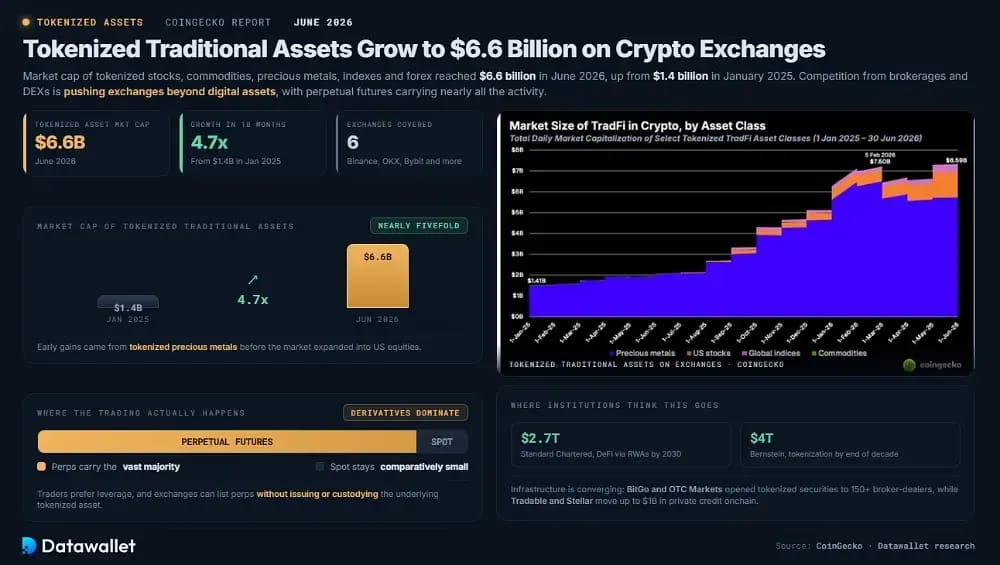
Tokenized traditional assets on crypto exchanges swelled to $6.6 billion by June, up from $1.4 billion in January 2025, according to CoinGecko. The study covered precious metals, US stocks, commodities, indexes, and forex across Binance, OKX, Bybit, Bitget, Gate, and MEXC.
Precious metals drove early growth before US equities took over, with stock perpetual futures overtaking gold in both volume and open interest by mid-2026. Derivatives dominate because exchanges can list perpetuals without custodying the underlying tokenized assets.
More Breaking News
- SEC chair Paul Atkins said the agency is ready to write crypto rules itself if Congress fails to pass the Clarity Act, which the Senate has shelved before its August recess.
- Quantum Solutions sold another 1,000 ether for $1.9 million to fund AI data center expansion, ceding its spot as Japan's largest corporate ETH treasury.
- Fortitude ordered 9,000 Bitmain miners for $31.5 million, a purchase set to lift its Zcash mining capacity by 145% and push it past half the network's hashrate.
- Binance.US will apply for a CFTC contract market license in August to launch its own prediction market, setting up a challenge to Kalshi and Polymarket.
- A Moscow court moved BitRiver founder Igor Runets into pre-trial detention on large-scale fraud charges tied to a mining equipment deal that allegedly cost Russian conglomerate En+ some $12.5 million.
- Tether's USAT stablecoin launched on Celo, its first expansion beyond Ethereum, with native minting and gas payments under the GENIUS Act framework.
- GrapheneOS called its software completely legal and constitutionally protected as the first US prosecution over a duress password proceeds against an Atlanta activist facing five years.
For the latest updates on digital asset markets, follow us on X @Datawalletcom.
For the latest updates on digital asset markets, follow us on X @Datawalletcom.
Get tomorrow’s issue in your inbox